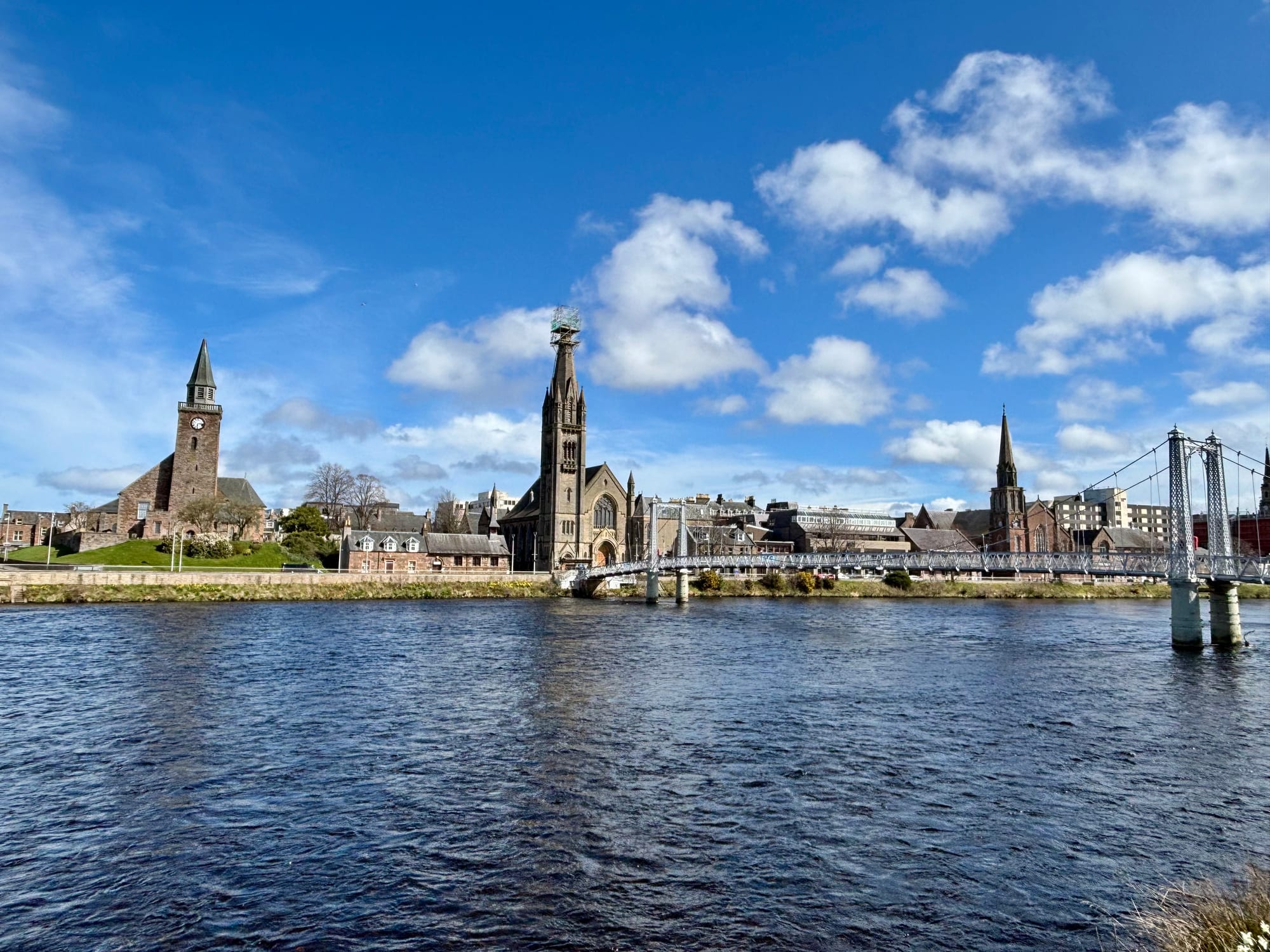
A wide blue river with church spires and a stone clock tower on the far bank and a white suspension footbridge on the right

The Highlands & Islands, United Kingdom

Inverness

Inverness city centre seen across the River Ness. (Iain Lees / Wikimedia Commons · CC BY-SA 2.0)

The northernmost city in the United Kingdom and the long-standing capital of the Highlands, where the River Ness runs from Loch Ness into the Moray Firth at the top of the Great Glen. A Pictish stronghold and medieval royal burgh, it became a city only in 2000 and is now one of Europe's fastest-growing cities and the base for Loch Ness and Culloden.

Neighbourhoods

  • City centre
    • First-time visitors
    • Close to public transport
    • Shopping

    The compact centre on the east bank around High Street, Church Street and Academy Street, with the Victorian Market and the Town House, and the railway and bus stations a short walk apart. Church Street has many of the city's pubs and bars.

    Open in Maps
  • Ness Bank and the castle
    • Riverside walks
    • Views

    The riverside south of the centre below the red sandstone castle, lined with guesthouses and restaurants, leading upstream to the wooded Ness Islands.

    Open in Maps
  • West bank and Bught
    • Arts and culture
    • Parks
    • Families

    Across the river from the centre: the Episcopal cathedral, Eden Court Theatre and, further upstream, Bught Park and the Botanic Gardens.

    Open in Maps
  • Merkinch and the canal
    • Local life
    • Canal walks

    A district in the city's north-west between the River Ness and the Caledonian Canal, home of Clachnacuddin football club, which has played at Grant Street Park since 1886.

    Open in Maps

Things to do

In the city

  • Inverness Castlelandmark

    The red sandstone castle above the river, completed in 1836 in an early castellated style for the county buildings and sheriff court, on the site of older castles; the courts left in 2020, and it reopened to the public in 2025.

    Open in Maps
  • Inverness Cathedrallandmark

    The Scottish Episcopal cathedral of St Andrew on the west bank, whose towers have a square-topped look because the money ran out before their spires were built.

    Open in Maps
  • Old High Churchlandmark

    The oldest church in the city, on St Michael's Mount by the river, a site perhaps used for worship since Celtic times.

    Open in Maps
  • Victorian Marketmarket

    A covered arcade built in 1869–70 between Academy Street, Union Street, Church Street and Queensgate, with shops, cafés and a food hall.

    Open in Maps
  • Inverness Museum and Art Gallerymuseum

    The city's museum and art gallery, in the centre.

    Open in Maps

Parks and the river

  • Ness Islandspark

    Two wooded islands in the river joined by footbridges, a place of recreation since the 1840s.

    Open in Maps
  • Inverness Botanic Gardenspark

    Gardens in Bught Park, a few minutes' walk from the west bank of the river near the Ness Islands.

    Open in Maps
  • Caledonian Canaltrail

    The canal that links the Beauly Firth through Loch Ness to Fort William and the sea at Loch Linnhe, with a towpath leading upstream out of the city.

    Open in Maps
  • Craig Phadrigtrail

    A wooded hill on the western edge of the city crowned by a vitrified fort, where the Pictish king Brude is supposed to have lived.

    Open in Maps

Music and sport

  • Eden Court Theatreattraction

    The main theatre, cinema and arts centre of Inverness, on the west bank of the river.

    Open in Maps
  • Northern Meeting Parkattraction

    The world's first Highland games stadium, built in 1864, and again home to the city's Highland games.

    Open in Maps

Short trips from the city

  • Culloden Battlefieldlandmark

    The moor five miles east where the Jacobite army of Charles Edward Stuart was defeated in 1746, ending the Jacobite rising of 1745.

    Open in Maps
  • Clava Cairnslandmark

    A Bronze Age burial site of stone cairns and standing stones near Culloden.

    Open in Maps
  • Fort Georgelandmark

    A fortress on a spit of land at Ardersier, jutting into the Moray Firth north-east of the city and guarding the sea approach to Inverness.

    Open in Maps
  • Urquhart Castlelandmark

    The ruins of a castle on the shore of Loch Ness, south-west along the Great Glen.

    Open in Maps
  • Chanonry Pointviewpoint

    A spit on the Black Isle across the Moray Firth, one of the best spots in the UK to watch bottlenose dolphins from land, especially on an incoming tide.

    Open in Maps

Seasonal events

  • Inverness Music FestivalMarch

    A music festival held over about ten days in March.

  • The Northern MeetingSeptember

    A piping gathering held in the city every September, which makes Inverness an important centre for bagpipe players.

  • Loch Ness Marathonlate September

    A marathon along the minor roads on the east side of Loch Ness from Fort Augustus, finishing in Bught Park.

Eat and drink

Long-standing places and food districts in Inverness. Hours, ratings and directions come from your maps app, always current.

Inverness classics

  • Church Street pubsneighborhood

    The street of many of the city's best-known pubs and bars, some with live music.

    Open in Maps
  • Victorian Marketmarket

    The covered market holds cafés and a food hall among its shops.

    Open in Maps

Food districts

  • Ness Bankneighborhood

    Restaurants along the riverside south of the centre.

    Open in Maps
  • Academy Street and the city centreneighborhood

    Cafés, pubs and restaurants around the railway station and the centre, including a cluster of Indian kitchens.

    Open in Maps

Experience Inverness

History

People have lived around Inverness since about 7000 BC. It was one of the chief strongholds of the Picts, and in 569 St Columba came to convert their king, Brude, who is supposed to have lived in the hill fort on Craig Phadrig. Macbeth, whose killing of King Duncan Shakespeare later dramatised, held a castle here; tradition says Malcolm III razed it and built the first Inverness Castle. David I granted the first royal charter in the 12th century, and William the Lion made Inverness a royal burgh.

The town suffered raids from the Hebrides, above all by the MacDonald Lords of the Isles, who burned its bridge in 1411 and stormed the castle in 1491. Mary, Queen of Scots, was refused entry to the castle in 1562, Cromwell built a citadel north of the town, Jacobites besieged it in 1689 and occupied the castle in 1715, and in 1746 they captured and blew up the first Fort George, built here in 1727. Weeks later the rising ended in defeat at Culloden, five miles to the east, and in the 1780s the Highland Clearances began in Inverness-shire.

The Caledonian Canal and the railway, which arrived in 1855, tied Inverness to the south, and its works built locomotives for the Highland Railway. In 1921 Lloyd George held the first Cabinet meeting outside London in the Town House, where the "Inverness Formula" behind the Anglo-Irish Treaty was drafted. Inverness became a city in 2000 as a Millennium City and has grown rapidly in the 21st century.

Culture & Customs

The area was solidly Gaelic-speaking until the late 19th century, and most place names around the city are Gaelic. Inverness still has about 2,800 Gaelic speakers — only Greater Glasgow and Edinburgh have more — and it hosted the Royal National Mòd in 2014.

Pipe music runs deep. Every September the Northern Meeting brings leading solo pipers to the city, and the Northern Meeting Society built the world's first Highland games stadium here in 1864; the Northern Meeting traces its roots to the Highland games the society staged in 1822. Eden Court is the main theatre and cinema, the Iron Works is another venue, and some of the pubs of Church Street have live music.

Sport means football and shinty. Inverness Caledonian Thistle was formed in 1994 from the merger of two Highland League clubs to join the Scottish League, while Clachnacuddin, founded in 1885, is one of only two founder members of the Highland League still competing. The Camanachd Association, shinty's governing body, is based in the city, which often hosts the Camanachd Cup final.

Daily Life

The old urban core of Inverness had 48,248 people in 2022, up from about 41,000 in 2001, and the wider area, including Culloden, Balloch, Smithton and Westhill, had about 63,000 in 2016. More than a quarter of the Highland population lives in or around the city, and new housing near Inshes continues to extend it.

As the administrative centre of the Highland Council, Inverness is the region's hub for healthcare, education, government, retail and transport. Raigmore Hospital serves the whole Highlands, the University of the Highlands and Islands has a campus here, and tourism brings visitors through all year. Inverness regularly ranks among the happiest places to live in Scotland and high in surveys of quality of life.

Daily life mixes city and country: shopping in the Eastgate Centre and the Victorian Market, walks along the Ness and the canal, and weekends in the hills, on the Black Isle or by Loch Ness. Growth brings pressures, from traffic on the A9 and A96 to the demand for housing.

Food

Crowdie, a soft fresh cheese traditionally made by crofters in the Highlands and Islands from the family cow's milk, with origins that may go back to the Viking era or even the Picts, is still made today, and cranachan — cream, raspberries, oats and whisky — is a traditional dessert that began as a harvest celebration.

Cullen skink, a thick Scottish soup of smoked haddock, potatoes and onions, appears on restaurant menus throughout Scotland, Inverness included. Church Street holds many of the city's pubs and bars, some with live music.

Eating out ranges from the riverside restaurants of Ness Bank to pubs, cafés and a strong cluster of Indian restaurants in the centre, including one inside the Victorian Market. The market's covered arcades, one of them opening off Academy Street, hold cafés and a food hall among their shops and are a handy stop for a coffee or a snack.

Planning tools

Budget

Inverness is the gateway to the Highlands and prices rise with demand in summer, when rooms fill with visitors heading for Loch Ness, Skye and the North Coast. Guesthouses, B&Bs and hostels keep options open. The riverside, the islands and the canal paths are free; Loch Ness cruises, dolphin trips and day tours are the main extra costs.

Daily Budget Midrange
USD 190–350 (guesthouse or hotel, restaurant seafood dinners, a Loch Ness or dolphin trip, a hire car)
Daily Budget Shoestring
USD 80–130 (hostel bed, pub meals and self-catering, buses and trains)

Book summer rooms early, as Inverness is the overnight stop for many Highland tours.

Best Time to Visit

May to September, when days are long and dolphin-watching boats run from the marina (from April to October). The Northern Meeting piping competitions and the Loch Ness Marathon come in early autumn, and the music festival in March. Winter days are short, and cold snaps can be severe.

Suggested Number of Days

Two days cover the city and Culloden. With four or five, Inverness makes a base for Loch Ness, the Black Isle and the Moray coast; longer Highland journeys to Skye or the far north usually move on rather than return each night.

First Visit
2 days
With Surroundings
4–5 days

Transportation

The centre is walkable. Local buses run to Culloden, the airport and Nairn, and along the east side of Loch Ness to Dores and Foyers. Bikes are useful for the canal towpath, Loch Ness and Culloden. A car gives the most freedom beyond the city, where buses are infrequent.

Check bus times in advance for Loch Ness and the villages, as some routes run only a few times a day.

Airport & Station Connections

Inverness Airport lies about 8 miles north-east of the city, with flights from London, Amsterdam and other European airports; its railway station opened in 2023. ScotRail trains link Inverness with Perth, Edinburgh, Glasgow, Aberdeen and the Highland lines to Thurso, Wick and Kyle of Lochalsh, and coaches run from the bus station to Fort William, Ullapool, Thurso and Aberdeen.

Walkability

Easy on foot. The stations, the Victorian Market, the castle and the river are within a few minutes of each other, and footbridges cross the Ness to the cathedral and Eden Court. A riverside walk upstream through the Ness Islands to Bught Park makes a level loop, and the canal towpath leads further out.

Safety

The UK is generally safe, with the main risks being pickpocketing and phone theft in crowded parts of London and other cities, occasional late-night antisocial behaviour, and drink-related trouble around nightlife. Inverness is a calm city; the real hazards lie beyond the city, on single-track roads, in fast-changing hill weather and in cold water.

Drive carefully on single-track roads around Loch Ness and check for ticks after country walks. Check current official travel advice before travelling.

Climate

An oceanic climate, like most of the United Kingdom. Records range from 29.7°C in July 2006 and June 2018 to −18.7°C in January 2010. Summer days are very long and winter days very short.

Summer
mild — the warmest day of a typical year reaches about 25°C
Winter
cool, with frost — the coldest night of a typical year falls to about −11°C

Local Customs

Inverness has more Gaelic speakers than anywhere in Scotland except Greater Glasgow and Edinburgh, and hosted the Royal National Mòd in 2014. Pipe music, Highland games and shinty are part of local life — the national shinty body is based here. Some of the pubs of Church Street have live music.

Taxi fares paid in cash are often rounded up, though not every driver expects it.

Common Payment Methods

The currency is the pound sterling. The Bank of Scotland, the Royal Bank of Scotland and Clydesdale Bank issue their own sterling notes, which can be difficult to change outside the UK. Visa and Mastercard are accepted by most shops and restaurants, American Express less often, and a contactless Visa or Mastercard card is recommended. Cash machines are easy to find in the centre.