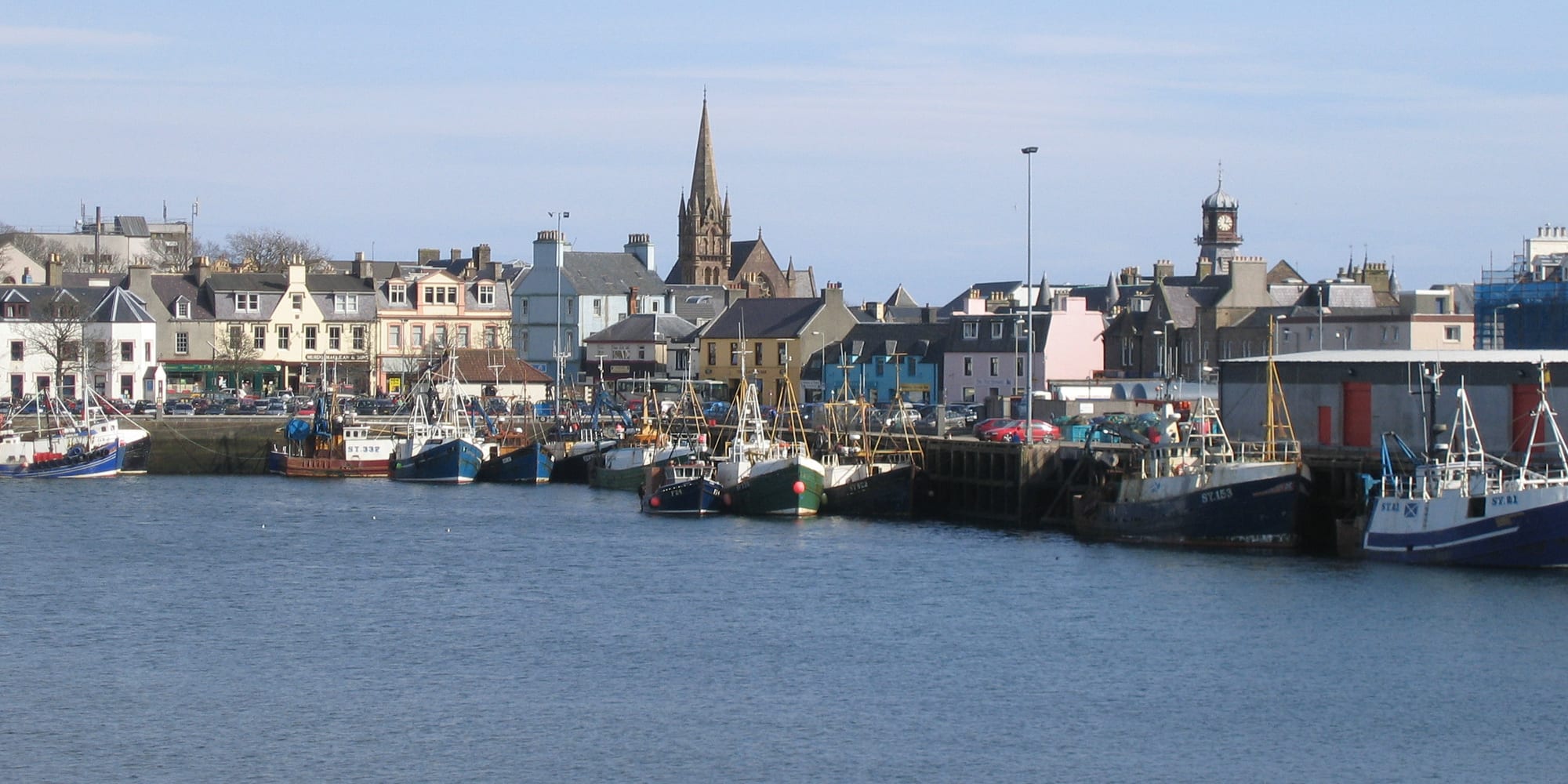
Stornoway harbour with the buildings of the town behind

The Highlands & Islands, United Kingdom

Stornoway

Stornoway harbour, below the town centre. (Robert W Watt / Wikimedia Commons · CC BY-SA 2.0)

The main town of the Outer Hebrides and the capital of Lewis and Harris, on a sheltered natural harbour on the east coast of Lewis. Founded by Vikings, shaped by clan feuds, a Victorian landowner and the Iolaire disaster of 1919, it is now a working port, the islands' administrative centre and a stronghold of the Gaelic language.

Neighbourhoods

  • The town centre and harbour
    • First-time visitors
    • Best for food
    • Pubs

    A compact grid of streets behind the inner harbour, with Cromwell Street, Point Street and Church Street holding the shops, banks, pubs, cafés and the library. The ferry terminal and An Lanntair arts centre are on the waterfront, and the fishing fleet ties up in the inner harbour.

    Open in Maps
  • Lews Castle and its grounds
    • Parks and walks
    • Museums
    • Festivals

    Across the inner harbour to the west, the Victorian castle stands in extensive woodland grounds with walking and bike trails and the island's only 18-hole golf course. The castle houses the museum and archive of island life, and the grounds host most of the Hebridean Celtic Festival.

    Open in Maps
  • Newmarket, Laxdale and Sandwick
    • Quiet and residential
    • Supermarkets

    The residential edges of the town, counted with it by the islands' council: Laxdale and Newmarket to the north along the main road towards the west and north of Lewis, and Sandwick to the east on the way to the airport and the Point peninsula.

    Open in Maps

Things to do

In the town

  • Lews Castlemuseum

    The castle built in 1844–51 for Sir James Matheson, who had bought the whole island; it housed the crews of a naval air squadron in the Second World War and later students, and after Heritage Lottery funding in 2011 it now holds the museum and archive of island life.

    Open in Maps
  • An Lanntairattraction

    The arts centre on the seafront, opened in 2005, with an art gallery, an auditorium seating over two hundred that doubles as the town's cinema, and a restaurant; its name is Gaelic for 'the lantern'.

    Open in Maps
  • Lewis War Memoriallandmark

    A memorial completed in 1924 in memory of the men of Lewis who died in the First World War and those drowned returning home on the Iolaire in 1919.

    Open in Maps
  • Iolaire Memoriallandmark

    A memorial at Holm, east of the town, to the men lost when HMY Iolaire struck a rock at the harbour entrance and sank on New Year's Day 1919 with the loss of 205 men.

    Open in Maps
  • Lews Castle Groundspark

    Woodlands across the harbour from the town, always open, with about 20 miles of off-road bike trails.

    Open in Maps

Short trips on Lewis and Harris

  • Callanish Stoneslandmark

    A Neolithic stone circle and stone avenues on the west coast of Lewis, built during the Neolithic period.

    Open in Maps
  • Dun Carlowaylandmark

    A remarkably well-preserved Iron Age broch on the west coast of Lewis, parts of whose drystone wall still stand about nine metres high.

    Open in Maps
  • Garenin blackhouse villageattraction

    Nine restored thatched cottages in a crofting township, lived in until 1974 and the last group of blackhouses to be inhabited in the Western Isles.

    Open in Maps
  • Arnol Blackhousemuseum

    A blackhouse museum owned by Historic Environment Scotland, probably the best example of a blackhouse on Lewis, in state care since its occupants moved out in the 1960s.

    Open in Maps
  • Luskentyrebeach

    A small settlement on the west coast of Harris whose wide beach has been voted Britain's best.

    Open in Maps

Seasonal events

  • Hebridean Celtic FestivalJuly

    HebCelt, a four-day community-led music festival held mostly in the grounds of Lews Castle and at An Lanntair, drawing more than 10,000 visitors; flights, ferries and rooms book out while it is on.

Eat and drink

Long-standing places and food districts in Stornoway. Hours, ratings and directions come from your maps app, always current.

Stornoway classics

  • Stornoway Fish Smokersmarket

    A traditional smokehouse on Shell Street that cures local fish into Stornoway kippers and smoked salmon in one of the last working brick kilns in the UK.

    Open in Maps
  • Cameron's Chip Shoprestaurant

    A fish and chip shop on Point Street in the town centre.

    Open in Maps
  • Harbour Kitchenrestaurant

    A seafood restaurant on Cromwell Street.

    Open in Maps

Cafés and bars

  • An Taigh Cèilidhcafe

    A non-profit Gaelic language centre and community café on Church Street, which also holds events on Gaelic language and culture.

    Open in Maps
  • An Lanntair café and barcafe

    The arts centre's café and bar on the seafront, open in the daytime and some evenings.

    Open in Maps
  • Town-centre pubsneighborhood

    Stornoway's concentration of pubs reflects the lack of them on the rest of Lewis; several traditional bars stand near the harbour.

    Open in Maps

Experience Stornoway

History

Stornoway was founded by Vikings in the early 9th century, who called it Stjórnavágr, "steering bay". The settlement grew around its sheltered natural harbour, and people from all over the island travelled there by boat or horse-drawn coach to trade and to sail on to the rest of Scotland. The MacLeods held a castle in the bay, which the Earl of Argyll besieged without success in 1554. In the early 1600s the islanders resisted government attempts to curb their traditional shipping rights and a plan by James VI to settle a Scottish trading company on Lewis, and in 1610 the king transferred the island to the MacKenzies of Seaforth.

In 1844 the MacKenzies sold Lewis to Sir James Matheson, who built Lews Castle and in 1882 destroyed the last ruins of the old castle to expand the harbour. The town became a police burgh in 1863. On New Year's Day 1919 HMY Iolaire, carrying sailors home from the First World War, struck rocks at the harbour entrance and sank, killing 205 men, one of the worst maritime disasters in British waters.

In 1918 the island was sold to the soap magnate Lord Leverhulme, whose economic plans failed; before leaving he gave Stornoway parish to its people, and the community-run Stornoway Trust still administers it. In the Second World War the aerodrome was a base for anti-submarine aircraft, and from 1986 to 1993 the airport served as a NATO forward operating base. The town hall reopened for community use in 2012.

Culture & Customs

Stornoway is one of the strongholds of Scottish Gaelic. At the 2011 census about 5,500 people in the greater Stornoway area, 43 per cent, spoke the language. The Gaelic television channel BBC Alba has been based here since its launch in 2008, BBC Radio nan Gàidheal has a studio in the town, the local station Isles FM broadcasts in Gaelic and English, and An Taigh Cèilidh on Church Street runs Gaelic events alongside its community café. The Royal National Mòd has been held in Stornoway several times, most recently in 2005, 2011 and 2016.

The Hebridean Celtic Festival, or HebCelt, is the town's biggest event, a four-day festival each July that draws more than 10,000 visitors to Lews Castle grounds and An Lanntair, the seafront arts centre opened in 2005. The town appears in the song "Lovely Stornoway" and in Peter May's Lewis Trilogy of crime novels.

Religion has long shaped the week. Observance of the Sabbath was traditionally strict on Lewis; Sundays have become more like those elsewhere in Scotland in recent years, but most shops and many cafés and pubs still close. Football is the most popular amateur sport, rugby has men's and women's teams, and Lewis Camanachd has brought a revival of shinty. The first mosque in the Western Isles opened in the town in 2018.

Daily Life

Stornoway is by far the largest town in the Outer Hebrides. The islands' council estimated about 7,000 people in 2019 for the town and its neighbouring districts of Laxdale, Sandwick and Newmarket, and the wider civil parish has just over 10,000. It is the administrative centre of the Western Isles, home to Comhairle nan Eilean Siar, the Western Isles Hospital and the Nicolson Institute, the only secondary school on Lewis, with around 1,000 pupils.

The economy mixes traditional work — fishing, Harris Tweed and farming — with tourism, the oil industry and commerce. Fish farming is now the main focus of the fishing industry, while inshore boats still catch prawns, crabs and lobsters around the islands. The Arnish Point yard at the harbour mouth, set up in the 1970s for the oil industry, has gone through boom and bust cycles and was operated by Harland and Wolff as of 2021. Just outside the town, Beinn Ghrideag is the UK's largest community-owned wind farm, and its revenue funds local activities.

Lews Castle College, part of the University of the Highlands and Islands, has around 2,700 students. Daily life follows the ferry to Ullapool, the weather and the week, with a busy Saturday and a quiet Sunday.

Food

Stornoway's best-known food is its black pudding, the marag dhubh, made from beef suet, oatmeal, onion and blood. It was granted protected status by the European Commission in 2013, so that puddings made elsewhere cannot be sold as "Stornoway". Stornoway kippers and smoked salmon are also produced in the town, at a smokehouse on Shell Street that keeps one of the last working brick kilns in the UK.

Seafood from the islands' waters — prawns, crabs and lobsters landed by the inshore fleet, and salmon from the fish farms — appears in the town's restaurants, and there is a chip shop in the town centre. Scottish dishes such as haggis, a savoury pudding of sheep's heart, liver and lungs with onion, oatmeal and suet, and cranachan, a dessert of cream, raspberries, oats and whisky, are found on menus too. The town's concentration of pubs reflects their absence on the rest of Lewis.

The islands also make their own spirits: Abhainn Dearg distils malt whisky at Uig on the west coast of Lewis, and there is a distillery at Tarbert on Harris.

Planning tools

Budget

Stornoway has the best amenities and transport links in the Outer Hebrides and is the obvious base for Lewis and Harris, but rooms are limited and book out during the July music festival and other big events. Supermarkets and chip shops keep food costs down; the car ferry and car hire are the largest expenses.

Daily Budget Midrange
USD 200–370 (bed and breakfast or guest house, seafood dinners, a hire car and the car ferry)
Daily Budget Shoestring
USD 80–130 (hostel or campsite, supermarket food and chip shop meals, island buses)

Book rooms, flights and ferry car space well ahead for July, and stock up on Saturday, as most shops stay closed on Sunday.

Best Time to Visit

April to July is the driest part of the year, with June the driest month, and summer brings long days and the Hebridean Celtic Festival in July. October to January is the wettest season, with frequent Atlantic storms, heavy rain and high winds, though winters are mild for so northerly a place.

Suggested Number of Days

Two or three days cover the town and the main prehistoric sites of Lewis. Four to six days allow time for Harris and the rest of the island as well, and a spare day helps when ferries or flights are disrupted by weather.

First Visit
2–3 days
With Surroundings
4–6 days

Transportation

The town is small and walkable. Every bus route on Lewis converges on Stornoway, with services to Point, Ness, Back and Tolsta, Uig, the West Side, Lochs and Tarbert in Harris, but they are infrequent. A hire car is the practical way to see the island in a short stay, and taxis are plentiful in town.

Many island roads are single-track; use passing places, and plan for Sunday, when most shops and many places to eat are closed.

Airport & Station Connections

The Caledonian MacBrayne ferry from Ullapool takes about two and a half hours, with two sailings a day most days; it is often heavily booked. Stornoway Airport, east of the town beside the village of Melbost, has Loganair flights to Edinburgh, Inverness and Glasgow and a link to Benbecula. Cruise ships anchor in the bay and bring passengers ashore by tender.

Walkability

The town centre is small and flat around the harbour, and Lews Castle and its grounds are a short walk across the head of the inner harbour. The ferry terminal is close to the centre. The airport and the outlying districts are better reached by bus or taxi.

Safety

The UK is generally safe, with the main risks being pickpocketing and phone theft in crowded parts of London and other cities, occasional late-night antisocial behaviour, and drink-related trouble around nightlife. Stornoway is a small, quiet town. The main hazards are the Atlantic weather, with storms and high winds from October to January, cold seas and remote single-track roads.

Allow for ferry and flight cancellations in storms, and take care on exposed coasts and beaches in high winds. Check current official travel advice before travelling.

Climate

An oceanic climate with little variation in temperature and damp conditions all year. Snow falls only occasionally, and Stornoway and Harris record the highest frequency of hail in the UK, with 30 or more days of measurable hail a year.

Summer
cool — average daytime highs in July and August are just over 16°C, and April to July is markedly drier
Winter
exceptionally mild for the latitude — daytime highs average about 7°C and nights stay above 2°C on average in January and February, but storms bring heavy rain and high winds

Local Customs

Gaelic is part of daily life: in 2011 about 5,500 people in the greater Stornoway area, 43 per cent, spoke it, and the Gaelic channel BBC Alba is based in the town. Sunday observance has long been strong on Lewis. It has relaxed in recent years — flights and ferries now run on Sundays — but most shops and many places to eat and drink still close.

Respect the quiet of Sunday; on Saturday night pubs and entertainment stop by midnight. Harris Tweed, woven by hand at home in the Outer Hebrides, is sold in several town shops.

Common Payment Methods

The currency is the pound sterling. Cards and contactless payment are widely accepted, and there are cash machines at the banks on Cromwell Street and at the supermarkets. Scottish banks issue their own sterling banknotes, which can be hard to change outside the UK.