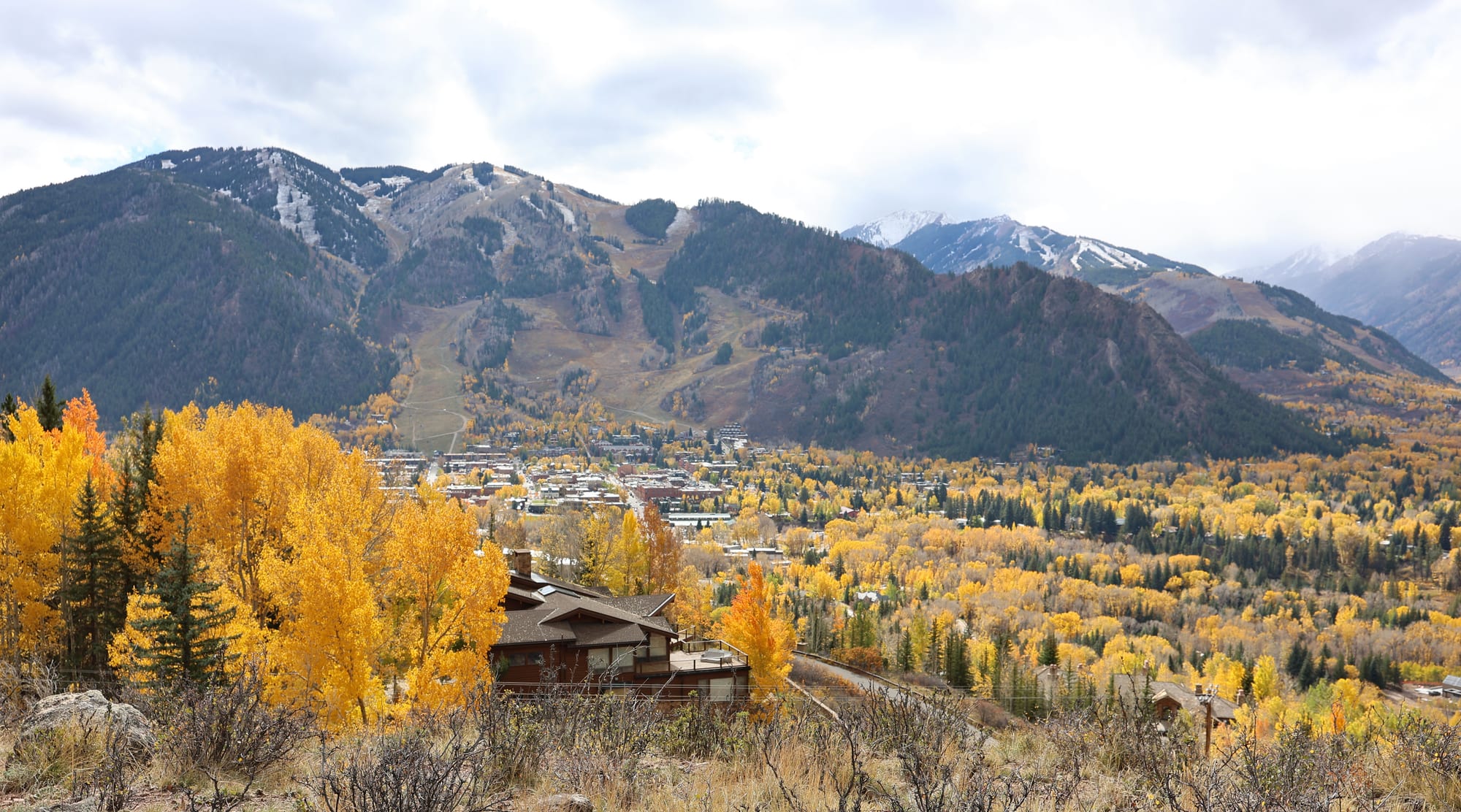
Aspen's low rooftops among golden autumn aspen trees, with the ski runs of Aspen Mountain rising behind under cloud

The Rocky Mountains, United States

Aspen

Aspen and Aspen Mountain in October, seen from the Hunter Creek Trail. (Jeffrey Beall / Wikimedia Commons · CC BY 4.0)

A small mountain town on the Roaring Fork River in western Colorado, just below 8,000 feet. Aspen boomed on silver in the 1880s, nearly emptied after 1893, and was remade from the 1940s as a ski resort and cultural centre. Today it has four ski areas, a classical music festival and some of the most expensive property of any ski town in the world.

Neighbourhoods

  • Downtown Aspen
    • First-time visitors
    • Close to the slopes
    • Best for food

    The old silver-boom grid at the foot of Aspen Mountain, with Victorian brick commercial buildings, the Wheeler Opera House, galleries, designer shops and most of the town's restaurants and bars. The gondola rises straight from downtown, and free buses link it with the other ski areas.

    Open in Maps
  • Snowmass Village
    • Families
    • Ski-in ski-out
    • Quieter evenings

    A separate resort town about 6 miles from downtown Aspen, built around the largest of the four ski areas. It has its own village centre of shops and restaurants and is linked to Aspen by free buses.

    Open in Maps
  • Basalt and the lower valley
    • Lower prices
    • Local life

    Down the Roaring Fork Valley towards Glenwood Springs, Basalt and Carbondale are where many of Aspen's workers live. Lodging is usually cheaper here, and valley buses run up to Aspen.

    Open in Maps

Things to do

Ski areas

  • Aspen Mountainattraction

    The original ski area, opened in 1946 and still called Ajax by locals, rising directly above the town, with a gondola climbing from downtown.

    Open in Maps
  • Aspen Highlandsattraction

    A ski mountain opened in 1958 and known above all for Highland Bowl, a steep open bowl of expert terrain near the top.

    Open in Maps
  • Buttermilkattraction

    A mountain widely regarded as one of the best places in North America to learn, and the venue of the Winter X Games.

    Open in Maps
  • Snowmassattraction

    The largest of the four ski areas, opened in December 1967 above Snowmass Village.

    Open in Maps

In town

  • Wheeler Opera Houselandmark

    A stone opera house of the 1890s at Hyman Avenue and Mill Street, the first building in Aspen listed on the National Register of Historic Places, now a stage for music, comedy and community productions.

    Open in Maps
  • Aspen Art Museummuseum

    A non-collecting contemporary art museum founded in 1979, with changing exhibitions of painting, sculpture and installations.

    Open in Maps

Mountains and wilderness

  • Maroon Bellsviewpoint

    Two fourteeners in the Elk Mountains about 12 miles south-west of town, a very heavily photographed view from the Maroon Creek valley; in summer access is by bus from Aspen Highlands.

    Open in Maps
  • Independence Passviewpoint

    Highway 82 climbs east of town to the Continental Divide at 12,095 feet, with alpine tundra above the treeline and views to Mount Elbert; the road closes in winter.

    Open in Maps
  • Ashcroftlandmark

    A silver-mining camp founded in 1880, about 10 miles south of Aspen, where a few weathered buildings still stand in the Castle Creek valley.

    Open in Maps

Short trips from the town

  • Glenwood Springsattraction

    The town at the bottom of the Roaring Fork Valley, about 40 miles away, where the Roaring Fork meets the Colorado River and Amtrak trains stop.

    Open in Maps

Seasonal events

  • Aspen Music Festival and Schoolsummer (about eight weeks)

    A classical music festival founded in 1949, with more than 400 events a season, concerts by five orchestras and staged opera; the lawn outside the music tent is free.

  • Food & Wine ClassicJune

    The food magazine's annual gathering of wine tastings, cooking demonstrations and talks, seen locally as the start of the summer season.

  • Aspen Ideas Festivalsummer

    A week of talks and debates run by the Aspen Institute since 2005, drawing politicians, scientists, writers and artists.

  • Winter X Gameswinter

    The action-sports competition of snowboarding and freestyle skiing, held at Buttermilk since 2002.

Eat and drink

Long-standing places and food districts in Aspen. Hours, ratings and directions come from your maps app, always current.

Aspen classics

  • Woody Creek Tavernrestaurant

    A down-valley tavern in the hamlet of Woody Creek, popular with locals and known for barbecue and large breakfasts.

    Open in Maps
  • Downtown restaurants and barsneighborhood

    The blocks around the Wheeler Opera House hold most of the town's restaurants, from diners and burger bars to expensive chef-led dining rooms.

    Open in Maps

Food districts and markets

  • Aspen summer marketmarket

    An open-air market held in the summer months.

    Open in Maps
  • Snowmass Villageneighborhood

    The village centre at the base of Snowmass has its own cluster of restaurants, cafés and sweet shops.

    Open in Maps

Experience Aspen

History

The land around the upper Roaring Fork belonged to the Ute people, who were fighting to keep it when prospectors crossed the Continental Divide in 1879, ignoring the governor's warnings to turn back. Their camp, first called Ute City, was renamed Aspen after the trees on the hillsides. Silver made it rich almost at once. Two railways raced to reach the town in the 1880s, the Denver and Rio Grande arriving first, and in its best years of 1891 and 1892 Aspen was the most productive silver-mining district in the United States. By 1893 it had banks, a hospital, two theatres, an opera house and electric lights.

The Panic of 1893 and the repeal of the Sherman Silver Purchase Act ended the boom. Mines closed, people left, and by 1930 only about 700 residents remained — "the quiet years", as the town remembers them.

Revival came with skiing. Soldiers of the 10th Mountain Division trained in the area during the Second World War, and one of them, Friedl Pfeifer, returned and joined forces with the Chicago industrialist Walter Paepcke and his wife Elizabeth. The Aspen Skiing Company was founded in 1946, the world championships came in 1950, and Buttermilk, Aspen Highlands and Snowmass followed between 1958 and 1967. Paepcke also brought culture: the Goethe Bicentennial Convocation of 1949, held in a tent designed by Eero Saarinen, led to the music festival and the Aspen Institute. In the late 20th century the town became a celebrity retreat — John Denver settled there and Hunter S. Thompson worked out of a downtown hotel — and rising property prices increasingly shut low- and middle-income workers out of the city.

Culture & Customs

Aspen's identity rests on an unusual pairing of sport and ideas. The three institutions Paepcke and his circle started — the Aspen Music Festival and School, the Aspen Institute and the Aspen Center for Physics — still give summer its character. The music festival fills the town for about eight weeks with concerts by five orchestras, opera and chamber music, and students who come from dozens of countries; many people listen from the free lawn beside the tent with a picnic. The Ideas Festival brings politicians and writers for a week of debates, and the Food & Wine Classic in June opens the season.

Winter culture is ski culture. Aspen hosted the world championships in 1950, Buttermilk has held the Winter X Games since 2002, and local freestyle skiers have gone on to the Olympics. The Wheeler Opera House, which passed to the city and has been restored, hosts music and comedy acts.

The town also carries the memory of its counter-cultural decades, when John Denver sang about it and Hunter S. Thompson ran for county sheriff. Locals tend to dress down whatever their wealth, to talk about snow conditions and housing, and to guard the small-town scale of the place: new building is tightly restricted.

Daily Life

Aspen is small — about 7,000 people lived in the city at the 2020 census — and second homes have multiplied: more than four in ten housing units were counted as vacant. Prime property here has been rated the most expensive per square foot of any ski resort studied in the world, and even deed-restricted employee housing can cost close to a million dollars.

The result is a long daily commute. Ski instructors, cooks, cleaners, teachers and nurses live down the Roaring Fork Valley in Basalt, Carbondale, Glenwood Springs and beyond, and the valley's bus system carries them up each morning. The county housing authority runs an extensive employee-housing programme for people who live and work locally, and limits on new construction and short-term rentals keep supply tight.

The year has a strong rhythm. Winter brings the ski crowds and the jets at the small airport; spring and late autumn, the off-seasons, are quiet, with some businesses closed and locals taking their own holidays. Summer is busy again with festivals, hikers and cyclists. Through it all residents ski before work, ride bikes on the river trails, and argue about growth, traffic on Highway 82 and how to keep a working town alive.

Food

Aspen's dining is shaped by money and by the mountains. Downtown has a large number of restaurants for a town its size, including expensive chef-led dining rooms, and the Food & Wine Classic each June brings well-known chefs and winemakers for tastings and demonstrations. The bars fill early in the evening in ski season. Aspen Mountain has restaurants on the mountain itself, one of them a private club.

Away from the expensive end, eating is hearty and casual. Diners, burger bars and breakfast places feed skiers, and down-valley at Woody Creek a tavern known for its barbecue and big breakfasts draws locals. In summer an open-air market is held, and picnics on the lawn at the music tent are part of the season.

Drinking has its own history. During Prohibition a spiked milkshake called the Aspen Crud was invented at a downtown hotel bar. Colorado's craft breweries and distilleries are well represented on local menus.

Planning tools

Budget

Aspen is one of the most expensive resort towns in North America, and lodging is the largest cost by far — highest in the ski season and over Christmas and New Year, lower in spring and autumn. Lift tickets add heavily to a winter trip. Free town buses, the free lawn at the music tent, hiking trails and the gondola views keep some days cheap, and staying down-valley saves money.

Daily Budget Midrange
USD 260–500 (condo or mid-range lodging, restaurant meals, lift ticket or guided activity, valley buses)
Daily Budget Shoestring
USD 120–200 (down-valley motel or campground, supermarket food, free buses and trails)

Look at Basalt, Carbondale or Glenwood Springs for cheaper beds and ride the valley buses up; ski season and the summer festival weeks fill rooms early.

Best Time to Visit

Two seasons. Winter, roughly late November to April, is ski season and the busiest and dearest time. Summer brings the music festival, the Maroon Bells buses, hiking and the open road over Independence Pass. Late September and early October, when the aspen groves turn gold, are quieter, and the off-season in late spring and late autumn is the cheapest, though some places close.

Suggested Number of Days

Two or three days are enough for the town and a look at the mountains. A ski holiday usually runs to a week, and a summer stay grows with the hiking and the festival programme; staying down-valley adds travel time.

First Visit
2–3 days
With Surroundings
4–6 days

Transportation

The Roaring Fork Transportation Authority runs free buses within Aspen and Snowmass Village, including to the ski areas, and paid buses down the valley to Basalt, Carbondale, Glenwood Springs and Rifle. In winter skiers move between the mountains by bus; in summer bikes and walking take over. A car is useful for the passes and trailheads but parking in town is limited and expensive.

In summer the road to Maroon Lake is closed to most private cars during the day, and visitors ride the bus from Aspen Highlands.

Airport & Station Connections

Aspen/Pitkin County Airport, also known as Sardy Field, is three miles north-west of downtown and has flights from American, Delta and United; bad weather can delay or divert them. By road, Highway 82 climbs from Glenwood Springs, about 40 miles down the valley; the eastern approach over Independence Pass is closed from about the end of October to Memorial Day. Amtrak trains stop at Glenwood Springs, with valley buses onward.

Walkability

The town centre is a compact grid that is easy on foot, with the gondola base downtown. The other ski areas and Snowmass Village are reached by bus. Pavements are icy in winter, and the altitude makes uphill walking harder than it looks.

Safety

For most visitors the US is safe, with the main risks being petty theft and car break-ins in tourist areas of some cities, road accidents over long distances, extreme weather, and the hazards of the outdoors. In Aspen the real risks are mountain ones: altitude, sudden storms and lightning in summer, avalanches off the marked slopes, and winter driving on mountain roads.

Drink plenty of water and go gently on arrival at altitude, carry warm layers on summer hikes, and stay within ski-area boundaries unless trained and equipped for avalanche terrain. Check current official travel advice before travelling.

Climate

A humid continental mountain climate. Winters are long, cold and snowy, which is what made the ski industry; summers are short, mild and sunny by day with cool nights and afternoon thunderstorms.

Summer
moderately warm, sunny days, cooler than the 77–95°F usual in Denver, with cool nights and frequent afternoon thunderstorms
Winter
cold and snowy, with very cold nights far below freezing (32°F) and heavy snowfall on the mountains

Local Customs

Dress is outdoor-casual even in expensive restaurants, and ski clothes are normal around town in winter. Tipping of roughly 18–22 per cent is expected in restaurants and bars. Recreational cannabis has been legal for adults in Colorado since 2012, though officials have sought to limit its use at the ski resorts.

Identification is asked for when buying alcohol (the legal age is 21); alcohol affects people more strongly at altitude.

Common Payment Methods

The currency is the US dollar. Cards and mobile payment are accepted almost everywhere, including on the mountains; ATMs are easy to find downtown. A few small bills are handy for tips.