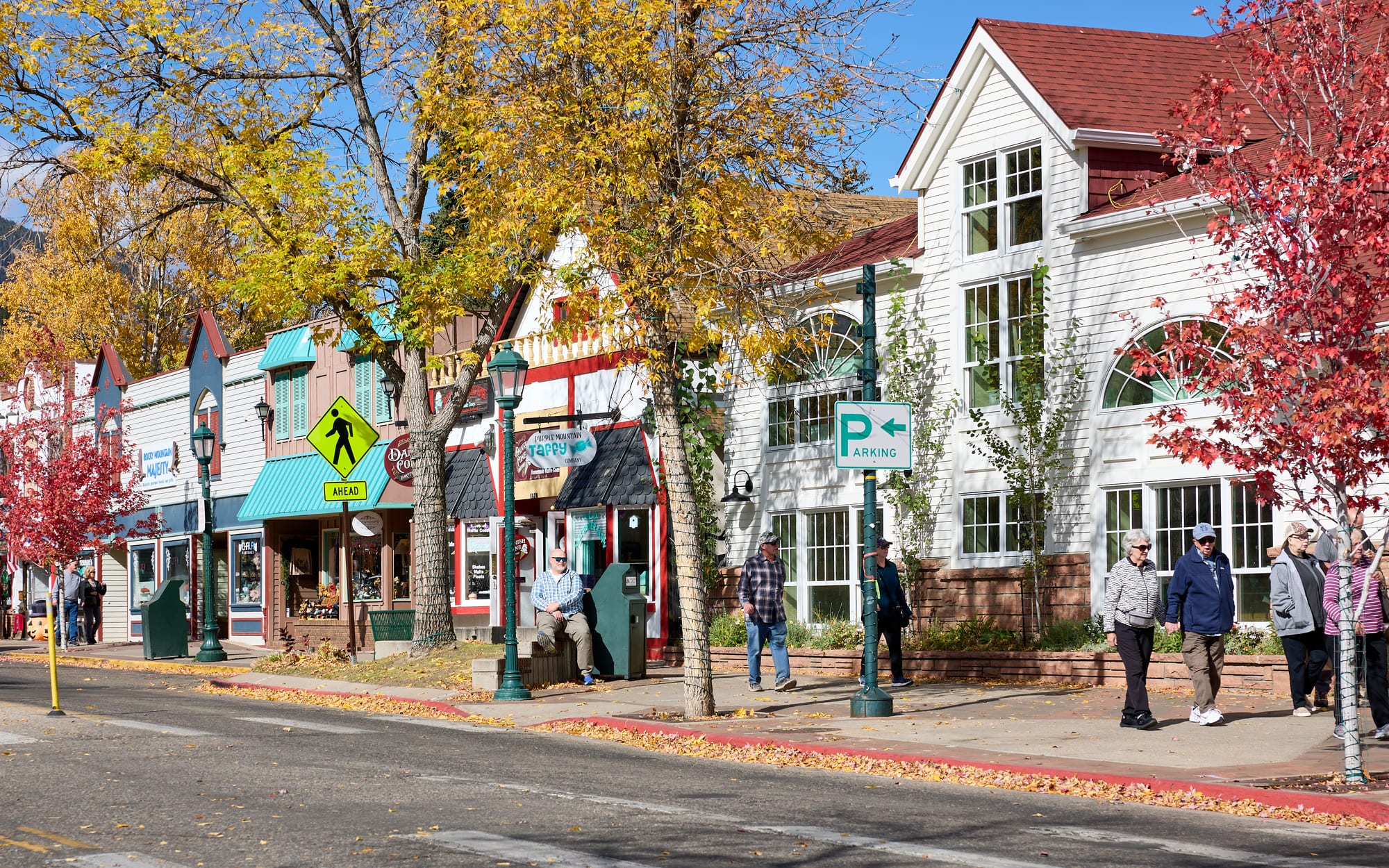
Shopfronts with gables and awnings on West Elkhorn Avenue under yellow and red autumn trees, with people walking the pavement

The Rocky Mountains, United States

Estes Park

West Elkhorn Avenue, the main street of Estes Park, in October 2024. (Frank Schulenburg / Wikimedia Commons · CC BY-SA 4.0)

A mountain resort town on the Big Thompson River in northern Colorado, at the eastern edge of Rocky Mountain National Park. Settled from 1859 and a tourist resort since the 19th century, it is now the base for most of the park's millions of yearly visitors, with a busy main street, a lake and elk grazing on the edge of town.

Neighbourhoods

  • Downtown and Elkhorn Avenue
    • First-time visitors
    • Shops and restaurants
    • Walkable

    The main street, Elkhorn Avenue, with gift shops, restaurants and cafés, and the river walk behind it along the Big Thompson, rebuilt after the flood of 1982. The free summer shuttles start from the town's visitor centre.

    Open in Maps
  • Lake Estes
    • Families
    • Walks
    • Quieter stays

    The reservoir on the east side of town, behind Olympus Dam, with about four miles of shoreline and open views of the mountains.

    Open in Maps
  • The roads to the park
    • Close to the park
    • Cabins and campgrounds

    West of downtown, the valleys of Fall River and the Big Thompson lead to the park's eastern entrances, lined with cabins, motels and campgrounds among the pines.

    Open in Maps

Things to do

Rocky Mountain National Park

  • Beaver Meadows Visitor Centerattraction

    The park headquarters and main visitor centre, completed in 1967 to a design by the architects of Frank Lloyd Wright's Taliesin practice, and a National Historic Landmark.

    Open in Maps
  • Trail Ridge Roadviewpoint

    The highest continuous paved road in North America, crossing the park for 48 miles to Grand Lake and topping out at 12,183 feet; the high section is closed from October to May.

    Open in Maps
  • Bear Laketrail

    An alpine lake at 9,450 feet below Hallett Peak and the Continental Divide, the start of trails from easy strolls to long hikes.

    Open in Maps
  • Moraine Parkmuseum

    A glaciated meadow where elk graze, with a museum in a 1923 lodge building that explains the park's natural history.

    Open in Maps
  • Old Fall River Roadviewpoint

    The first motor road into the park's interior, a dirt road climbing to Fall River Pass in mid-summer, past the alluvial fan left by the 1982 flood.

    Open in Maps
  • Longs Peakviewpoint

    The park's highest summit at 14,256 feet, about 10 miles south-west of town, the northernmost fourteener in the Rockies and a long, serious climb.

    Open in Maps

Around town

  • Lumpy Ridgeviewpoint

    The granite cliffs and slabs immediately north of town, known for rock climbing and for the Twin Owls formation, which looks like a pair of owls from town.

    Open in Maps
  • Lake Estespark

    The reservoir on the Big Thompson River, with a path along its shore and views back to the mountains.

    Open in Maps

Seasonal events

  • Elk rutautumn

    In autumn visitors come to watch and hear the elk rut in the park's meadows; the park holds some 2,000 to 3,000 elk in summer.

Eat and drink

Long-standing places and food districts in Estes Park. Hours, ratings and directions come from your maps app, always current.

Food districts

  • Elkhorn Avenueneighborhood

    The main street holds most of the town's restaurants, pizza places, coffee shops and bakeries, with the river walk behind it.

    Open in Maps
  • Barlow Plaza and the river walkneighborhood

    The small plazas and the path between Elkhorn Avenue and the Big Thompson River, with cafés and casual places to eat beside the water.

    Open in Maps

Experience Estes Park

History

For centuries the valley was a summer home to the Arapaho, who called it "the Circle" and camped around Mary's Lake; Ute hunters came for bighorn sheep, and the Arapaho remembered fighting Apache here in the 1850s. When three elderly Arapaho men visited in 1914, they could still point out their old trails, tipi sites and dance rings. The town takes its name from Joel Estes, a Missouri rancher who settled in the valley in 1859, when it was part of Nebraska Territory. The newspaper editor William Byers wrote of his attempt on Longs Peak in 1864, and his reports helped publicise the valley as pristine wilderness.

Settlers followed. Alex and Clara MacGregor homesteaded at the foot of Lumpy Ridge and in 1874 built a toll road from Lyons, which brought visitors, many of them in search of better health. Enos Mills, who arrived in 1884, became the leading campaigner for a national park, and President Woodrow Wilson signed the act creating Rocky Mountain National Park in January 1915. Steam cars carried visitors from Loveland from 1907, and the steam-car inventor F. O. Stanley ran buses from Lyons. The Civilian Conservation Corps built Trail Ridge Road in the 1930s.

Disaster has struck twice from the water. In July 1982 the Lawn Lake Dam failed in the park, killing three campers and causing $31 million of damage downstream; downtown was rebuilt with a river walk along the Big Thompson. Floods in 2013 badly damaged Highway 34 and the other roads into town.

Culture & Customs

Estes Park lives with and for the national park, and its identity is that of a gateway town: outfitters, gift shops and restaurants on Elkhorn Avenue, hiking boots everywhere, and conversations about trail conditions and the weather. The park holds some 2,000 to 3,000 elk in summer and 800 to 1,000 in winter, and they graze the meadows around town as well as inside the park; in autumn visitors flock to watch the elk rut.

The town's calendar includes a rodeo, a Scottish festival and an Elk Fest, and its museum keeps the photographs and memories of the valley's past, including the 1914 visit of the Arapaho elders. Rock climbers come for Lumpy Ridge and mountaineers for Longs Peak, while others follow the example of Enos Mills, the naturalist and author whose campaigning created the park and who was appointed a government lecturer by Theodore Roosevelt.

Tourism here has deep roots: early visitors came for their health, F. O. Stanley's steam buses carried them up from Lyons, and the aerial tramway to the summit of Prospect Mountain has run since 1955, under new owners since 2024. Crowding is the town's constant subject of debate, and the park's timed-entry permits, used from May to October since 2020, were introduced in response to it.

Daily Life

About 5,900 people lived in Estes Park at the 2020 census. The national park counted 4.1 million recreational visits in 2023, after a record of about 4.7 million in 2019, and most visitors use the town as their base, so tourism shapes everything from traffic to work. The town is the location of the park's headquarters, and it belongs to the Fort Collins metropolitan area on the plains below.

The year has two halves. From late spring to autumn, restaurants, shops, outfitters and lodging are busy, the free town shuttle runs, and the park's buses carry hikers to Bear Lake. In winter most of Trail Ridge Road is closed, life is quieter, colder and windier, and locals take to snowshoes and cross-country skis in the park.

Living in a mountain valley has its hazards. The roads up from the plains run through narrow canyons, and the floods of 1982 and 2013 showed how quickly they and the town can be damaged; downtown's river walk dates from the rebuilding after the first. Residents also share their streets with elk, whose numbers in the park are high enough that the park service fences them out of wetlands so that willows and aspens can grow.

Food

Estes Park eats like a mountain gateway town. Elkhorn Avenue and the plazas along the river walk hold most of its restaurants: pizza places, family restaurants, steak houses, a bakery and coffee shops. Breakfast before a hike and a big dinner afterwards are the usual pattern for visitors, and in summer the main street is at its busiest in the evening.

Picnics are part of many park visits, and the town is the place to stock up before driving in, because inside the park the choice is small: one place to buy food on Trail Ridge Road is the Trail Ridge Store and Cafe at Fall River Pass, beside the Alpine Visitor Center at almost 11,800 feet, on the high section of the road that is closed from October to May.

Colorado's wider food and drink culture reaches the town through its menus: craft beer from the state's many breweries, Colorado wine, and the hearty, informal cooking of the Rocky Mountain resorts. Because the season is short and the visitors many, the town's food is more about comfort than refinement, and some restaurants keep shorter hours in winter.

Planning tools

Budget

Estes Park is a gateway town, and prices follow the park's season: rooms are dearest and fill fastest from June to September and on autumn weekends during the elk rut, and much cheaper in winter. Park entry is the other main cost; the free town shuttles and the park's own buses help avoid parking problems at the busiest trailheads.

Daily Budget Midrange
USD 220–400 (cabin or mid-range motel, restaurant meals, park entry, rental car and fuel)
Daily Budget Shoestring
USD 90–150 (campground or budget motel, supermarket food and picnics, free shuttles)

An America the Beautiful annual pass covers park entry and pays for itself across several national parks.

Best Time to Visit

Summer, from about June to September, is when Trail Ridge Road is open, the high trails are clear of snow and the town is busiest. September and October bring the elk rut and smaller crowds. Winter is quiet, cold and windy, with snowshoeing and cross-country skiing in the park and most of Trail Ridge Road closed.

Suggested Number of Days

Two or three days give time for the town and the main part of the park. Allow four or five to reach the west side of the park or to take on longer hikes; winter visits are usually shorter.

First Visit
2–3 days
With Surroundings
4–5 days

Transportation

A car is the usual way to reach and explore the area. In summer the town runs Estes Transit, a free shuttle from the visitor centre to stops in town, and the park's own shuttle buses run between the Moraine Park and Bear Lake areas, which eases parking at the trailheads.

Since 2020 the park has used a timed-entry system: from May to October most visitors need a reservation to enter, so check the park's website before arriving.

Airport & Station Connections

Denver International Airport, the main airport for Estes Park, is about 75 miles to the south-east; private shuttle companies run to town, but most visitors drive. The main roads come up the canyons from Boulder, Lyons and Loveland; Highway 34 through Big Thompson Canyon was badly damaged in the 2013 floods and rebuilt.

Walkability

Downtown is compact and easy to walk, with the river walk running behind the main street. Everything else — the lake, the park entrances and the trailheads — is spread out along the valleys, and the free summer shuttles or a car are needed. Altitude makes uphill walking harder than it looks.

Safety

For most visitors the US is safe, with the main risks being petty theft and car break-ins in tourist areas of some cities, road accidents over long distances, extreme weather, and the hazards of the outdoors. Around Estes Park the risks are mountain ones: falls on trails, sudden summer thunderstorms, winter blizzards and wildlife — most deaths in the park between 2007 and 2024 were from accidental falls while hiking or climbing.

Keep well back from elk, especially in the autumn rut, start high hikes early to avoid afternoon storms, and carry warm layers in every season. Check current official travel advice before travelling.

Climate

A dry mountain climate that changes sharply with height. Summers are mild by day and cool at night, with afternoon thunderstorms; winters are cold and windy, with deep snow in the high country and snow possible on trails into May.

Summer
in July and August days in the park are generally in the 70s or 80s °F, falling to the 40s °F at night; afternoon storms can drop the temperature by 20°F
Winter
cold and windy, with nights well below freezing (32°F) and arctic conditions, blizzards and deep snow in the high country

Local Customs

The atmosphere is casual and outdoorsy. Tipping of roughly 18–22 per cent is expected in restaurants and bars. In the park, wildlife is best watched from a distance; stay on trails above the treeline, where the tundra plants are fragile.

Identification is asked for when buying alcohol (the legal age is 21); cannabis is legal for adults in Colorado but not in the national park, which is federal land.

Common Payment Methods

The currency is the US dollar. Cards and mobile payment are accepted almost everywhere in town; ATMs are on and around Elkhorn Avenue, and a little cash is useful for tips.