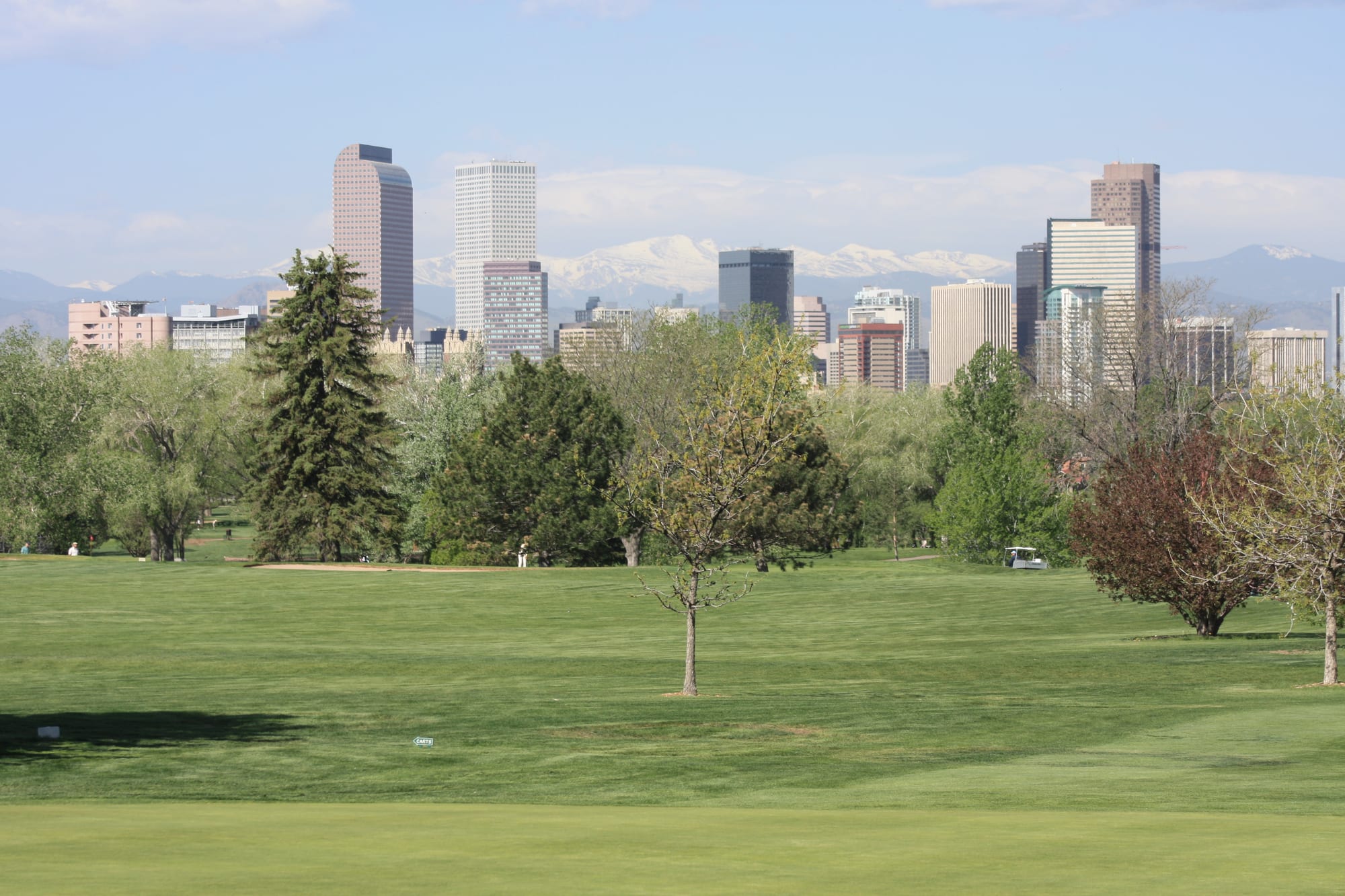
Downtown Denver's towers rising above the green lawns and trees of City Park, with snow-capped mountains on the horizon

The Rocky Mountains, United States

Denver

The downtown Denver skyline and the snow-capped Front Range seen across City Park. (David Herrera from Albuquerque, NM, Bernalillo / Wikimedia Commons · CC BY 2.0)

Colorado's capital and largest city, on the South Platte River where the High Plains meet the Front Range of the Rockies, exactly a mile above sea level. Founded in the gold rush of 1858, it grew into the commercial and transport hub of the Great Plains and the Mountain West; today it is a fast-growing city of museums, sports teams, breweries and parks with the mountains in view.

Neighbourhoods

  • LoDo and Union Station
    • First-time visitors
    • Nightlife
    • Close to public transport

    Lower Downtown is one of the oldest parts of the city: blocks of 19th-century brick warehouses and storefronts redeveloped since the late 1980s into restaurants, bars, shops and flats. Union Station, Coors Field and Larimer Square are all here, and the trains to the airport start at the station.

    Open in Maps
  • Five Points and RiNo
    • Arts and culture
    • Best for food
    • Nightlife

    One of Denver's oldest neighbourhoods and now one of its fastest-growing, north-east of downtown. Much of the new building is in RiNo, the River North Art District, which many locals treat as a neighbourhood of its own.

    Open in Maps
  • Capitol Hill
    • Historic district
    • Nightlife
    • Close to downtown

    The dense neighbourhood east of Broadway and south of Colfax Avenue, just beyond the State Capitol. Many count neighbouring Cheesman Park, with its park and the Denver Botanic Gardens, as part of it.

    Open in Maps
  • Highland
    • Best for food
    • Quiet and residential

    A city-centre neighbourhood across the South Platte River north-west of downtown. Together with West Highland, often called the Highlands, it is home to around 57,000 people.

    Open in Maps
  • Art District on Santa Fe
    • Galleries
    • Latino culture

    Santa Fe Drive in the La Alma-Lincoln Park neighbourhood south-west of downtown, lined with hundreds of galleries, studios and theatres, including the Museo de las Americas and Su Teatro. First Friday Art Walks are the district's signature event.

    Open in Maps
  • Washington Park
    • Quiet and residential
    • Parks

    A residential neighbourhood south-east of the centre built around its large park, first laid out in 1899 by the landscape architect Reinhard Schuetze and busy with walkers, cyclists and volleyball players.

    Open in Maps

Things to do

Famous landmarks

  • Denver Union Stationtransit hub

    The city's main railway station, whose central hall dates from 1914; renovated and reopened in 2014, it holds restaurants and shops and is the hub for trains to the airport, light rail and buses.

    Open in Maps
  • Colorado State Capitollandmark

    The seat of the state government on Colfax Avenue, where a benchmark on the steps marks Denver's official elevation of exactly one mile.

    Open in Maps
  • Larimer Squarelandmark

    Denver's oldest surviving commercial district, on Larimer Street, the city's oldest street, made its first historic district in 1971.

    Open in Maps
  • 16th Streetlandmark

    The 1.25-mile pedestrian and transit street through downtown, first designed by I. M. Pei, rebuilt and reopened in October 2025 without the word 'Mall' in its name, with a free shuttle bus along its length.

    Open in Maps
  • Denver Mintlandmark

    A working United States Mint on Colfax Avenue, producing coins for circulation.

    Open in Maps

Museums

  • Denver Art Museummuseum

    One of the largest art museums between the West Coast and Chicago, with more than 70,000 works and noted collections of American Indian and Western American art, including a wing by Daniel Libeskind.

    Open in Maps
  • Clyfford Still Museummuseum

    A museum opened in 2011 beside the art museum, holding about 93 per cent of the abstract expressionist Clyfford Still's lifetime output.

    Open in Maps
  • Denver Museum of Nature and Sciencemuseum

    A large natural history and science museum in City Park, with more than a million objects in its natural history and anthropology collections.

    Open in Maps
  • History Colorado Centermuseum

    The state history museum, opened in 2012 on Broadway near the Civic Center.

    Open in Maps
  • Molly Brown House Museummuseum

    The home of Margaret Brown, the 'Unsinkable Molly Brown' who survived the Titanic, with exhibits on her life and Victorian Denver.

    Open in Maps
  • Meow Wolf Convergence Stationattraction

    A large immersive art installation by the Meow Wolf collective, opened in 2021.

    Open in Maps

Parks and gardens

  • City Parkpark

    Denver's largest park, at 330 acres, with lakes, a boathouse, the Denver Zoo, and the nature and science museum.

    Open in Maps
  • Denver Botanic Gardenspark

    A 23-acre botanical garden in Cheesman Park with a conservatory, themed gardens and a sunken amphitheatre used for summer concerts.

    Open in Maps
  • Confluence Parkpark

    The riverside park where Cherry Creek meets the South Platte River — where a party of prospectors began searching for gold in May 1858.

    Open in Maps

Music, sport and nights out

  • Denver Performing Arts Complexattraction

    One of the largest performing arts centres in the country, with ten venues under an 80-foot glass roof, home to the Colorado Ballet, the Colorado Symphony, Opera Colorado and touring Broadway shows.

    Open in Maps
  • Coors Fieldattraction

    The Colorado Rockies' baseball park in LoDo, opened in 1995, known as a hitter's park because balls fly further in the thin, dry air.

    Open in Maps
  • Ball Arenaattraction

    The arena of the Nuggets basketball team, NBA champions in 2023, and the Colorado Avalanche ice hockey team.

    Open in Maps

Short trips from the city

  • Red Rocks Amphitheatreattraction

    An open-air concert venue owned by the city near Morrison, about ten miles south-west of Denver, set between two huge sandstone monoliths, with seating for about 9,500.

    Open in Maps
  • Goldenattraction

    A foothills town west of Denver where Coors has brewed beer since the 1870s.

    Open in Maps
  • Rocky Mountain National Parkpark

    A national park of high peaks, alpine tundra and lakes about 55 miles north-west of Denver.

    Open in Maps

Seasonal events

  • National Western Stock ShowJanuary

    A livestock show and festival held each January since 1906, with a horse show and rodeo; by number of animals it is the world's largest stock show.

  • Cinco de MayoMay

    One of four large Mexican-American celebrations in the city, attracting more than 500,000 people.

  • PrideFestJune

    The largest LGBTQ Pride festival in the Rocky Mountain region, held in Civic Center Park; the first Denver Pride event took place in 1974.

  • Great American Beer Festivallate September or early October

    The largest ticketed beer festival in the United States, established in 1982 and hosted by the Brewers Association.

Eat and drink

Long-standing places and food districts in Denver. Hours, ratings and directions come from your maps app, always current.

Denver classics

  • Buckhorn Exchangerestaurant

    Opened in 1893, the oldest continuously operating restaurant in Denver, a landmark steakhouse that doubles as a museum of the frontier.

    Open in Maps
  • Casa Bonitarestaurant

    A vast pink Mexican restaurant of themed rooms and an indoor waterfall with cliff divers in suburban Lakewood, first opened in 1974, bought by the creators of South Park and relaunched in 2023 after a major renovation.

    Open in Maps

Food districts and markets

  • Denver Central Marketmarket

    A food hall of counters and bars, with a smaller branch at the airport.

    Open in Maps
  • Union Stationneighborhood

    The restored station hall and the blocks around it hold restaurants and bars, busy with train passengers and LoDo crowds.

    Open in Maps
  • RiNoneighborhood

    The River North Art District, where new restaurants and bars have opened among the galleries of one of the city's fastest-growing areas.

    Open in Maps
  • Larimer Squareneighborhood

    Restaurants and bars in the restored 19th-century buildings of Denver's oldest commercial block.

    Open in Maps

Experience Denver

History

The Denver area was home to Apache, Ute, Cheyenne, Comanche and Arapaho peoples, and the 1851 Treaty of Fort Laramie recognised it as Cheyenne and Arapaho land. The discovery of gold in November 1858 brought a rush of prospectors. On 22 November 1858 the land speculator William Larimer staked a claim where Cherry Creek meets the South Platte River and named it Denver City after the Kansas Territorial governor, James W. Denver, unaware that he had already resigned. The town was incorporated in 1861, shortened its name to Denver in 1866, and became the capital of Colorado Territory in 1867. Treaties forced on the Cheyenne and Arapaho, the Colorado War of 1864–65 and the Sand Creek massacre cleared them from the area by the end of the 1860s.

When the first transcontinental railroad was routed through Cheyenne, 100 miles to the north, local leaders raised money to build their own link, completed in 1870. Silver fortunes followed: Horace Tabor built an opera house, and by 1890 Denver was the second-largest city west of Omaha. The silver crash of 1893 brought depression. In 1902 the City and County of Denver was created, and Mayor Robert Speer's City Beautiful programme built many of its parks and parkways.

In 1972 Colorado voters refused to fund the 1976 Winter Olympics, which Denver had been chosen to host. The oil bust of the 1980s hit hard, but the new airport opened in 1995, the restored Union Station reopened in 2014, and the city has grown rapidly since.

Culture & Customs

Denver's culture mixes the Old West with the outdoors and a large Latino community. The National Western Stock Show, held in January since 1906, brings cattle, horses and rodeo to the city, a reminder of its role as the market town of the High Plains. Denver has one of the largest Mexican American populations in the country, and its Cinco de Mayo, El Grito de la Independencia and lowrider shows draw huge crowds.

The arts grew with the city's wealth. The Denver Performing Arts Complex is one of the largest in the country, the Denver Art Museum is known for its American Indian and Western art, and the city built a museum for Clyfford Still's paintings after acquiring his estate in 2004. Galleries cluster in RiNo and along Santa Fe Drive, and the city has active pop, jazz, folk, jam-band, metal and classical scenes. Red Rocks Amphitheatre in the foothills is one of its best-known concert stages.

Sport is followed closely: the Broncos have sold out nearly every home game since 1970 and won the Super Bowl in 1997, 1998 and 2015, the Nuggets won their first NBA title in 2023, and the Avalanche and Rockies have devoted followings; Denver Summit FC began play in the National Women's Soccer League in 2026. Craft beer is a point of pride, and the Great American Beer Festival is held here every autumn. Denverites are informal and outdoor-minded, spending weekends on trails and slopes to the west, and the city's LGBTQ community holds the region's largest Pride festival each June.

Daily Life

Denver had 715,522 people at the 2020 census, making it the 19th most populous city in the United States, in a ten-county metropolitan area of about 3.1 million. It is the only state capital that is also a consolidated city and county, and the most populous city within about 500 miles, which has made it a natural centre for storage, distribution and transport across the Mountain West. Energy and mining are still important, and its airport ranks among the busiest in the world.

The city has 78 official neighbourhoods, and older streets have been joined by new towers around Union Station and by large developments such as Central Park, built on the site of the old Stapleton airport and renamed in 2020 because Benjamin Stapleton had belonged to the Ku Klux Klan.

Life has an outdoor rhythm: cycling on the paths along Cherry Creek and the South Platte, walks in the parks, and weekend drives into the mountains for hiking or skiing. Mike Johnston is the city's mayor.

Food

Denver's signature flavour is chile. The city is best known for its green and red chile sauce, served with Colorado burritos, breakfast burritos, chiles rellenos and tamales. The Denver omelette — diced ham, onions and green peppers — carries the city's name. Ranch-country food survives too, in rainbow trout and Rocky Mountain oysters, bulls' testicles that are often coated in flour and deep-fried.

Denver has also been a launch pad for national chains: Chipotle Mexican Grill, Qdoba, Noodles & Company and Good Times all began here. Food halls such as Denver Central Market, the restaurants of Union Station and LoDo, and the newer places in RiNo and the Highlands reflect the city's growth, while one of the country's largest Mexican American communities keeps tamales, empanadas and chile at the centre of local cooking.

Beer is the drink of Denver. Coors has brewed in nearby Golden since the 1870s, many restaurants have their own breweries, larger brewers offer tours, and the Great American Beer Festival makes the city a gathering place for brewers every autumn. Colorado's orchards and farms add Palisade peaches from the Western Slope and Rocky Ford melons in summer.

Planning tools

Budget

Denver is mid-priced by American standards, cheaper than the coastal cities. Downtown hotel rates rise during big events. Food ranges from inexpensive burritos and food halls to upscale dining, and the A Line train makes a car unnecessary for a city-only visit.

Daily Budget Midrange
USD 220–380 (downtown hotel, restaurant meals, museum tickets, ride-hailing or a rental car for the mountains)
Daily Budget Shoestring
USD 90–150 (hostel bed or budget motel, burritos and food-hall meals, RTD trains and buses)

Use the A Line from the airport rather than a taxi; the free 16th Street shuttle, the parks, the State Capitol steps and the First Friday art walks cost nothing.

Best Time to Visit

Late spring to early autumn is the classic season, with concerts at Red Rocks, baseball, patios and easy access to the mountains; summers are hot by day with afternoon thunderstorms. Winters bring spells of snow and cold broken by milder days from warm Chinook winds, and are the season for the stock show and for skiing in the mountains to the west.

Suggested Number of Days

Two or three days cover the city's main museums and neighbourhoods. Add several more for the foothills and the mountains — the national park and the ski areas are within a day's reach.

First Visit
2–3 days
With Surroundings
5–7 days

Transportation

The Regional Transportation District (RTD) runs more than 100 bus routes and ten light rail and commuter rail lines over 113 miles of track. A free shuttle bus runs the length of 16th Street downtown. The city has more than 850 miles of off-road bike paths along its parks and creeks. A car is useful for the mountains, though Bustang buses and, in winter, the Winter Park Express train reach some destinations.

Downtown streets follow an older grid laid out parallel to the confluence of the South Platte River and Cherry Creek, set diagonally to the rest of the city's north–south grid.

Airport & Station Connections

Denver International Airport, one of the busiest in the world, is 25 miles by road north-east of downtown — closer to Aurora than to central Denver. The A Line commuter train links it with Union Station. Amtrak's California Zephyr stops at Union Station, and long-distance buses, including Greyhound, Burlington Trailways and Colorado's Bustang, serve the city.

Walkability

Downtown is compact and walkable: LoDo, Union Station, Larimer Square, 16th Street, the Civic Center museums and the State Capitol lie close together, and the free shuttle covers 16th Street. Outer neighbourhoods are spread out, but trains, buses and the many bike paths link them, and most residents live within a ten-minute walk of a park.

Safety

Crime in Denver is mainly car break-ins and petty theft. The weather can change fast at the foot of the mountains: summer afternoons bring thunderstorms and sometimes severe hail, and winter can bring sudden snow and cold. In the mountains west of the city, altitude, lightning and winter driving are the main hazards.

For most visitors the US is safe, with the main risks being petty theft and car break-ins in tourist areas of some cities, road accidents over long distances, extreme weather, and the hazards of the outdoors. Leave nothing visible in parked cars, especially at trailheads, and check mountain road and weather conditions before driving west. Check current official travel advice before travelling.

Climate

A cool semi-arid climate with low humidity, four distinct seasons and about 3,100 hours of sunshine a year. Most rain falls from April to August, and the high elevation means large differences between day and night temperatures.

Summer
warm to hot — July averages a high of about 90°F, about 38 days a year reach 90°F, and afternoon thunderstorms are common
Winter
changeable — December averages a high of about 44°F, with spells of snow and cold broken by milder weather from Chinook winds; snowfall averages about 54 inches a year

Local Customs

Denver is casual and outdoorsy; dress is informal almost everywhere. Tipping of around 18–22 per cent is expected in restaurants and bars. Sales tax is added at the till. Colorado legalised recreational cannabis in 2012.

Identification is asked for when buying alcohol or cannabis (the legal age for both is 21).

Common Payment Methods

The currency is the US dollar. Cards and contactless payment are accepted almost everywhere, and some venues no longer take cash. A little cash is useful for tips.