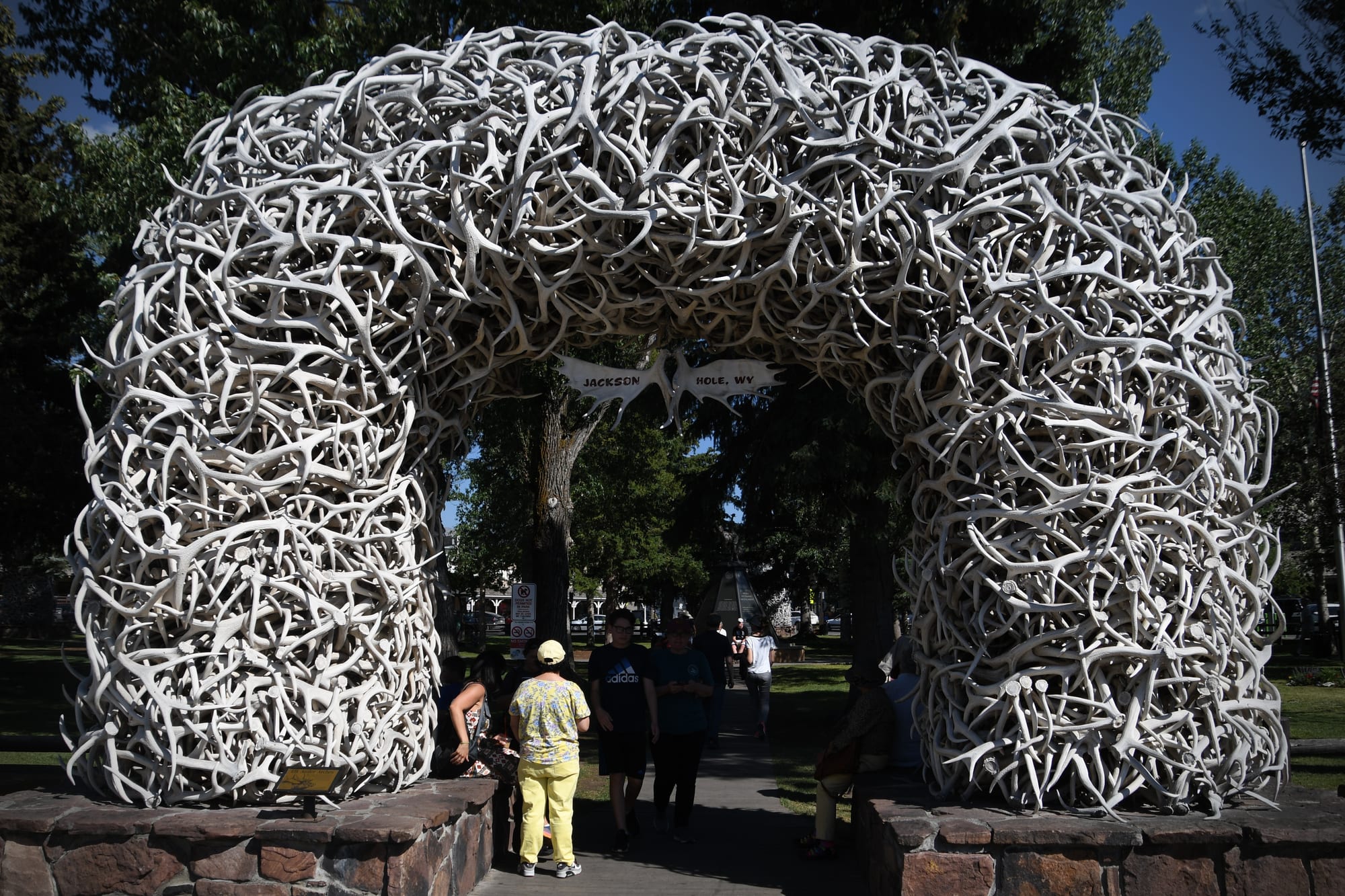
A large arch built from hundreds of pale elk antlers at the entrance to a tree-shaded town square in summer

The Rocky Mountains, United States

Jackson

One of the four elk-antler arches at the corners of the town square in Jackson, Wyoming. (Schwerdf / Wikimedia Commons · CC BY 4.0)

A small resort town at the southern end of the Jackson Hole valley in north-west Wyoming, between the Teton and Gros Ventre ranges. Fur trappers named the valley and ranchers settled it; national parks, ski resorts and wealth have shaped it since. Today it is the largest incorporated town in Wyoming, with antler arches on its town square and the National Elk Refuge at its edge.

Neighbourhoods

  • Town Square and downtown
    • First-time visitors
    • Shopping and galleries
    • Nightlife

    The compact centre around the town square, George Washington Memorial Park, with an elk-antler arch at each corner. Wooden boardwalks lead past art galleries, outdoor-clothing shops, restaurants and western bars, and the base of Snow King Mountain is about six blocks away.

    Open in Maps
  • Teton Village
    • Skiing
    • Mountain access

    A small resort village about twelve miles north-west of town, built around the base of the Jackson Hole Mountain Resort. It is busiest in the ski season and is linked to Jackson by the START bus and the Moose–Wilson Road.

    Open in Maps
  • Wilson
    • Quiet and residential
    • Teton Pass

    A small community just north-west of Jackson at the foot of Teton Pass, founded in 1889 by Elijah Nicholas Wilson. Quieter than town, it sits on the road over the pass to Idaho.

    Open in Maps

Things to do

In town

  • Town Square and the antler archeslandmark

    The square at the heart of town, with arches built from hundreds of shed elk antlers at its four corners, a stone memorial to the trapper John Colter in the middle and galleries all around.

    Open in Maps
  • Snow King Mountainpark

    The 'town hill' on the south-east edge of Jackson, Wyoming's first ski area, with skiing in winter and hiking, an alpine slide and a planetarium at the summit.

    Open in Maps
  • National Elk Refugepark

    A refuge created in 1912 that borders the town and shelters thousands of elk each winter, when horse-drawn sleigh rides take visitors out among the herd.

    Open in Maps
  • National Museum of Wildlife Artmuseum

    A museum of wildlife painting and sculpture in a building of Idaho quartzite on a bluff overlooking the elk refuge, about 2.5 miles north of town, with a sculpture trail outside.

    Open in Maps

Mountains and skiing

  • Jackson Hole Mountain Resortattraction

    The ski area at Teton Village, opened in 1966 and known for its steep terrain and a vertical drop of 4,139 feet, one of the largest in North America.

    Open in Maps
  • Teton Passviewpoint

    The mountain pass at 8,431 feet on the road to Idaho, about eleven miles from Jackson, popular for backcountry skiing and mountain biking.

    Open in Maps

Short trips from the town

  • Grand Teton National Parkpark

    The park of the Teton Range and the northern part of Jackson Hole, established in 1929 and greatly enlarged in 1950 with land bought by John D. Rockefeller Jr.

    Open in Maps
  • Yellowstone National Parkpark

    The first national park in the United States, established in 1872, known for Old Faithful, its other geothermal features and its wildlife, reached from Jackson through Grand Teton.

    Open in Maps

Seasonal events

  • Grand Teton Music Festivalsummer, for seven weeks

    A classical music festival founded in 1962, bringing more than 250 orchestral musicians from across North America and Europe to Jackson Hole each summer.

  • Elk antler auctionspring

    An annual auction at which local Boy Scouts sell the antlers shed on the National Elk Refuge, with the proceeds shared between the Scouts and the refuge.

Eat and drink

Long-standing places and food districts in Jackson. Hours, ratings and directions come from your maps app, always current.

Jackson classics

  • Million Dollar Cowboy Barrestaurant

    The town's landmark western bar on the town square, known for its saddle bar stools and dancing, with a restaurant downstairs.

    Open in Maps
  • Jackson Drugrestaurant

    A restaurant on East Deloney Avenue near the town square, with ice cream on the menu.

    Open in Maps
  • Dornan's Chuckwagonrestaurant

    Chuckwagon fare — beef stew, ribs, beans and cornbread — eaten at picnic tables at the foot of the Tetons in Moose, north of town.

    Open in Maps

Food districts and bars

  • Restaurants around the town squareneighborhood

    Most of the town's restaurants and bars are within a few blocks of the square, from bagel shops to dining rooms serving elk and other local meat.

    Open in Maps
  • Snake River Brew Pubrestaurant

    A brewpub on South Millward Street with a boisterous atmosphere, popular after a day of hiking or skiing.

    Open in Maps

Experience Jackson

History

The valley was home to Native peoples long before Europeans arrived, among them the Shoshone, Crow, Blackfeet, Bannock and Gros Ventre. In the early 19th century it became a crossing for trappers and mountain men: John Colter, freshly discharged from the Lewis and Clark expedition, passed through in the winter of 1807–08, and Jim Bridger, Jedediah Smith and William Sublette followed. The valley — "Jackson's Hole" to the trappers, who used "hole" for a high mountain valley — took its name from David Edward Jackson, who spent a winter on the shores of Jackson Lake. On the Hayden Expedition of 1871–72 the photographer William Henry Jackson took the first photographs of the Teton Range and Yellowstone, and in 1872 Congress made Yellowstone a national park.

Ranching settlers followed, and the town was named in 1894 and incorporated in 1914. In 1920 Jackson elected an all-woman town government, with women as mayor, council members, marshal, clerk and treasurer. Grand Teton National Park was created in 1929 to protect the peaks, and over the following years John D. Rockefeller Jr. bought more than 30,000 acres of the valley floor and gave them to the government; despite much local opposition, most of that land joined the park in 1950.

Skiing began on Snow King, the town hill, in the 1930s, and the Jackson Hole Mountain Resort opened at Teton Village in 1966. Since then tourism and wealthy second-home owners have transformed the old cattle town, and since 1978 the Kansas City Federal Reserve has held its annual economic symposium in the valley.

Culture & Customs

Jackson trades on its western past and its mountain setting at once. Cowboy hats, boardwalks and saloon fronts survive around the town square, where in summer actors stage a mock shoot-out with bank robbers and a stagecoach, and the Million Dollar Cowboy Bar keeps saddles for bar stools. The four antler arches on the square, built from elk antlers shed on the neighbouring refuge, became famous far beyond Wyoming after a live webcam of the square went viral on the internet in 2016. Each spring local Boy Scouts auction antlers collected on the refuge.

The town also has a serious arts scene for its size. Galleries of western and wildlife art line the streets around the square, the National Museum of Wildlife Art holds one of the major collections of its kind, and the Center for the Arts, founded in 1991, gives local artists and performers a home. The Grand Teton Music Festival, founded in 1962, brings an orchestra of musicians from across North America and Europe for seven weeks every summer.

Outdoor sport is central to local identity: skiing on steep terrain, climbing in the Tetons, rafting and fishing on the Snake River, and hiking straight from town into the hills. Hollywood has long used the valley as a backdrop, from The Big Trail in 1930 and Shane in 1953 to Django Unchained in 2012.

Daily Life

Jackson had 10,760 people at the 2020 census, and an estimated 10,680 in 2024. It is the only incorporated town in Teton County and the largest incorporated town in Wyoming, and the principal town of a micropolitan statistical area that also includes Teton County, Idaho. The town sits at 6,237 feet, with Flat Creek running through it and the elk refuge bordering it to the north-east.

Tourism drives the economy: hotels, restaurants, shops, galleries, guiding and the ski industry employ much of the town, alongside construction and services. Wealth is very visible, and housing is the defining local issue. Less than 3 per cent of the land in Teton County is privately owned, and the average home in Jackson was valued at more than USD 1.9 million in 2025. More than a quarter of residents were Hispanic or Latino at the 2010 census.

The year turns on the seasons. Summer brings crowds bound for Grand Teton and Yellowstone; winter brings skiers; spring and autumn are quiet, and some businesses shut for weeks while residents travel themselves. Public schools, a branch of the county library and the START bus serve the year-round community.

Food

Jackson eats like a western ranch town with a resort's money. Beef and elk are menu staples, from burgers to steaks, and elk turns up in dishes as unexpected as Bolognese. Rocky Mountain food in general is hearty and plain, and in Jackson it is often served with views of the mountains.

The chuckwagon meal is the classic local experience: beef stew, ribs, beans and cornbread eaten at long picnic tables, as at Dornan's in Moose at the foot of the Tetons. In town, Jackson Drug serves ice cream, bagel shops and casual burrito places feed workers and hikers, while the streets around the square hold dining rooms aimed at visitors with money to spend.

Beer and bars complete the picture. The Snake River Brew Pub brews its own beer, and the western saloons around the square, the Million Dollar Cowboy Bar above all, are where visitors and locals meet after a day on the slopes or the trails.

Planning tools

Budget

Jackson is one of the most expensive places to stay in the Rocky Mountains, especially in summer and the ski season, when demand from visitors to the parks and the slopes is highest. Housing in the town is among the dearest in the country, and restaurant prices reflect it. In spring and autumn the town is quieter, but many hotels and restaurants close for the off-season.

Daily Budget Midrange
USD 250–450 (motel or mid-range hotel, restaurant meals, rental car and fuel, park entry or lift tickets)
Daily Budget Shoestring
USD 100–170 (hostel bed or campground, supermarket food and casual meals, the START bus)

Book summer rooms well ahead; the town square, the elk refuge viewing road and the START bus within town limits cost nothing.

Best Time to Visit

Two seasons dominate. Summer is the main season for Grand Teton and Yellowstone, and the town is at its busiest; September brings fewer crowds and autumn colour. Winter is ski season, with sleigh rides among the elk on the refuge. Spring and autumn are slow, and many businesses close for weeks at a time.

Suggested Number of Days

Two or three days cover the town and a first look at the nearby park. Allow a week to include Yellowstone as well, since its main sights are far apart and the drive is long. Winter visits are usually planned around the number of ski days.

First Visit
2–3 days
With Surroundings
5–7 days

Transportation

The town is small enough to explore on foot or by bicycle. START buses (Southern Teton Area Rapid Transit) run free within the town limits and north to the wildlife art museum, and connect Jackson with Teton Village, Star Valley to the south and Teton Valley in Idaho. A car is needed for the national parks, and rental companies operate at the airport and in town.

Teton Pass is steep and is often closed early in the morning in winter for avalanche control.

Airport & Station Connections

Jackson Hole Airport, the only commercial airport in the United States inside a national park, lies about seven miles north of town in Grand Teton National Park. It is the busiest airport in Wyoming, served year-round by Alaska, American, Delta and United. By road, Salt Lake City is about 307 miles away, roughly five hours' drive, and buses run to Salt Lake City and Idaho Falls.

Walkability

The centre is easy on foot: boardwalks run past the shops around the town square, and the base of Snow King is about six blocks from it. The parks, Teton Village and the airport are too far to walk, and winter pavements can be icy.

Safety

Crime in Jackson is low. The real risks are natural: cold, snow and avalanches in winter, and wildlife in the valley and the parks. Elk, bison and moose live close to town, grizzly bears are found in the surrounding ecosystem, and wildlife on the roads is a hazard after dark.

For most visitors the US is safe, with the main risks being petty theft and car break-ins in tourist areas of some cities, road accidents over long distances, extreme weather, and the hazards of the outdoors. Keep well back from bison and elk, carry bear spray on park trails, and check road and avalanche conditions in winter. Check current official travel advice before travelling.

Climate

At 6,237 feet, Jackson has a humid continental climate close to subarctic, with warm summers and very cold winters. Its narrow valley gets more precipitation, much of it snow, than most of Wyoming, and the altitude brings large differences between day and night temperatures.

Summer
warm days and cool nights; the record high is 101°F, set in July 1934
Winter
very cold and snowy — about 78 inches of snow a year; on average 236 mornings a year fall below freezing and about 35 below 0°F, and the record low is −52°F

Local Customs

The town mixes western ranch style with resort wealth, and dress is casual almost everywhere, including in good restaurants. Tipping of around 18–22 per cent is expected in restaurants and for guides and other services. 'Jackson' is the town; 'Jackson Hole' is the whole valley, and also the name of the ski resort.

Identification is asked for when buying alcohol (the legal age is 21). Never approach or feed wildlife, including the elk at the edge of town.

Common Payment Methods

The currency is the US dollar. Cards and contactless payment are accepted almost everywhere, and ATMs are easy to find in town. Sales tax is added at the till, and a little cash is useful for tips.