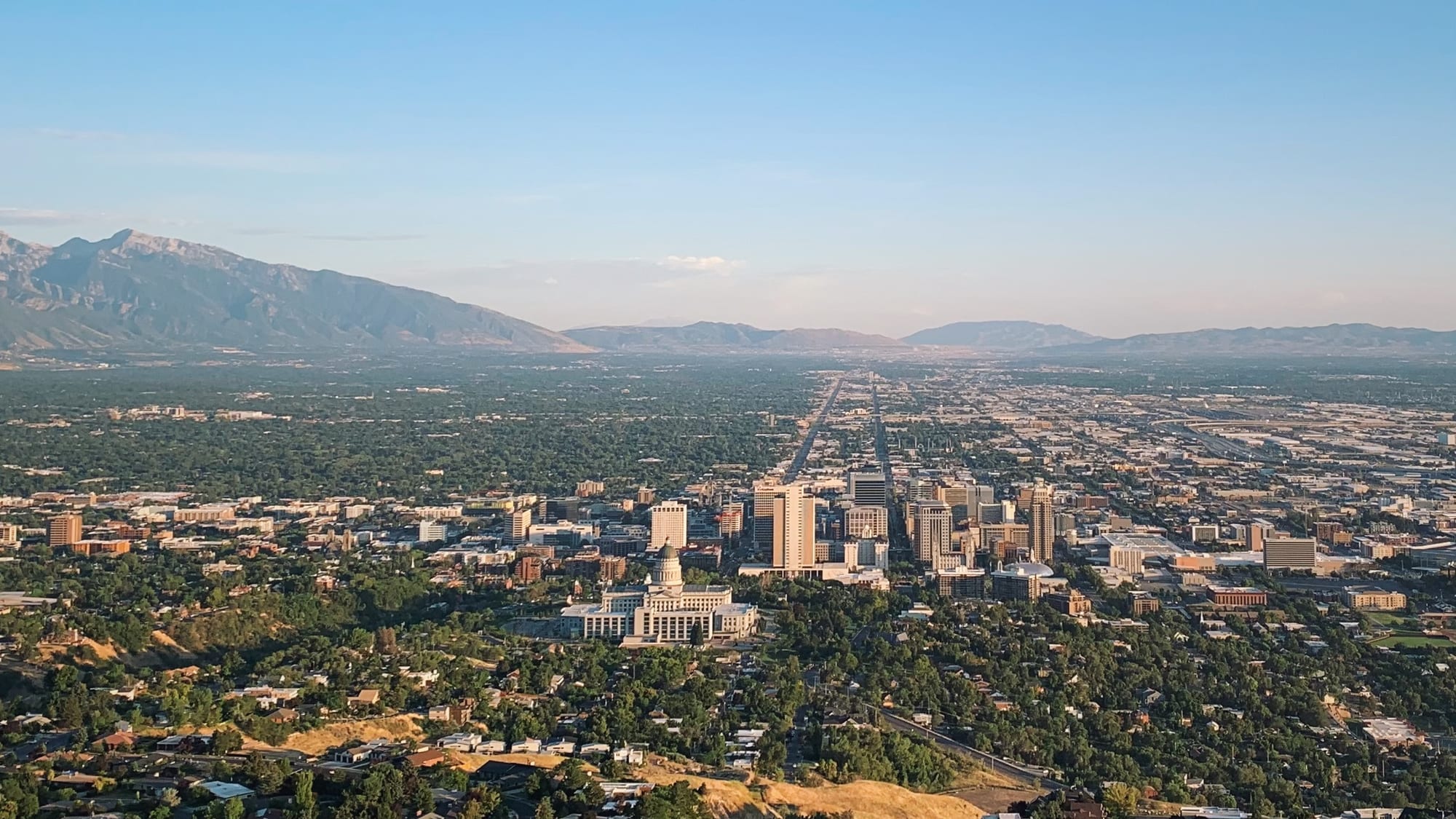
The domed Utah State Capitol and the downtown towers of Salt Lake City spread across a green valley below the Wasatch Mountains

The Rocky Mountains, United States

Salt Lake City

Salt Lake City from Ensign Peak, with the State Capitol in front of downtown and the Wasatch Range on the left. (Iansmh98 / Wikimedia Commons · CC BY-SA 4.0)

Utah's capital, laid out on a wide compass grid below the Wasatch Range near the Great Salt Lake. Founded by Latter-day Saint pioneers in 1847, it grew on railways and mining into the 'Crossroads of the West'. Today it is the headquarters of the church, a fast-growing tech and university city, and a base for some of the best skiing in North America.

Neighbourhoods

  • Downtown
    • First-time visitors
    • Close to public transport
    • Sport and events

    The historic core along Main Street, running from Temple Square to the City and County Building, with the City Creek Center, the Delta Center arena, the convention centre and The Gateway around the old Union Pacific depot. TRAX trains cross it, and most of the city's hotels are here.

    Open in Maps
  • The Avenues
    • Historic homes
    • Quiet and residential
    • Walks

    A hillside neighbourhood north-east of downtown on its own grid of small blocks, with lettered streets and numbered avenues. Older houses fill the lower slopes, and small restaurants and shops have opened in old retail space; its streets climb steeply into the foothills to the north.

    Open in Maps
  • Sugar House
    • Local life
    • Best for food
    • Parks

    An older neighbourhood in the south-east, often called the city's 'second downtown', with small shops, new apartment blocks and the S Line streetcar.

    Open in Maps
  • 9th and 9th and Central City
    • Cafés and shops
    • Students

    The small commercial district around 900 East and 900 South, an informal outdoor mall of cafés, galleries and shops popular with students, a short walk from Liberty Park.

    Open in Maps
  • The west side
    • Local life
    • Best for food

    Rose Park, Glendale and Poplar Grove, on the west side, are the more working-class and ethnically diverse part of the city; Rose Park and Glendale are predominantly Spanish-speaking.

    Open in Maps

Things to do

Famous landmarks

  • Temple Squarelandmark

    The ten-acre heart of the Church of Jesus Christ of Latter-day Saints, with the temple, the domed Tabernacle and the Assembly Hall; a National Historic Landmark District since 1964 and the origin point of the city's street grid.

    Open in Maps
  • Salt Lake Templelandmark

    The granite temple dedicated in 1893 after forty years of building, closed since 2019 for a renovation that includes earthquake strengthening; the church plans public open-house tours in 2027.

    Open in Maps
  • Utah State Capitollandmark

    The domed Neoclassical capitol of 1912–16 on Capitol Hill above downtown, restored and placed on earthquake base isolators before reopening in 2008.

    Open in Maps
  • Cathedral of the Madeleinelandmark

    The Catholic cathedral completed in 1909, the only American cathedral dedicated to Mary Magdalene.

    Open in Maps
  • FamilySearch Libraryattraction

    Formerly the Family History Library, the world's largest genealogical library, west of Temple Square and free to the public.

    Open in Maps

Museums

  • Natural History Museum of Utahmuseum

    The University of Utah's natural history museum, in a building opened in 2011 in the university's Research Park, with an emphasis on Utah and the Intermountain West.

    Open in Maps
  • Utah Museum of Fine Artsmuseum

    The art museum on the University of Utah campus.

    Open in Maps

Parks and viewpoints

  • Ensign Peakviewpoint

    A dome-shaped hill just north of downtown, a landmark for the pioneers of 1847, reached by a short popular trail with a view over the valley to the Great Salt Lake.

    Open in Maps
  • Memory Grovepark

    A war memorial park established in 1924 at the mouth of City Creek Canyon.

    Open in Maps
  • Liberty Parkpark

    An 80-acre park with a pond and islands, the historic Isaac Chase Mill and the Tracy Aviary.

    Open in Maps
  • Red Butte Gardenpark

    The University of Utah's botanical garden in the Wasatch foothills, with over 100 acres of gardens, trails and a summer concert amphitheatre.

    Open in Maps
  • Gilgal Sculpture Gardenpark

    A small city park full of unusual symbolic sculpture tied to Mormonism, including a sphinx with the head of Joseph Smith.

    Open in Maps
  • This Is the Place Heritage Parkpark

    A state park at the mouth of Emigration Canyon marking the pioneers' arrival in the valley, with a monument and a village of historic buildings.

    Open in Maps

Sport and nights out

  • Delta Centerattraction

    The downtown arena of the Utah Jazz basketball team and, since 2024, the Utah Mammoth ice hockey team.

    Open in Maps

Short trips from the city

  • Antelope Island State Parkpark

    The largest island in the Great Salt Lake, with a free-ranging bison herd introduced in 1893, pronghorn and bighorn sheep, and millions of waterfowl along the salty shore.

    Open in Maps
  • Altaattraction

    One of the oldest ski resorts in the country, at the head of Little Cottonwood Canyon, with a base at 8,530 feet.

    Open in Maps
  • Snowbirdattraction

    A ski and summer resort opened in 1971 in Little Cottonwood Canyon, best known for its winter powder skiing.

    Open in Maps

Seasonal events

  • Days of '47 and Pioneer DayJuly

    A week of events around 24 July, the anniversary of the pioneers' arrival, with one of the country's largest parades, a rodeo and fireworks at Liberty Park.

  • Utah Pride FestivalJune

    One of the largest Pride festivals in the country and the city's second-largest festival after Days of '47.

  • Twilight Concert Seriessummer

    A low-cost summer concert series.

  • Greek FestivalSeptember, the weekend after Labor Day

    Three days of Greek music, dance, cathedral tours and food at the Greek Orthodox cathedral downtown.

Eat and drink

Long-standing places and food districts in Salt Lake City. Hours, ratings and directions come from your maps app, always current.

Salt Lake classics

  • Fry saucerestaurant

    Utah's own condiment, ketchup mixed with mayonnaise, popularised in Utah by Don Carlos Edwards, who served it at the first Arctic Circle restaurant in Salt Lake City in 1950; eaten with fries and onion rings.

    Open in Maps
  • Red Iguanarestaurant

    A long-popular Mexican restaurant on North Temple, cooking from old family recipes and busy enough to have opened a second branch two blocks away.

    Open in Maps

Food districts and markets

  • Downtown Farmers Marketmarket

    The city's main farmers' market, held in Pioneer Park downtown from June to October.

    Open in Maps
  • 9th and 9thneighborhood

    A small cluster of cafés and restaurants around the 900 East and 900 South crossroads, popular with students.

    Open in Maps
  • Downtown breweries and food trucksneighborhood

    Many new breweries and restaurants opened downtown in the 2010s, and food trucks gather for lunch at the Gallivan Center.

    Open in Maps

Experience Salt Lake City

History

For thousands of years the Salt Lake Valley was the home of Shoshone, Ute, Paiute and Goshute peoples, and at the time of settlement it lay within Northwestern Shoshone territory. In July 1847 Latter-day Saint pioneers led by Brigham Young, escaping persecution further east, entered the semi-arid valley and immediately began digging the irrigation network that let the city grow. When measles devastated the Shoshone that year, Shoshone people taught the settlers to dig sego lily bulbs for food. Great Salt Lake City, as it was first called, was laid out on a wide compass grid measured from Temple Square, and dropped "Great" from its name in 1868.

The completion of the transcontinental railway at Promontory Summit in 1869, a branch line to the city in 1870, and mining booms in the surrounding mountains brought immigrants who were not Latter-day Saints, including Greek, Japanese and Chinese communities. Conflict with the federal government over polygamy led to the imprisonment of many church leaders in the 1880s, until the church's Manifesto of 1890 began its abandonment of plural marriage; Utah became a state in 1896, and the temple, begun in 1853, was dedicated in 1893.

In the 20th century the city became a regional centre of rail, mining and government. Downtown stagnated in the age of suburban sprawl, then revived after TRAX light rail opened in the late 1990s, the 2002 Winter Olympics put the city in the international spotlight, and the City Creek Center opened downtown. In 2024 the International Olympic Committee chose Salt Lake City to host the Winter Games again in 2034.

Culture & Customs

The Church of Jesus Christ of Latter-day Saints shapes the city's rhythm and skyline: its headquarters, Temple Square, the Conference Center and the world's largest genealogical library stand together downtown. The Tabernacle Choir at Temple Square, founded in 1847 just after the pioneers arrived, has broadcast its weekly programme Music & the Spoken Word every week since 1929, and Pioneer Day on 24 July, with the Days of '47 parade and rodeo, is the city's biggest celebration.

Yet Salt Lake City is less uniform than its reputation. Its Catholic, Episcopal and Greek Orthodox cathedrals date from the city's mining-boom diversity, about a fifth of residents are Hispanic, the valley has a large Pacific Islander population, mainly Samoan and Tongan, and the city has a significant LGBT community whose Utah Pride Festival in June is one of the largest in the country. Arts festivals, the free Gallery Stroll on the third Friday of each month, and the Greek Festival each September fill the calendar.

Sport is followed closely. The Utah Jazz have played here since moving from New Orleans in 1979, and the Utah Mammoth brought the NHL to the Delta Center in 2024. The rivalry between the University of Utah and Brigham Young University divides families. Winter belongs to the canyons, where skiers drive up before work, and the city's identity as an outdoor capital has grown with each Olympic bid.

Daily Life

About 200,000 people lived in the city at the 2020 census, in a metropolitan area of an estimated 1.3 million; the urban corridor of the Wasatch Front from Ogden to Provo holds about 2.8 million. The metro area is projected to keep growing quickly, and new apartment towers are rising downtown and in Sugar House.

The economy has moved from railways, steel and mining to government, trade, professional services and health care, with Intermountain Healthcare the largest health provider in the region and the University of Utah a major employer; technology firms have a large presence in the suburbs. The church is also a major employer.

The city is divided east and west. The eastern neighbourhoods — The Avenues, Federal Heights, Yalecrest, 9th and 9th and Sugar House — are more affluent and closer to the university and the foothills, while Rose Park, Glendale and Poplar Grove on the west side are more working-class and diverse. Daily life is car-centred but transit is improving, and residents head for the canyons in every season. The big local worries are winter air pollution, when inversions trap smog in the valley, the shrinking Great Salt Lake, housing costs and the risk of a major earthquake on the faults beneath downtown.

Food

Salt Lake City is not famous for its cooking, but it has one invention every visitor meets: fry sauce, a pink mix of ketchup and mayonnaise served by Don Carlos Edwards at the first Arctic Circle restaurant in Salt Lake City in 1950 and still offered by the chain. Burger places, drive-throughs and family restaurants are common.

The most interesting eating follows immigration. The west side has Mexican and other Latin American restaurants, bakeries and grocers, and one long-popular Mexican restaurant on North Temple draws queues; and the Greek Festival each September is a reminder of the Greek community that came for the mines and railways. Italian communities hold festivals of food and culture in August and September.

Downtown filled with new breweries and restaurants in the 2010s, and food trucks gather at the Gallivan Center for lunch. From June to October the farmers' market in Pioneer Park sells produce from the valley's farms. Drinking follows Utah's strict laws: stronger beer, wine and spirits come from state-run liquor stores, restaurants serve alcohol only with food, and many locals do not drink alcohol at all.

Planning tools

Budget

Salt Lake City is cheaper than most big American cities, and much cheaper than the ski towns in the mountains around it. Hotels downtown are the main cost and rise for conventions, big games and the ski season. Many of the main sights — Temple Square, the Capitol, the parks and the foothill trails — are free, and trains run from the airport to downtown.

Daily Budget Midrange
USD 200–380 (downtown hotel, sit-down meals, museum tickets, a rental car or ski lift ticket)
Daily Budget Shoestring
USD 90–150 (hostel or budget motel, fast food, food trucks and market lunches, buses and TRAX)

For skiing, staying in the city and driving or taking a ski bus up the canyons usually costs much less than sleeping at the resorts.

Best Time to Visit

Late spring and early autumn are the most comfortable seasons in the city. Summer is hot and dry, with festivals and long evenings in the foothills; winter is ski season, with snow in the canyons and a lively downtown, but winter inversions can trap smog in the valley for days.

Suggested Number of Days

Two or three days cover the city itself. Add more for the Great Salt Lake, the canyons or a ski trip; skiers often base themselves in the city for a week.

First Visit
2–3 days
With Surroundings
4–6 days

Transportation

The Utah Transit Authority runs buses across the Wasatch Front, three TRAX light-rail lines (one to the airport, one to the University of Utah), the S Line streetcar to Sugar House and the FrontRunner commuter train north through Davis and Weber counties and south to Provo. Downtown's very wide streets were laid out for wagons and are easy to drive; a car is useful for the canyons, the lake and the ski areas, though ski buses run in winter.

Addresses follow the grid: a number like 900 East 900 South gives the distance from the corner of Temple Square, which makes the city easy to navigate.

Airport & Station Connections

Salt Lake City International Airport, a Delta Air Lines hub and by far the busiest airport in Utah, is about 4 miles west of downtown; the TRAX Green Line runs to it. Amtrak trains and intercity buses also serve the city, and the I-15 and I-80 interstates meet here.

Walkability

Downtown is walkable but the blocks are very large and the streets wide, so distances feel longer than they look on the map. Temple Square, the City Creek Center and the arena are close together; the Capitol is a steep walk uphill. TRAX covers the longer gaps, and The Avenues and 9th and 9th are pleasant on foot.

Safety

For most visitors the US is safe, with the main risks being petty theft and car break-ins in tourist areas of some cities, road accidents over long distances, extreme weather, and the hazards of the outdoors. Salt Lake City has its own environmental risks: winter inversions that bring poor air quality, a serious earthquake risk from the Wasatch Fault, and summer heat.

Check air-quality alerts in winter, watch avalanche and road reports before driving up the canyons, and carry water on summer foothill trails. Check current official travel advice before travelling.

Climate

A humid continental climate with large variations in temperature between seasons. Summers are hot and dry, winters cold with regular snow, and the Great Salt Lake adds occasional heavy lake-effect snowfalls.

Summer
hot and dry — on average 56 days a year reach 90°F, and the record of 109°F was set in July 2026
Winter
cold — the temperature reaches freezing (32°F) on about 127 days a year, and snowfall averages about 60 inches a season

Local Customs

Salt Lake City is the headquarters of the Latter-day Saint church, and many residents do not drink alcohol or coffee, but the city also has a large secular population, a significant LGBT community and plenty of bars and breweries. Utah's alcohol rules are stricter than most states': wine, spirits and stronger beer are sold in state-run liquor stores, and restaurants serve alcohol only with food. Tipping of roughly 18–22 per cent is expected in restaurants.

Dress modestly and keep voices low on Temple Square; identification is asked for when buying alcohol (the legal age is 21).

Common Payment Methods

The currency is the US dollar. Cards and mobile payment are accepted almost everywhere, including on trains and buses; ATMs are easy to find downtown. A few small bills are useful for tips.