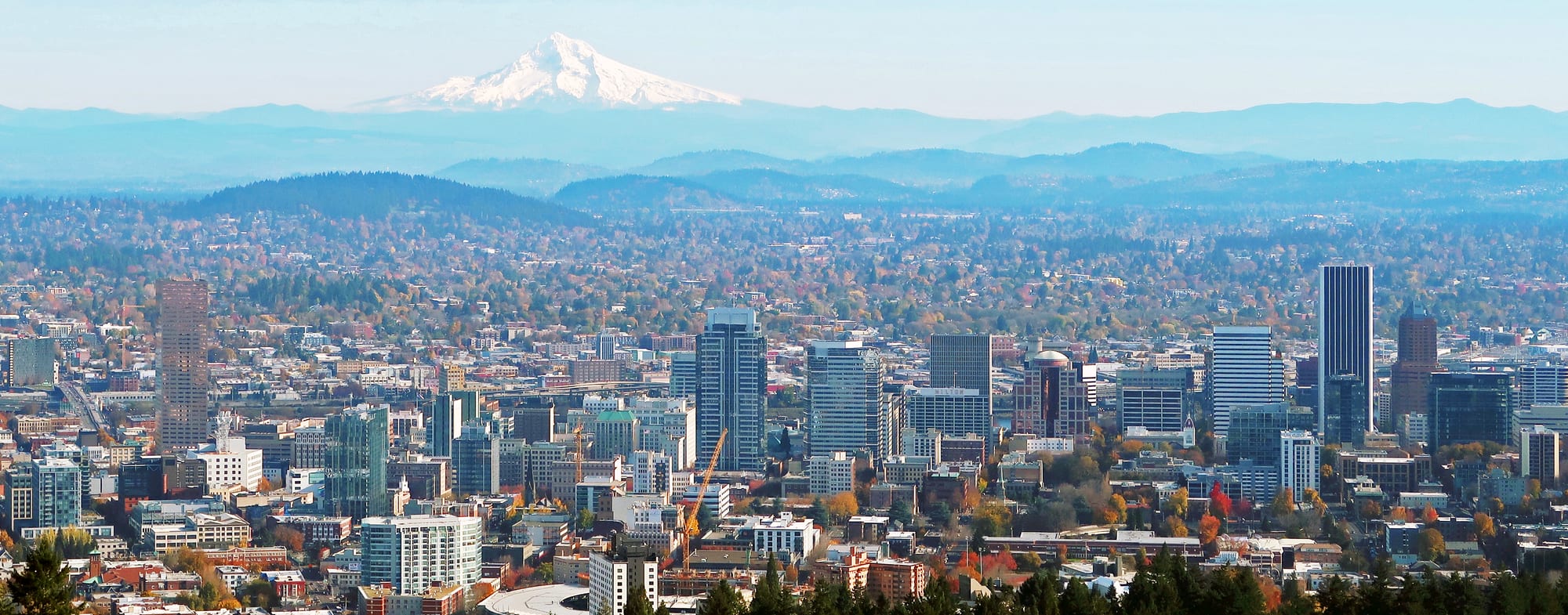
Downtown Portland's towers among autumn trees, with forested hills behind and the snow-covered cone of Mount Hood on the skyline

The Pacific Northwest, United States

Portland

Downtown Portland and Mount Hood seen from Pittock Mansion in the West Hills. (Truflip99 / Wikimedia Commons · CC BY-SA 4.0)

Oregon's largest city, where the Willamette River meets the Columbia, with Mount Hood on the eastern horizon. Founded in the 1840s as a river port for Oregon Trail settlers and grown on timber, shipping and wartime shipyards, it is now known for its bridges, rose gardens, food carts, breweries, bookshops and a strong independent streak.

Neighbourhoods

  • Downtown
    • First-time visitors
    • Close to public transport
    • Museums

    The west-bank centre between the Willamette and the West Hills, laid out in short blocks that are easy to walk. Pioneer Courthouse Square, the art and history museums along the South Park Blocks, Portland State University and the riverside Tom McCall Waterfront Park are all here, and the MAX light rail and the streetcar meet in its streets.

    Open in Maps
  • Pearl District
    • Best for food
    • Galleries
    • Shopping

    Former warehouses, light industry and railway yards north of downtown, turned into one of the city's wealthiest districts of flats, art galleries, restaurants and shops. Powell's City of Books stands on its southern edge, and the streetcar runs through it.

    Open in Maps
  • Old Town Chinatown
    • Historic district
    • Nightlife

    The oldest part of the city beside the Burnside Bridge, with historic commercial buildings, the walled Lan Su Chinese Garden and the Saturday Market by the river. It is also where the city's homelessness is most visible.

    Open in Maps
  • Nob Hill and NW 23rd Avenue
    • Shopping
    • Cafés
    • Quiet and residential

    A district of Victorian houses and older apartment blocks west of the Pearl, below the hills of Forest Park. NW 23rd Avenue and the streets around it are lined with boutiques, cafés and restaurants, and the streetcar connects it with downtown.

    Open in Maps
  • Alberta Arts District
    • Arts and culture
    • Best for food
    • Local life

    A long commercial street in Northeast Portland with galleries, murals, bars and restaurants. On the last Thursday of the month in summer, a street fair of artisans and traders fills it.

    Open in Maps
  • Hawthorne and Southeast
    • Bars
    • Vintage shops
    • Local life

    The largely residential east side, where Hawthorne Boulevard, Belmont and Division Street carry independent shops, cafés and music venues among streets of older houses. Mount Tabor, a volcanic cone with a park on top, rises to the east.

    Open in Maps

Things to do

Gardens and parks

  • International Rose Test Gardenpark

    A terraced garden in Washington Park with thousands of rose bushes and views over the city, the best-known symbol of the City of Roses.

    Open in Maps
  • Portland Japanese Gardenpark

    A series of traditional Japanese gardens on a hillside in Washington Park, with a viewpoint that looks over the city towards Mount Hood.

    Open in Maps
  • Hoyt Arboretumpark

    A tree museum in Washington Park with collections of conifers and other trees from around the world, crossed by walking trails.

    Open in Maps
  • Forest Parkpark

    One of the largest urban forests in the United States, stretching for miles along the hills north-west of downtown, with long trails through Douglas fir and bigleaf maple.

    Open in Maps
  • Lan Su Chinese Gardenpark

    A walled classical Chinese garden in Old Town, built around a central lake, with pavilions and a teahouse.

    Open in Maps
  • Tom McCall Waterfront Parkpark

    A long riverside park on the west bank of the Willamette in downtown, the setting for the Rose Festival and many of the city's summer festivals.

    Open in Maps
  • Mount Taborpark

    An extinct volcanic vent in Southeast Portland with a city park, reservoirs and walking trails to the summit.

    Open in Maps

Museums and landmarks

  • Portland Art Museummuseum

    The city's art museum, on the South Park Blocks downtown, with Native American, Northwest, Asian, American and modern art among its collections.

    Open in Maps
  • Oregon Historical Society Museummuseum

    The museum of the historical society founded in 1898, with books, films, pictures, artefacts and maps covering the whole of Oregon's history.

    Open in Maps
  • Oregon Museum of Science and Industrymuseum

    A large science museum on the east bank of the river, with a planetarium, a giant-screen theatre and the submarine USS Blueback moored outside.

    Open in Maps
  • Pittock Mansionlandmark

    The hilltop mansion of the newspaper publisher Henry Pittock in the West Hills, now a museum with a famous view of the city and Mount Hood.

    Open in Maps
  • Powell's City of Booksattraction

    The flagship of the city's large independent bookshop, a building filling a whole block at the edge of the Pearl District with new and used books shelved side by side.

    Open in Maps
  • Pioneer Courthouse Squarelandmark

    The brick-paved public square at the heart of downtown, used for concerts, markets and gatherings.

    Open in Maps

Markets

  • Portland Saturday Marketmarket

    An open-air crafts and food market by the river under the Burnside Bridge, the largest continuously operated outdoor market in the United States.

    Open in Maps

Sport and nights out

  • Providence Parkattraction

    The stadium on the edge of downtown where the Timbers and the Thorns play football.

    Open in Maps
  • Moda Centerattraction

    The arena of the Trail Blazers basketball team in the Rose Quarter on the east bank.

    Open in Maps

Short trips from the city

  • Multnomah Fallsattraction

    A two-tiered waterfall dropping down the cliffs of the Columbia River Gorge, crossed by a footbridge, with hiking trails above it.

    Open in Maps
  • Vista Houseviewpoint

    A stone observatory and rest stop of 1918 on Crown Point, high above the Columbia River at the western end of the gorge.

    Open in Maps

Seasonal events

  • Portland Rose FestivalJune

    The city's civic festival since the early 20th century, with parades and events across the city each June.

  • Oregon Brewers Festivalsummer

    A long-running craft beer festival held in Tom McCall Waterfront Park, one of several beer festivals in the city's calendar.

  • Holiday Ale FestivalDecember

    A winter beer festival, one of several beer festivals in the city's year.

Eat and drink

Long-standing places and food districts in Portland. Hours, ratings and directions come from your maps app, always current.

Portland classics

  • Food cart podsmarket

    Clusters of food carts parked on lots across the city — about 25 pods and some 500 carts in 2025 — serving cooking from many countries.

    Open in Maps
  • Voodoo Doughnutcafe

    The original shop of a doughnut company founded in Old Town in 2003, known for its pink boxes and unusual doughnuts such as the bacon maple bar.

    Open in Maps
  • Craft breweriesneighborhood

    Dozens of breweries and brewpubs within the city limits.

    Open in Maps

Food districts and markets

  • Jade Districtneighborhood

    Portland's second Chinatown along SE 82nd Avenue, with Chinese supermarkets, Hong Kong-style noodle houses, dim sum and Vietnamese phở restaurants.

    Open in Maps
  • Portland Farmers Marketmarket

    The city's main farmers' market, held downtown, with Oregon fruit, vegetables, bread and stalls of prepared food.

    Open in Maps

Experience Portland

History

Before American settlement the lower Willamette and Columbia valleys were among the most densely populated parts of the Pacific coast, home to the Multnomah and Clackamas bands of the Chinook people, whom Lewis and Clark recorded in 1805. In the 1840s settlers arriving on the Oregon Trail began clearing a site on the Willamette between Oregon City and Fort Vancouver, at first called Stumptown or The Clearing for its felled trees. Its two owners, Asa Lovejoy of Boston and Francis Pettygrove of Portland, Maine, each wanted to name it after his home town; Pettygrove won a best-of-three coin toss. The city was incorporated in 1851 with some 800 inhabitants, a sawmill and a newspaper, the Weekly Oregonian.

As the port for the Willamette Valley's farms and the region's timber, it grew to more than 46,000 people by 1890, despite a fire that destroyed twenty downtown blocks in 1873. The Rose Society was founded in 1889, and the push to become the City of Roses came with the Lewis and Clark Centennial Exposition of 1905. The population tripled between 1900 and 1930.

The Second World War brought shipyards and tens of thousands of workers, greatly enlarging the city's small Black community, while up to 3,676 people of Japanese descent were sent from an assembly centre in Portland to internment camps. The Vanport flood of 1948 destroyed the wartime housing town and displaced many Black families. In the late 20th century the city became known for planning and public transport, and it grew by more than 90,000 people between 2000 and 2014. Daily protests after the murder of George Floyd lasted from May 2020 into 2021. In 2025 a new mayor–council government took office, with councillors elected from four districts.

Culture & Customs

Portland has many nicknames — the City of Roses, Bridgetown for the bridges over the Willamette, Stumptown, Rip City — and a reputation, captured by the slogan Keep Portland Weird and the television comedy Portlandia, for eccentricity, independent businesses and left-leaning politics. The annual Rose Festival in June is the main civic celebration, and the World Naked Bike Ride, held every June since 2004, has been described by a judge as a well-established local tradition.

The arts are lively for a city of its size, with a strong music and performing arts scene, independent cinemas and galleries clustered in the Pearl District and on Alberta Street. Books matter here: the city's large independent bookshop draws crowds to a building covering a whole block. Sport has a devoted following — the Trail Blazers of the NBA, the Timbers and Thorns in soccer, and the Portland Fire in the WNBA — and the Timbers' MLS Cup win in 2015 was the city's first men's professional title since the Blazers' championship of 1977.

Communities are more mixed than the city's mostly white image suggests. Vietnamese Americans are the largest Asian group, there is a historic Roma population, and a second Chinatown has grown along SE 82nd Avenue. The Portland area has long had a large LGBT community. Residents are informal, outdoor-minded and loyal to their side of the river, and the rivalry between east and west siders is mostly good-humoured.

Daily Life

Portland had 652,503 people at the 2020 census, and almost half of all Oregonians live in its metropolitan area, which reaches across the Columbia into Washington. The city sits about 60 miles inland from the Pacific, split by the Willamette into east and west and by Burnside Street into north and south, with addresses that start with their quadrant.

The economy mixes healthcare, the port, manufacturing and the sportswear and technology firms of the western suburbs with local companies such as the bookshop and the grocery chain New Seasons. Brewing is an industry in its own right. Many people commute by MAX, bus or bicycle, though the car still dominates: in 2024 about 7 per cent of commutes were by public transport and 3 per cent by bike.

The city's main problems are homelessness, which residents ranked as the city's top challenge in a 2019 city survey, and property crime, which remains among the highest in the country even as violent crime fell sharply in 2025. Housing costs have risen steeply. Life still revolves around the outdoors: the rainy months are spent in cafés and brewpubs, and in the dry summer people head for the rivers, the gorge, Mount Hood and the coast at weekends.

Food

Food carts are the city's signature. Around a thousand of them were trading in 2023, and about 500 in some 25 pods in 2025, gathered on vacant lots, where a single block might offer cooking from several countries side by side — the cheapest good meals in town. Voodoo Doughnut, founded in Old Town in 2003, is known for unusual creations such as the bacon maple bar.

Portland is also one of the country's great beer cities, with dozens of breweries inside the city limits and many more in the metro area; festivals celebrate beer through the year, from the Oregon Brewers Festival on the waterfront to the Holiday Ale Festival in December. Coffee is just as much a local passion, with many independent coffee shops, and Oregon wine fills out the bar lists.

The surrounding farmland shapes restaurant menus: Oregon hazelnuts, marionberries, Hood River pears, Pacific salmon, shellfish and wild mushrooms. Immigrant communities add much of the rest, above all the Vietnamese restaurants and the Chinese supermarkets, noodle houses and dim sum halls of the Jade District on SE 82nd Avenue. The downtown farmers' market and the Saturday Market's food stalls show off the region's produce.

Planning tools

Budget

Portland is cheaper than Seattle or San Francisco but no longer a bargain, and hotel prices downtown are the main cost. Oregon has no sales tax, so shop and restaurant prices are what is paid before the tip. Food carts and happy hours keep eating out affordable.

Daily Budget Midrange
USD 230–420 (mid-range hotel, sit-down dinners with tips, museum and garden tickets, transit or ride-hailing)
Daily Budget Shoestring
USD 100–160 (hostel bed or budget motel, food carts and markets, MAX and buses)

Many of the best things are free or cheap: Forest Park, the Rose Test Garden, the riverfront and the Saturday Market.

Best Time to Visit

Mid-June to early September is the dry, sunny season, when the roses bloom, the Rose Festival runs and evenings are long; it is also the busiest and most expensive time. Spring and autumn bring changeable weather and fewer visitors. From November to March the city is grey and drizzly but mild, and Mount Hood's ski season is in full swing.

Suggested Number of Days

Two or three days cover the city on both banks of the river. Allow four to six to add the Columbia River Gorge, Mount Hood or the coast, which are easiest with a car.

First Visit
2–3 days
With Surroundings
4–6 days

Transportation

Portland has an extensive public transport system. TriMet's MAX light rail lines cross the city, the Portland Streetcar runs two routes through the central districts, and buses cover the rest. The city is known for cycling, with bike lanes and a bike share scheme, and the Willamette bridges have paths for walkers and cyclists.

The river divides the city into east and west and Burnside Street into north and south, so every address begins N, NW, NE, S, SW or SE — check the prefix before setting off.

Airport & Station Connections

Portland International Airport (PDX) lies inside the city limits by the Columbia River, about 12 miles by road north-east of downtown, and the MAX Red Line runs from the terminal into the centre. Its new main terminal opened its first phase on 14 August 2024 and was declared complete on 30 June 2026. Amtrak trains arrive at Union Station on the edge of Old Town, and Interstate 5 links the city with Seattle and California.

Walkability

Downtown's short blocks make it one of the easier American centres to walk, and the Pearl, Old Town and the riverfront join it on foot. The east-side districts are walkable within themselves but spread out, so the bus, streetcar or a bike links them. Washington Park and Forest Park are hilly, and the West Hills are steep.

Safety

For most visitors the US is safe, with the main risks being petty theft and car break-ins in tourist areas of some cities, road accidents over long distances, extreme weather, and the hazards of the outdoors. Portland's violent crime fell sharply in 2025, but property crime and car break-ins remain common, and homelessness and drug use are visible in parts of downtown and Old Town.

Leave nothing visible in a parked car and keep to busy streets in Old Town at night. In late summer, wildfire smoke can affect air quality. Check current official travel advice before travelling.

Climate

A mild Mediterranean-type climate: warm, dry summers and cool, cloudy, rainy winters, with drizzle often lasting for days on end. Measurable rain falls on about 157 days a year, mostly from October to May.

Summer
warm, dry and sunny from mid-June to early September — 80°F or more on about 61 days a year, with occasional heatwaves over 90°F and an all-time record of 116°F in June 2021
Winter
cool, grey and wet — December highs average about 47°F, frost comes on about 32 nights a year, and snow is light, about 4 inches a year

Local Customs

Tipping of roughly 18–22 per cent in restaurants is expected, and a about a dollar a drink at a bar. Dress is casual everywhere — rain jackets and fleece are worn to restaurants and concerts. Portlanders are proud of the city's independent businesses, its cycling and its popular slogan, Keep Portland Weird; locals speak of the east and west sides as two different worlds.

Identification is asked for when buying alcohol (the legal age is 21). Cannabis is legal for adults in Oregon, but using it in public is not allowed.

Common Payment Methods

The currency is the US dollar. Cards and contactless payment are accepted almost everywhere, including most food carts, and some places no longer take cash at all. With no sales tax, the price shown is the price paid, plus any tip.