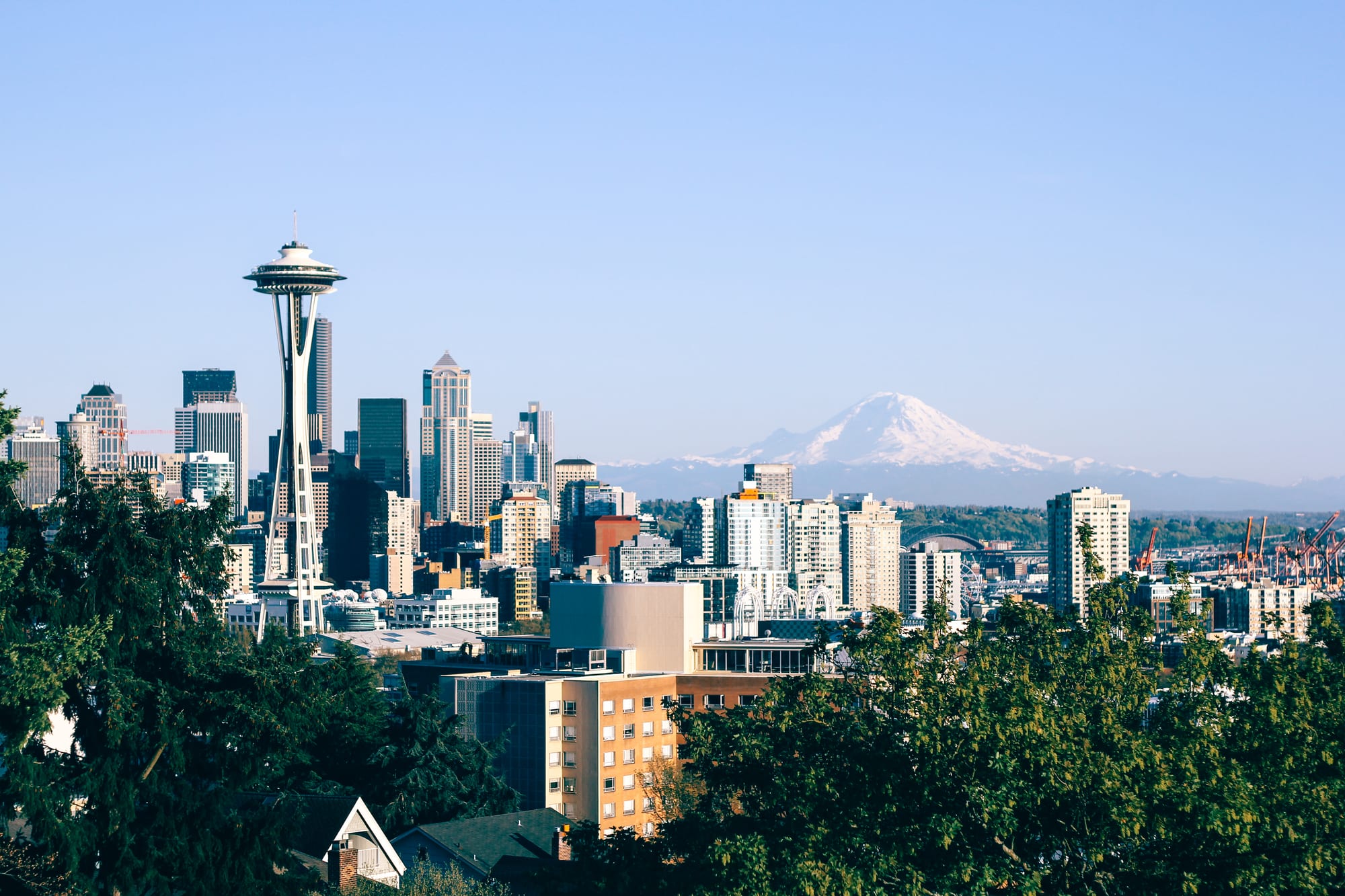
The Space Needle and the towers of downtown Seattle under a clear sky, with snow-covered Mount Rainier rising behind

The Pacific Northwest, United States

Seattle

The Space Needle, downtown Seattle and Mount Rainier seen from Kerry Park on Queen Anne Hill. (Sajad Mohamad / Wikimedia Commons · CC BY-SA 4.0)

Washington's largest city, built on hills between Puget Sound and Lake Washington and named after the Duwamish and Suquamish leader Chief Seattle. A logging town that boomed as the gateway to the Klondike, it grew on Boeing's aircraft and then on Microsoft, Amazon and other technology firms, and is known for Pike Place Market, the Space Needle, grunge, coffee and ferries across the Sound.

Neighbourhoods

  • Downtown and the waterfront
    • First-time visitors
    • Close to public transport
    • Shopping

    The towers, shops and hotels of the city centre, sloping steeply down to Elliott Bay. Pike Place Market sits on the bluff above the water, linked since 2024 by the Overlook Walk to a rebuilt waterfront of piers, the aquarium, the Great Wheel and the ferry terminal.

    Open in Maps
  • Pioneer Square
    • Historic district
    • Sport
    • Galleries

    Where the city was founded in 1852, rebuilt in brick and stone after the Great Fire of 1889. Its Romanesque Revival blocks hold galleries, bars and cafés, with Smith Tower, King Street Station and the stadiums at its edges.

    Open in Maps
  • Chinatown–International District
    • Best for food
    • Asian American heritage
    • Close to public transport

    The centre of Seattle's Asian American community, made up of Chinatown, Japantown and Little Saigon, just east of Pioneer Square. Restaurants, groceries and bakeries line its streets, and the Wing Luke Museum tells its history.

    Open in Maps
  • Belltown
    • Nightlife
    • Restaurants
    • Waterfront

    The most densely populated neighbourhood in the city, on land flattened by the regrading of Denny Hill. Once a low-rent arts district, it is now a place of restaurants, bars, clubs and apartment towers, with the Olympic Sculpture Park at its waterfront end.

    Open in Maps
  • Capitol Hill
    • Nightlife
    • Live music
    • LGBTQ culture

    A dense residential district on the hill immediately east of downtown, the centre of the city's LGBTQ life since the 1970s and one of its busiest areas for bars, music venues and restaurants, with Volunteer Park at its north end.

    Open in Maps
  • Queen Anne and Seattle Center
    • Sightseeing
    • Families
    • Views

    Seattle Center, the grounds of the 1962 World's Fair with the Space Needle and its museums, lies at the foot of Queen Anne Hill, whose residential streets climb to viewpoints such as Kerry Park.

    Open in Maps
  • Fremont
    • Quirky
    • Cafés and bars
    • Local life

    A former separate city on the north side of the ship canal, annexed in 1891, known for its eccentric public art, including a troll under a bridge, and for its casual bars and cafés.

    Open in Maps
  • Ballard
    • Breweries
    • Nordic heritage
    • Waterfront

    Another former city in the north-west, with the Ballard Locks, the National Nordic Museum, a marina and Golden Gardens Park; its brewery district has about a dozen breweries.

    Open in Maps

Things to do

Famous landmarks

  • Space Needlelandmark

    The 605-foot observation tower built for the 1962 World's Fair, with a deck 520 feet up looking over downtown, Elliott Bay, the Olympic and Cascade mountains and Mount Rainier.

    Open in Maps
  • Smith Towerlandmark

    A 38-storey skyscraper of 1914 in Pioneer Square, for years the tallest building west of the Mississippi.

    Open in Maps
  • Seattle Central Librarylandmark

    The glass-and-steel flagship library designed by Rem Koolhaas's office and opened in 2004, which drew more than two million visitors in its first year.

    Open in Maps
  • Kerry Parkviewpoint

    A small park on the south slope of Queen Anne Hill with the classic view of the skyline, the Space Needle, Elliott Bay and, on clear days, Mount Rainier.

    Open in Maps

Museums

  • Museum of Pop Culturemuseum

    A museum of contemporary popular culture at Seattle Center, founded in 2000 as the Experience Music Project, with exhibitions on music, science fiction and film.

    Open in Maps
  • Chihuly Garden and Glassmuseum

    An exhibition of Dale Chihuly's studio glass beside the Space Needle, opened in 2012, with a garden, a glasshouse and indoor galleries.

    Open in Maps
  • Seattle Art Museummuseum

    The city's main art museum downtown, which also runs the Seattle Asian Art Museum in Volunteer Park and the Olympic Sculpture Park.

    Open in Maps
  • Wing Luke Museummuseum

    A Smithsonian-affiliated museum of Asian Pacific American culture, art and history in the Chinatown–International District, founded in 1967.

    Open in Maps
  • Burke Museummuseum

    The University of Washington's natural history museum and Washington's official state museum, with more than 16 million objects.

    Open in Maps

The waterfront and the market

  • Pike Place Marketmarket

    A public market opened in 1907 on the bluff above Elliott Bay, the city's most popular attraction, with fishmongers, produce stands and craft stalls in its arcades and small shops on the levels below.

    Open in Maps
  • Seattle Aquariumattraction

    An aquarium on Piers 59 and 60, opened in 1977, with a third building, the Ocean Pavilion, added in 2024 for the reefs of the Coral Triangle.

    Open in Maps
  • Seattle Great Wheelattraction

    A 175-foot Ferris wheel on Pier 57, opened in 2012, with views over Elliott Bay.

    Open in Maps
  • Olympic Sculpture Parkpark

    A free outdoor sculpture park run by the art museum, opened in 2007 at the northern end of the central waterfront, with a small beach on Puget Sound.

    Open in Maps

Parks and the lakes

  • Discovery Parkpark

    The city's largest park, on the grounds of the old Fort Lawton in Magnolia, with forest, beaches, bluffs and the West Point lighthouse.

    Open in Maps
  • Gas Works Parkpark

    A park on the north shore of Lake Union built around the rusting towers of a former coal gasification plant, with views across the lake to downtown.

    Open in Maps
  • Ballard Locksattraction

    The Hiram M. Chittenden Locks on the ship canal, busier with boats than any other lock in the country, with a fish ladder and botanical gardens.

    Open in Maps
  • Volunteer Parkpark

    A 48-acre park at the top of Capitol Hill, home to the Seattle Asian Art Museum.

    Open in Maps
  • Fremont Trollattraction

    A large public sculpture of a troll crouching under the Aurora Bridge in Fremont, the best known of the neighbourhood's eccentric artworks.

    Open in Maps

Short trips from the city

  • Bainbridge Islandattraction

    An island city across Puget Sound reached by Washington State Ferries from downtown, a common way to ride the ferry across the Sound.

    Open in Maps
  • Museum of Flightmuseum

    One of the largest private air and space museums in the world, at Boeing Field in Tukwila, just south of the city.

    Open in Maps
  • Mount Rainier National Parkpark

    The national park around the 14,406-foot volcano about 59 miles south-south-east of Seattle, established in 1899, with glaciers, wildflower meadows and the Wonderland Trail.

    Open in Maps

Seasonal events

  • Northwest Folklife FestivalMemorial Day weekend, late May

    A free festival of folk, ethnic and traditional music, dance and crafts at Seattle Center, with thousands of performers.

  • SeafairJuly and August

    A summer of neighbourhood events leading up to the Torchlight Parade, the Seafair Cup hydroplane races on Lake Washington and an air show.

  • BumbershootLabor Day weekend, early September

    One of North America's largest music and arts festivals, held at Seattle Center.

Eat and drink

Long-standing places and food districts in Seattle. Hours, ratings and directions come from your maps app, always current.

Seattle classics

  • Pike Place Marketmarket

    Fish stalls, produce, bakeries and small restaurants above the bay; at one fish stall the staff famously throw whole salmon to each other across the counter.

    Open in Maps
  • The Pink Doorrestaurant

    An Italian restaurant founded in 1981 behind a nearly unmarked door on Post Alley in the market, with a deck over the bay and occasional live jazz.

    Open in Maps

Food districts

  • Chinatown–International Districtneighborhood

    Chinese, Japanese and Vietnamese restaurants, bakeries and groceries in the historic heart of the city's Asian American community.

    Open in Maps
  • Capitol Hillneighborhood

    Cafés, bars and some of the city's most fashionable restaurants, along with many Ethiopian and Thai places.

    Open in Maps

Coffee and beer

  • Ballard taproomsneighborhood

    Brewery tasting rooms, found especially around Ballard, selling beer by the glass, pint or growler.

    Open in Maps

Experience Seattle

History

The Duwamish had at least 17 villages around Elliott Bay when the first settlers arrived, and people had lived in the area for at least 4,000 years; the city's Lushootseed name, "little crossing-over place", comes from a village where King Street Station now stands. In 1851 a party of American pioneers claimed land at the mouth of the Duwamish River, and on 13 November that year the Denny Party landed at Alki Point in a rainstorm. In 1852 the settlement moved across the bay to what is now Pioneer Square and, at the urging of David "Doc" Maynard, was named after Chief Seattle of the Duwamish and Suquamish.

The Great Seattle Fire of 1889 destroyed the business district, which was rebuilt in brick and stone. In July 1897 a ship arrived with Klondike gold, and Seattle became the outfitting port for the rush, prospering by clothing and feeding the miners. Engineers then flattened whole hills in the regrades, and after the Jackson Regrade of 1907 a new Chinatown and a Japantown grew up in the area that became the Chinatown–International District.

Boeing's aircraft brought prosperity in the Second World War, and the 1962 World's Fair gave the city the Space Needle. A Boeing slump in the early 1970s was followed by revival as Microsoft moved to nearby Bellevue in 1979 and technology, biotechnology and internet firms followed; grunge took Seattle's sound around the world in the 1990s. Amazon's move to South Lake Union started a boom that made Seattle one of the fastest-growing large cities, and also one of the most expensive. Katie Wilson took office as mayor in January 2026, and Seattle was one of the host cities of the 2026 FIFA World Cup, with matches at Lumen Field.

Culture & Customs

Music is central to Seattle's image. Between 1918 and 1951 nearly two dozen jazz clubs lined Jackson Street from the Chinatown–International District to the Central District; Jimi Hendrix grew up here; and in the early 1990s Nirvana, Pearl Jam, Soundgarden and Alice in Chains made the city the home of grunge. The Museum of Pop Culture at Seattle Center keeps that history, and venues such as The Crocodile carry on the live scene. The city also has the Seattle Symphony, Seattle Opera and the Pacific Northwest Ballet, and around a hundred theatre companies.

Seattle is diverse and progressive. Asian Americans make up a large part of the population, the Chinatown–International District is a historic centre of Chinese, Japanese, Filipino and Vietnamese communities, and Ballard keeps its Nordic heritage in the National Nordic Museum. Capitol Hill has been the centre of LGBTQ life since the 1970s, and the city has one of the highest shares of LGBT residents among large American metropolitan areas. It is also one of the least religious: a large share of adults rarely or never attend services.

The calendar runs from Northwest Folklife over Memorial Day weekend through Seafair's hydroplane races and the Torchlight Parade to Bumbershoot on Labor Day weekend. Sport is followed keenly — the Seahawks and the Sounders share Lumen Field — and coffee is a local ritual, from long-established chains to independent espresso roasters.

Daily Life

About 785,000 people lived in the city in 2025, with over 4.15 million in the metropolitan area. The economy mixes older industries — the port, among the busiest for containers in North America, and Boeing's plants in the region — with Amazon, headquartered in South Lake Union and the Denny Triangle, Microsoft across the lake in Redmond, and a large biotechnology, retail and coffee sector. Seattle's minimum wage is among the highest in the country, at more than 20 dollars an hour in 2025.

Rapid growth has made housing the dominant local issue: by 2025 new apartments were the smallest on average in the country, tens of thousands of households spend more than half their income on housing, and homelessness is highly visible. Traffic is among the worst in the country at rush hour, and the Link light rail network, now 63 miles long, has become central to getting around.

Neighbourhoods each have their own character, from the apartment towers of Belltown and South Lake Union to the quieter residential streets of Fremont, Ballard and the hills. Life is lived outdoors in the dry summer — on the lakes, the Sound, the trails and the long evenings — and indoors in the grey months, in cafés, bars, bookshops and music venues.

Food

Seafood defines Seattle cooking. Salmon is the signature, abundant in late summer and especially prized as red or sockeye salmon, and the city has handled the Alaskan salmon trade since the gold-rush years. Dungeness crab, named after the Dungeness Spit on the Strait of Juan de Fuca, is valued for its sweet meat, and clams, mussels and oysters are easy to find; the giant geoduck clam turns up for the more adventurous. Pike Place Market, opened in 1907, remains the place to see it all, from fishmongers throwing salmon across the counter to farmers selling produce in the arcades.

The city's immigrant communities shape everyday eating. For decades the local comfort food has been teriyaki, a Japanese-inspired dish of grilled chicken in a sweet-savoury sauce over white rice, sold in small shops across the city. Thai restaurants are everywhere, Chinese food is found in most neighbourhoods, newer arrivals have added Vietnamese pho and Korean dishes, and Ethiopian restaurants cluster in the Central District and South Seattle.

Coffee and beer are the local drinks. The city's first coffeehouses opened in the late 1950s, and its coffee culture has its own slang: "drip" for filter coffee, a "doppio" for a double espresso. Washington is one of the world's largest hop-growing states, and from mid-September to mid-October many breweries make fresh-hop beers; brewery taprooms cluster especially around Ballard.

Planning tools

Budget

Seattle is one of the most expensive cities in the country. Hotels downtown are the biggest cost and rise sharply in the summer festival season and for big games and concerts; restaurant prices reflect the city's high minimum wage. Public transport, the market, the parks and the ferry ride as a foot passenger keep the cost of sightseeing down.

Daily Budget Midrange
USD 250–480 (mid-range hotel, restaurants with tips, a museum or the Space Needle, transit and the odd taxi)
Daily Budget Shoestring
USD 110–180 (hostel bed, market food, teriyaki and pho, light rail and buses)

Use the light rail from the airport instead of a taxi, and stay near a Link station to manage without a car.

Best Time to Visit

July to September is the dry, sunny season, with long daylight and the clearest views of the mountains — and the highest hotel prices. Autumn brings the fresh-hop beer season and late-summer salmon. From October to May skies are mostly grey with frequent light rain and short winter days, but temperatures stay mild and the museums, music venues and cafés come into their own.

Suggested Number of Days

Three or four days cover the centre and a few neighbourhoods. Allow five to seven to add ferry trips and the mountains. The weather matters: clear days are the ones worth keeping for views and time outdoors.

First Visit
3–4 days
With Surroundings
5–7 days

Transportation

Seattle has good public transport for an American city. Link light rail runs from the airport through downtown, Capitol Hill and the University District to the northern suburbs; King County Metro buses cover the rest of the city; two streetcar lines and the 1962 monorail from Westlake Center to Seattle Center fill gaps. Washington State Ferries cross the Sound from the downtown terminal. An ORCA card or the transit app works across most systems. Bike and scooter hire is by app; the hills are steep.

Buy a light rail ticket before boarding and keep it for the whole ride, as tickets are checked on the trains.

Airport & Station Connections

Seattle–Tacoma International Airport, a hub for Alaska Airlines and Delta with flights across North America and to Asia, Europe and the Middle East, is in the city of SeaTac about 14 miles south of downtown; the Link 1 Line runs from the airport to downtown and beyond. King Street Station in Pioneer Square has Amtrak's Cascades trains to Portland and Vancouver, the Coast Starlight to California and the Empire Builder to Chicago. Ferries and floatplanes link the city with the islands.

Walkability

Downtown, Pike Place Market, the waterfront, Belltown and Pioneer Square are close together and easy on foot, though the streets climbing from the water are very steep in places; the Overlook Walk and the market's stairs and lifts link the bluff and the shore. Capitol Hill, Seattle Center and the Chinatown–International District are a short ride or a longer walk away, and Fremont and Ballard are best reached by bus.

Safety

For most visitors the US is safe, with the main risks being petty theft and car break-ins in tourist areas of some cities, road accidents over long distances, extreme weather, and the hazards of the outdoors. In Seattle the usual problems are property crime and car break-ins, and visible homelessness in parts of downtown. The city lies in an earthquake zone, and summer wildfire smoke can affect air quality.

Leave nothing visible in a parked car, keep an eye on belongings on transit and in quiet downtown streets at night, and check air-quality alerts in late summer. Check current official travel advice before travelling.

Climate

A mild marine climate. The Seattle area is the cloudiest part of the continental United States, with frequent drizzle from autumn to spring, yet its total rainfall is lower than that of many eastern cities. Rain is rare from July to September. Extreme heat is uncommon, and very cold temperatures, below about 15°F, are rare.

Summer
dry and comfortable, with average summer highs of 79°F and lows of 59°F; in an average year the hottest day reaches about 94°F
Winter
mild, grey and damp, with short days and frequent light rain; temperatures below about 15°F are rare

Local Customs

Tipping of roughly 18–22 per cent in restaurants is expected, and sales tax is added at the till. Dress is casual and practical. Coffee culture has its own vocabulary — a "drip" is filter coffee. Recycling and composting are taken seriously. The city is named after a Duwamish and Suquamish leader, and Native history is part of its public identity.

The legal drinking age is 21, and identification is asked for when buying alcohol.

Common Payment Methods

The currency is the US dollar. Cards and contactless payment are accepted almost everywhere, and some businesses no longer take cash. ATMs are easy to find. Washington has no state income tax but a high sales tax, added to listed prices.