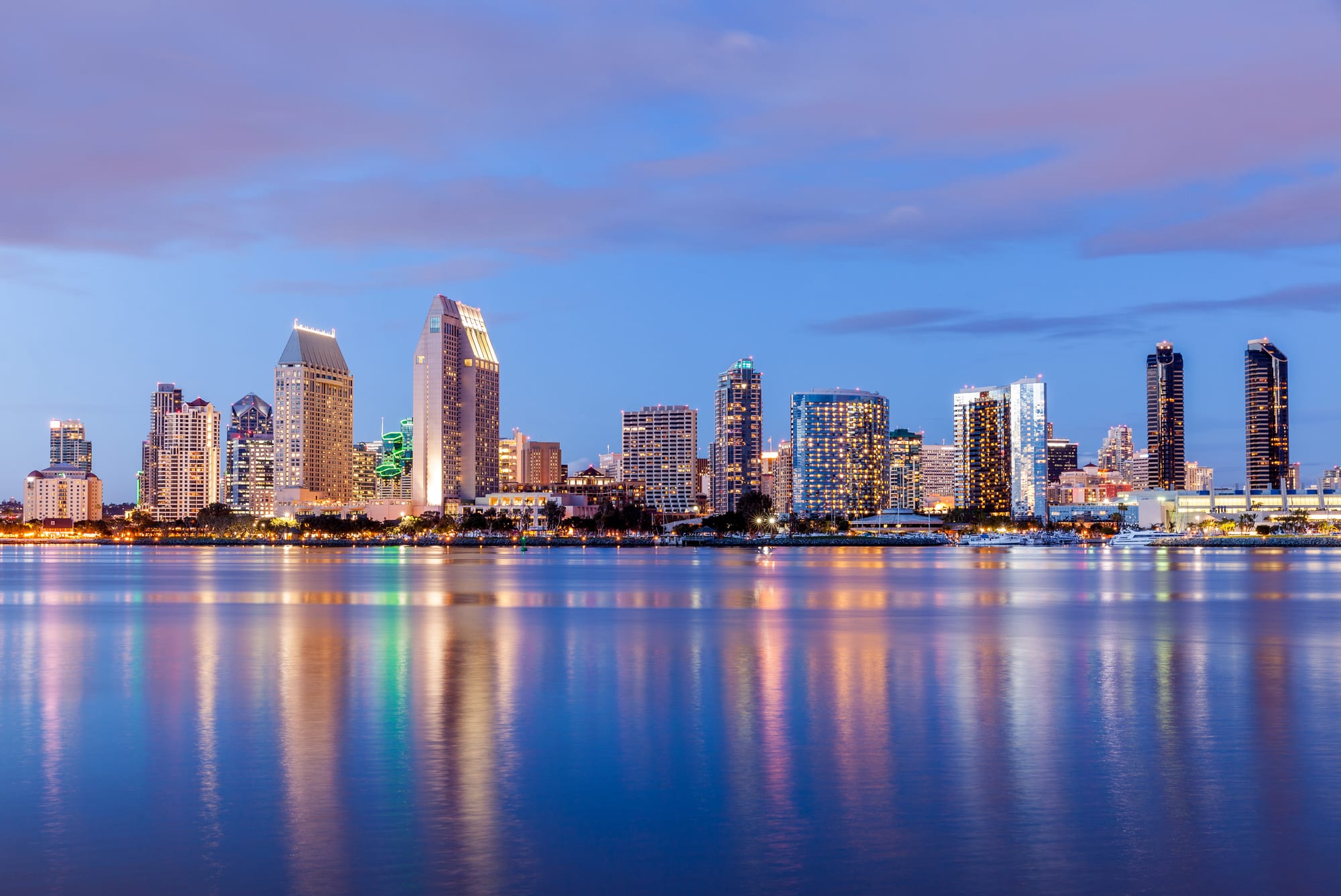
The lit towers of downtown San Diego at dusk, reflected in the calm water of San Diego Bay under a pink and blue sky

California, United States

San Diego

Downtown San Diego at dusk, seen across San Diego Bay from Coronado. (russellstreet / Wikimedia Commons · CC BY-SA 2.0)

California's second-largest city, on a deep natural harbour at the south-western corner of the United States, next to the Mexican border and Tijuana. The first European settlement in California, founded in 1769, grew into a great Navy town; today it is known for its mild climate, beaches, Balboa Park and its zoo, craft beer and biotechnology.

Neighbourhoods

  • Gaslamp Quarter and Downtown
    • First-time visitors
    • Nightlife
    • Close to public transport

    Downtown's historic core of Victorian commercial buildings, revived since the 1980s as a district of restaurants, bars and clubs, beside the convention centre, Petco Park and the bayfront. Trolley lines meet nearby at 12th & Imperial and at the Santa Fe Depot.

    Open in Maps
  • Little Italy
    • Best for food
    • Cafés and bars
    • Close to public transport

    The former home of Italian tuna fishermen on the northern edge of downtown, now a busy area of restaurants, cafés and flats a few blocks from the waterfront.

    Open in Maps
  • Old Town
    • Historic district
    • Families
    • Mexican food

    The site of the original settlement at the foot of Presidio Hill, where the state historic park preserves adobe and early American buildings among Mexican restaurants and shops; a transit centre links it with the trolley, the Coaster and Amtrak.

    Open in Maps
  • Hillcrest and North Park
    • Cafés and bars
    • Craft beer

    Older, dense neighbourhoods north of Balboa Park with craftsman houses, independent restaurants, breweries and bars.

    Open in Maps
  • Pacific Beach and Mission Beach
    • Beaches
    • Nightlife
    • Surfing

    Beach districts on a sandy strip between the ocean and Mission Bay, with a boardwalk, surf shops, bars and the Belmont Park amusement park.

    Open in Maps
  • La Jolla
    • Coastline
    • Quiet and residential
    • Snorkelling

    A seaside community in the north of the city, with sea cliffs, coves, the University of California San Diego and shops along its village streets.

    Open in Maps

Things to do

History and landmarks

  • Old Town San Diego State Historic Parklandmark

    Restored and reconstructed buildings from the Mexican and early American town, on the site where San Diego began.

    Open in Maps
  • Mission San Diego de Alcalálandmark

    The first Spanish mission in what is now California, founded in 1769 and moved up the San Diego River to its present site after a Kumeyaay revolt in 1775.

    Open in Maps
  • Cabrillo National Monumentlandmark

    A headland at the tip of Point Loma marking Juan Rodríguez Cabrillo's landing of 1542, with an old lighthouse and views over the harbour.

    Open in Maps
  • USS Midway Museummuseum

    The aircraft carrier Midway, moored at Navy Pier downtown as a museum with a large collection of aircraft, many built in Southern California.

    Open in Maps
  • Maritime Museum of San Diegomuseum

    Historic ships on the downtown waterfront, headed by the 19th-century sailing ship Star of India.

    Open in Maps

Balboa Park and the zoo

  • Balboa Parkpark

    A 1,200-acre park of gardens, museums and theatres, whose Spanish-style buildings were built for the expositions of 1915–16 and 1935–36.

    Open in Maps
  • San Diego Zooattraction

    The most visited zoo in the United States, in Balboa Park, a pioneer of open-air exhibits without cages.

    Open in Maps
  • San Diego Museum of Artmuseum

    The city's main art museum, in Balboa Park.

    Open in Maps
  • San Diego Air & Space Museummuseum

    A museum of aviation and spaceflight in Balboa Park.

    Open in Maps
  • Old Globe Theatreattraction

    The theatre in Balboa Park that produces about fifteen plays and musicals a year.

    Open in Maps

Beaches and the coast

  • La Jolla Covebeach

    A small sheltered cove below the cliffs of La Jolla, used by swimmers and snorkellers.

    Open in Maps
  • Torrey Pines State Natural Reservepark

    Cliff-top trails above the ocean through one of the few places where the rare Torrey pine grows.

    Open in Maps
  • Coronadobeach

    A separate city across the bay, reached by the San Diego–Coronado Bridge, with a wide sandy beach and views back to the downtown skyline.

    Open in Maps
  • Mission Baypark

    A large aquatic park of calm water, beaches and lawns, used for sailing, kayaking and cycling.

    Open in Maps

Sport and nights out

  • Petco Parkattraction

    The downtown ballpark of the San Diego Padres, opened in 2004 beside the Gaslamp Quarter.

    Open in Maps

Short trips from the city

  • San Diego Zoo Safari Parkpark

    A large wildlife park run by the zoo's parent organisation, with herds of animals in open, field-like enclosures, in the San Pasqual Valley, in the northern part of the city.

    Open in Maps
  • Legoland Californiaattraction

    A Lego-themed theme park in Carlsbad, up the coast in northern San Diego County.

    Open in Maps

Seasonal events

  • San Diego Comic-Consummer

    Called by Forbes the largest convention of its kind in the world, filling the convention centre with more than 130,000 fans of comics, film and pop culture.

  • San Diego Beer WeekNovember

    A week of events celebrating the city's many craft breweries.

  • Grey whale migrationwinter, December to March

    Migrating grey whales can be seen off the coast from the Whale Overlook at Cabrillo National Monument, opened in 1950 as the world's first public whale-watching lookout.

Eat and drink

Long-standing places and food districts in San Diego. Hours, ratings and directions come from your maps app, always current.

San Diego classics

  • Fish tacosrestaurant

    Grilled or fried fish in a tortilla with cabbage and a creamy sauce, a dish that originated in Baja California across the border.

    Open in Maps
  • California burritorestaurant

    A staple of San Diego's local food: carne asada and French fries wrapped in a flour tortilla, sold at the city's many taco shops.

    Open in Maps

Food districts and breweries

  • Little Italyneighborhood

    Italian and other restaurants and cafés in the old fishermen's quarter.

    Open in Maps
  • Old Townneighborhood

    Mexican restaurants with patios around the historic park.

    Open in Maps
  • North Park breweriesneighborhood

    Craft breweries, taprooms and bars in one of the city's liveliest neighbourhoods.

    Open in Maps

Experience San Diego

History

The Kumeyaay lived around San Diego Bay for centuries before Europeans arrived; their village of Kosa'aay stood where Old Town is today. Juan Rodríguez Cabrillo claimed the bay for Spain in 1542, and in 1602 Sebastián Vizcaíno named it after the Spanish saint Didacus, San Diego de Alcalá. In 1769 Gaspar de Portolà established the Presidio on a hill above the San Diego River and the Franciscans founded the mission — the first European settlement in what is now California, which is why San Diego calls itself the Birthplace of California. The Kumeyaay revolted in 1775, and the mission moved six miles up the river.

Under Mexico the town grew up below Presidio Hill, but it shrank in the 1830s amid conflict with the Kumeyaay. After the Mexican–American War the border was drawn just south of the bay. In 1850 William Heath Davis began a 'New San Diego' on the waterfront, but it grew slowly; in the late 1860s Alonzo Horton promoted a bayside 'New Town', which soon eclipsed the original settlement, known to this day as Old Town. In 1916 the Stingaree district, home to the first Chinatown, was cleared to make way for what became the Gaslamp Quarter.

The Panama–California Exposition of 1915–16 left Balboa Park many of its Spanish-style buildings and the animals that started the zoo. The Navy arrived in 1901 and grew enormously; by the Second World War San Diego was a major military and defence-manufacturing centre, and the tuna fleet, crewed by immigrant fishermen from Japan, the Azores and Italy, supplied the city's canneries. Defence cuts after the Cold War hit hard, but downtown revived from the 1980s with the Gaslamp Quarter, the convention centre and, in 2004, Petco Park, while biotechnology and Qualcomm reshaped the economy.

Culture & Customs

San Diego's identity is tied to the ocean, the military and the border. The Navy and Marine Corps have been part of the city for more than a century, and many of the Pacific Fleet's ships are based in the bay. The city shares a 15-mile border with Mexico, and the San Diego–Tijuana region is one of the largest cross-border metropolitan areas in the Western Hemisphere; Spanish is heard everywhere, and Mexican culture shapes food, music and festivals.

Balboa Park is the cultural heart of the city, with the San Diego Museum of Art, the Natural History Museum, the Museum of Us, the Air & Space Museum and the Old Globe Theatre, which stages about fifteen productions a year. Each summer Comic-Con fills the convention centre with more than 130,000 fans, and the city's craft breweries, which have earned it the nickname 'America's Craft Beer Capital', are celebrated each November in San Diego Beer Week.

Surfing and beach life are central to local culture, from Pacific Beach to La Jolla. Sport means the Padres baseball team at Petco Park, San Diego FC in Major League Soccer and San Diego Wave FC in the women's league.

Daily Life

More than 1.4 million people live in the city, and the San Diego area has more than 3.3 million residents. The city sprawls over mesas and canyons from the border to the north county, with San Ysidro and Otay Mesa cut off from the rest of the city by Chula Vista and National City.

The largest parts of the economy are the military and defence, tourism, international trade and research. San Diego hosts one of the largest naval fleets in the world, and about one in twenty civilian jobs in the county is military-related. The University of California San Diego and research institutes in La Jolla and Sorrento Valley have built one of the country's largest biotechnology clusters, and Qualcomm, founded here, is one of the city's largest private employers. Cross-border trade passes through the commercial crossing at Otay Mesa.

Housing is very expensive, and homelessness is a visible problem, though reports in 2023 noted a decline in the downtown core. Life is outdoors much of the year — surfing before work, walks on the beaches and bay paths, and weekends in Balboa Park — and wildfire in the chaparral of the inland hills is a recurring threat in dry, windy weather.

Food

San Diego's food is shaped by the border. Fish tacos, which originated in Baja California — grilled or fried fish in a tortilla with cabbage and a creamy sauce — are sold across the city, and the California burrito, carne asada and French fries wrapped in a flour tortilla, is a staple of the local taco shops. Mixing French fries with traditional burrito fillings, it is an example of fusion border food. Old Town has Mexican restaurants around its historic park.

The fishing fleets that once filled the bay left their mark too: Little Italy, built by Italian tuna fishermen, is now one of the city's main restaurant districts, and seafood is plentiful along the waterfront. Point Loma kept the Portuguese heritage of the Azorean fishing families.

Craft beer is San Diego's other claim to fame. The region has a very large number of breweries, many of them in North Park, and beer tours draw visitors from around the country.

Planning tools

Budget

San Diego is expensive. Hotels downtown and at the beaches cost most in summer and during big conventions such as Comic-Con, when rooms are scarce. Food can be cheap at taco shops, and the trolley and buses cover many of the main sights.

Daily Budget Midrange
USD 250–450 (mid-range hotel, restaurants with tax and tips, zoo or museum tickets, a hire car or ride-hailing)
Daily Budget Shoestring
USD 100–170 (hostel bed, taco shops, trolley and buses)

Book well ahead for Comic-Con week; Balboa Park's gardens and grounds, the beaches and the coastal trails are free.

Best Time to Visit

The climate is mild all year, with about 200 days above 70°F. The months from May to September are almost completely dry, though May and June often bring a thick, grey marine-layer cloud along the coast. Winter is mild, with most of the year's little rain falling between December and March, and is the season for grey whale watching.

Suggested Number of Days

Three or four days suit a first visit to the city and its beaches. Five or six allow time for the north county coast and the inland hills as well. Families visiting the large animal parks and theme parks usually need more time.

First Visit
3–4 days
With Surroundings
5–6 days

Transportation

The San Diego Trolley light rail serves downtown, Old Town, Mission Valley, the east county and the south bay to the border at San Ysidro, and since 2021 runs north from Old Town to the University of California San Diego. MTS buses and Rapid bus services cover the rest, and the Coaster and Amtrak's Pacific Surfliner run up the coast. The beaches and La Jolla are easier by car.

Use the trolley for downtown, Old Town and the border, and a car or ride-hailing for La Jolla and the beaches.

Airport & Station Connections

San Diego International Airport, a hub for Alaska Airlines and the busiest single-runway airport in the United States, is about 3 miles north-west of downtown, and planes land low over the city. Amtrak's Pacific Surfliner connects the Santa Fe Depot and Old Town with Los Angeles. The San Ysidro Port of Entry, at the southern end of the city, is the busiest land border crossing outside Asia.

Walkability

Downtown, the Gaslamp Quarter, Little Italy and the bayfront are all walkable, and Balboa Park is a pleasant walk or short ride from downtown. Old Town and the beach neighbourhoods are good on foot once reached, but the city is spread out over hills and canyons, so moving between areas needs transit or a car.

Safety

For most visitors the US is safe, with the main risks being petty theft and car break-ins in tourist areas of some cities, road accidents over long distances, extreme weather, and the hazards of the outdoors. Homelessness is visible downtown, though reports in 2023 noted a decline in the urban core. The main natural hazard is wildfire in the chaparral of the hills in dry, windy weather, alongside the usual risks of the sea and cliffs along the coast.

Leave nothing visible in a parked car, swim at lifeguarded beaches, keep back from cliff edges, and check the rules before any trip across the border. Check current official travel advice before travelling.

Climate

A mild, dry Mediterranean climate moderated by the ocean, with only 9–13 inches of rain a year, falling mostly from December to March. A cool, damp marine layer often covers the coast in late spring and early summer, while areas a few miles inland are sunny and noticeably hotter.

Summer
warm and almost rainless — downtown averages August highs of about 78°F, while El Cajon, 12 miles inland, averages about 88°F
Winter
mild — downtown averages January lows of about 50°F, and February is the only month averaging 2 inches of rain or more

Local Customs

Tipping is expected, at roughly 18–22 per cent in restaurants and about a dollar a drink at a bar. Dress is casual, and beachwear is normal near the shore but not in restaurants away from it. The city is closely tied to the Navy and Marines, and service members are a familiar part of daily life. Spanish is widely spoken.

Identification is asked for when buying alcohol (the legal age is 21). Keep back from wildlife on the beaches and rocks.

Common Payment Methods

The currency is the US dollar. Cards and contactless payment are accepted almost everywhere; taco shops and market stalls sometimes prefer cash. ATMs are easy to find. Prices are shown without sales tax, which is added at the till.