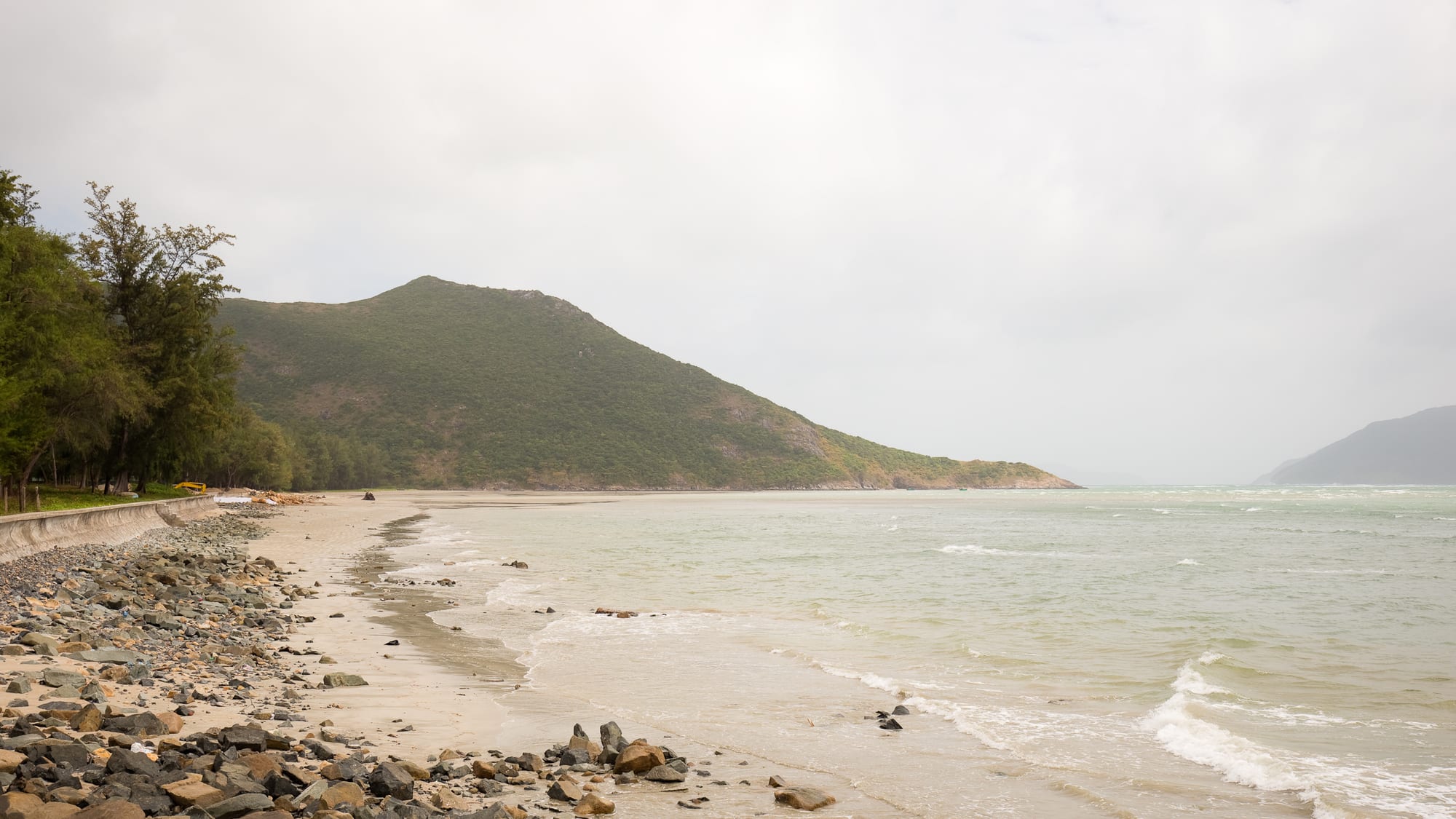
A curving grey-sand beach backed by casuarina trees, with a steep forested headland running out into a pale green sea

Ho Chi Minh City, Da Lat & the Southeast, Vietnam

Con Dao

A beach on Côn Sơn, the largest island of the Côn Đảo archipelago. (Tycho / Wikimedia Commons · CC BY-SA 3.0)

An archipelago of sixteen islands in the South China Sea, well off the southern coast of Vietnam, with one small town on the largest island, Côn Sơn. For more than a century the islands held a penal colony, first French and then South Vietnamese, whose buildings still stand; today most of the land and sea around them is national park, with quiet beaches, forest and nesting turtles.

Neighbourhoods

  • Côn Sơn town
    • First-time visitors
    • Historic district
    • Close to the sea

    The only settlement of any size, laid out by the French along a seafront road with low colonial buildings, a pier and a wide bay. Almost every guesthouse, restaurant and office is here, and the prison sites and the cemetery are within walking or cycling distance.

    Open in Maps
  • The west and south coast
    • Beaches
    • Quiet and residential
    • Resorts

    The road south from town runs past An Hải and Lò Vôi bays towards the cliffs above Bãi Nhát, with a handful of resorts and long stretches of empty shore. There is little here beyond the beaches and the sea.

    Open in Maps
  • Cỏ Ống and the north
    • Beaches
    • Close to the airport
    • Walks

    The northern end of Côn Sơn island, a short drive up the coast from town, where the airport sits beside a small village. Forest tracks and a few of the island's best-known beaches lie nearby, and boats to the outer islands leave from this side.

    Open in Maps

Things to do

The penal colony

  • Côn Đảo Prisonlandmark

    The preserved prison compounds in and beside the town, built by the French from 1861 and used until 1975, including the roofless stone cells known as the tiger cages.

    Open in Maps
  • Hàng Dương Cemeterylandmark

    The burial ground on the edge of town where thousands of prisoners lie, among them Võ Thị Sáu, whose grave draws visitors late into the night.

    Open in Maps

The national park and the sea

  • Côn Đảo National Parkpark

    A park covering most of the islands' forest and a large area of sea, protected since 1984, with coral reefs, seagrass beds, dugongs and beaches where green and hawksbill turtles nest.

    Open in Maps
  • Hòn Bảy Cạnhbeach

    The second-largest island of the group at about 5.5 square kilometres, reached by boat from Côn Sơn, with mangroves, a lighthouse on its high point and beaches used by nesting turtles.

    Open in Maps

Beaches and viewpoints

  • Bãi Đầm Trầubeach

    A sandy bay on the north coast below the airport approach, backed by forest and rocks, and the beach most visitors on Côn Sơn head for.

    Open in Maps
  • Bãi Nhát and the Con Ngua passviewpoint

    A short beach beneath the cliffs on the south-west coast, with a road above it that gives the island's widest view of the sea and the outlying islets.

    Open in Maps
  • Vân Sơn pagodalandmark

    A small hillside temple above the town, reached by a flight of steps, with a view over the bay and the roofs of Côn Sơn.

    Open in Maps

Town sights

  • Côn Đảo Airporttransit hub

    The small airport at Cỏ Ống in the north of the island, with a single 1,830-metre runway, flights to the mainland and a road to town along the coast.

    Open in Maps

Seasonal events

  • Turtle nesting seasonroughly May to October

    Green turtles come ashore to lay eggs on the park's beaches, and rangers release hatchlings; numbers of visitors to the nesting beaches are limited.

  • Reunification holidaylate April and early May

    The national holiday at the end of April, which on the islands also marks the freeing of the last prisoners in 1975, with ceremonies at the prison sites and the cemetery.

  • Vu Lan, the ghost festivalseventh lunar month, usually August

    Offerings and incense at Hàng Dương cemetery and the island's temples, when many mainland visitors come to honour the dead.

Eat and drink

Long-standing places and food districts in Con Dao. Hours, ratings and directions come from your maps app, always current.

Con Dao classics

  • Côn Sơn marketmarket

    The small morning market in the middle of town, where the island's fish, vegetables brought from the mainland and cheap noodle stalls are found.

    Open in Maps
  • Seafood along Nguyễn Đức Thuậnneighborhood

    The seafront road holds most of the island's restaurants, grilling fish, squid and shellfish landed the same day.

    Open in Maps

Local specialities

  • Mứt hạt bàngmarket

    Roasted or candied seeds of the sea almond trees that line the town's streets, sold salted or sweet and the island's usual gift to take home.

    Open in Maps
  • Ốc vú nàngrestaurant

    A limpet gathered on the rocks around the islands, usually grilled or dressed as a salad, and the dish most associated with Côn Đảo.

    Open in Maps

Experience Con Dao

History

The archipelago appears on old European charts as Pulo Condore, a landmark for ships crossing the South China Sea, and the English East India Company held a short-lived post on Côn Sơn in the early 18th century before it was destroyed. Vietnamese fishermen used the islands seasonally, and Nguyễn Ánh, later the emperor Gia Long, promised them to France in the Treaty of Versailles of 1787 in return for military help.

France took the islands by conquest in 1861 and began building a penal colony there the same year, using the islands' isolation as the wall. Over the following century Côn Đảo held political prisoners of every generation of Vietnamese resistance: anti-colonial scholars, the founders of the communist movement, and later opponents of the Republic of Vietnam, which kept the prisons in use after 1954 and ran them with American support. The stone compounds, the forced labour in the quarries and coral pits, and the open-topped cells known as the tiger cages, exposed to the public in 1970, made the name notorious. Thousands died and were buried at Hàng Dương.

The last prisoners were freed at the very end of the war in 1975. The prison buildings, the cemetery and the French administrative quarter were preserved as a national monument, and from 1984 the forest and the surrounding sea were given protected status as a national park. Tourism arrived slowly, held back by the difficulty of getting there, and grew after the airport was upgraded and fast ferries began running. In the 2025 administrative reform the district, formerly part of Bà Rịa–Vũng Tàu province, became Ho Chi Minh City's only special zone.

Culture & Customs

Côn Đảo is unusual among Vietnamese destinations in being a place of pilgrimage before it is a place of holidays. A large share of its visitors are Vietnamese who come to burn incense at the prison sites and at Hàng Dương cemetery, and above all at the grave of Võ Thị Sáu, a teenage fighter executed on the island in 1952 and widely regarded as a protective spirit. Offerings of flowers, mirrors, combs and fruit are left at her grave, and the cemetery is busiest around midnight, when families queue to pray.

Temples on the island reflect the same mixture of memorial and folk religion. The hillside pagoda above the town and the shrine at Hàng Keo draw offerings from islanders and visitors alike, and the sea itself is honoured in the whale worship common along the southern Vietnamese coast, where a stranded whale is buried with ceremony.

The resident community is small and much of it has arrived within living memory, from the mainland, to work in the park, in the district administration or in tourism. Life is correspondingly informal: people know one another, doors are left open, and the pace is slow. Islanders are protective of the national park's rules and of the dignity of the prison sites, and the standard courtesies of Vietnam apply — modest dress at temples and graves, shoes removed indoors, and two hands used when giving or receiving something.

Daily Life

About 5,000 people live on Côn Sơn, almost all of them in and around the one town; the other fifteen islands are uninhabited apart from park rangers and lighthouse keepers. The population rises and falls with the flights and ferries, and schools, the hospital and the administration are all sized for a small district rather than a resort.

Work comes from three sources: the national park and the historic sites, tourism and its hotels, restaurants and boats, and fishing. Almost everything else is imported by sea, which keeps prices high, and electricity and fresh water have long been constraints on how much the island can grow. Building has accelerated in the last decade, and how many rooms the island can absorb without damaging the reefs and the quiet is the subject of continuous local argument.

The day starts early, with the market busy before seven and fishing boats coming in to the pier. The middle of the day is hot and empty; the seafront fills again in the late afternoon as families swim, children play football on the sand, and restaurants set out tables. Evenings are quiet, and much of the town's late activity is at the cemetery rather than in bars.

Food

The islands eat what the boats bring in. Grilled fish, squid, prawns and crab are the staples of the seafront restaurants, usually cooked simply with salt, chilli and lime, and served with rice and herbs in the southern manner. The speciality most associated with Côn Đảo is ốc vú nàng, a conical limpet prised off the rocks and grilled or dressed as a salad with herbs and roasted peanuts; mắm nhum, a paste made from sea urchin, is another island product, made in small quantities.

Ordinary Vietnamese food is easy to find in town: bún, phở and bánh mì in the mornings, cơm tấm and rice-and-dish plates at lunchtime, and hotpots in the evening. Vegetables and most fruit arrive from the mainland, so menus are shorter and a little dearer than in the delta, and seafood is the sensible thing to order.

The island's own snack is hạt bàng, the seed of the sea almond trees planted along the streets by the French. The fruit is gathered, dried, cracked by hand and the kernels roasted with salt or sugar; bags of them are sold in the market and at the airport and are the usual present to bring back. Rượu, rice spirit, is drunk with dinner, and coffee is taken the southern way, strong and iced with condensed milk.

Planning tools

Budget

Côn Đảo is more expensive than the mainland. Almost everything, from vegetables to building materials, arrives by boat or plane, flights are dearer than the distance suggests, and the island has a number of high-end resorts alongside its guesthouses. Food in town remains reasonable, and the national park charges only modest fees.

Daily Budget Midrange
USD 70–150 (hotel or small resort, seafood dinners, a boat trip to the outer islands, a guide at the prison sites)
Daily Budget Shoestring
USD 30–50 (guesthouse, market and street food, a hired motorbike or bicycle)

Hire a bicycle or motorbike for the day; the island has no public transport and distances between the town, the airport and the beaches are short but hot on foot.

Best Time to Visit

March to September has the calmest seas on the southern and eastern beaches and the clearest water for snorkelling and diving, and overlaps the turtle nesting season. From October to February the north-east monsoon brings wind and choppy crossings, and ferries are more often cancelled, though the islands stay warm and the forest is green.

Suggested Number of Days

Two or three days covers the prison sites, the museum, the cemetery and a couple of beaches. Add a day or two for a boat trip to the outer islands, for diving, or simply because the weather can hold boats in port.

First Visit
2–3 days
With Surroundings
4–5 days

Transportation

There is no bus service. Visitors get around by hired motorbike, bicycle, electric buggy or taxi; the coast road between the town, the airport at Cỏ Ống and the southern beaches is quiet and well surfaced. Boats to the smaller islands are arranged through the national park office or through hotels, and depend on the sea state.

Fuel is sold at a small number of stations on the island, so fill up in town before a long ride, and carry a helmet and a light waterproof.

Airport & Station Connections

Côn Đảo Airport, at Cỏ Ống in the north of the main island, takes flights from Ho Chi Minh City and other mainland points, flown by VASCO, Bamboo Airways and a helicopter operator; the runway is 1,830 metres, so the aircraft are small and seats are limited. A ferry crosses overnight from Vũng Tàu, bringing most of the islands' goods as well as passengers, and a faster service from Trần Đề — the delta port that has belonged to Cần Thơ since the 2025 merger — takes about three hours. There is no road connection of any kind.

Walkability

Côn Sơn town is flat, small and easy on foot: the seafront, the market, the museum, the main prison compounds and the cemetery are all within a couple of kilometres of one another. Anything beyond the town — the airport, the northern beaches, the southern headlands — needs wheels, and the heat makes even short midday walks hard work.

Safety

Côn Đảo is a quiet place with very little crime. The real hazards are the sea and the road: currents and jellyfish on some beaches, crossings that can turn rough, steep and slippery forest paths in the national park, and a coast road with blind bends where motorbike accidents are the most common cause of injury to visitors.

Ride a motorbike only if experienced and licensed, and always with a helmet; hold bags away from the road; drink bottled or filtered water; and check surf conditions before swimming. Check current official travel advice before travelling.

Climate

Tropical and warm all year, generally 25–33°C, with high humidity. The south-west monsoon brings rain from about June to September and the north-east monsoon brings wind and rougher seas from about October to February; the islands are drier and sunnier than the delta.

Summer
hot and humid, 26–33°C, with heavy showers and calm seas on the east and south coasts
Winter
warm and mostly dry, 24–30°C, but windy, with choppy crossings from the mainland

Local Customs

The prison sites and Hàng Dương cemetery are places of mourning as well as history: many Vietnamese visitors come specifically to pay respects, often after dark at Võ Thị Sáu's grave. Dress modestly at the cemetery and in temples, keep voices low, and do not step over graves or offerings. Photography is accepted at the prison museums but taking playful pictures there is resented.

Tipping is not expected, though guides and boat crews appreciate it; shoes come off before entering a temple, and coral, shells and turtle products must not be taken away.

Common Payment Methods

The currency is the Vietnamese đồng. Cash is needed for market stalls, small restaurants, motorbike hire and park fees; hotels, resorts and some restaurants take cards, and QR-code payment is common. There are only a few ATMs, all in the town, so it is worth arriving with enough cash.