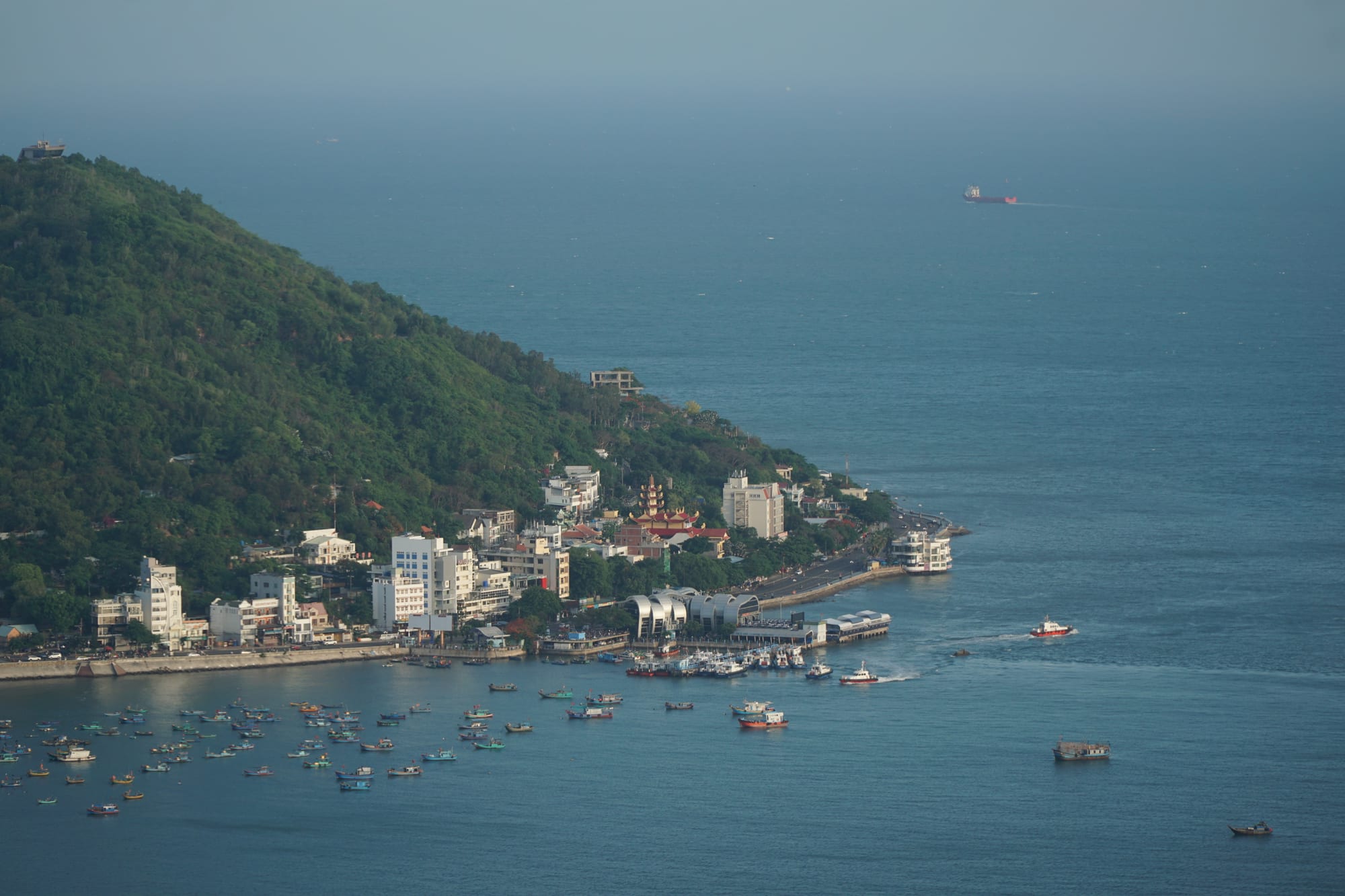
A wooded headland above a curving seafront of white buildings, with dozens of small fishing boats moored in blue water below

Ho Chi Minh City, Da Lat & the Southeast, Vietnam

Vung Tau

The Front Beach and harbour of Vũng Tàu seen from the Big Mountain. (NDTK08 / Wikimedia Commons · CC BY 4.0)

A seaside city on a hooked headland at the mouth of the Saigon River approaches, about two hours from central Ho Chi Minh City, into which the whole province was absorbed in 2025. The French built a resort here called Cap Saint-Jacques; offshore oil later made it prosperous. Two hills, a hilltop statue of Christ, lighthouses and long beaches give it the character of a weekend city for the south.

Neighbourhoods

  • Bãi Trước, the Front Beach
    • First-time visitors
    • Seafront walks
    • Close to transport

    The city's original waterfront, a crescent facing west towards the river mouth, with a park along the promenade, a pier, hotels and the oldest streets behind. The water here is a working anchorage rather than a swimming beach.

    Open in Maps
  • Bãi Sau, the Back Beach
    • Beaches
    • Families
    • Nightlife

    The long open beach on the eastern, seaward side of the headland, several kilometres of sand backed by hotels, seafood restaurants and the busiest holiday strip. This is where weekend crowds from Ho Chi Minh City go.

    Open in Maps
  • Núi Nhỏ, the Small Mountain
    • Views
    • Historic district

    The southern hill, with the statue of Christ on its crest, a lighthouse on a shoulder above the harbour, colonial villas on the slopes and steep lanes between them. Paths and roads climb from both beaches.

    Open in Maps
  • Núi Lớn, the Big Mountain
    • Quiet and residential
    • Walks
    • Temples

    The larger northern hill, wooded and much less built up, with temples and a Buddhist complex on its flanks, a cable car from the bottom and viewpoints over the harbour and the plain.

    Open in Maps

Things to do

Hills and landmarks

  • Christ of Vũng Tàulandmark

    A statue of Christ with arms outstretched 18 metres, 32 metres tall on a 4-metre platform, standing on the Small Mountain; it was begun in 1974 and finished in 1994, a staircase of 133 steps runs up inside it, and it is the largest Christian statue in Asia.

    Open in Maps
  • Thích Ca Phật Đàilandmark

    A terraced Theravada Buddhist complex on the slope of the Big Mountain, built between 1961 and 1963 around a large white seated Buddha and a 19-metre octagonal stupa, with sculptures along the path illustrating the Buddha's life.

    Open in Maps
  • Bạch Dinhlandmark

    A white European-style villa of the late 19th century on the slope of the Big Mountain, built as a retreat for the Governor-General of Indochina and later used by Emperor Bảo Đại; the deposed king Thành Thái was held here from 1907 to 1916.

    Open in Maps
  • Vũng Tàu lighthouseviewpoint

    A white cylindrical tower 18 metres high on the Small Mountain, first built by the French in 1862 and rebuilt higher in 1913, one of the oldest lighthouses in Vietnam and a viewpoint over the whole headland.

    Open in Maps
  • Nghinh Phong capeviewpoint

    The rocky southern tip of the headland, which the French called Cap Saint-Jacques, and the southernmost point of mainland Ho Chi Minh City.

    Open in Maps
  • Hòn Bàattraction

    A rocky islet off the southern tip of the headland with a small shrine on top, reached on foot along a stone causeway that surfaces at low tide.

    Open in Maps

Beaches

  • Back Beachbeach

    The main swimming beach on the seaward side of the city, a straight stretch of several kilometres with lifeguard stations, deckchairs and a long line of restaurants behind it.

    Open in Maps
  • Bãi Dứabeach

    A small rocky cove on the road that rounds the Small Mountain between the two main beaches, with views from the cliffs above rather than much sand.

    Open in Maps

Short trips from the city

  • Long Sơnattraction

    An island of mangroves, oyster farms and floating seafood restaurants north of the city, known for the compound and unusual religious community of the Ông Trần house.

    Open in Maps
  • Long Hảibeach

    A fishing and beach town up the coast, quieter than the city, with a long sandy shore and hills of forest behind.

    Open in Maps
  • Núi Đấtattraction

    A low hill inland that was the main Australian and New Zealand base during the war, near the Long Tân cross that marks a 1966 battle.

    Open in Maps

Seasonal events

  • Nghinh Ông whale festivaleighth lunar month, usually September

    The fishing community's festival, in which the whale god is carried in procession from the sea to the Thắng Tam temple, where the whale bones are kept, with decorated boats and ceremonies over several days.

  • Tếtlate January or February

    The lunar new year, when the beaches and hotels fill with families from Ho Chi Minh City and the seafront is decorated with flowers.

  • Summer weekendsMay to August

    The domestic holiday season, when the Back Beach is at its busiest and the roads from the city are heavy on Friday evening and Sunday afternoon.

Eat and drink

Long-standing places and food districts in Vung Tau. Hours, ratings and directions come from your maps app, always current.

Vung Tau classics

  • Bánh khọt housesneighborhood

    The city's signature dish — small crisp rice-flour cakes cooked in a dimpled pan, each topped with a prawn and eaten wrapped in lettuce and herbs with fish sauce.

    Open in Maps
  • Seafood restaurants on the Back Beachneighborhood

    A long row of open-fronted places where crab, squid, mantis shrimp, clams and scallops are chosen from tanks and grilled or steamed.

    Open in Maps
  • Lẩu cá đuối stallsneighborhood

    Stingray hotpot with sour bamboo shoots, a local speciality eaten in groups, sold in small restaurants around the centre.

    Open in Maps

Markets and the waterfront

  • Vung Tau marketmarket

    The central market, with a wet-fish hall, dried squid, fish sauce and cooked-food stalls, busiest early in the morning.

    Open in Maps
  • Front Beach promenade caféscafe

    Cafés and juice stalls along the park facing the anchorage, where the city gathers in the late afternoon to watch the boats and the sunset.

    Open in Maps

Experience Vung Tau

History

The headland has guarded the approaches to Saigon for as long as ships have used them. Vietnamese fishing families settled the bays, and the Nguyễn emperors posted soldiers here against pirates, giving the place one of its early names. Portuguese sailors knew the cape as Cape Saint Jacques, and the French, who seized the approaches in 1859, kept the name as Cap Saint-Jacques and made the headland the outer defence of their new colony, building coastal batteries on both hills and the lighthouse on the Small Mountain in 1862.

By the end of the 19th century it had become a seaside resort. Governors built villas on the slopes, including the white Villa Blanche, known as Bạch Dinh, on the slope of the Big Mountain, and Saigon society came down for the sea air. During the war the area served as a logistics base and rest centre, and the Australian and New Zealand forces in the province were based at Núi Đất inland, with a supply base at the city itself.

After 1975 the character of the place changed again. Oil and gas were found offshore in the Cửu Long and Nam Côn Sơn basins, and from the 1980s the city became the onshore base of the industry, with Soviet-Vietnamese and later international companies, helicopters, supply vessels and a foreign workforce. Oil money and weekend tourism from Ho Chi Minh City have driven its growth since, and in 2025 the province of Bà Rịa–Vũng Tàu was merged into an enlarged Ho Chi Minh City, the old city becoming one of its wards.

Culture & Customs

Vung Tau is a holiday town for southerners first of all, and its culture reflects that: seafood restaurants, promenades, kite-flying on the beach in the windy months and families camped on the sand in the late afternoon. It has none of the package-resort feel of the coast further north, and most of the crowds are Vietnamese.

Religion is unusually visible for a beach city. The Christ statue on the southern hill, the Buddhist complex on the northern one, a large Catholic community with churches near both beaches and Chinese temples in the older streets all sit within a short distance of each other. The fishing community keeps the whale cult of the southern coast, honouring whales that come ashore; their bones are preserved at the Thắng Tam temple, and the Nghinh Ông festival takes the community out to sea in procession.

The oil industry has left its own mark: a long-established Russian community dating from the Soviet-era joint venture, with a Russian quarter, Orthodox services and restaurants, alongside other foreign workers. The result is a city that mixes fishing families, oil engineers, hotel workers and weekenders, informal in manner and used to outsiders, and one where dress rules are nonetheless taken seriously at the religious sites.

Daily Life

Vũng Tàu ward, the old downtown and the beaches, covers about 17 square kilometres and had some 117,000 residents at the end of 2024, with the built-up area running on beyond it along the coast. Oil and gas services form the economic backbone — supply bases, engineering yards and offices, with helicopters crossing to the rigs — alongside a large fishing fleet, fish processing, a busy container port complex up the river at Cái Mép and the tourism that peaks at weekends.

Residential life runs behind the seafronts: streets of narrow houses, markets, schools and cafés, with newer apartment blocks near the Back Beach. Mornings start with the fish market and exercise groups on the promenade, the middle of the day is quiet, and the evening brings the seafront alive again as the heat drops. Friday brings traffic from Ho Chi Minh City and Sunday afternoon takes it away.

The city's issues are those of a coast under pressure: beach erosion and occasional pollution, the effect of construction on the hillsides, the dependence of jobs on the oil price and on weekend visitors, and the balance between port expansion up the river and the tourism the beaches support. The 2025 reorganisation, which merged the province into the enlarged Ho Chi Minh City, has tied its future still more closely to the metropolis.

Food

Bánh khọt is the dish the city is known for: small rice-flour and coconut-milk batter cakes cooked in a dimpled cast-iron pan until the edges crisp, each topped with a prawn, dusted with dried shrimp and spring onion oil and eaten wrapped in lettuce and herbs with a bowl of sweetened fish sauce. Whole restaurants do nothing else, and it is the standard thing to eat before heading to the beach.

Seafood follows, unloaded at the harbour and cooked plainly. Grilled squid, steamed crab with ginger, mantis shrimp, scallops with spring onion and peanuts, and tamarind prawns are the standards, eaten with chilli-lime salt. Lẩu cá đuối, stingray hotpot soured with bamboo shoots, is a local favourite, as is bánh canh ghẹ, thick noodles in a crab broth. The oyster farms of the island north of the city supply grilled and raw oysters to restaurants built out over the water.

Beyond that the city eats southern Vietnamese: bánh mì, cơm tấm, hủ tiếu and the whole range of ốc, shellfish cooked dozens of ways over beer in the evening. Dried and seasoned squid, fish sauce and cashew nuts are the things people buy to take home. Vietnamese iced coffee is drunk in the promenade cafés, coconut water is sold along the beach, and Bia Saigon is the local beer.

Planning tools

Budget

Prices are moderate and driven by demand from Ho Chi Minh City: rooms cost noticeably more at weekends and on public holidays than midweek, and much more during Tết and the summer peak. Food is inexpensive except at the beachfront seafood restaurants, where the bill depends on what is chosen from the tank.

Daily Budget Midrange
USD 65–130 (seafront hotel, seafood dinners, taxis and the cable car)
Daily Budget Shoestring
USD 20–35 (guesthouse, market and street food, local buses or a rented motorbike)

Come on a weekday for cheaper rooms and an empty beach, and check the price per kilogram before ordering seafood.

Best Time to Visit

December to April is the dry season, with sunny days, calmer seas and the most reliable beach weather. The wet season from about May to November brings heavy afternoon showers and rougher water but is also the busiest domestic holiday period. Weekends are crowded all year, and Tết is the peak.

Suggested Number of Days

One or two days cover the beaches, the hills and the seafront, which is why so many people come for a weekend. Two or three allow the coast further north-east and the island to the north. Longer stays are usually about the beach rather than sightseeing.

First Visit
1–2 days
With Surroundings
2–3 days

Transportation

The city is long and narrow along its beaches, and most people use motorbikes, ride-hailing cars or taxis to move between the Front and Back Beaches, which are a couple of kilometres apart across the neck of the headland. Motorbikes and bicycles can be rented easily, and a cable car climbs the Big Mountain. Local buses run along the main roads and up the coast.

Traffic on the coast road is heavy on weekend evenings; allow extra time for the drive back towards Ho Chi Minh City on Sunday afternoons.

Airport & Station Connections

Most visitors drive or take a bus from Ho Chi Minh City, roughly two hours by expressway and coast road, with frequent coaches to the city bus station. Buses also run from Biên Hòa and along the coast. There is no railway, and the local airport is used for helicopter flights to the offshore oil and gas fields rather than scheduled services; the nearest international airport is in central Ho Chi Minh City.

Walkability

Each beach is pleasant to walk along, with promenades and shaded parks, and the Front Beach area is compact. Crossing between the beaches, or reaching the hilltop sights, means a climb of steps or a ride. Distances along the Back Beach are longer than they look, and midday heat is strong.

Safety

The city is generally safe, with petty theft from beaches the commonest problem. The sea is the real hazard: rip currents on the Back Beach cause drownings every year, and the wind season makes the water rougher. Lifeguards patrol marked sections and use flags. The causeway to the islet off the southern tip is covered at high tide.

Swim between the flags and only where lifeguards are on duty, and check tide times before walking out to the islet. Only ride a motorbike if experienced and licensed, and always with a helmet; hold bags away from the road; drink bottled or filtered water; and check surf conditions before swimming. Check current official travel advice before travelling.

Climate

Tropical and warm all year, with a wet season from about May to November of short heavy downpours and a dry season from December to April. The sea breeze keeps the headland a little cooler than Ho Chi Minh City, and humidity is high throughout.

Summer
hot and humid, about 26–33°C, with afternoon storms and warm sea temperatures
Winter
dry and breezy, about 23–32°C, with clear skies and the calmest weather of the year

Local Customs

Swimwear is for the beach and the pool; people cover up in restaurants and in town. Shoulders and knees should be covered at the statue of Christ, the pagodas and the Buddhist complex on the hill, and shoes come off where indicated. Tipping is not expected. Sunday and holiday crowds are family affairs, with picnics and games on the sand from late afternoon.

Cover up before climbing to the Christ statue, where dress rules are enforced, and leave nothing unattended on the beach.

Common Payment Methods

The currency is the Vietnamese đồng. Hotels and larger restaurants take cards, while markets, beach stalls, seafood places and motorbike hire are cash, and QR-code payment by phone is common. ATMs are plentiful along both seafronts.