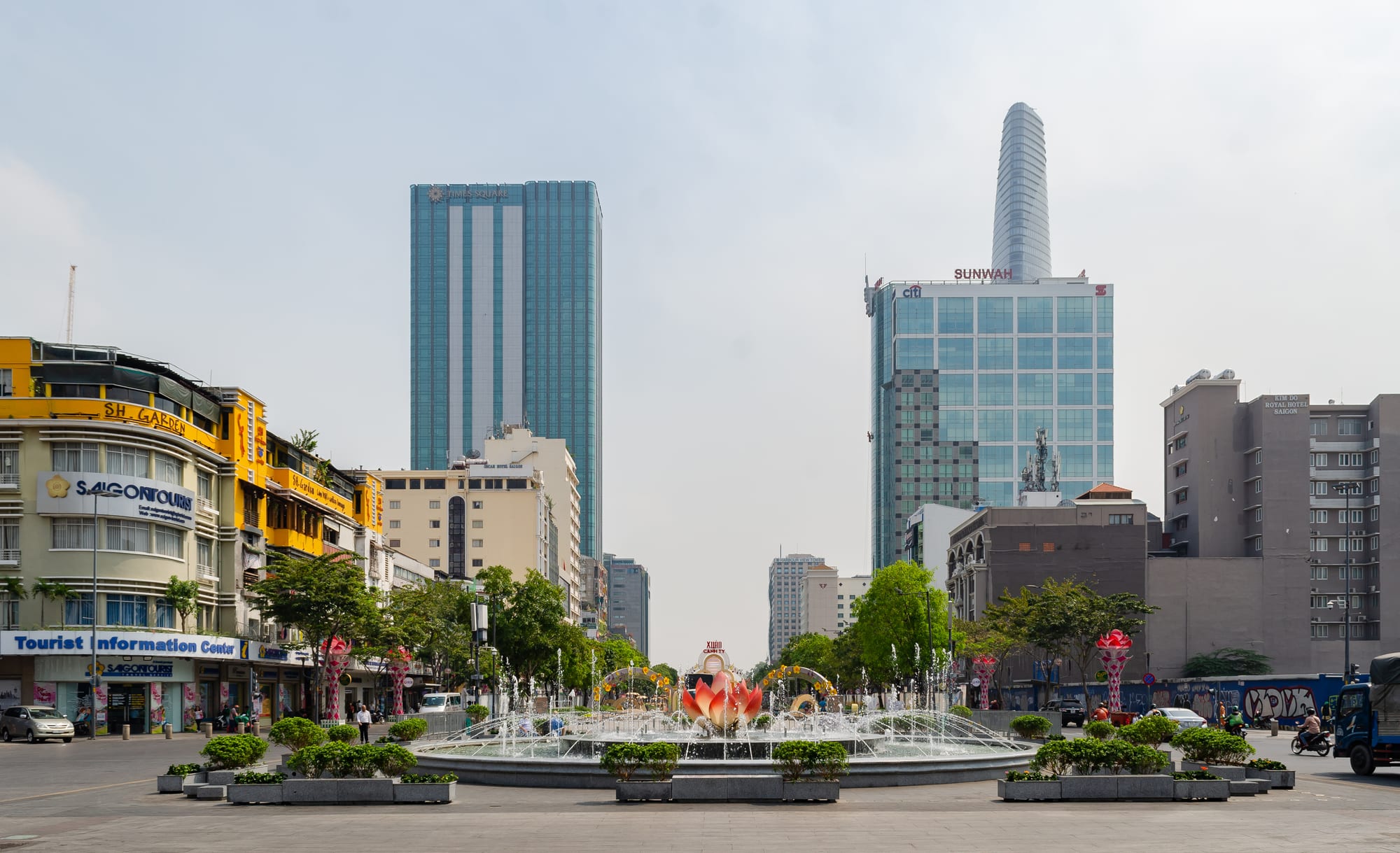
A wide pedestrian boulevard with a circular fountain and low shophouses in the foreground, and glass office towers rising behind

Ho Chi Minh City, Da Lat & the Southeast, Vietnam

Ho Chi Minh City

Nguyễn Huệ Boulevard in central Ho Chi Minh City, with the towers of the business district behind. (Steffen Schmitz / Wikimedia Commons · CC BY-SA 4.0)

Vietnam's largest city and its commercial capital, on the Saigon River a little above the Mekong Delta. Founded on a Khmer port, rebuilt by France as the capital of Cochinchina and capital of South Vietnam until 1975, it is still widely called Saigon. Colonial boulevards, alley neighbourhoods, the Chinese quarter of Chợ Lớn and a skyline of towers sit side by side.

Neighbourhoods

  • District 1
    • First-time visitors
    • Landmarks
    • Nightlife

    The colonial and commercial core, where the cathedral, post office, opera house, Reunification Palace and Bến Thành market stand within a short walk of each other. Most hotels, the riverfront, the pedestrian boulevard of Nguyễn Huệ and the backpacker streets around Bùi Viện are here.

    Open in Maps
  • District 3
    • Best for food
    • Quiet and residential
    • Architecture

    A leafy district of villas, tamarind-shaded streets and pagodas immediately north-west of the centre. It has long been where Saigonese rather than visitors eat, with coffee houses, cơm tấm stalls and small restaurants on its side streets.

    Open in Maps
  • Chợ Lớn and District 5
    • Best for food
    • Historic district
    • Markets

    The Chinese quarter, once a separate town, west of the centre. Herbal medicine shops, Cantonese, Teochew and Fujian assembly halls and temples, and the wholesale trade of Bình Tây market fill dense streets that feel older and busier than District 1.

    Open in Maps
  • Bình Thạnh and Phú Nhuận
    • Local life
    • Close to public transport

    Residential districts between the centre and the eastern river bend, a mix of alleys, markets and new apartment towers, including the tallest building in Vietnam. Rents are lower than District 1 and the food is largely local.

    Open in Maps
  • Thủ Đức and Thảo Điền
    • Quiet and residential
    • Riverside
    • Families

    The city's eastern section across the Saigon River, administered as a separate city within the city from 2021 until the 2025 reorganisation. Thảo Điền by the river is a low-rise area of expatriate housing, cafés and international schools, while further out are university campuses, technology parks and high-rise developments.

    Open in Maps

Things to do

Famous landmarks

  • Independence Palacelandmark

    The modernist 1960s presidential palace of South Vietnam, kept as it was on the day tanks broke through its gates in April 1975, down to the war rooms in the basement.

    Open in Maps
  • Saigon Notre-Dame Basilicalandmark

    A twin-towered brick cathedral completed in 1880, built with materials shipped from France, standing at the head of a square in the centre.

    Open in Maps
  • Saigon Central Post Officelandmark

    A grand vaulted post office of the same period facing the cathedral, still working, with painted maps of old Saigon and the telegraph network on its walls.

    Open in Maps
  • Municipal Theatrelandmark

    The city's opera house of 1900, a French colonial theatre on Đồng Khởi Street that now stages ballet, concerts and touring shows.

    Open in Maps
  • Ho Chi Minh City Halllandmark

    The ornate 1900s Hôtel de Ville at the head of Nguyễn Huệ Boulevard, floodlit at night and best seen from the street rather than inside, as it houses the city government.

    Open in Maps
  • Landmark 81landmark

    A tower of 81 storeys beside the river in Bình Thạnh, the tallest building in Vietnam, with an observation deck near the top.

    Open in Maps
  • Bitexco Financial Towerlandmark

    The tapering downtown tower with a helipad jutting from one side, long the city's symbol of its boom, with a skydeck on the forty-ninth floor.

    Open in Maps

Museums

  • War Remnants Museummuseum

    One of Vietnam's most visited museums, drawing around half a million visitors a year, documenting the Vietnam War and its aftermath through photographs, captured aircraft and armour, and exhibitions on Agent Orange; its displays are graphic.

    Open in Maps
  • Ho Chi Minh City Museummuseum

    The city's own history in a neoclassical palace of 1890 that served in turn as a colonial museum, a governor's residence and a presidential refuge.

    Open in Maps
  • Ho Chi Minh City Museum of Fine Artsmuseum

    Vietnamese painting, lacquer, sculpture and ceramics, with Champa and Óc Eo relics upstairs, in a 1930s mansion built for the Hua family.

    Open in Maps

Temples and markets

  • Bến Thành Marketmarket

    The covered market with a clock tower that has marked the centre of the city since 1912, selling cloth, souvenirs, coffee and food at its stalls.

    Open in Maps
  • Bình Tây Marketmarket

    Chợ Lớn's great wholesale market, built in the 1920s by a Chinese merchant around a courtyard, supplying traders across the south.

    Open in Maps
  • Jade Emperor Pagodalandmark

    A temple founded by a Cantonese migrant in District 1, dark with incense smoke, its halls full of carved wooden figures of Taoist deities.

    Open in Maps
  • Giác Lâm Pagodalandmark

    Founded in 1744 and among the oldest pagodas in the city, set in a quiet compound in the Bảy Hiền area west of the centre, with a stupa garden and a bodhi tree.

    Open in Maps

Parks and streets

  • Nguyễn Huệ Boulevardneighborhood

    A pedestrian boulevard running from the City Hall to the river, laid over a filled-in canal, busy in the evenings and lined with flowers at Tết.

    Open in Maps
  • Saigon Zoo and Botanical Gardenspark

    Commissioned in 1864 and open to the public since 1869, one of the world's oldest zoos still working, with large trees, orchid houses and the history museum at its gate.

    Open in Maps
  • Tao Đàn Parkpark

    A shaded park near the Reunification Palace, full of exercise groups, bird-cage owners and chess players in the early morning.

    Open in Maps

Short trips from the city

  • Củ Chi tunnelsattraction

    A preserved section of the underground network dug by communist fighters, with crawl-through tunnels, workshops and trapdoors displayed in forest north-west of the city.

    Open in Maps
  • Cần Giờ Mangrove Forestpark

    A replanted mangrove forest and UNESCO biosphere reserve on the estuary south-east of the city, with monkeys, birdlife and boat channels.

    Open in Maps

Seasonal events

  • Tếtlate January or February

    The lunar new year, when Nguyễn Huệ Boulevard becomes a flower street, the city empties as workers return to their home provinces, and shops close for several days.

  • Reunification Day30 April

    The anniversary of the end of the war in 1975, marked with flags, parades in some years and a public holiday that runs into May Day.

  • Mid-Autumn FestivalSeptember or October

    Lantern and mooncake sellers fill the streets of Chợ Lớn and Lương Nhữ Học Street in the weeks beforehand, with lion dances on the night.

  • Nghinh Ông whale festivalthe eighth lunar month, usually September

    A fishermen's festival at Cần Giờ honouring the whale spirit, with a procession of decorated boats out to sea.

Eat and drink

Long-standing places and food districts in Ho Chi Minh City. Hours, ratings and directions come from your maps app, always current.

Saigon classics

  • Cơm tấm stallsneighborhood

    Broken rice with a grilled pork chop, shredded pork skin and a steamed egg cake, sold from morning stalls across the city and a Saigon institution.

    Open in Maps
  • Bánh mì countersneighborhood

    Baguettes split and filled with pâté, cold cuts or grilled pork, pickled carrot and daikon, coriander and chilli, sold from pavement carts everywhere.

    Open in Maps
  • Ốc restaurantsneighborhood

    Snail and shellfish houses, thickest on the streets of District 4, where dozens of species are grilled, steamed or stir-fried with tamarind, coconut or chilli salt and eaten with beer.

    Open in Maps

Markets and food districts

  • Bến Thành Marketmarket

    Food stalls inside the market and a night street market around it, convenient though pricier than the neighbourhood equivalents.

    Open in Maps
  • Chợ Lớnneighborhood

    The Chinese quarter, where hủ tiếu noodle houses, dim sum, roast meats and herbal soups have been made by Cantonese and Teochew families for generations.

    Open in Maps
  • Bùi Viện Streetneighborhood

    The backpacker street of bars, hostels and cheap kitchens in Phạm Ngũ Lão ward, loud and neon-lit after dark.

    Open in Maps

Coffee

  • Apartment-block cafés on Nguyễn Huệcafe

    An old apartment block on the boulevard whose flats have been turned into small independent cafés floor by floor, one of the city's coffee landmarks.

    Open in Maps
  • Pavement coffee stallscafe

    Low plastic stools on the pavement and cà phê sữa đá, coffee dripped through a metal filter over condensed milk and ice, drunk slowly at any hour.

    Open in Maps

Experience Ho Chi Minh City

History

A Khmer settlement and port called Prey Nokor stood on this stretch of the Saigon River before Vietnamese migrants moved south in numbers during the 17th century. In 1698 the Nguyễn lords sent Nguyễn Hữu Cảnh to organise the region as Gia Định, and a citadel town grew, trading rice from the delta. Chinese refugees settled to the west and built Chợ Lớn, which remained a separate city until the 1930s.

France took Saigon in 1859 and from 1862 made it the capital of Cochinchina. Engineers filled canals to make boulevards, and within a few decades the city had a cathedral, an opera house, a post office and a reputation among colonials as the Pearl of the Far East, all built on rice and rubber exports and on the labour of a Vietnamese population excluded from most of it. The city also became a centre of anti-colonial organising, and Ho Chi Minh left from its docks in 1911.

From 1955 Saigon was the capital of the Republic of Vietnam and the centre of the American presence, its population swelled by refugees from the countryside. It was attacked during the Tết Offensive of 1968, and on 30 April 1975 North Vietnamese tanks entered the grounds of the Independence Palace, ending the war; the city was renamed after Ho Chi Minh the following year. The post-war decade was hard — nationalised businesses, rationing, and the departure of hundreds of thousands of people by boat, many of them from the Chinese community. The Đổi Mới reforms from 1986 restarted private enterprise, and the city became the motor of the Vietnamese economy. The provincial reform of 2025 merged Bình Dương and Bà Rịa-Vũng Tàu into an enlarged city.

Culture & Customs

Saigon thinks of itself as the open, commercial, informal counterweight to Hanoi: less concerned with protocol, quicker to do business, readier to invite a stranger to sit down and eat. The southern accent merges sounds that northerners keep apart, and most residents still say Saigon in conversation whatever the maps say. Almost everyone is from somewhere else — the delta, the central coast, the highlands — and the city absorbs newcomers without much ceremony.

It is also the most religiously varied city in the country. Large Catholic congregations, many descended from families who moved south in 1954, fill churches on Sunday; Mahayana Buddhist pagodas, Chinese assembly halls in Chợ Lớn dedicated to Thiên Hậu and other deities, Cao Đài and Hòa Hảo communities and a small Muslim population all have their own places of worship. Ancestor altars stand in shops and houses, and incense smoke on the pavement in the seventh lunar month is ordinary.

The performing arts belong to the south as well: cải lương, the reformed opera that grew out of delta towns in the early 20th century, and đờn ca tài tử, the amateur chamber music of the southern delta. Modern Vietnamese pop, film, fashion and start-up culture are largely made here. Daily manners run on coffee, long meals and the pavement — tables, stools, conversation and business all happen outdoors, and the city is at its most sociable between dusk and midnight.

Daily Life

The city had more than 9 million residents before the 2025 mergers, and the enlarged city, which now includes Bình Dương and Bà Rịa-Vũng Tàu, counts around 14 million — by far the largest urban area in Vietnam. Millions more commute from the industrial provinces around it. It produces a large share of national economic output through banking, trade, ports, technology, consumer goods and the factories of its outer belt.

Most people live in alleys — hẻm — running back from the main roads: narrow lanes of tall thin houses with shops at street level, where neighbours know one another and much of life happens in the doorway. Around them rise new apartment towers, especially east of the river in Thủ Đức, where campuses and technology parks have been built. Housing costs, an hour or more of commuting by motorbike and the price of schooling are constant concerns.

The day starts before six with markets, exercise in the parks and phở or bánh mì on the way to work, pauses through the fiercest heat and comes alive again in the evening. Rain in the wet season and unusually high tides both flood low-lying districts, a problem made worse by subsidence and building over canals, and air quality is poor on still days. Motorbike traffic, and the slow shift towards metro lines and electric bikes, define the city's arguments about its future.

Food

Southern cooking is sweeter and more herb-heavy than the north's, and Saigon's version adds everything brought by migrants and by the Chinese of Chợ Lớn. Cơm tấm — broken rice with a marinated grilled pork chop, shredded pork skin, a steamed egg and pork cake, and a bowl of sweetened fish sauce — is the signature dish, eaten at any hour. Hủ tiếu, a clear pork-and-prawn noodle soup of Teochew origin, comes dry or in broth and is sold from carts and shophouses; bánh mì, the baguette sandwich of pâté, cold cuts or grilled pork with pickles and coriander, was perfected here.

Phở is eaten everywhere but made southern-style, with a sweeter broth and a plate of bean sprouts, basil, lime and chilli sauces alongside. Bánh xèo, a wide crisp turmeric pancake of prawn and pork folded into lettuce and herbs, bún thịt nướng, grilled pork over cold noodles, and gỏi cuốn, fresh rice-paper rolls, are staples. Chợ Lớn contributes dim sum, roast duck, herbal soups and mì vằn thắn wonton noodles.

Evenings belong to ốc — snails, clams and other shellfish cooked dozens of ways with tamarind, coconut milk, chilli salt or butter and eaten over beer — and to bột chiên, fried rice-flour cakes with egg. Sweets are coconut-based: chè, the family of sweet soups with beans, jelly and fruit, and sinh tố, thick fruit smoothies. Coffee is drunk dark and strong through a metal phin filter, iced with condensed milk, and increasingly as speciality arabica in the city's many roasters; the local beers are Bia Saigon and 333.

Planning tools

Budget

The most expensive city in Vietnam, but only by local standards. Hotels, rooftop bars and international restaurants in District 1 cost real money, while street food, local beer and hostels in the backpacker streets remain very cheap. Ride-hailing is inexpensive, and the main extra costs are guided trips to the tunnels and the delta.

Daily Budget Midrange
USD 70–150 (city hotel, restaurant meals, Grab cars, museums and a guided tunnels tour)
Daily Budget Shoestring
USD 25–40 (hostel bed, street food, city buses and ride-hailing motorbikes)

Rooms outside District 1 — in District 3, Bình Thạnh or Phú Nhuận — cost much less and are a short ride from the centre; most museums charge only a small entry fee.

Best Time to Visit

December to April, the dry season, when days are hot but rain is rare; February and March are the busiest months. The wet season from about May to November brings heavy afternoon downpours that flood streets for an hour or two and then clear. Around Tết the city empties of workers, many small businesses close and transport is heavily booked.

Suggested Number of Days

Two or three days are enough for the central districts. Four to six allow day trips out of the city to the north-west or into the delta. Heat, traffic and distance slow everything down, so most visitors manage less in a day than the map suggests.

First Visit
2–3 days
With Surroundings
4–6 days

Transportation

Motorbikes dominate the streets, and most people use ride-hailing apps for cars and motorbike taxis, which are cheap and remove any argument about fares. City buses are extensive but slow and hard to use without the apps. The first metro line, running east from the centre to the suburbs, opened in December 2024. River ferries and a waterbus run on the Saigon River.

Use a ride-hailing app rather than flagging down a street taxi, and agree nothing in cash with drivers who approach at the airport or outside tourist sites.

Airport & Station Connections

Tân Sơn Nhất is Vietnam's busiest airport, unusually close to the centre, though traffic can make the journey slow. Trains on the north–south line leave from Sài Gòn station in District 3 for Nha Trang, Da Nang, Huế and Hanoi. Sleeper buses reach Đà Lạt, Mũi Né and the delta, and Vũng Tàu is about two hours by road.

Walkability

The colonial core of District 1 is walkable, and the main landmarks lie within a kilometre or so of one another. Beyond it, pavements are often occupied by parked motorbikes and stalls, crossings are few and the heat is heavy. Crossing the road is done by walking slowly and steadily so that riders can flow around, rather than waiting for a gap.

Safety

Violent crime against visitors is rare, but street theft is common: phones and bags are snatched by thieves riding pillion on motorbikes, above all on District 1 streets and around the backpacker area at night. Overcharging by taxis and touts around the airport and the market is the other frequent complaint. Traffic is the real physical danger.

Keep a phone out of sight near the kerb, carry bags on the side away from the road, and use ride-hailing after dark. Only ride a motorbike if experienced and licensed, and always with a helmet; hold bags away from the road; drink bottled or filtered water; and check surf conditions before swimming. Check current official travel advice before travelling.

Climate

Tropical and warm all year, with little variation in temperature and a sharp division between the wet season from about May to November and the dry season from December to April. Humidity is high throughout, and March and April are the hottest months.

Summer
hot and humid, about 26–34°C, with a heavy downpour most afternoons and occasional street flooding
Winter
dry and slightly cooler, about 22–33°C, with clear skies and the most comfortable evenings of the year

Local Customs

Tipping is not obligatory, though it is appreciated in restaurants and by drivers and guides; upmarket restaurants may add a service charge. Shoes come off at the door of homes and some temples, shoulders and knees are covered in pagodas, and modest dress is expected away from the beach. Saigonese are informal and quick to strike up conversation. Older visitors are addressed with respect, and political discussion is best left alone.

Ask before photographing people, their stalls or their homes, and do not photograph military sites or checkpoints.

Common Payment Methods

The currency is the Vietnamese đồng, quoted in large numbers. Cards work in hotels, malls and mid-range restaurants, but street food, markets and small cafés are cash only, and QR-code payment by phone is now common. ATMs are everywhere, though many cap withdrawals low and charge a fee per transaction.