A silver steel truss bridge on stone piers crossing a wide green river, framed by feathery branches under a grey sky

Hue & the North Central Coast, Vietnam

Hue

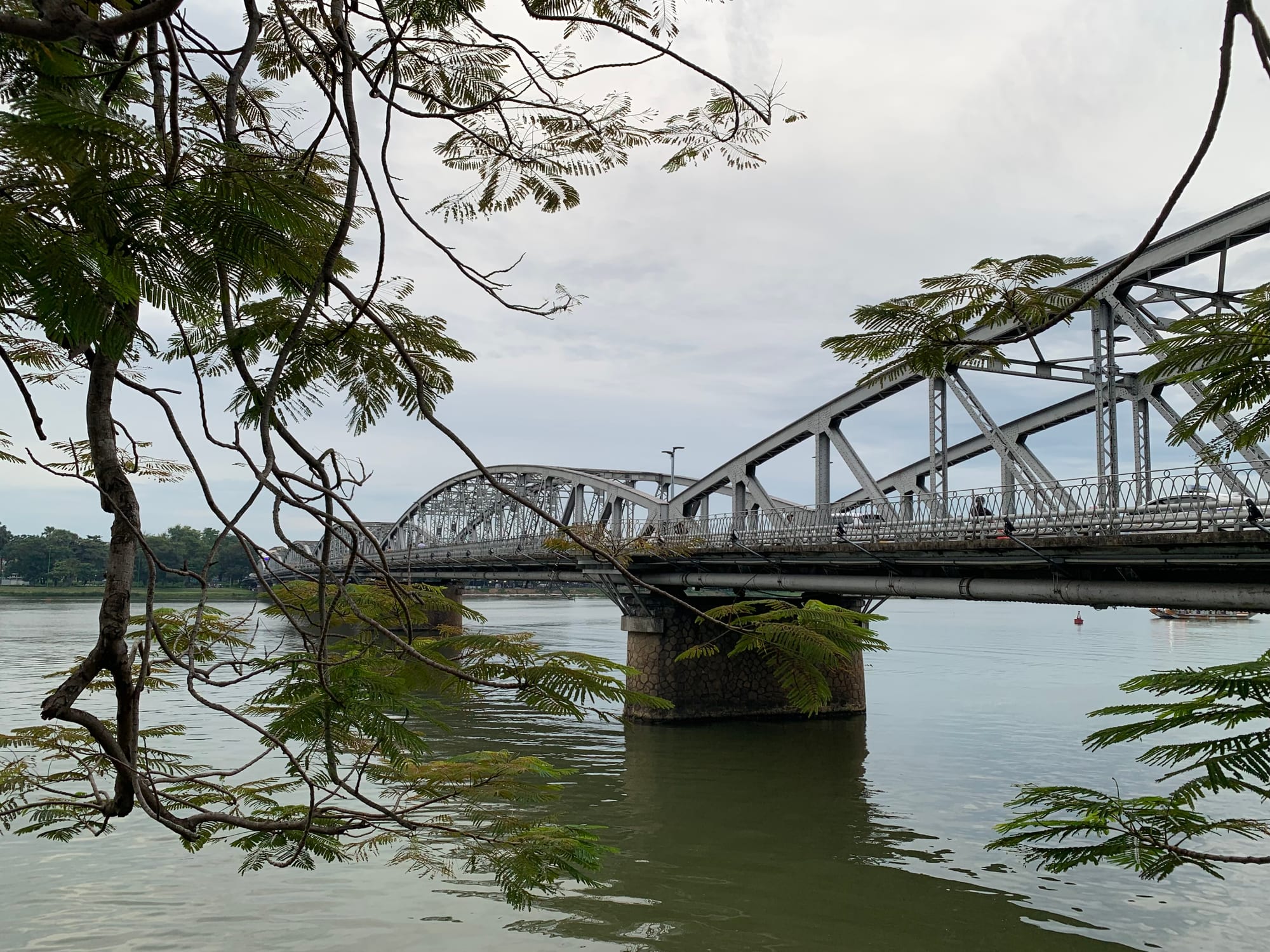
The Trường Tiền bridge over the Perfume River in the centre of Hue. (Chainwit. / Wikimedia Commons · CC BY 4.0)

Vietnam's imperial capital from 1802 to 1945, on the Perfume River a few kilometres inland from the central coast. A vast walled citadel holds the palaces of the Nguyễn emperors, whose garden tombs lie in the hills upstream, and the city that grew around them is known for pagodas, court music, a refined cuisine and a quieter pace than Vietnam's larger cities.

Neighbourhoods

  • The Citadel
    • Historic district
    • First-time visitors
    • Local life

    The walled quarter on the north bank, laid out inside a moat and earth ramparts, containing the Imperial City and, around it, ordinary streets of houses, schools and markets. Mornings there are quiet, with people cycling along the walls, and the gates are the landmarks everyone navigates by.

    Open in Maps
  • Phú Hội and the south bank
    • First-time visitors
    • Restaurants and bars
    • Close to transport

    The modern centre across the Trường Tiền bridge, laid out by the French around Lê Lợi street. Most hotels, travel agencies, banks and international restaurants are here, along with the museum quarter, the university buildings and the riverside promenade.

    Open in Maps
  • Đông Ba and the riverside market quarter
    • Best for food
    • Markets
    • Local life

    The blocks on the north bank around the city's main market, between the citadel wall and the river. Trade spills into the surrounding lanes, with fabric and conical-hat sellers, food stalls and boat landings on the Perfume River.

    Open in Maps
  • Kim Long and the upstream bank
    • Quiet and residential
    • Garden houses
    • Temples

    The riverside strip west of the citadel, once an aristocratic suburb and still known for its walled garden houses and their fruit trees. The Thiên Mụ pagoda stands at its edge, and the road continues towards the royal tombs.

    Open in Maps
  • Vỹ Dạ
    • Quiet and residential
    • Local food

    A leafy area downstream on the south bank, remembered in Vietnamese poetry for its gardens and river light. It is mostly residential, with small shrines, chè shops and some of the city's best-known bánh and noodle kitchens.

    Open in Maps
  • Thuận An and the coast
    • Beaches
    • Seafood

    The fishing town and beach east of the centre, where the Perfume River reaches the sea beside the Tam Giang lagoon. Seafood shacks, dunes and a broad, exposed beach draw city families on hot afternoons.

    Open in Maps

Things to do

The imperial city

  • Imperial Citylandmark

    The walled palace complex at the heart of the citadel, entered through the Meridian Gate, with the Thái Hòa throne hall, temples to the emperors and the ruins of the Forbidden Purple City.

    Open in Maps
  • Citadel of Huếlandmark

    The 19th-century fortress of earth and brick ramparts, bastions and a moat, built to a European-influenced plan, that encloses the imperial quarter.

    Open in Maps
  • Flag Towerlandmark

    The tall masonry flagstaff facing the Meridian Gate across the parade ground, first raised in 1807 and rebuilt after storms and war.

    Open in Maps
  • Huế Museum of Royal Fine Artsmuseum

    A collection of court furniture, ceramics, costumes and objects from the Nguyễn palaces, displayed in the timber Long An palace of 1845.

    Open in Maps
  • An Định Palacelandmark

    An ornate early 20th-century palace on the An Cựu river, built in a mixed European and Vietnamese style and associated with the last emperor's family.

    Open in Maps

Tombs and pagodas

  • Tomb of Tự Đứclandmark

    A walled garden of lakes, pavilions and pine woods upstream of the city, used by the emperor as a retreat before it became his mausoleum.

    Open in Maps
  • Tomb of Minh Mạnglandmark

    The most formally planned of the royal tombs, built between 1840 and 1843 as a long axis of gates, courtyards and bridges set among lakes about 12 km from the centre.

    Open in Maps
  • Tomb of Khải Địnhlandmark

    A hillside mausoleum of blackened concrete finished in the 1930s, with an interior covered in glass and porcelain mosaic.

    Open in Maps
  • Thiên Mụ Templelandmark

    The pagoda on a bluff above the Perfume River, founded in 1601, whose seven-storey Phước Duyên tower is the city's emblem.

    Open in Maps
  • Từ Hiếu Templelandmark

    A pine-shaded monastery south-west of the centre, long associated with the palace eunuchs buried in its grounds and with the monk Thích Nhất Hạnh.

    Open in Maps
  • Tomb of Gia Longlandmark

    The mausoleum of the dynasty's founder, the furthest and least visited of the royal tombs, in open country upstream from the city.

    Open in Maps

The river and green spaces

  • Perfume Riverattraction

    The river that runs through the city, crossed by the Trường Tiền bridge and used by dragon boats that carry visitors upstream to the pagoda and tombs.

    Open in Maps
  • Trường Tiền Bridgelandmark

    The steel truss bridge designed and built by French engineers and opened in 1900, linking the citadel to the modern centre and lit in changing colours at night.

    Open in Maps
  • Hổ Quyềnlandmark

    A walled Nguyễn-era arena in Thủy Biều, west of the centre, where staged fights between elephants and tigers were held before the court.

    Open in Maps
  • Thanh Toàn Bridgelandmark

    A tiled covered footbridge of 1776, paid for by a village woman, Trần Thị Đạo, in farming country east of the centre.

    Open in Maps

Markets and streets

  • Đông Ba Marketmarket

    The city's main market for more than a century, on the north bank by the river, selling food, fabric, conical hats and sesame sweets.

    Open in Maps

Short trips from the city

  • Bạch Mã National Parkpark

    A mountain park of cloud forest, waterfalls and the ruins of a French hill station begun in 1932, reached by a steep road that climbs to about 1,250 m.

    Open in Maps
  • Lăng Côbeach

    A long beach on a sandy spit between a lagoon and the sea, below the Hải Vân Pass on the road and railway to Da Nang.

    Open in Maps
  • Hải Vân Passviewpoint

    The mountain crossing where the Annamite range reaches the sea, with an old gate at the summit and long views along the coast.

    Open in Maps
  • Quảng Trị Citadellandmark

    The brick fortress north of the city, destroyed in a battle of eighty-one days in 1972 and kept as a memorial to it.

    Open in Maps

Seasonal events

  • Huế Festivaleven-numbered years

    The city's cultural festival of court music, theatre, craft and street performance, held every second year in and around the citadel.

  • TếtJanuary or February

    The lunar new year, when families visit ancestral graves and the pagodas and shrines of the city are at their busiest.

  • Vesakthe fourth lunar month, usually May

    The Buddha's birthday is marked seriously in this strongly Buddhist city, with lanterns on the river, floats and processions between the pagodas.

  • The flood seasonOctober to December

    Not an event but a fixture of the calendar, a period of heavy rain and river floods that regularly reach the low-lying streets and interrupt river trips.

Eat and drink

Long-standing places and food districts in Hue. Hours, ratings and directions come from your maps app, always current.

Hue classics

  • Bún bò Huế kitchensneighborhood

    The city's most famous dish, a lemongrass-scented beef and pork noodle soup with chilli oil and shrimp paste, is eaten at breakfast at small shops all over the city.

    Open in Maps
  • Bánh bèo, nậm and lọc housesneighborhood

    Little steamed rice-flour cakes topped with dried shrimp and crackling, and chewy tapioca dumplings wrapped in banana leaf, served by the tray in family kitchens across the city.

    Open in Maps
  • Cơm hến stalls in Vỹ Dạneighborhood

    Rice with tiny river clams, herbs, peanuts, crackling and a bowl of clam broth, associated with the sandbanks and villages along the Perfume River.

    Open in Maps

Markets and food streets

  • Đông Ba Marketmarket

    The riverside market's upstairs food hall and its surrounding stalls sell noodle soups, chè and mè xửng, the chewy sesame sweet made in the city.

    Open in Maps
  • The lanes off Lê Lợi and Phạm Ngũ Lãoneighborhood

    The south bank's concentration of traveller cafés, vegetarian restaurants and bars, within a short walk of the river promenade.

    Open in Maps
  • Vegetarian kitchensneighborhood

    Buddhist cooking is a Hue speciality, and cơm chay kitchens near the pagodas are busiest on the first and fifteenth days of the lunar month.

    Open in Maps
  • Chè shopsneighborhood

    Sweet soups of beans, lotus seed, jelly and coconut milk, served cold in dozens of varieties, including a version with candied pork fat inside a lotus seed.

    Open in Maps

Experience Hue

History

The site was Cham territory before it passed to Đại Việt in 1306 as part of a marriage settlement, and for centuries it was a provincial town on a contested frontier. Its rise began under the Nguyễn lords, who moved their seat to Kim Long in 1636 and to Phú Xuân on the Perfume River in 1687, making it the capital of the southern half of a divided country. The Tây Sơn took the city in 1786 and ruled from it; in 1802 Nguyễn Ánh defeated them, took the name Gia Long and made Phú Xuân the capital of a reunified Vietnam. It was officially renamed Huế in 1899.

The dynasty built on a scale the country had not seen. A citadel of ramparts and moats went up between 1805 and 1832, following French military principles, with an Imperial City inside it and, within that, the Forbidden Purple City for the emperor's household; the tombs of successive emperors were laid out as walled gardens in the hills upstream. French forces stormed the citadel in 1885, and from then the court ruled under a protectorate, the emperors increasingly ceremonial. Bảo Đại, the last of them, abdicated in 1945 at the Meridian Gate.

War damaged the city severely. Hue lost its status as capital, and during the Tết Offensive of 1968 it was held for a month and retaken street by street; much of the citadel and the Imperial City was wrecked, and thousands of civilians were killed. Restoration began in the 1980s with international help, and the complex of monuments became, in 1993, the first site in Vietnam inscribed on the UNESCO World Heritage List. Since 2025 Hue has been a city governed directly by the central government.

Culture & Customs

Hue thinks of itself as the keeper of Vietnamese refinement, and the claim is not only about palaces. Nhã nhạc, the court music of the Nguyễn, was recognised by UNESCO in 2003 as a masterpiece of oral and intangible heritage and is performed in the citadel and at festivals; the city's poets, its tradition of calligraphy and its garden houses, with their screens, ponds and fruit trees, belong to the same inheritance. The local áo dài, worn in the city more often than elsewhere, is associated with a deep purple, and conical hats made here have poems and patterns cut into the leaf, visible when held against the light.

Buddhism runs deeper here than in most Vietnamese cities. Hue has hundreds of pagodas and monasteries, it was the centre of the Buddhist protests of 1963, and the car that carried Thích Quảng Đức to Saigon is kept at Thiên Mụ. Vegetarian cooking, lanterns floated on the river at Vesak, and the regular rhythm of observance on the first and fifteenth days of the lunar month are all part of ordinary life. Ancestral graves crowd the sandy ground towards the coast, and family shrines are maintained with care.

People from Hue are stereotyped elsewhere in Vietnam as reserved, formal and soft-spoken, with an accent other Vietnamese find hard to follow. The city is proud and a little inward-looking, conscious of having been a capital, and students from its universities give the riverfront and cafés a younger, livelier edge in the evenings.

Daily Life

The city, which since 2025 covers the whole of the former province, has about 1.14 million residents, more than half a million of them living in urban wards, the oldest of which face each other across the river. The south bank holds offices, hotels and the university; inside the citadel walls ordinary neighbourhoods of narrow houses, schools and small markets occupy ground that was once palace precinct. Suburbs spread towards the airport and along the roads to the coast.

Tourism, government and education are the mainstays. The monuments employ large numbers directly and support the hotels, boats, drivers and restaurants around them; the university, founded in 1957, draws students from across the centre of the country; and the surrounding districts contributes farming, fishing on the Tam Giang lagoon and a share of light industry. Wages are modest, and many young people leave for Da Nang, Ho Chi Minh City or work abroad, sending money back.

The year is shaped by water. Autumn floods are expected rather than exceptional, and houses keep raised platforms, boats and stocks of food for them. In daily terms the pattern is early and unhurried: markets from before dawn, a long break in the afternoon heat, then the riverbank in the evening, where the promenade, the lit bridge and the pedestrian street on the south bank fill with families, students and vendors.

Food

Hue cooking is the most distinctive of any Vietnamese city, the product of a court that expected many small, carefully made dishes and of a poor province that made the most of little. Bún bò Huế is the best-known: thick round rice noodles in a broth of beef and pork bones scented with lemongrass and shrimp paste, with chilli oil, sliced beef shank, cubes of congealed blood and a handful of herbs. It is breakfast food, eaten at low tables before the heat.

The city's repertoire of small steamed and wrapped cakes is unmatched. Bánh bèo arrive as trays of little dishes of rice flour topped with dried shrimp and pork crackling; bánh nậm are flattened in banana leaf; bánh lọc are translucent tapioca parcels holding a shrimp and a piece of pork; and bánh khoái is a crisp stuffed pancake served with a thick peanut and liver sauce. Cơm hến, rice at room temperature tossed with tiny clams from the river, herbs, peanuts, crackling and chilli, with a bowl of the clam water alongside, is the dish most tied to the place. Nem lụi, lemongrass pork grilled on skewers and rolled at the table, is eaten in the evening.

Sweet things and vegetarian food matter here too. Chè comes in dozens of kinds — lotus seed, mung bean, taro, jellies, and the famous one hiding candied pork fat inside a lotus seed — and mè xửng, a chewy sesame and peanut sweet, is the souvenir. Buddhist cơm chay kitchens turn tofu, mushrooms and jackfruit into versions of the meat dishes, and tea, rice wine and very sweet iced coffee round out the table.

Planning tools

Budget

Hue is one of the cheaper cities in Vietnam for food and accommodation, with a wide range of guesthouses, hotels and some riverside resorts. The main costs beyond meals are entry to the Imperial City and the tombs, which are ticketed separately or by combined ticket, and transport to the sights outside the centre by taxi, boat or hired motorbike.

Daily Budget Midrange
USD 50–120 (riverside hotel, restaurant meals, combined monument ticket, a car or boat for the tombs)
Daily Budget Shoestring
USD 20–35 (guesthouse or hostel, street food, bicycle or local bus, one or two sites)

The combined ticket for the Imperial City and the main tombs costs less than separate entries, and the citadel's streets, pagodas and riverbank are free to walk.

Best Time to Visit

February to May is the most comfortable season, dry and mild, with the festival calendar at its fullest. June to August is hot and bright, good for the coast but heavy going in the middle of the day. October to December is the flood season, with long rain and the highest chance of disruption, and January is cool and damp.

Suggested Number of Days

Most visitors spend two or three days, enough for the citadel and a selection of the tombs and pagodas at an unhurried pace. Four or five allow the coast, the mountains and the sites north of the city; heat and rain both slow everything down.

First Visit
2–3 days
With Surroundings
4–5 days

Transportation

The city is small and mostly flat, and bicycles, motorbike hire, taxis and ride-hailing apps cover it easily. Boats run up the Perfume River to the pagoda and some of the tombs, and cyclos still work the central streets. Local buses serve Thuận An and the district towns but are of limited use for the tombs, which are scattered in the hills south of the river.

A cycle or motorbike loop through the villages south of the river links several tombs without backtracking; agree fares with cyclo and taxi drivers in advance.

Airport & Station Connections

Phú Bài airport lies south-east of the centre, with domestic flights from Hanoi and Ho Chi Minh City. Hue is a main stop on the north–south railway, and the stretch south to Da Nang over the Hải Vân Pass is among the most scenic rail journeys in the country, taking around three hours; buses and cars use the road tunnel or the pass in about the same time. Sleeper trains and buses connect to Hanoi.

Walkability

The centre is comfortable on foot: the south bank's hotels, restaurants and riverside park are compact, and the walk across the Trường Tiền bridge to the market and citadel gates takes about fifteen minutes. The citadel itself is large, and crossing it means a long walk in the heat. The tombs and pagodas are too far to reach on foot. Pavements are usable but often full of parked motorbikes.

Safety

Hue is a calm city with little crime against visitors beyond overcharging, bag snatching in crowded places and the usual caution with valuables on a motorbike. The genuine hazards are traffic, the strength of the sun in summer, rip currents on the open beaches, and autumn floods, when streets and roads to the tombs can be under water.

Only ride a motorbike if experienced and licensed, and always with a helmet; hold bags away from the road; drink bottled or filtered water; and check surf conditions before swimming. Check current official travel advice before travelling.

Climate

One of the wettest cities in Vietnam, with a short dry season and an intense wet one. Rain is concentrated between September and December, when typhoons and river floods are common; the months from February to August are drier, and the dry westerly wind off the mountains can push summer temperatures high.

Summer
hot and humid, typically 32–38°C, with strong sun and occasional storms
Winter
mild but wet and grey, about 17–23°C, with long spells of drizzle

Local Customs

Hue is the country's most self-consciously traditional city and is strongly Buddhist. Shoulders and knees should be covered at pagodas and at the royal tombs, which are places of worship and burial rather than museums, and shoes come off where others remove theirs. People speak softly and the local accent is regarded as distinctive; formality and politeness are valued. Tipping is not expected, though it is welcomed.

Walk around, not over, graves in the fields and hillsides, ask before photographing people at prayer, and keep quiet in temple halls where services are under way.

Common Payment Methods

The currency is the Vietnamese đồng. Hotels, restaurants, monuments and larger shops take cards and QR-code payments, and ATMs are plentiful in the centre. Markets, boatmen, cyclos and street stalls work in cash, so small notes are useful, and prices at markets are often negotiable.