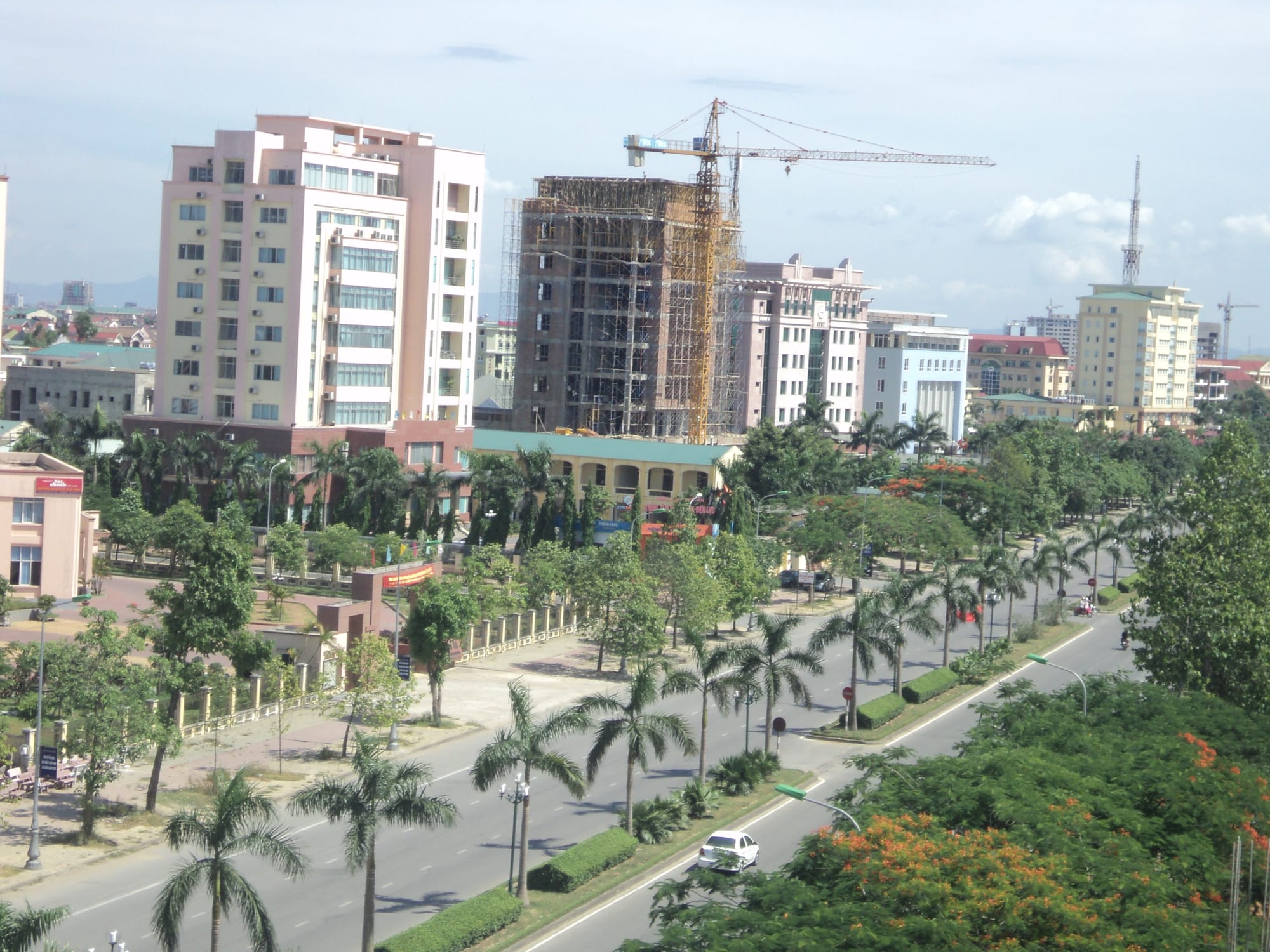
A broad palm-lined avenue with a central reservation running between mid-rise apartment and office blocks under a blue sky

Hue & the North Central Coast, Vietnam

Vinh

Lenin Avenue in Vinh, one of the wide boulevards laid out when the city was rebuilt after the war. (Dungshc at vi.wikipedia / Wikimedia Commons · Public domain)

A principal city of Vietnam's north central coast, on the Lam River a few kilometres inland from the sea in Nghệ An. A French colonial industrial town and a centre of the 1930–31 Nghệ-Tĩnh uprising, it was flattened in two wars and rebuilt from the 1970s with East German help. Today it is a flat, wide-streeted commercial and university city, and the gateway to Hồ Chí Minh's home village at Kim Liên.

Neighbourhoods

  • The city centre around Quang Trung
    • First-time visitors
    • Close to public transport
    • Shopping

    The rebuilt heart of Vinh, laid out on a grid of wide avenues around the long Quang Trung housing blocks put up with East German assistance in the 1970s. Most hotels, banks, offices and the main shopping streets are here, within walking distance of Hồ Chí Minh Square.

    Open in Maps
  • Hồng Sơn and the market quarter
    • Markets
    • Best for food
    • Local life

    The older commercial district near the river, built around Vinh's central market. Narrow lanes of wholesalers, hardware shops, fabric stalls and cheap eating houses fill up early in the morning and again in the evening.

    Open in Maps
  • Bến Thủy
    • Quiet and residential
    • Students
    • Walks and viewpoints

    The southern end of the city, where the Lam River is crossed by the Bến Thủy bridges towards Hà Tĩnh. Vinh University and the wooded slopes of Núi Quyết are here, and the old riverside port gave the area its industrial history.

    Open in Maps
  • Hưng Bình and Hưng Dũng
    • Quiet and residential
    • Local life

    Spreading suburbs north and east of the centre, where most of Vinh's residents actually live — lanes of narrow tube houses, small cafés, schools and ponds left over from the villages the city absorbed.

    Open in Maps
  • Cửa Lò
    • Beaches
    • Seafood
    • Summer holidays

    The coastal strip east of the city, a former district-level town merged into Vinh in 2024, with a long sandy beach lined with guesthouses and seafood restaurants. It is quiet for much of the year and crowded with Vietnamese families through the summer months.

    Open in Maps

Things to do

Landmarks and viewpoints

  • Núi Quyếtviewpoint

    A pine-covered hill above the Lam River at the southern edge of the city, with a park and a wide view over Vinh towards the sea.

    Open in Maps
  • Phượng Hoàng Trung Đôlandmark

    The remains of the citadel that the Tây Sơn emperor Quang Trung ordered built at the foot of Quyết Hill as a new imperial capital, left unfinished when he died in 1792.

    Open in Maps

Museums and memory

  • Nghệ An – Xô Viết Nghệ Tĩnh Museummuseum

    A history museum built on the site of the former Vinh prison and opened in 1963, devoted to the Nghệ-Tĩnh uprising of 1930–31 and to the thousands from Nghệ An and Hà Tĩnh who took part in it. It was merged with the Nghệ An Museum in 2025.

    Open in Maps

Markets and city life

  • Chợ Vinhmarket

    The city's central market, a large covered hall with streets of stalls around it selling produce, dried fish, fabric and household goods.

    Open in Maps
  • Vinh railway stationtransit hub

    One of the main stations on the north–south railway, the line worked by the Reunification Express between Hanoi and Ho Chi Minh City.

    Open in Maps

Short trips from the city

  • Kim Liên Museummuseum

    The thatched childhood home of Hồ Chí Minh at Làng Sen in Kim Liên village, about 12 kilometres west of the centre, rebuilt in 1959 and kept as a memorial site; he was born at his mother's home at nearby Hoàng Trù.

    Open in Maps
  • Cửa Lòbeach

    A long, gently shelving beach about 17 kilometres east of the centre, the summer resort of choice for much of north central Vietnam.

    Open in Maps
  • Pù Mát National Parkpark

    A national park of some 95,000 hectares in the mountains about 110 kilometres west of Vinh, near the Lao border, part of the Western Nghệ An Biosphere Reserve and home to saola, doucs and white-cheeked gibbons.

    Open in Maps

Seasonal events

  • Tết Nguyên Đánlate January or February

    The lunar new year empties the offices and fills the family houses and temples; markets and flower stalls take over the streets for the week before it.

  • Cửa Lò summer seasonsummer

    The beach town opens its season in the spring and stays busy with domestic holidaymakers until the storms arrive in the autumn.

  • Mid-Autumn FestivalSeptember or early October

    Lantern processions, lion dances and mooncakes in the residential lanes, aimed above all at children.

Eat and drink

Long-standing places and food districts in Vinh. Hours, ratings and directions come from your maps app, always current.

Vinh classics

  • Eel soup and eel porridge stallsrestaurant

    Cháo lươn and súp lươn, the city's signature dishes — rice porridge or a thin peppery soup with strips of fried river eel, turmeric and herbs, eaten with a soft rice sheet called bánh mướt.

    Open in Maps
  • Chợ Vinhmarket

    The central market, where the produce, dried fish and fermented pastes of Nghệ An are sold and cheap cooked-food stalls fill the surrounding lanes.

    Open in Maps

Seafood and drinks

  • Cửa Lò seafood restaurantsneighborhood

    Plastic tables behind the beach serving squid, prawns, clams and grilled fish, at their best in the summer when the boats come in each morning.

    Open in Maps
  • Cafés along the central avenuesneighborhood

    Vietnamese iced coffee, sugarcane juice and green tea served on low chairs on the pavements of the wide rebuilt streets, busiest early in the morning and after work.

    Open in Maps

Experience Vinh

History

Vinh grew where the Lam River meets the coastal plain, a crossing point on the route south fortified long before it was a city and the site of an old citadel. In his short reign from 1788 the Tây Sơn emperor Quang Trung ordered a new imperial citadel, Phượng Hoàng Trung Đô, built at the foot of Quyết Hill; he died in 1792 and the court never moved.

Under French rule Vinh became one of the few industrial towns in central Vietnam, with railway workshops, sawmills and a match factory, and the port of Bến Thủy on the river below it. Factory and dock workers in one of the country's poorest provinces made it politically combustible: the Nghệ-Tĩnh uprising of 1930–31 spread from strikes here into the countryside, where peasant committees briefly displaced the colonial administration before troops put them down. Hồ Chí Minh had been born in 1890 at Hoàng Trù, his mother's village just west of the city, and grew up nearby at Kim Liên.

The 20th century then destroyed the place twice. Vinh was burned during the war against France in the 1950s, and bombed repeatedly by the United States during the Vietnam War as a junction on the supply route south, until almost nothing of the old town remained. Reconstruction from the early 1970s drew on East German assistance, which is why the centre has long parallel avenues and rows of low-rise concrete flats rather than the tangled lanes of most Vietnamese cities. Growth since the 1990s has been steady, and the city's boundaries widened to take in surrounding communes and the coast.

Culture & Customs

Nghệ An's reputation within Vietnam is for hardness and study. The province is poor, the weather is punishing, and the local answer has long been education and emigration: families push children towards examinations, and the province produces a disproportionate number of teachers, officials and scholars, along with large numbers of workers in Hanoi, the south and abroad. The Nghệ accent, with its flattened tones and its own vocabulary, is famous and often gently mocked elsewhere in the country.

The area's folk tradition is ví and giặm, the call-and-response work songs of Nghệ Tĩnh, counted among Vietnam's great folk song traditions and sung unaccompanied by rice farmers, weavers and boat crews and now kept alive by clubs and staged performances. Revolutionary history is the other great local theme. Kim Liên draws a steady stream of Vietnamese visitors, school groups and party delegations, and the 1930–31 uprising is commemorated in museums, street names and memorials across the city.

Daily manners are those of provincial Vietnam: ancestor altars in every house, weddings and funerals that involve the whole lane, respect measured by how carefully people are addressed, and a strong sense of home village even among families who have lived in the city for generations. Football matters here more than in most Vietnamese cities, and the local club's supporters are known nationally for their noise.

Daily Life

Vinh had about 580,000 residents in 2025, when district-level units were abolished across Vietnam and the city ceased to exist as a municipal unit, its area now divided into wards. It remains the administrative and commercial centre of one of Vietnam's most populous provinces, drawing students, patients and traders from a wide area of the north central coast. Its universities and colleges, the provincial hospitals, government offices and the market trade provide much of the work, alongside food processing, building materials, light manufacturing in the industrial zones on the edge of town and the port at Bến Thủy.

The day starts very early. Markets are busiest before seven, street kitchens serve breakfast from dawn, and the hottest hours in summer are spent indoors behind shutters. People live mostly in narrow tube houses along lanes off the main avenues, in the older blocks of the centre, or in new estates pushing out across former paddy fields. Remittances matter: money sent home by Nghệ An workers in Hanoi, South Korea, Japan and Taiwan pays for many of the newer houses.

The city's problems are those of a provincial capital trying to grow — modest wages, young people leaving for Hanoi and Ho Chi Minh City, flooding when the autumn storms coincide with high river levels, and heat that is more extreme than on the coast further south. Evenings are the reward: the avenues fill with motorbikes, the pavement cafés and beer stalls put out their chairs, and in summer whole families drive out to Cửa Lò to swim after dark.

Food

Vinh's kitchen is built around the river eel. Cháo lươn, a rice porridge loosened with eel stock and topped with strips of eel fried with turmeric, chilli and herbs, is the dish the city is known for across Vietnam, and súp lươn is its thinner, sharper, peppery cousin, usually eaten with bánh mướt — soft sheets of freshly steamed rice flour, rolled and dipped in the broth. Both are breakfast food as much as anything else, sold from shops that open before dawn.

The wider province supplies the rest of the table. Tương, a fermented soybean sauce made in the farming districts west of the city, is the local seasoning; nhút, shredded young jackfruit pickled with salt, turns up in soups and with boiled meat; and neighbouring Hà Tĩnh sends kẹo cu đơ, a peanut and molasses sweet set between two rice-paper wafers, eaten with green tea. Beef and goat from the hill districts are grilled or served as a hotpot in the evening.

The sea is a short drive away, so Cửa Lò's restaurants form the other half of the city's eating out: squid, mantis shrimp, clams and whole fish cooked simply over charcoal, with rice paper and herbs. To drink there is bia hơi, the cheap fresh draught beer poured from kegs at pavement bars, strong filtered coffee taken with condensed milk, and green tea drunk at all hours.

Planning tools

Budget

Vinh is one of the cheaper cities in Vietnam. It has few foreign visitors and prices follow local expectations: guesthouses and mid-range hotels are inexpensive, street food costs very little, and the main extras are a car or motorbike for Kim Liên and the beach. Cửa Lò is the exception — rooms there rise sharply in the summer holiday season.

Daily Budget Midrange
USD 35–75 (city hotel, restaurant meals, a car or driver for Kim Liên and Cửa Lò)
Daily Budget Shoestring
USD 18–30 (guesthouse room, street food, local buses and shared taxis)

Hotel prices in Cửa Lò roughly double in June, July and August; staying in Vinh itself and travelling out to the beach is cheaper.

Best Time to Visit

February to April is the most comfortable time, mild and mostly dry before the summer heat. May to August is hot, sometimes fiercely so when the dry Lào wind blows off the mountains, but it is the beach season at Cửa Lò. September to November brings the heaviest rain, storms and occasional flooding.

Suggested Number of Days

A day or two covers the city itself. Three or four allow time for the memorial village west of the city, the coast and a trip inland towards the mountains. Travellers on the north–south railway often stop for a single night.

First Visit
1–2 days
With Surroundings
3–4 days

Transportation

The city is flat and spread out, and almost everyone moves by motorbike. Metered taxis and ride-hailing apps work well and are cheap, motorbike taxis are everywhere, and local buses run out to Cửa Lò and the surrounding districts. Bicycles are practical in the centre, and hired motorbikes are common for the run to Kim Liên.

Agree a fare or use an app rather than an unmetered taxi, and take care on the wide junctions, where traffic turns across several lanes at once.

Airport & Station Connections

Vinh International Airport lies a few kilometres north of the centre, served by several Vietnamese carriers with domestic flights and a small number of international services. The city is a principal stop on the north–south railway, roughly five to seven hours from Hanoi depending on the service, and Highway 1 and the north–south expressway pass the edge of town, with frequent long-distance and sleeper buses.

Walkability

The rebuilt centre is flat, with wide pavements on the main avenues, and the distance from the market quarter to Hồ Chí Minh Square is an easy walk. Beyond that the city sprawls and the heat is heavy for much of the year, so most journeys are made by motorbike or taxi. Crossing the big boulevards takes patience.

Safety

Vinh is a safe city with little crime against visitors, and foreigners attract friendly curiosity more than attention from touts. Traffic is the real hazard, as everywhere in Vietnam. The beach at Cửa Lò has rip currents and few lifeguards outside the main season, and the autumn brings storms and flooding.

Only ride a motorbike if experienced and licensed, and always with a helmet; hold bags away from the road; drink bottled or filtered water; and check surf conditions before swimming. Check current official travel advice before travelling.

Climate

A tropical monsoon climate bordering on humid subtropical, with a hot summer and a cool, damp winter. The dry westerly Lào wind can push temperatures well above 35°C between May and July, and the wettest, stormiest months are August to October, when typhoons reach this coast.

Summer
hot and humid, with daytime temperatures usually in the mid-30s°C and little relief at night when the Lào wind blows
Winter
cool, grey and drizzly, with daytime temperatures around 20°C, cooler than anywhere further south

Local Customs

Nghệ An people have a reputation across Vietnam for frugality, blunt speech and seriousness about education, and the local accent is one of the hardest for other Vietnamese to follow. Few foreigners pass through, so English is limited outside hotels. Shoes come off at the door of a house or temple, and modest clothing is expected at Kim Liên and at pagodas.

Tipping is not expected, though small amounts are appreciated; ask before photographing people, and dress and behave respectfully at the memorial sites, which are places of pilgrimage for many Vietnamese.

Common Payment Methods

The currency is the Vietnamese đồng. Cash rules in markets, at street stalls and in small guesthouses; cards are accepted in hotels, larger restaurants and supermarkets. ATMs are plentiful in the centre but limit each withdrawal and charge a fee. Vietnamese QR-code payment apps are widely used by residents.