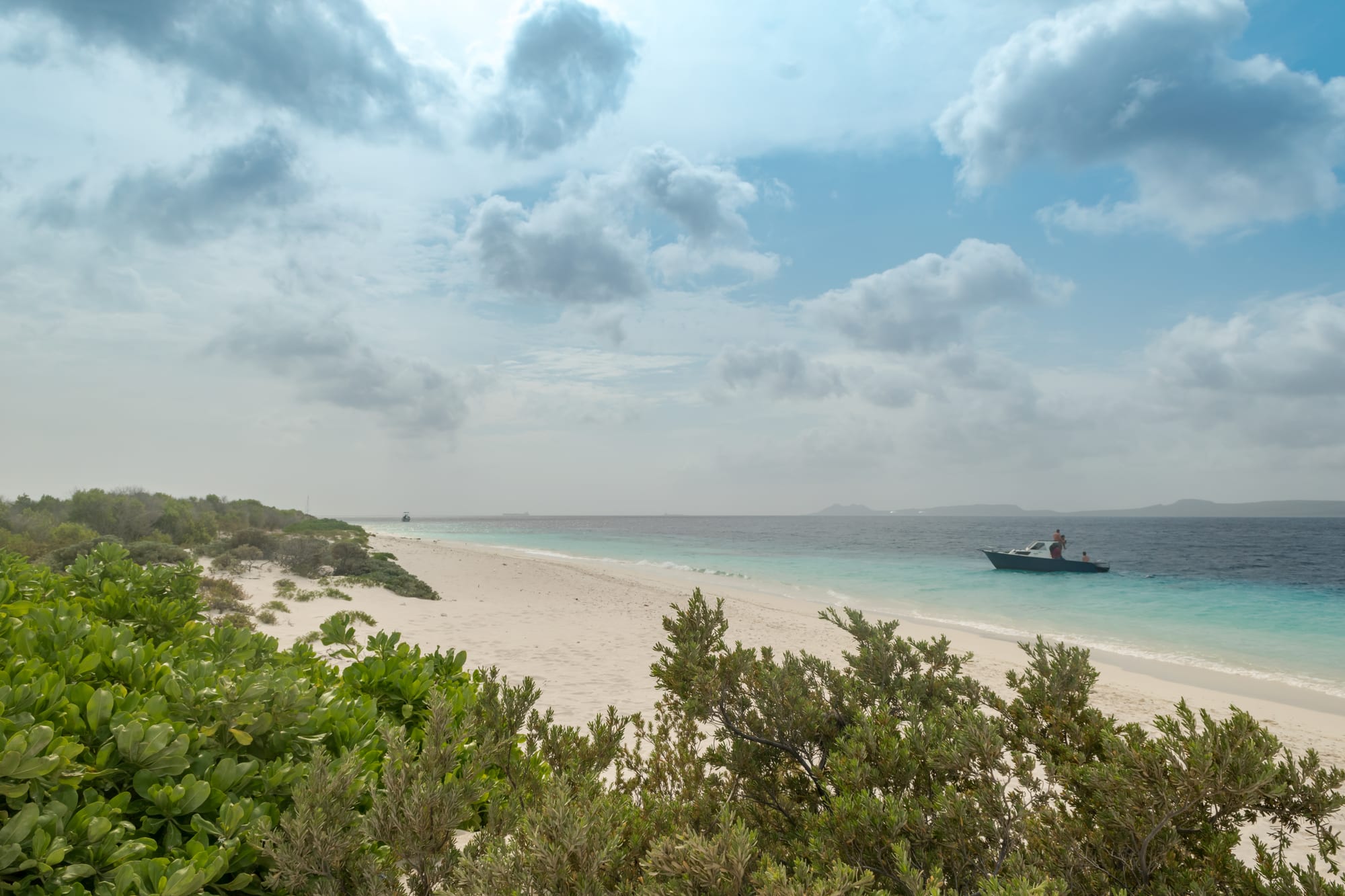
A narrow uninhabited island of pale sand and low scrub ringed by vivid turquoise shallows, seen from the air

Caribbean Netherlands

Klein Bonaire, an uninhabited islet off Bonaire whose reefs form part of one of the Caribbean's oldest marine parks. (dronepicr / Wikimedia Commons · CC BY 2.0)

Three small islands — Bonaire off the Venezuelan coast, and Sint Eustatius and Saba near Sint Maarten — that are "special municipalities" of the Netherlands proper, not autonomous countries, and that use the US dollar. Bonaire is a diving and flamingo destination; Statia and Saba are tiny, steep, and very quiet.

Explore Caribbean Netherlands

History

Bonaire's first people were the Caquetío, an Arawak group; Sint Eustatius and Saba had Amerindian settlers long before Europeans arrived, Statia later home to Island Caribs. The Dutch took Bonaire in 1636 and worked its salt pans with enslaved Africans and Indigenous labour, and the small stone "slave huts" beside the southern salt flats still stand as a memorial. Sint Eustatius — "Statia" — became, in the eighteenth century, "the Golden Rock": a free-trade port so busy that warehouses lined its waterfront, and the first foreign territory to formally salute the flag of the newly independent United States, in November 1776. A British raid in 1781 and the rise of other ports ended its boom. Saba, a single steep volcano with no harbour, was farmed and fished by a small, largely self-reliant population, many of them sailors and boat-builders.

All three were governed as part of the Netherlands Antilles. When the Antilles were dissolved in 2010, Bonaire, Sint Eustatius, and Saba did not become autonomous countries like Curaçao and Sint Maarten; instead they became "special municipalities" — openbare lichamen — of the Netherlands itself, closer in status to a Dutch municipality than to a colony, and in 2011 they switched from the guilder to the US dollar. An administrative intervention by the Dutch government in Sint Eustatius put the island's elected council aside for several years: the council elections due in March 2019 were postponed and finally held in October 2020, and local powers have been handed back in stages.

Culture & Customs

The three islands are culturally distinct from one another. Bonaire is Papiamentu-speaking and closely tied to Curaçao and Aruba, with its own simadan harvest festivals and barí drum and dance traditions, and a strong identity around the sea and the salt.

Saba and Sint Eustatius are English-speaking, with a heritage of seafaring, small-island self-sufficiency, and — on Saba — the drawn-thread needlework known as "Saba lace" and a home-made spiced rum, "Saba Spice". Communities are tiny and tight-knit. Same-sex marriage opened on all three islands in October 2012 and the first such wedding in the Caribbean Netherlands was held on Saba that December.

Church life, community festivals, and, on Saba and Statia, a long tradition of seafaring and of work abroad shape the social fabric.

Daily Life

About 26,500 people live on Bonaire, and only around 3,300 on Sint Eustatius and 2,000 on Saba. As Dutch nationals they are EU citizens, and movement to the Netherlands for education, healthcare, and work is common, especially from the two smaller islands.

Bonaire's economy is dive tourism, the Cargill solar salt works, and some cruise calls, and the island has debated the pace of tourism growth and its strain on water and nature. Sint Eustatius depends on a large oil-storage terminal and on government, and Saba on tourism, a well-regarded offshore medical school, and public-sector jobs. All three rely heavily on Dutch state funding, and the cost of imported goods is high.

Life is quiet and small-scale — on Saba and Statia everyone knows everyone — and organised around the sea, the trails, the church, and the flight or ferry timetable.

Food

Bonaire's food follows Curaçao's Krioyo cooking: stobá (a stew made with goat or beef), funchi (cornmeal paste), kadushi (cactus soup), fresh fish and seafood, and pastechi, the fried crescent-shaped pastries eaten all over the ABC islands, with goat stew and grilled snapper the local favourites.

Saba and Sint Eustatius eat Caribbean-English home cooking: goat water (a spiced goat stew), johnnycakes, saltfish, pea and pumpkin soups, and fresh fish and lobster, with pigeon peas and rice on the side. On Saba, the meal might finish with a nip of Saba Spice, the local aromatic rum.

Imported groceries fill the gaps on all three islands; regional beers, local rums, and fresh juices are the usual drinks, and Bonaire grows small quantities of its own produce despite the dry climate.

Attractions & Natural Wonders

Bonaire is a diving destination first: the entire coastline has been a protected marine park since 1979, shore-diving sites are marked by yellow stones along the coast road, and the reefs off Klein Bonaire are especially rich. On land, Washington Slagbaai National Park covers the arid north with hiking and birdlife; the Pekelmeer sanctuary in the south is one of the Caribbean's few flamingo breeding sites, its water turned pink beside the salt pans; and Lac Bay on the east coast, fringed by mangroves, is a world-class windsurfing spot.

Sint Eustatius is dominated by the Quill, a near-perfect dormant volcanic cone whose crater holds a pocket of tropical forest, reached by a well-made trail from the historic capital, Oranjestad, where the ruins of the eighteenth-century warehouses line the shore. The waters are protected as the Sint Eustatius National Marine Park, and the shipwrecks and anchorages of the trading era are among the many archaeological sites recorded on and around the island.

Saba is essentially one mountain rising from the sea: Mount Scenery, at 870 metres the highest point in the entire Kingdom of the Netherlands, is climbed through cloud forest via more than a thousand stone steps, and the island's other trails — including the old "Ladder" cut into the cliff — link its four tiny villages. Offshore, the Saba Marine Park protects a set of submerged pinnacles that make for dramatic wall diving.

Planning basics

Budget

Bonaire is moderately priced, built around diving, with apartments and guesthouses as well as resorts. Sint Eustatius and Saba have only a handful of small hotels and guesthouses each and little else to spend money on; the cost is getting there, since both are reached by a short, pricey flight or ferry from Sint Maarten.

Daily Budget Midrange
USD 160–330 (hotel or dive lodge, restaurants, car hire, a dive package or boat trip)
Daily Budget Shoestring
USD 70–120 (guesthouse or apartment, self-catering and local snacks, shared or small hire car)

On Bonaire, rent a pickup and buy a marine-park tag for shore diving; for Saba and Statia, book the limited flights from Sint Maarten well ahead.

Visa Requirements

The three islands are part of the Netherlands proper but sit outside the Schengen Area, and as overseas territories of the EU they are not covered by EU law automatically, so Schengen rules do not apply. Citizens of the EU, UK, US, Canada, and many other countries enter visa-free for up to 90 days with a passport; nationals who need a visa require a Caribbean Netherlands visa.

Typical Stay
Up to 90 days visa-free for most Western passports; separate from Schengen

The islands share one visa with Aruba, Curaçao and Sint Maarten rather than using the Schengen visa, though holders of a valid Schengen or UK visa or residence permit may be admitted for up to 90 days; carry proof of onward travel and, for Bonaire, complete any required online arrival form.

Safety

All three islands have low crime and a strong community feel; petty theft from cars and unattended dive gear on Bonaire is the main issue. The real hazards are in the water and on the trails — strong currents on exposed coasts, boat traffic, and steep, slippery hiking on Saba and up the Quill — plus the hurricane risk on Saba and Statia. Medical facilities are basic, and serious cases may need transfer off the island.

Health
Ask locally about drinking tap water; dengue occurs in the region; decompression and dive-accident risk on Bonaire

Follow marine-park rules and dive within your limits on Bonaire, take a guide or good map for Mount Scenery and the Quill, and carry insurance that covers diving and regional evacuation.

Climate

All three are tropical. Bonaire is hot, dry, and breezy year-round and lies outside the main hurricane development region. Saba and Sint Eustatius are greener and a little wetter, cooler with altitude, and fully within the Atlantic hurricane zone (June–November), with a drier season December–April.

Bonaire
Hot, dry, windy; outside the main hurricane development region, though storms occasionally reach it
Saba And Statia
Warm and humid; hurricane season Jun–Nov; drier Dec–Apr

Transportation

Bonaire's Flamingo Airport has flights from the Netherlands, North America, and other Caribbean islands including Curaçao and Aruba; a hire car (usually a pickup for dive gear) is standard. Saba and Sint Eustatius are reached by small aircraft or ferry from Sint Maarten — Saba's airport has the shortest commercial runway in the world, on a shelf between cliffs — and both are small enough to explore on foot with the odd taxi.

Plan Saba and Statia around the limited Winair flights or the ferry from Sint Maarten, and keep buffer days for weather.

Best Time to Visit

Bonaire is good all year; December to April is busiest. For Saba and Sint Eustatius, December to April offers the most settled weather and the lowest hurricane risk, and clearer conditions for hiking and diving.

Events
Bonaire Day (6 September); Statia Day (16 November), marking the 1776 salute to the American flag; Saba Day in early December; Saba Carnival in the last week of July

Currency

Unusually for territory of the Netherlands, the currency is the US dollar, adopted in 2011. Cards are accepted on Bonaire and in the main places on Saba and Statia; carry cash for small shops and market stalls.

Symbol
$
Currency Code
USD — United States dollar

Language

Dutch is an official language on all three, but everyday life differs: Papiamentu (with Dutch and English) is the common language of Bonaire, while English is the everyday and school language of Saba and Sint Eustatius, both historically English-speaking.

Bonaire
Papiamentu, the first language of most Bonaireans; Dutch is the official language; English and Spanish widely spoken
Saba And Statia
English (everyday); Dutch also official