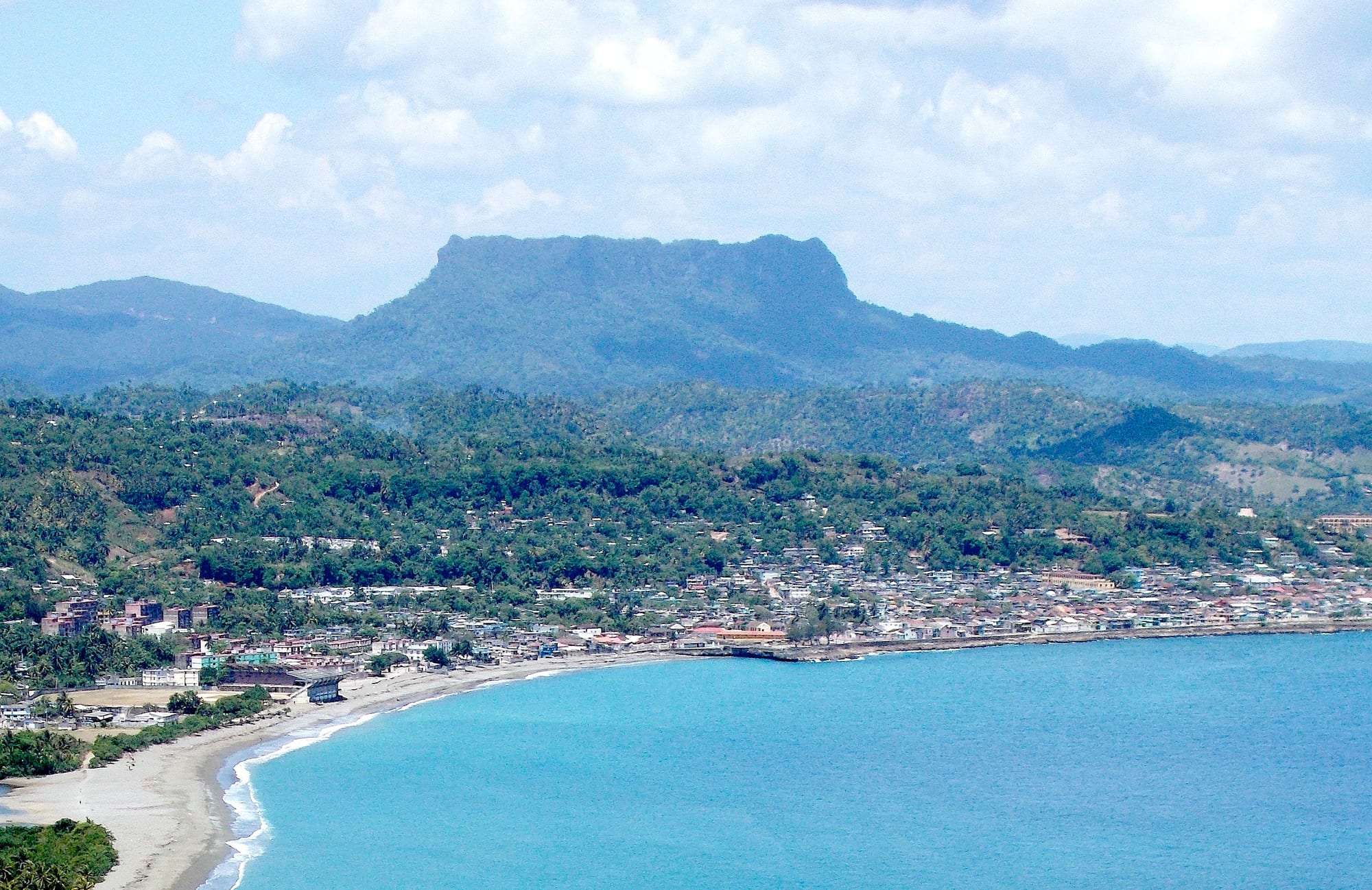
A curving bay of blue water and a sandy beach below the town of Baracoa, with a flat-topped forested mountain behind

Cuba

Santiago de Cuba & the East

Baracoa and its bay, with the flat-topped mountain of El Yunque rising behind the town. (HYanWong / Wikimedia Commons · Public domain)

Cuba's mountainous eastern end, the old Oriente, covering the provinces of Holguín, Granma, Santiago de Cuba and Guantánamo — the region where Columbus landed, where both the independence wars and the 1959 revolution began, and the heartland of son, Afro-Caribbean culture and the Sierra Maestra.

Explore Santiago de Cuba & the East

History

The east is where Cuba's recorded history begins. Columbus made his first landfall on the island in October 1492 on the Holguín coast, near Bariay, and the Taíno of the region left many sites, including the archaeological site of Chorro de Maíta. Diego Velázquez founded Baracoa in 1511, the first Spanish town in Cuba, and the Taíno chief Hatuey, who resisted the conquest, was burned at the stake in 1512. Bayamo followed in 1513 and Santiago de Cuba in 1515; Santiago was the colony's capital until the seat of government moved to Havana in the 16th century.

After the Haitian Revolution in the 1790s, French planters and their enslaved workers fled to the hills around Santiago and Guantánamo and founded coffee estates. The independence struggle began here: on 10 October 1868 Carlos Manuel de Céspedes freed the enslaved people on his estate, La Demajagua, near Manzanillo, and launched the Ten Years' War; Bayamo became the rebel capital, and its residents burned it in 1869 rather than hand it back to Spain. In 1898 US and Cuban forces fought at San Juan Hill outside Santiago, and the Spanish fleet was destroyed leaving the bay. In 1903 the United States leased land on Guantánamo Bay for a naval base, which it still operates; the Cuban government regards the lease as invalid and demands the land's return.

The 1959 revolution also started here, with the 26 July 1953 attack on Santiago's Moncada barracks, the landing of the Granma yacht in 1956 and the guerrilla war in the Sierra Maestra. Fidel Castro was born at Birán in Holguín and his ashes lie in Santiago. In 2021, and again in 2024 in Santiago, residents protested against blackouts and shortages.

Culture & Customs

Orientales see themselves as the most Caribbean, musical and rebellious of Cubans, and Santiago is the capital of that identity. Son, the root of salsa, grew up in the eastern countryside and in Santiago, and guitar-based trova was created by travelling singers of the Oriente, especially in Santiago. Santiago's carnival in July, with its conga bands and comparsas, is the most famous in Cuba, and the Fiesta del Fuego is the city's other great popular festival.

The mix of peoples is unusually rich. Descendants of French and Haitian migrants keep the tumba francesa, a drum and dance tradition of Haitian origin. Guantánamo province gave the world changüí, a rustic style of Cuban music, and lent its name to the song Guantanamera. Haitian labourers who came to work in the early 20th century also left their mark on the east.

Religion is strong and varied. The Basilica of El Cobre, near Santiago, is one of Cuba's most venerated Catholic shrines, visited by Pope Francis in 2015, and the Virgin of Charity is also venerated in Santería as Ochún.

Daily Life

Santiago de Cuba, with about 500,000 people, is the country's second city, and Holguín, with around 350,000, is Cuba's fourth-largest city. Bayamo, Guantánamo and Manzanillo are the other main cities, and Baracoa is a town of a few tens of thousands at the end of a long mountain road. The mountains hold many small farming communities.

The economy rests on farming — coffee, cacao, coconut, sugar and cattle — and on nickel mining around Moa in Holguín. Santiago has a port and an oil refinery, and tourism is concentrated at Guardalavaca, Santiago and Baracoa.

The east is poorer than the west, and the crisis is felt hardest here. Blackouts of many hours a day, water shortages and damage from hurricanes, including Matthew in 2016 and Melissa in 2025, have left many homes in poor condition. Migration to Havana and abroad is heavy, and many families depend on remittances.

Food

Eastern cooking has its own identity. Congrí, rice cooked with red beans, is the eastern version of the national dish, and pork roasted in the open for fiestas is the centrepiece of any celebration. Baracoa, with its coconut and cacao plantations, has the most distinctive food of the region: bacán, made from bananas and wrapped in a banana leaf, and cucurucho, a sweet of coconut, sugar and fruit such as orange, guava or pineapple wrapped in a palm leaf. Baracoa is also Cuba's main chocolate-making area.

Coffee has been grown in the mountains around Santiago and Guantánamo since French planters arrived from Haiti, and bananas, coconut and cacao come from the Baracoa area.

Santiago is the birthplace of Bacardí rum, founded in the city in 1862; the family company left Cuba after the government confiscated its Cuban assets in 1960.

Attractions & Natural Wonders

Santiago de Cuba is the main base. Its colonial centre holds the cathedral. The Moncada barracks is now a school and museum, the Santa Ifigenia cemetery holds the tombs of José Martí and Fidel Castro, and the Castillo del Morro, a UNESCO World Heritage Site, guards the entrance to the bay. Outside the city are the Basilica of El Cobre and San Juan Hill.

The Sierra Maestra runs along the south coast. Pico Turquino, Cuba's highest peak at about 1,970 metres, can be climbed with guides, and the Comandancia de la Plata, the rebel headquarters, is reached on foot. On the coast of Granma, the Desembarco del Granma National Park marks the 1956 landing and has marine terraces listed by UNESCO. Bayamo keeps its Plaza del Himno and Céspedes' birthplace.

In the north-east, Baracoa is ringed by rivers, beaches and El Yunque, a flat-topped mountain climbed on a guided trail, and the rainforests of Alejandro de Humboldt National Park, a UNESCO World Heritage Site. Holguín province has the beaches of Guardalavaca, the Chorro de Maíta archaeological site, the old port of Gibara and Bariay's Columbus monument.

Cities in Santiago de Cuba & the East

Planning basics

Budget

The east is one of the cheaper parts of Cuba. Casas particulares and paladares in Santiago, Baracoa, Bayamo and Holguín cost less than in Havana or Trinidad, though choice is thinner and shortages are often worse. The Guardalavaca resorts are sold mostly as packages, and guided treks in the Sierra Maestra and Alejandro de Humboldt park add to the cost.

Daily Budget Midrange
USD 80–180 (a good casa or hotel, paladar dinners, private drivers, guided hikes)
Daily Budget Shoestring
USD 30–55 (casa particular with home-cooked meals, buses and colectivos)

Bring enough cash for the whole eastern trip, since exchange and card options are scarcer here than in Havana.

Safety

The east is safe for visitors in terms of violent crime, but daily hardship is severe: power cuts are among the longest in the country, and water and food shortages are common, especially since recent hurricanes. Santiago has hustling and petty theft in the centre. In the mountains the risks are steep trails, heat and heavy rain.

Carry water, basic medicines and a torch, hike with a licensed guide, and do not approach or photograph the military zone around Guantánamo Bay. Check current official travel advice before travelling.

Climate

The hottest region of Cuba. Santiago and the south coast, sheltered by the Sierra Maestra, are hot and fairly dry, and the coast east of Guantánamo is semi-arid, with cacti. Baracoa and the north-eastern mountains are the wettest part of the island, covered in rainforest. The high Sierra Maestra is cool and misty. Hurricanes are a serious risk, and Hurricane Melissa caused heavy damage here in 2025.

Summer
very hot, often 32–35°C in Santiago, with heavy rain in Baracoa and the mountains
Winter
warm, around 27–30°C on the coast, cool nights in the Sierra Maestra

Transportation

Santiago and Holguín have international airports, and Bayamo and Baracoa have smaller domestic ones. By road Santiago is the best part of a day from Havana by bus or train. Víazul buses and colectivos link Santiago, Bayamo, Holguín and Guantánamo, and the La Farola road climbs over the mountains from the south coast to Baracoa, a journey of several hours. The Sierra Maestra is reached from Bartolomé Masó and the surrounding villages in Granma, and treks are made with guides.

Allow extra days in the east: long distances, fuel shortages and hurricane damage to roads can delay any journey.

Best Time to Visit

December to April is the driest and most comfortable season, and the best time for climbing Pico Turquino or walking around Baracoa. Santiago celebrates its carnival in July, a hot but lively time to come. September and October carry the highest hurricane risk.