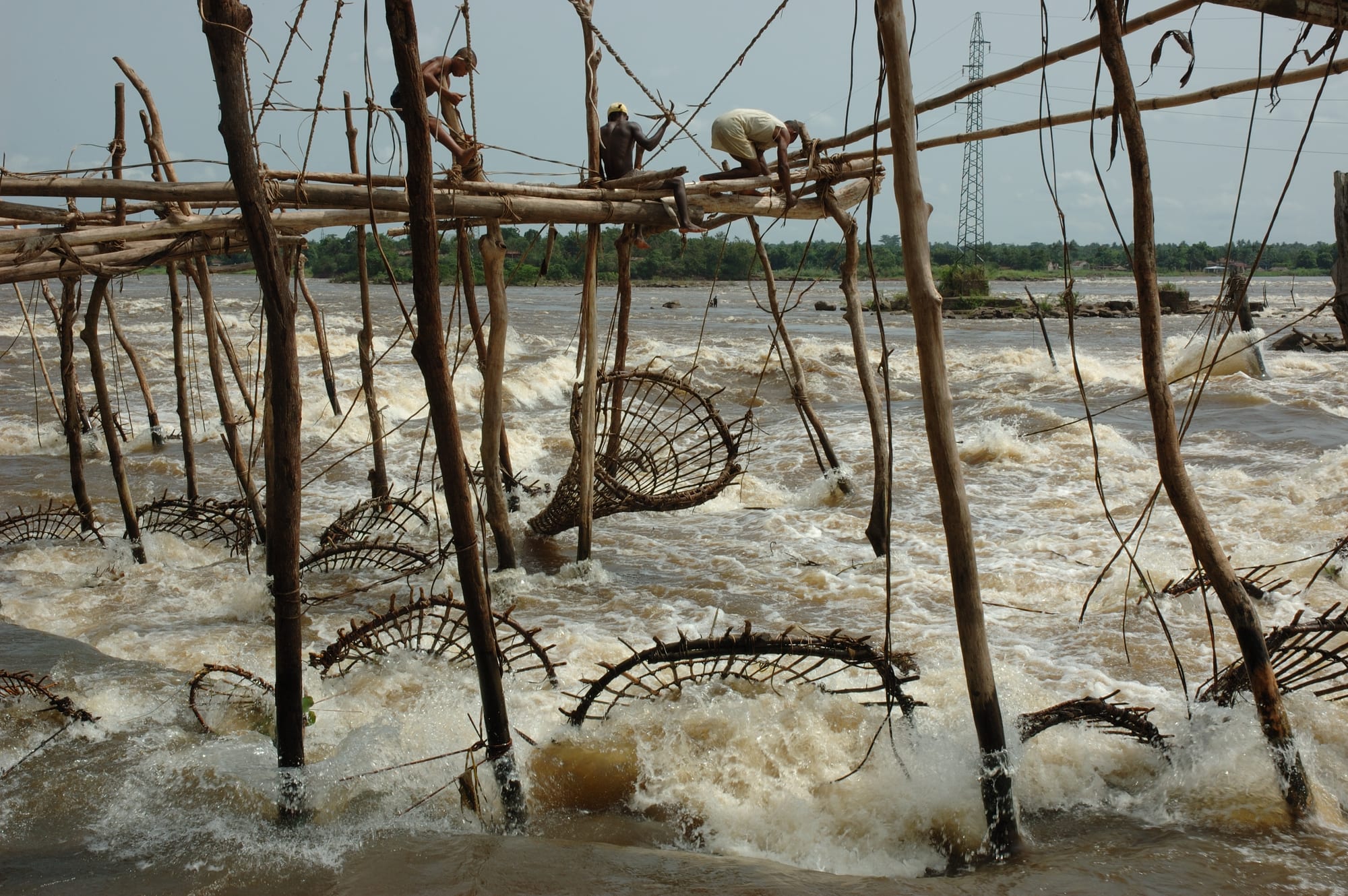
Wooden poles and conical fish traps set in foaming brown rapids, with fishermen working on a timber frame above

Democratic Republic of the Congo

Kisangani & the North

Wagenya fish traps on the Wagenia falls, the last of the Boyoma Falls, at Kisangani. (Julien Harneis / Wikimedia Commons · CC BY-SA 2.0)

The north-eastern DR Congo, from Kisangani at the head of navigation on the Congo River through the Ituri forest to the Uélé savannas and the Ugandan and South Sudanese borders — a region of great rainforest, gold, the okapi and the Mbuti, marked by repeated wars and, in Ituri, by armed conflict that continues today.

Explore Kisangani & the North

History

The Ituri forest has long been home to the Mbuti hunter-gatherers, who trade meat, hides and other forest products with neighbouring farming peoples. In the north, the Mangbetu and Azande built powerful kingdoms in the 18th and 19th centuries. From the east came the Swahili-Arab trading networks of Tippu Tip, who dealt in ivory and slaves and was made governor of the Stanley Falls district by the Congo Free State in 1887 before war broke out between the Free State and the Arab traders in the 1890s.

Henry Morton Stanley founded a station at the Boyoma Falls in 1883 that became Stanleyville. Under the Free State and Belgian rule the north supplied rubber, ivory, cotton and gold, and gold from the Kilo-Moto belt in Ituri and Haut-Uélé was mined commercially from 1905. Stanleyville became Patrice Lumumba's political stronghold, and after his murder his supporters set up a rival government there. In 1964 Simba rebels took the city and held foreign hostages until Belgian paratroopers, flown in by US aircraft, retook it; the city was renamed Kisangani in 1966.

During the Second Congo War, the Rwandan and Ugandan armies fought each other in Kisangani in 2000, killing around a thousand people, most of them civilians. Ituri descended into conflict between Hema and Lendu militias from 1999, and in 2012 the Ituri warlord Thomas Lubanga became the first person convicted by the International Criminal Court. The Lord's Resistance Army attacked villages across the Uélé provinces from the late 2000s, and violence in Ituri revived from 2017.

Culture & Customs

Kisangani is a meeting point of languages: Lingala from the river and Swahili from the east are both widely spoken, alongside French. The Uélé provinces are home to the Azande and Mangbetu, and Ituri to the Hema, Lendu, Alur, Bira and many others, as well as the Mbuti of the forest.

The Mangbetu are famous for their art — carved harps and anthropomorphic pots — and for the old aristocratic custom of binding infants' heads to create an elongated skull, admired as a sign of beauty; the custom has died out. Mbuti polyphonic singing, performed in the forest, has fascinated musicologists for decades. Around Kisangani the Wagenya fishing families still use their own trap-fishing technique at the falls.

Most people are Christian, with many Catholic, Protestant and revival churches. Community identity is powerful in Ituri, where competition over land, cattle and mines between groups has fuelled conflict.

Daily Life

Kisangani, capital of Tshopo, is the country's fifth-most populous urban area, with well over a million people, a university and a river port. Bunia, Isiro and Buta are the other provincial capitals, and Bunia has grown fast as displaced families arrived from the countryside. Most people farm cassava, rice, plantain and beans, or fish the rivers.

Gold is the great economic force. The Kibali mine in Haut-Uélé is one of Africa's largest gold mines, while in Ituri thousands of artisanal miners dig around Mongbwalu and elsewhere, often in areas contested by armed groups. Timber, palm oil and river trade support Tshopo, and oil has been found in the Lake Albert basin.

Daily life in Kisangani moves at a slow, river-town pace, with motorbike taxis, markets full of smoked fish and forest produce, and evening music. In Ituri, displacement camps, curfews and the constant threat of attack shape the rhythm of life for hundreds of thousands of people.

Food

Around Kisangani the table is set by the river and the forest: grilled and smoked fish, cassava as fufu or chikwangue, pondu, plantain and rice, with palm-oil sauces and plenty of chilli. Forest foods, including mushrooms, caterpillars in season, honey and bushmeat, are sold in the city's markets, although trade in protected species is illegal.

In Ituri's highlands the diet shifts east: beans, sweet potatoes, maize, bananas and vegetables grown on the plateau, fresh fish from Lake Albert, and milk and beef from the cattle of Hema herders. Maize or cassava dough, called ugali in Swahili, is the daily staple, eaten with beans or vegetables.

Palm wine is widely drunk in Tshopo and the Uélé provinces, and banana and sorghum beers are brewed at home in the east. Tea with sugar and milk is common in Bunia.

Attractions & Natural Wonders

Kisangani stands where the Boyoma Falls, a chain of seven cataracts on the upper Congo (Lualaba), end and the river becomes navigable downstream. At the last of them, the Wagenia falls, Wagenya fishermen set conical basket traps in the rapids from scaffolds of timber poles, a sight that became one of the most photographed in the Congo. Downstream, the Yangambi Biosphere Reserve protects rainforest around a historic agricultural research station, and the Tshopo falls lie on the Tshopo river near the city.

To the east, the Okapi Wildlife Reserve covers a large part of the Ituri rainforest around Epulu, where a conservation station has studied and protected the okapi, the forest giraffe found only in the DR Congo. The reserve is a UNESCO World Heritage Site and home to Mbuti communities. Further east, Bunia sits on the plateau above Lake Albert, whose western shore belongs to Ituri.

In the far north-east, Garamba National Park, established in 1938 and a UNESCO World Heritage Site, protects savanna and woodland with elephants, buffaloes, hippos and the last Kordofan giraffes in the country; its northern white rhinos were lost to poaching.

Cities in Kisangani & the North

Planning basics

Budget

Costs are high relative to what is on offer. Kisangani has a few hotels used by aid workers, traders and the UN, priced in US dollars, while Bunia and Isiro have basic lodging. Garamba is visited, when it accepts visitors, as an expensive fly-in trip organised with its managers. Flights and security arrangements are the main costs.

Daily Budget Midrange
USD 150–300 (hotel in Kisangani, driver, meals), before flights and any park fees
Daily Budget Shoestring
Not realistically applicable for visitors

Carry clean US dollar notes and arrange any travel beyond Kisangani through an organisation with people on the ground.

Safety

Ituri is part of the eastern conflict zone. Armed groups including the CODECO militia, drawn largely from the Lendu community, and the Allied Democratic Forces, an Islamic State-affiliated group of Ugandan origin, have killed thousands of civilians in massacres and attacks on villages, camps and churches, and large numbers of people have been displaced. Ituri has been under a military "state of siege" since 2021. An Ebola epidemic first reported in Ituri in May 2026 has killed thousands of people in the eastern DR Congo, and the WHO declared it a public health emergency of international concern. The Uélé provinces see banditry and poaching gangs, and Kisangani, while calmer, has crime and occasional unrest.

Globeway covers the DR Congo so it can be understood, not to encourage travel there now. Most governments advise against all travel to Ituri and against all but essential travel to much of the rest of the region. Check current official travel advice before travelling.

Climate

Kisangani and the Ituri forest are equatorial — hot, humid and wet through most of the year. North towards the Uélé rivers and Garamba the forest gives way to savanna with a clear dry season from about December to February. Bunia, on a plateau at around 1,200 metres, is noticeably cooler than the lowlands.

Summer
hot and humid in the lowlands, 21–31°C, with frequent storms; milder on the Bunia plateau
Winter
equatorial rain continues around Kisangani; a dry season from about December to February in the north

Transportation

Kisangani's Bangoka airport has flights to Kinshasa and eastern cities, and barges link Kisangani downstream to Kinshasa over several weeks. Roads east to Bunia and north to Buta and Isiro are long, rough and often cut in the rains, and the road through the Ituri forest via Epulu is exposed to armed attacks. Bunia has flights, and Garamba is reached by light aircraft.

Do not travel overland between Kisangani and Ituri; use flights and follow the guidance of organisations working in the area.

Best Time to Visit

The drier months, roughly December to February in the north and the short breaks between rains around Kisangani, make roads easier. Garamba is best seen in the dry season when grass is short. Security in Ituri and the Uélé provinces, not season, is the deciding factor.