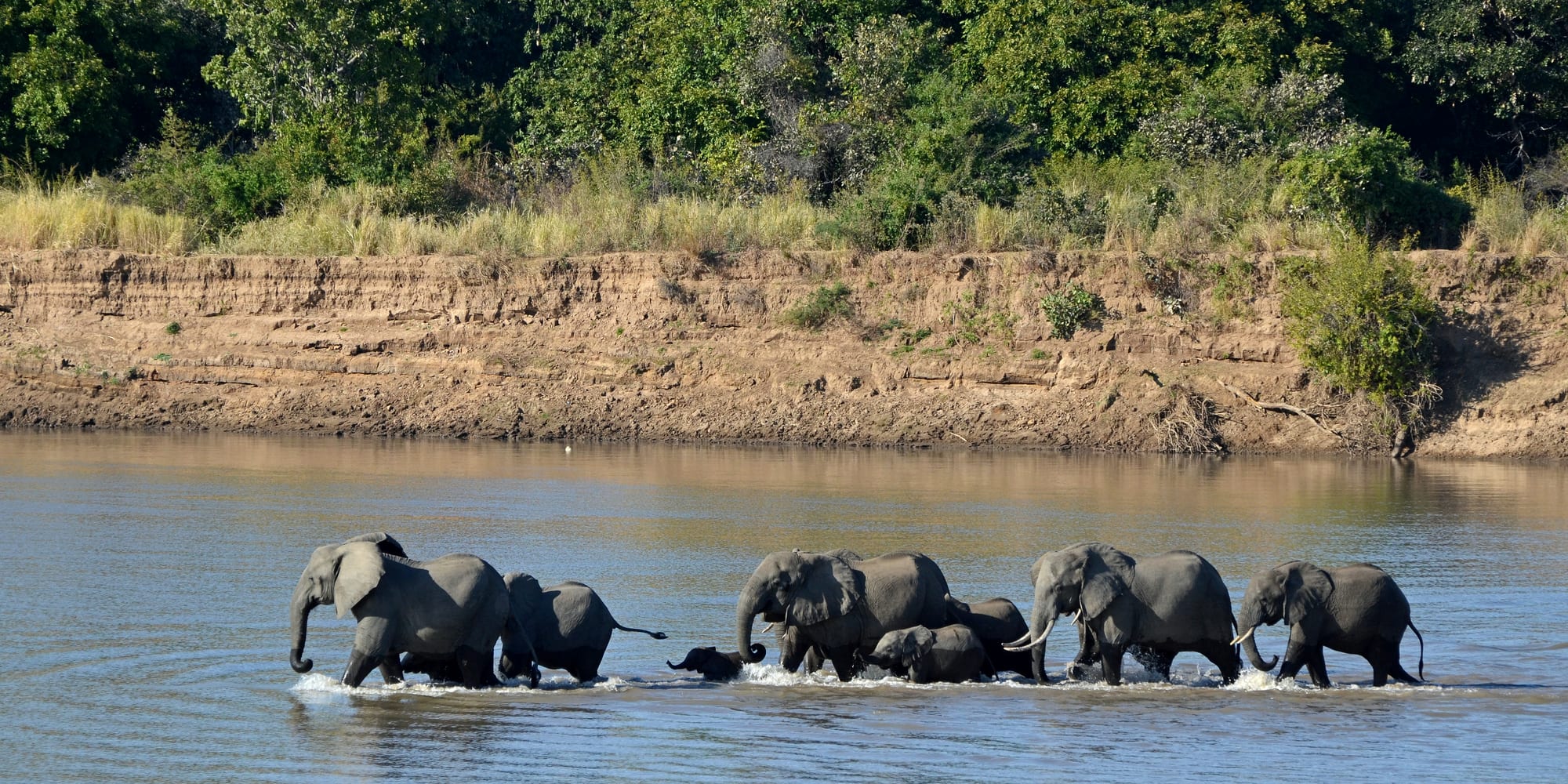
A herd of elephants with calves wading across a shallow river beneath a sandy bank and green bush

Zambia

Lusaka, the Copperbelt & the Luangwa Valley

Elephants crossing the Luangwa River in South Luangwa National Park, eastern Zambia. (Geoff Gallice / Wikimedia Commons · CC BY 2.0)

Zambia's populous heart and its eastern wilds — the capital Lusaka, the old mining town of Kabwe and the Copperbelt cities of Ndola and Kitwe along the line of rail, and to the east the Luangwa Valley, Chipata and the Lower Zambezi, home to the country's best-known safari parks.

Explore Lusaka, the Copperbelt & the Luangwa Valley

History

The region holds one of Africa's most famous early human fossils: the Broken Hill skull, found in 1921 in a mine at what is now Kabwe and dated to around 300,000 years ago. Much later, Bantu-speaking farmers settled the plateau, and by the nineteenth century the east was home to Chewa chiefdoms linked to the old Maravi states. In the 1830s the Ngoni, who had fled the upheavals in southern Africa, crossed the Zambezi, and one branch under Mpezeni settled in the highlands around present-day Chipata.

The British South Africa Company defeated Mpezeni in 1898 and founded Fort Jameson, today's Chipata, as the capital of North-Eastern Rhodesia. The railway from the south reached Broken Hill in 1906, drawing a line of settlement that still shapes the country. From the late 1920s large copper deposits were developed on the Copperbelt, and company towns at Luanshya, Kitwe, Mufulira and Chingola grew around the shafts, with Ndola as the commercial centre; strikes by African miners in 1935 and 1940 became landmarks in the rise of nationalism. Lusaka, a small railway siding, was chosen as the colonial capital and took over from Livingstone in 1935.

After independence in 1964 the mines were nationalised and then privatised around 2000, bringing new owners from India and elsewhere. The Chinese-built TAZARA railway from Kapiri Mposhi to Dar es Salaam, opened in the 1970s, gave the copper an outlet that avoided white-ruled Rhodesia.

Culture & Customs

This is Zambia's most mixed region. Lusaka draws people from every province, and Nyanja is its street language, while Bemba dominates the Copperbelt, where decades of migration to the mines produced an urban culture of its own. The Copperbelt is also the heart of Zambian football: Kitwe's Nkana and Power Dynamos are among the country's best-supported clubs.

The east keeps older traditions. The Ngoni hold N'cwala each February at Mutenguleni near Chipata, when the paramount chief tastes the first fruits of the harvest and regiments perform warrior dances. The Chewa gather for Kulamba near Katete, and their masked Nyau societies perform the Gule Wamkulu dances, which UNESCO lists as intangible heritage shared with Malawi and Mozambique. Tumbuka, Nsenga and Kunda communities also live in the province, and Kunda villages border South Luangwa.

Music moves between the two worlds. The 1970s Zamrock scene, with bands such as WITCH, grew out of the towns, and today gospel choirs, kalindula and Zambian hip-hop share the minibus radios. Churches of every denomination fill on Sundays, and greetings, handshakes that clasp the forearm and deference to elders matter in city and village alike.

Daily Life

Lusaka is by far the largest city, with more than two million people, a sprawl of planned suburbs, markets and unplanned compounds spreading out from Cairo Road. Kitwe and Ndola are the next largest cities in the country, each with several hundred thousand people, followed by the other Copperbelt towns and by Kabwe. Chipata is the main town of the east, a trading centre close to the Malawi border.

The Copperbelt lives by copper: large mines around Chingola, Kitwe, Mufulira and Luanshya, smelters, contractors and the services that feed them, with fortunes tied to the world price. Kabwe's old lead and zinc mine left a severe pollution problem that still affects the town. Central and Eastern provinces are farming country, growing maize, cotton, groundnuts and tobacco, and the Luangwa and Lower Zambezi valleys depend on safari tourism for jobs.

Days start early: minibuses fill before dawn, and market traders are set up by seven. Load-shedding during droughts has forced businesses onto generators, and the cost of maize meal and fuel dominates conversation. Evenings in the cities centre on bars, churches and televised football.

Food

Nshima, the stiff maize porridge, anchors every meal here as elsewhere, eaten by hand with relishes. Around Lusaka and the east, typical accompaniments are chibwabwa (pumpkin leaves), kalembula (sweet potato leaves) and delele (okra), often cooked with pounded groundnuts, along with beans, dried kapenta and village chicken. Bream from the Kafue and the Zambezi appears grilled or stewed.

The Copperbelt's Bemba kitchen adds ifisashi, greens simmered in groundnut sauce, and chikanda, a savoury loaf made from the tubers of wild orchids and ground peanuts, nicknamed "African polony". Caterpillars and flying termites are eaten in season. Street food in Lusaka includes grilled meat, roasted maize cobs and vitumbuwa, small fried dough balls.

Munkoyo, a lightly fermented drink made from maize and a root, is sold in villages and markets, and Chibuku, the thick sorghum beer, remains the cheap social drink, while bottled Mosi lager is the national beer.

Attractions & Natural Wonders

South Luangwa National Park is the region's great sight: the Luangwa River loops through the valley past oxbow lagoons and ebony groves, with dense populations of leopard, elephant, hippo and Thornicroft's giraffe. Most visitors arrive through Mfuwe, the village and airport outside the main gate, and the walking safari associated with Norman Carr remains the park's speciality. Chipata, a few hours south-east, is the gateway town for the valley and the Malawi border.

The Lower Zambezi National Park stretches along the river below the Zambezi escarpment, facing Mana Pools across the water; canoe trips pass hippos and elephants on the floodplain, and fishing for tigerfish is popular in the adjoining Chiawa area. Lusaka, the capital, is a working city rather than a sightseeing one, but its National Museum and markets reward a day.

North of Lusaka, Kabwe has the old Broken Hill mine and a colonial main street, and Kasanka National Park stages its bat gathering at the start of the rains. Nearby, the Livingstone memorial at Chitambo marks where the explorer died in 1873. On the Copperbelt, Ndola has the memorial at the site of the 1961 air crash that killed the UN secretary-general Dag Hammarskjöld, Kitwe is the base for mine country, and the Chimfunshi chimpanzee sanctuary lies west of Chingola.

Cities in Lusaka, the Copperbelt & the Luangwa Valley

Planning basics

Budget

The region holds both ends of the Zambian price scale. Lusaka and the Copperbelt towns have cheap buses, markets and local guesthouses alongside business hotels, while South Luangwa and the Lower Zambezi are safari country, where park fees, guided activities and all-inclusive camps are priced in US dollars. Mfuwe has a few budget campsites and lodges outside the park gate that bring South Luangwa within reach of independent travellers.

Daily Budget Midrange
USD 130–300 (city hotels, private transfers, some guided game drives)
Daily Budget Shoestring
USD 40–75 (guesthouses or camping, buses, market meals; Mfuwe campsites with park fees on top)

Price safari camps as packages including transfers and park fees, and look at the green season (roughly November to March) for lower rates.

Safety

The region is calm by regional standards. Pickpocketing and bag-snatching are the main risks in Lusaka's markets, bus stations and city centre after dark, and the long highways carry heavy truck traffic. In the parks the hazards are wildlife: hippos and crocodiles in the rivers, elephants around unfenced camps. Power cuts affect the cities during droughts.

Use registered taxis at night in Lusaka and the Copperbelt, take malaria precautions, and follow camp rules about walking after dark. Check current official travel advice before travelling.

Climate

Lusaka and the Copperbelt sit on the plateau at roughly 1,200–1,300 metres, which keeps them pleasant for most of the year, with cool, dry winter nights and a wet season of heavy afternoon storms; the Copperbelt receives more rain than Lusaka. The Luangwa and Zambezi valleys lie far lower and are much hotter, with October days that regularly pass 40°C.

Summer
warm to hot and wet on the plateau, around 25–30°C; very hot in the valleys before the rains
Winter
dry and sunny, with days around 23–26°C and cold nights in Lusaka; mild in the valleys

Transportation

Kenneth Kaunda International Airport at Lusaka is the national gateway, and Ndola has its own international airport for the Copperbelt. The Great North Road runs from Lusaka to Kabwe and on to the Copperbelt, and the Great East Road crosses the Luangwa to Chipata, a full day's drive, with Mfuwe a few hours beyond. Scheduled light aircraft fly from Lusaka to Mfuwe, and Lower Zambezi camps are reached by road and boat from the Chirundu side or by airstrip. The TAZARA railway to Tanzania starts at Kapiri Mposhi.

Fly to Mfuwe if time is short; if driving the Great East Road, travel by day and allow for slow trucks and police checks.

Best Time to Visit

June to October is the prime safari season in South Luangwa and the Lower Zambezi, as the bush thins and animals gather at the rivers; September and October are hottest and best for game. Many Lower Zambezi camps close in the rains, while some Luangwa lodges stay open for green-season boat safaris. The cities are comfortable from May to August, Kasanka's bats gather from October to December, and N'cwala falls in February.