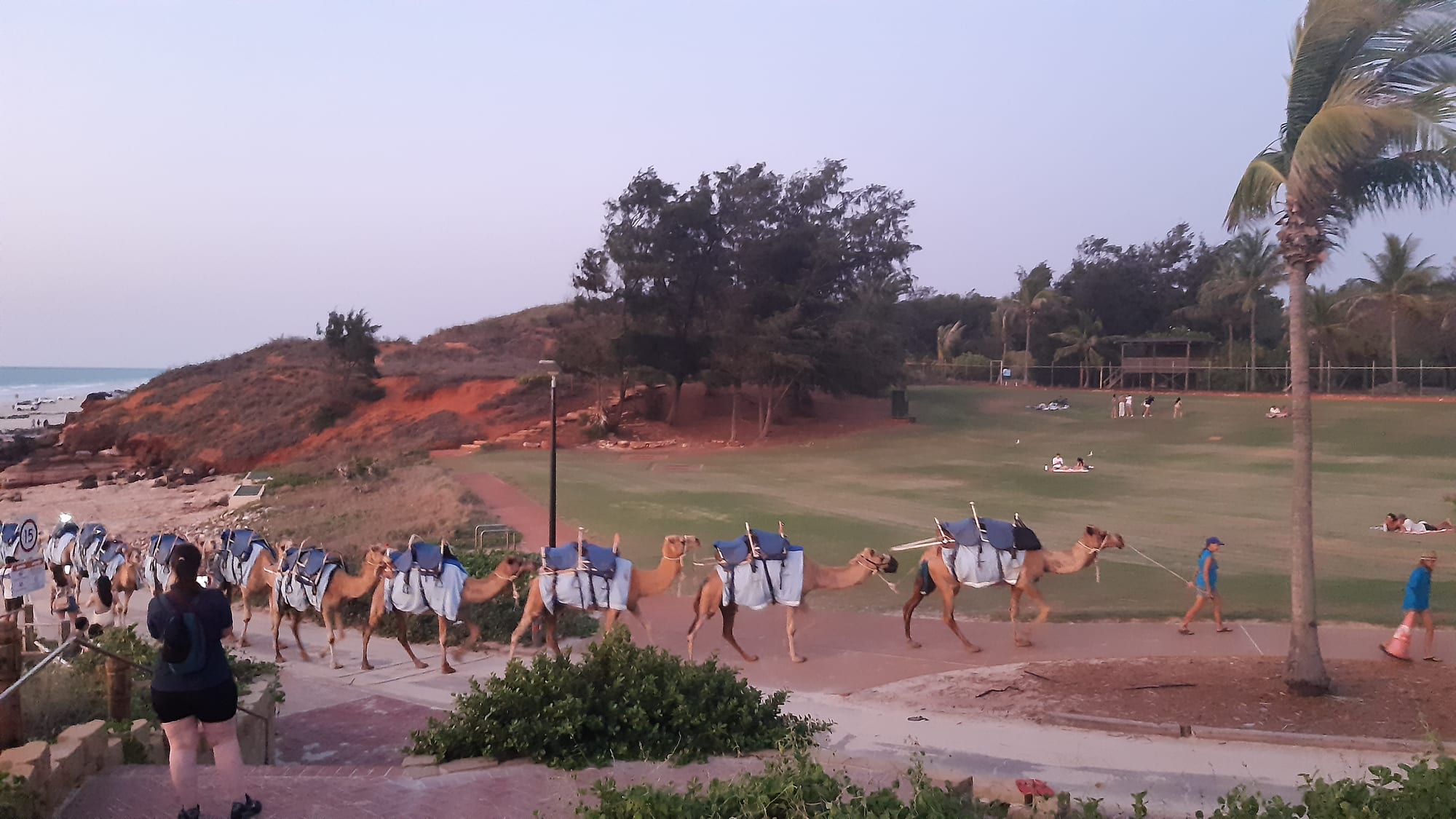
A train of saddled camels led in single file along a path above Cable Beach at dusk, with red cliffs and the sea behind

Western Australia, Australia

Broome

A camel train at dusk beside Cable Beach, with the red cliffs of the foreshore behind. (Ridiculopathy / Wikimedia Commons · CC0)

A tropical town of about 15,000 people on the Kimberley coast of Western Australia, between the red cliffs and white sand of Cable Beach and the tidal mudflats of Roebuck Bay. Built on pearl shell from the 1880s by Japanese, Chinese, Malay, Filipino and Aboriginal crews, it is the gateway to the Kimberley and the mixed-descent town that pearling left behind.

Neighbourhoods

  • Chinatown and the town centre
    • First-time visitors
    • Historic district
    • Best for food

    The old pearling quarter on Roebuck Bay, a few blocks of corrugated iron and lattice verandahs around Carnarvon Street and Dampier Terrace. Pearl showrooms, restaurants, galleries, the open-air cinema and the small jetty in the mangroves are all here, and the airport is a short walk away.

    Open in Maps
  • Cable Beach
    • Beaches
    • Resorts
    • Sunsets

    The resort side of town, about six kilometres west over the peninsula, where the long white beach faces the Indian Ocean. Hotels, holiday apartments, a caravan park and a handful of restaurants sit behind the dunes, and the sunset crowd gathers on the sand every evening in the dry season.

    Open in Maps
  • Old Broome and Town Beach
    • Quiet and residential
    • Historic homes
    • Sunrises

    The streets between Chinatown and the bay, with mango trees, bungalows on stilts, the old courthouse gardens and the shaded lawns of Bedford Park. Town Beach looks east over the mudflats, which is why the full-moon crowds and the night markets come here.

    Open in Maps
  • Djugun and Broome North
    • Quiet and residential
    • Close to shops
    • Families

    The everyday suburbs inland from the two centres, where most residents actually live, holding the main shopping centre, the hospital, the schools and the sports grounds. Quiet, unremarkable and useful, with the cheaper motels and self-contained units.

    Open in Maps

Things to do

Beaches and the coast

  • Cable Beachbeach

    Twenty-two kilometres of white sand named after the telegraph cable laid to Java in 1889, with vehicles allowed on the northern half and camel trains crossing the sand at sunset.

    Open in Maps
  • Gantheaume Pointviewpoint

    Red sandstone ledges about six kilometres from the centre, where dinosaur footprints around 130 million years old are exposed in the rock offshore at very low tide.

    Open in Maps
  • Roebuck Bayattraction

    The shallow bay on the town's eastern side, whose mudflats turn turquoise and ochre on the tide and feed more than 300,000 migratory waders a year on their way to and from northern-hemisphere breeding grounds.

    Open in Maps
  • Town Beachbeach

    A small sheltered beach and park on the bay below the old town, used for swimming at high tide, for night markets and for watching the full moon rise over the mudflats.

    Open in Maps

Chinatown and the pearling story

  • Sun Pictureslandmark

    An open-air picture garden in Chinatown that has shown films since December 1916 and is recorded as the world's oldest picture gardens still in operation, with deckchairs under the stars.

    Open in Maps
  • Japanese Cemeterylandmark

    The resting place of 919 Japanese divers who died working in the pearling fleet, of the bends, in cyclones or at work on the luggers.

    Open in Maps
  • Streeter's Jettylandmark

    A short timber jetty running out through the mangroves from Dampier Terrace, built for the pearling luggers, with a colony of some 50,000 flying foxes living in the mangroves beside it.

    Open in Maps

Wildlife and trips out of town

  • Broome Bird Observatoryattraction

    A research station and campsite in pindan woodland on the northern shore of Roebuck Bay, about 24 kilometres out, running tours and courses beside a bay with the highest diversity of migratory waders in Australia.

    Open in Maps
  • James Price Pointviewpoint

    Red pindan cliffs dropping straight to the sea about 50 kilometres north, known to Yawuru people as Walmadany and once proposed as the site of a gas processing hub and the focus of a long campaign against it.

    Open in Maps

Seasonal events

  • Staircase to the Moonfull moons from March to October

    An optical effect in which the rising full moon reflects off the exposed mudflats of Roebuck Bay as a ladder of light, watched from Town Beach with night markets alongside.

  • Shinju MatsuriAugust or September

    The Festival of the Pearl, the town's annual celebration of the mixture of cultures that the pearling industry brought together, with a parade, food stalls and ceremonies.

Eat and drink

Long-standing places and food districts in Broome. Hours, ratings and directions come from your maps app, always current.

Chinatown and the centre

  • Chinatownneighborhood

    The densest run of eating in town, where Chinese, Malay, Japanese and Indonesian kitchens sit beside modern Australian restaurants, pearl showrooms and cafés in old shopfronts.

    Open in Maps

The beaches

  • Cable Beachneighborhood

    A small cluster of restaurants, bars and a beach club behind the dunes, where the evening is arranged around the sunset and a table facing west.

    Open in Maps
  • Town Beach night marketsmarket

    Food vans and stalls on the lawn above the bay on Staircase to the Moon nights, selling noodles, curries, tropical juices and desserts to the crowd waiting for the moon.

    Open in Maps

Experience Broome

History

The land and waters around the town are Yawuru country, and Rubibi is the Yawuru name for the area the town was built on. Middens, fish traps and story places line Roebuck Bay, and the coast was visited by Makassan and, later, European seafarers long before settlement — the English buccaneer William Dampier explored this coast in 1699 in HMS Roebuck, the ship that gave the bay its name.

Pearl shell built Broome. Beds of mother-of-pearl were being worked along the coast from the 1860s, at first by Aboriginal divers, many of them coerced or effectively enslaved, and the town was laid out in 1883 and named after a governor of the colony. Hard-hat diving from luggers followed, crewed by Japanese, Malay, Chinese, Filipino and Koepanger men brought in under exemptions to Australia's restrictive immigration laws. By the early 1900s some 300 luggers worked out of Broome, a fleet that peaked at 403 in 1913, and about 3,500 of the town's 5,000 people worked in the industry, at a terrible price: divers died of the bends, and cyclones destroyed fleets and drowned hundreds of men.

Plastic buttons ended the shell trade after the Second World War, during which Japanese residents were interned and, in March 1942, an air raid on the flying boats in Roebuck Bay killed at least eighty-eight people, many of them Dutch refugees from Java. Cultured pearls revived the industry from the 1950s, and tourism followed in the 1980s, when Chinatown was restored and the first resort opened behind Cable Beach. Yawuru native title was recognised in 2006 and confirmed by a Federal Court decision in 2010.

Culture & Customs

Broome's defining feature is its mixture. Generations of intermarriage between Aboriginal families and the Japanese, Chinese, Malay, Filipino and Timorese men of the pearling fleet produced a community that is neither one thing nor another and is proud of it, with its own surnames, its own cooking and, in the lugger years, its own pidgin. The Shinju Matsuri festival, the Festival of the Pearl, celebrates that mixture every year.

Yawuru culture underpins the town. Yawuru people mark six seasons rather than four — Barrgana, Wirlburu, Laja, Marrul, Wirralburu and Man-gala — reading them from the winds, the flowering of plants and the movement of fish, and Yawuru rangers now help manage the bay and the conservation reserves around the town. Kimberley pearl shell is carved and incised as riji, worn and traded across the region, and galleries in Chinatown sell work from art centres across the Kimberley and the desert.

Daily manners are relaxed to the point of parody — bare feet, no hurry, the phrase Broome time offered as both apology and explanation. Life is lived outdoors in the dry season and indoors under fans in the wet, and football fills the winter social calendar, while the open-air cinema in Chinatown has been showing films since 1916.

Daily Life

About 15,000 people live in Broome, roughly a quarter of them Aboriginal, and the town is the service centre for the west Kimberley — hospital, high schools, courts, a campus of a national university and the government offices that remote communities depend on. In July and August the population swells several times over with visitors and seasonal workers, and in February the streets are almost empty.

Tourism and pearling are the best-known industries, but the port matters more than visitors realise, handling live cattle exports, supply vessels for offshore gas and cruise ships in season. Cattle stations run on the plains behind the town, and fishing, construction and government services provide the rest of the work. Everything arrives by road from Perth, which is why prices are high, and housing is scarce and expensive.

The year has two moods. Through the dry season the town works long hours, seven days a week; when the wet arrives, tours stop, some businesses close for months, roads to outlying communities flood and staff fly south. Alcohol restrictions, the long-term effects of dispossession, housing and the future of the remote communities on the peninsula are the issues that dominate local debate.

Food

Broome's own delicacy is pearl meat, the muscle that holds the shell of the South Sea pearl oyster, cut into white medallions and served raw as sashimi or briefly seared. It is a by-product of the pearl farms and is rarely found far from the Kimberley coast. The rest of the catch is tropical — barramundi, threadfin salmon, Spanish mackerel, prawns and mud crabs from the mangroves of the bay, often cooked with chilli, ginger and lime.

The pearling crews left the kitchens. Chinese, Malay, Japanese and Indonesian cooking has been part of the town for more than a century, and satay, laksa, nasi goreng, sashimi and chilli crab read as local food rather than imported. Mangoes ripen in November and are made into smoothies, chutneys, ice cream and beer, and mango beer and ginger beer brewed in the town are sold well beyond the Kimberley.

From the country behind the town come Kimberley beef, boab and gubinge, the small green plum also called the Kakadu plum, which grows wild on the pindan around Broome and carries an exceptional amount of vitamin C. Dry season markets sell all of it, along with tropical fruit, coffee and the cold drinks that the climate really calls for.

Planning tools

Budget

Broome is expensive, and prices swing hard with the season. Everything is freighted more than 2,000 kilometres, and in the dry season rooms are scarce and dear; in the wet they can fall by half. Tours are the other large cost, whether a pearl farm, a bird walk or a flight over the Kimberley. The beaches, the cliffs and the markets cost nothing.

Daily Budget Midrange
USD 200–350 (hotel or holiday apartment, restaurant meals, a tour or two, a hire car)
Daily Budget Shoestring
USD 100–170 (hostel bed or caravan park site, self-catering, the town bus, beaches and markets)

Book accommodation and tours months ahead for July and August, and check what is open if visiting between December and March, when many businesses close or cut back.

Best Time to Visit

May to September, the dry season, is warm, sunny and almost rainless, and it is when everything operates — July and August are the busiest and most expensive weeks. April and October are hotter but quieter. From November to March the wet season brings humidity, monsoon storms, cyclone risk and closures, though the country turns green and the town is cheap and calm.

Suggested Number of Days

Three or four days cover the town, both coasts and a tour or two without hurrying. Five to seven allow a trip up the peninsula or a flight into the Kimberley. Tides and the heat dictate the timing of most things, so plans here are built around the water rather than the clock.

First Visit
3–4 days
With Surroundings
5–7 days

Transportation

The town has two centres about six kilometres apart, linked by one road. A town bus service runs between Chinatown, the suburbs and Cable Beach through the day, and taxis operate, but most visitors hire a car. A four-wheel drive is needed for the beach tracks, the creeks north of town and anything on the Dampier Peninsula, although the road up the peninsula is now sealed. Cycle paths follow the main roads, and tour buses collect from the hotels.

Check the tide tables before driving on any beach, and give way to road trains on the highway.

Airport & Station Connections

Broome International Airport sits in the middle of town, a short walk from Chinatown, with flights from Perth in about two and a half hours, from Darwin, and from the eastern capitals in the dry season. By road it is more than 2,200 kilometres from Perth and about 1,900 from Darwin on the Great Northern Highway, a drive of several days; long-distance coaches run the same route. Cruise ships anchor off the port between May and September.

Walkability

Chinatown is small, flat and easily walked, and so is the strip of shops and hotels behind Cable Beach. The six kilometres between them, however, cross open ground in tropical heat, and few people walk it. Footpaths and cycle paths follow the main road, the beach itself can be walked for kilometres at low tide, and mornings and evenings are the only comfortable times to be out on foot.

Safety

Saltwater crocodiles live in the creeks and mangroves around the town and occasionally appear on beaches, and box jellyfish and the small Irukandji are present in the warmer months. The tide range is close to nine metres, so mudflats, sandbars and vehicles are cut off quickly by water that moves faster than people expect. Heat, dehydration and strong sun are constant, cyclones cross the coast in the wet season, and alcohol-related trouble occurs late at night in parts of town.

Swim only at patrolled parts of the beach and obey crocodile and stinger signs, carry far more water than seems necessary, and read the tide tables before walking out on the flats or driving on sand. Check current official travel advice before travelling.

Climate

Tropical, with two seasons rather than four. The dry season, from about May to October, is warm, sunny and almost rainless, with cool nights and south-easterly winds. The wet, from November to April, is hot and humid with monsoon storms, most of the year's rain and the risk of cyclones. Summer in the southern hemisphere falls in the wet season, from December to February.

Summer
hot and humid, generally about 26–35°C, with monsoon storms and cyclone risk from December to February
Winter
warm and dry, roughly 14–30°C, with clear skies and cool nights in the dry season

Local Customs

This is Yawuru country, and the Yawuru name for the town area, Rubibi, is in everyday use alongside dual-named parks and reserves. Dress is as casual as anywhere in Australia, and the pace has a local name, Broome time, which visitors are expected to accept rather than fight. Aboriginal land on the Dampier Peninsula may need a permit or an invitation, and some sites and stories are restricted. Alcohol is regulated across the Kimberley, with limits on what can be bought as takeaway and when.

Tipping is not expected in Australia. Ask before photographing people, communities or cultural sites, and buy Aboriginal art through galleries and art centres that name the artist.

Common Payment Methods

The currency is the Australian dollar. Cards and contactless payment are taken almost everywhere, with cash machines in Chinatown and at the shopping centre, and a little cash is useful at markets and stalls. Prices are noticeably higher than in Perth because of freight, and fuel costs more again on the roads out of town.