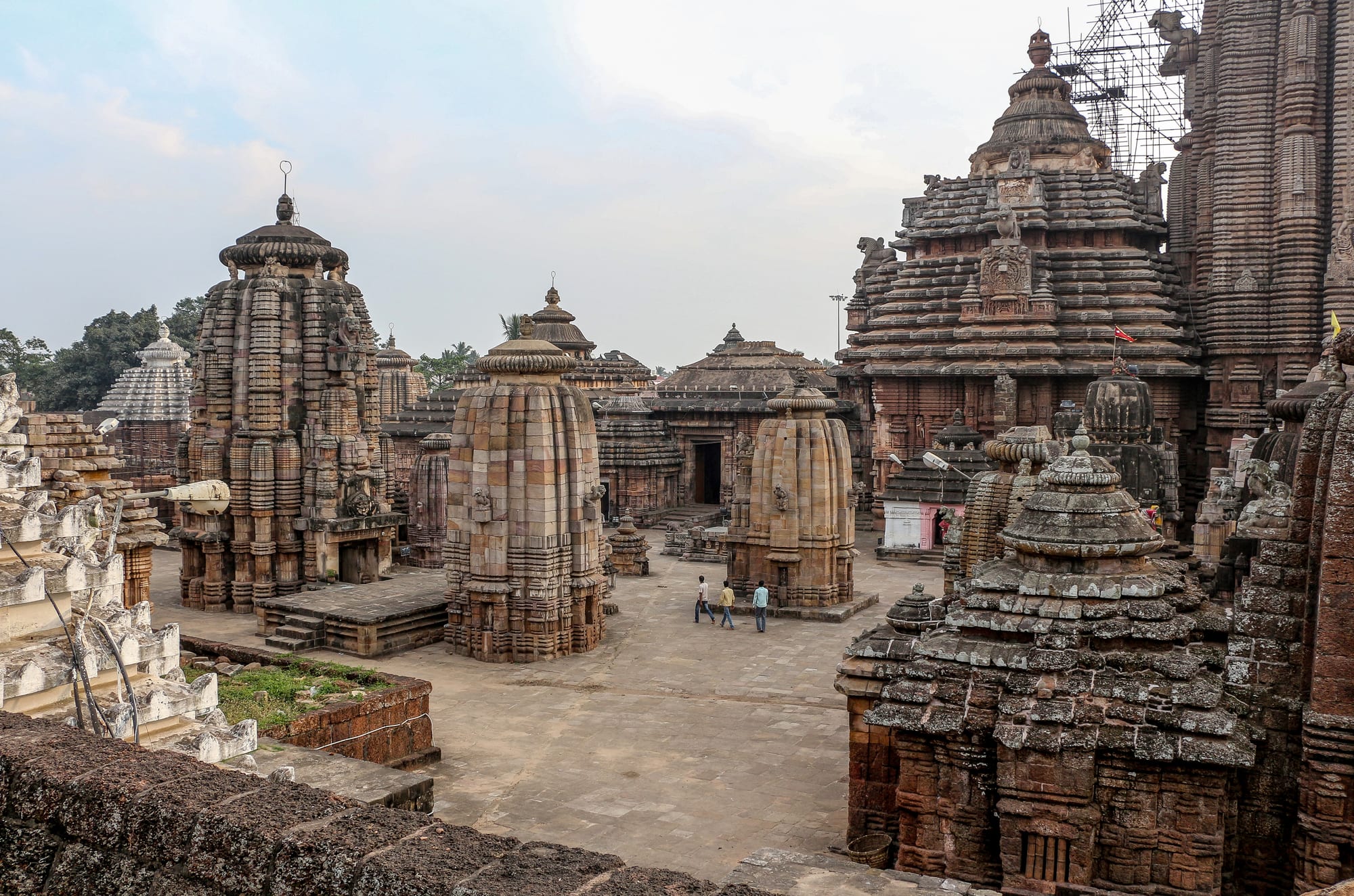
A courtyard of carved sandstone shrines with curved and stepped towers inside a walled temple compound under a pale sky

Kolkata, Darjeeling & the East, India

Bhubaneswar

Shrines inside the Lingaraja temple compound in the old town of Bhubaneswar. (Bernard Gagnon / Wikimedia Commons · CC BY-SA 3.0)

The capital of the Indian state of Odisha, a city of two halves: an old quarter of medieval sandstone temples around the Lingaraja and the Bindusagar tank, and a planned modern capital laid out after 1948 in numbered units, now spreading into university and technology suburbs. It is the usual base for the Sun Temple at Konark and the Jain caves at Khandagiri.

Neighbourhoods

  • Old Town (Ekamra Kshetra)
    • First-time visitors
    • Historic district
    • Temples

    The medieval city in the south, where hundreds of sandstone temples stand among lanes and houses around the Lingaraja and the Bindusagar tank. Mukteshvara, Rajarani and Parasurameswara are all within a short walk, and the streets still turn on temple ritual, flower sellers and the festival calendar.

    Open in Maps
  • The Unit areas and Master Canteen
    • First-time visitors
    • Close to public transport
    • Museums

    The core of the planned capital, numbered in units around the railway station and the Raj Mahal roundabout. Government buildings, the state museum, hotels, the Unit 1 market and the long shopping streets of Janpath and Saheed Nagar are here, and it is the easiest base for buses and trains.

    Open in Maps
  • Nayapalli and Jayadev Vihar
    • Best for food
    • Shopping

    West and north of the centre, a district of wide roads, hotels, malls and restaurants built as the city expanded. It holds the crafts market at Ekamra Haat and much of the city's mid-range hotel stock.

    Open in Maps
  • Chandrasekharpur and Patia
    • Quiet and residential
    • Students

    The northern suburbs, home to university campuses, research institutes and the technology parks around Infocity. Apartment blocks, student cafés and newer housing colonies give this side of the city a young, suburban feel.

    Open in Maps
  • Khandagiri and the western edge
    • Historic district
    • Quiet and residential

    The area beneath the twin rock hills of Udayagiri and Khandagiri on the road west out of the city, with Jain caves, monasteries and shrines above and a busy roadside settlement below.

    Open in Maps

Things to do

Temples of the old town

  • Lingaraja Templelandmark

    The largest temple in the city, an 11th-century shrine to Shiva as Tribhuvaneswara with a tower some 55 metres high; entry is restricted to Hindus, but a viewing platform outside overlooks the compound.

    Open in Maps
  • Mukteshvara Templelandmark

    A small 10th-century temple often called a gem of Odishan architecture, known for its carved stone torana, a gateway arch found on no other temple in the region.

    Open in Maps
  • Rajarani Templelandmark

    An 11th-century temple built of warm-toned sandstone and carved with figures of women and guardians of the directions; it has no presiding deity today and stands in a garden.

    Open in Maps
  • Parasurameswara Templelandmark

    One of the oldest surviving temples in the city, dating from the 7th century, with dense early carving of Shaiva subjects and a latticed hall.

    Open in Maps
  • Ananta Vasudeva Templelandmark

    A 13th-century Vishnu temple on the Bindusagar whose kitchen cooks the abadha, an offering meal served to devotees.

    Open in Maps
  • Brahmeswara Templelandmark

    An 11th-century Shiva temple with four corner shrines, richly carved and set in a walled enclosure east of the old town.

    Open in Maps
  • Bindusagar Lakeattraction

    The large tank north of the Lingaraja whose water is used in temple ritual, ringed by small shrines and bathing steps.

    Open in Maps

Ancient sites

  • Udayagiri and Khandagiri Caveslandmark

    Rock-cut cells carved for Jain ascetics on two hills west of the city, largely under King Kharavela in the 2nd or 1st century BC, including the elephant-carved Hathigumpha with its long inscription.

    Open in Maps
  • Dhaulilandmark

    A hill beside the Daya river where Ashoka's rock edicts are carved, widely held to be the site of the Kalinga war, with a white peace pagoda built above it in 1972.

    Open in Maps
  • Sisupalgarhattraction

    The earthwork ramparts and gateways of a fortified ancient city on the southern edge of Bhubaneswar, occupied for several centuries around the start of the common era.

    Open in Maps

Museums, parks and sport

  • Odisha State Museummuseum

    The state collection of sculpture, coins, arms, tribal material and a large holding of palm-leaf manuscripts.

    Open in Maps
  • Nandankanan Zoological Parkpark

    A zoo and botanical garden in forest north of the city, known for its white tigers, its lion safari and a breeding programme for Indian pangolins.

    Open in Maps
  • Kalinga Stadiumattraction

    The city's main sports complex, host of international field hockey including World Cup matches, and a sign of Odisha's heavy sponsorship of the sport.

    Open in Maps

Short trips from the city

  • Konark Sun Templelandmark

    A UNESCO World Heritage Site on the coast, a 13th-century temple built as the sun god's chariot with vast carved stone wheels.

    Open in Maps
  • Pipiliattraction

    A town on the Puri road known for appliqué work: stitched canopies, umbrellas and lampshades in bright patched cloth.

    Open in Maps
  • Raghurajpurattraction

    A crafts village near Puri where families paint Pattachitra on cloth and engrave palm leaf, their houses covered in murals.

    Open in Maps

Seasonal events

  • Maha ShivaratriFebruary or March

    The night of Shiva, when the old town fills and lamps are carried to the top of the Lingaraja temple.

  • AshokastamiMarch or April

    A chariot festival at the Lingaraja temple, when the deity is drawn through the old town to the Rameswara temple and back.

  • Raja ParbaJune

    A three-day Odia festival marking the earth's monsoon renewal, when swings are hung from trees and pithas, rice cakes, are made at home.

  • Durga Puja and DussehraSeptember or October

    Pandals, lights and processions across the city, ending with the immersion of the goddess's images.

Eat and drink

Long-standing places and food districts in Bhubaneswar. Hours, ratings and directions come from your maps app, always current.

Bhubaneswar classics

  • Dalma and the Odia thalineighborhood

    Lentils cooked with vegetables and tempered with cumin and dried chilli, served with rice and a spread of small dishes in Odia kitchens across the city.

    Open in Maps
  • Chhena poda and sweet shopsmarket

    Odisha's baked, caramelised cottage-cheese sweet, sold in slabs alongside rosogolla and rasabali at sweet counters throughout the city.

    Open in Maps

Food districts and markets

  • Ekamra Haatmarket

    An open-air crafts market near the city centre with stalls of handloom, applique and metalwork and a cluster of Odia food counters.

    Open in Maps
  • Unit 1 market and Janpathneighborhood

    The market building and the shopping street beside it, ringed by sweet shops, tea stalls, dosa counters and mid-range restaurants.

    Open in Maps
  • Old Town food stallsneighborhood

    Carts around the temple lanes selling dahi bara aloo dum, ghuguni and puffed-rice snacks to worshippers and passers-by.

    Open in Maps

Experience Bhubaneswar

History

Bhubaneswar's old town is the survivor of the ancient city of Ekamra Kshetra, a temple centre that grew up where Kalinga's religious life had been concentrated for centuries. The region's earlier capital, the fortified city of Sisupalgarh, stood just to the south and flourished from about the third century BC to the fourth century AD. Near it, at Dhauli by the Daya river, the Maurya emperor Ashoka had his edicts carved after the Kalinga war of about 261 BC, a campaign so bloody that, by his own account, it turned him towards Buddhism. In the next century King Kharavela of the Mahameghavahana dynasty cut the Jain caves of Udayagiri and Khandagiri and recorded his reign in the Hathigumpha inscription.

From the 7th century onwards the Shailodbhava, Somavamshi and Eastern Ganga dynasties built in stone here on an extraordinary scale, and the temples of Bhubaneswar became the main record of Odishan architecture, developing from the compact early shrines of Parasurameswara to the great tower of the Lingaraja in the 11th century. Hundreds of temples survive, out of many more that once stood around the Bindusagar tank.

Under Mughal, Maratha and then British rule the town shrank to a temple settlement in the shadow of Cuttack, Odisha's administrative centre. That changed in 1948, after Indian independence, when Bhubaneswar replaced Cuttack as the capital of Odisha and the foundation of the new city was laid on 13 April that year. The German-born architect Otto Königsberger had drawn a plan of low-rise neighbourhood units with their own markets and schools, and the legislative assembly moved here from Cuttack in 1949. Growth since the 1990s — universities, hospitals, an information technology sector and a steady flow of migrants from rural Odisha — has pushed the built-up area far beyond that plan.

Culture & Customs

The city lives with its temples in a matter-of-fact way. Morning worship, marriage ceremonies and festival processions run through the old town's lanes, and the temple calendar shapes the year: the lamps of Shivaratri on the Lingaraja tower, the chariot of Ashokastami, the swings and rice cakes of Raja Parba in June. Sanskrit ritual and Odia popular devotion sit alongside the pilgrimage traffic heading on to Puri, 60 kilometres away.

Bhubaneswar is also the cultural capital of Odisha. Odissi, the state's classical dance, has its main schools and performance halls here, and the sculptural poses carved on the old temples are its acknowledged source. The city stages regular seasons of dance and music in and around temple precincts, and the state museum and crafts institutions hold the Pattachitra painting, palm-leaf manuscripts, applique and silver filigree that Odisha is known for. Odia literature and theatre have a strong local following, and the language's status as a classical language is a point of pride.

Modern Bhubaneswar has a young, educated character created by its universities and technology parks, with students from across eastern India and a large tribal-welfare and research presence reflecting Odisha's many Adivasi communities. Sport is unusually prominent: the state government has sponsored India's national hockey teams for years, and international tournaments at the Kalinga Stadium draw big crowds. Manners are conservative and hospitable — guests are fed generously, and visitors to homes and temples are expected to remove their shoes.

Daily Life

The city proper counted about 840,000 residents at the 2011 census, and the built-up area it shares with Cuttack some 1.7 million; the city's population has more than doubled since 1991. Government is the anchor: the state secretariat, the assembly, directorates and public agencies employ a large share of residents, and the planned units around the centre were laid out for exactly that workforce. Hospitals, colleges and the large private universities to the north have grown alongside, and the information technology parks at Infocity give the city a second white-collar economy.

Life differs sharply between districts. The old town is dense and low-rise, with extended families in lanes around the temples and an economy of priests, flower and sweet sellers, and small workshops. The Unit areas are ordered and green, built around markets and parks. Chandrasekharpur, Patia and the new colonies beyond them are a landscape of apartment blocks, coaching centres and student rentals, still filling in. Slum settlements sit between these areas, and the state has run a well-publicised programme granting land rights to their residents.

The day starts early — sunrise comes before six in summer because India keeps a single time zone — and much of the city is out by seven, with offices working through the morning and shops open late into the evening. Recurring concerns are heat, water supply, traffic on roads not built for the present volume, cyclone preparedness after storms such as Fani in 2019, and the pressure of building work on the old temple precincts.

Food

Odia cooking is subtler and less oily than that of its neighbours, built on rice, vegetables, mustard and panch phutana, the five-spice mix of mustard, cumin, fennel, fenugreek and nigella. The everyday standard is dalma, lentils boiled with pumpkin, raw banana and other vegetables and finished with ghee and dried chilli, eaten with rice. Around it come santula, lightly cooked mixed vegetables; besara, a mustard-based curry; and saga, green leaves sautéed with garlic. Pakhala, rice left to ferment overnight in water and served with fried fish, badi and lime, is the answer to the hot season.

Fish and mutton appear at most meals that are not vegetarian: macha besara, fish in mustard gravy, chingudi, prawns from the coastal lagoons, and mutton curry for Sundays and festivals. Temple food is a category of its own — the kitchens of the Ananta Vasudeva temple cook and sell an offering meal, in the same tradition as Puri's mahaprasad, with rice, dal and vegetables prepared in earthen pots.

The sweets are the best-known part of Odia food. Chhena poda, cottage cheese baked with sugar until the surface caramelises, is the state's signature, and Odisha contests with Bengal the origin of rosogolla; rasabali, fried cheese discs soaked in thickened milk, comes from Kendrapara. Street eating means dahi bara aloo dum in the morning, ghuguni made from dried peas, gupchup — the local name for the crisp filled shells known elsewhere as phuchka or pani puri — and pithas, steamed or fried rice cakes made at festivals and sold at Ekamra Haat.

Planning tools

Budget

Bhubaneswar is inexpensive by the standards of Indian state capitals. Hotels near the railway station and in Nayapalli are good value, food is cheap, and the sights charge little or nothing. Costs rise mainly with transport, since seeing Konark, Puri and the caves in comfort usually means hiring a car with a driver for the day.

Daily Budget Midrange
USD 40–95 (mid-range hotel, restaurant meals, a car with driver for Konark and the temples)
Daily Budget Shoestring
USD 15–28 (budget hotel or guesthouse, thalis and street food, buses and shared autos)

City buses and app-based autos and cabs cover most of the capital cheaply; keep hired cars for the day trips out to the coast.

Best Time to Visit

October to February, when days are warm and dry and the temples are comfortable to walk between. March to May is very hot, with temperatures that make midday sightseeing hard; the monsoon from June to September is humid and wet, though the temple stone looks its best in the rain and the surrounding country turns green.

Suggested Number of Days

Two days is enough for the old town temples, the caves and the museums. Four allows the coast at Konark and Puri and the craft villages between them, which many visitors use Bhubaneswar as a base for. Pilgrimage festivals and the hottest months both slow things down.

First Visit
2 days
With Surroundings
4 days

Transportation

The city is spread out and most people use app-based cabs and auto-rickshaws, which are plentiful and cheap. City buses run on the main corridors between the old town, the station area and the northern suburbs, and shared autos fill the gaps. A metro line for Bhubaneswar and Cuttack was proposed for years, but the state government scrapped the project in 2026.

Distances between the temple cluster in the old town and the newer districts are several kilometres, so plan on a cab or auto between them rather than walking.

Airport & Station Connections

Biju Patnaik International Airport is about 3 kilometres from the centre, with domestic flights across India and a few regional international services. Bhubaneswar is a major stop on the east coast railway, with trains to Kolkata, Chennai, Delhi and Puri, and the station sits in the middle of the planned city. Puri is about 60 kilometres away by road, and buses run constantly.

Walkability

The old town rewards walking: the main temples lie within a kilometre or so of each other around the Bindusagar, along lanes with little traffic. The planned city is the opposite, built for vehicles, with wide roads, long blocks and patchy pavements. Heat and humidity limit walking to the early morning and evening for much of the year.

Safety

Bhubaneswar is generally calm, with the usual big-city risks of pickpocketing in crowded markets and at festivals. Traffic is the main hazard: roads are busy, lane discipline is loose and crossings are few. Coastal Odisha is exposed to cyclones, mostly in spring and autumn, and storms occasionally bring flooding and power cuts to the city. Summer heat is severe and heatwaves are a real health risk.

Drink plenty of water and avoid the middle of the day in the hot months, cross busy roads with other pedestrians, and follow official warnings during cyclone season. Check current official travel advice before travelling.

Climate

A tropical climate with a long hot season and a heavy monsoon from June to September. Cyclones forming in the Bay of Bengal can bring strong winds and rain, mostly in the months before and after the monsoon. Winter is dry, sunny and mild.

Summer
very hot and humid, commonly 33–42°C before the monsoon breaks, with heavy rain from June
Winter
dry and pleasant, generally 15–29°C, with cool mornings

Local Customs

Temple etiquette matters here: shoes and leather are left outside, modest clothing covering shoulders and knees is expected, and photography inside shrines is often restricted. Entry to the Lingaraja temple is limited to Hindus, though the compound can be seen from the platform outside. Odia is the state language, Hindi and English are widely understood, and greetings use joined palms rather than a handshake.

Ask before photographing worshippers or rituals, remove footwear when entering homes as well as temples, and use the right hand for eating and for giving or receiving things.

Common Payment Methods

The currency is the Indian rupee. Cards work in hotels, malls and larger restaurants, and UPI mobile payments are accepted almost everywhere, including by small stalls. Cash is still needed for autos, temple offerings and market shopping, and ATMs are common in the Unit areas and the newer suburbs.