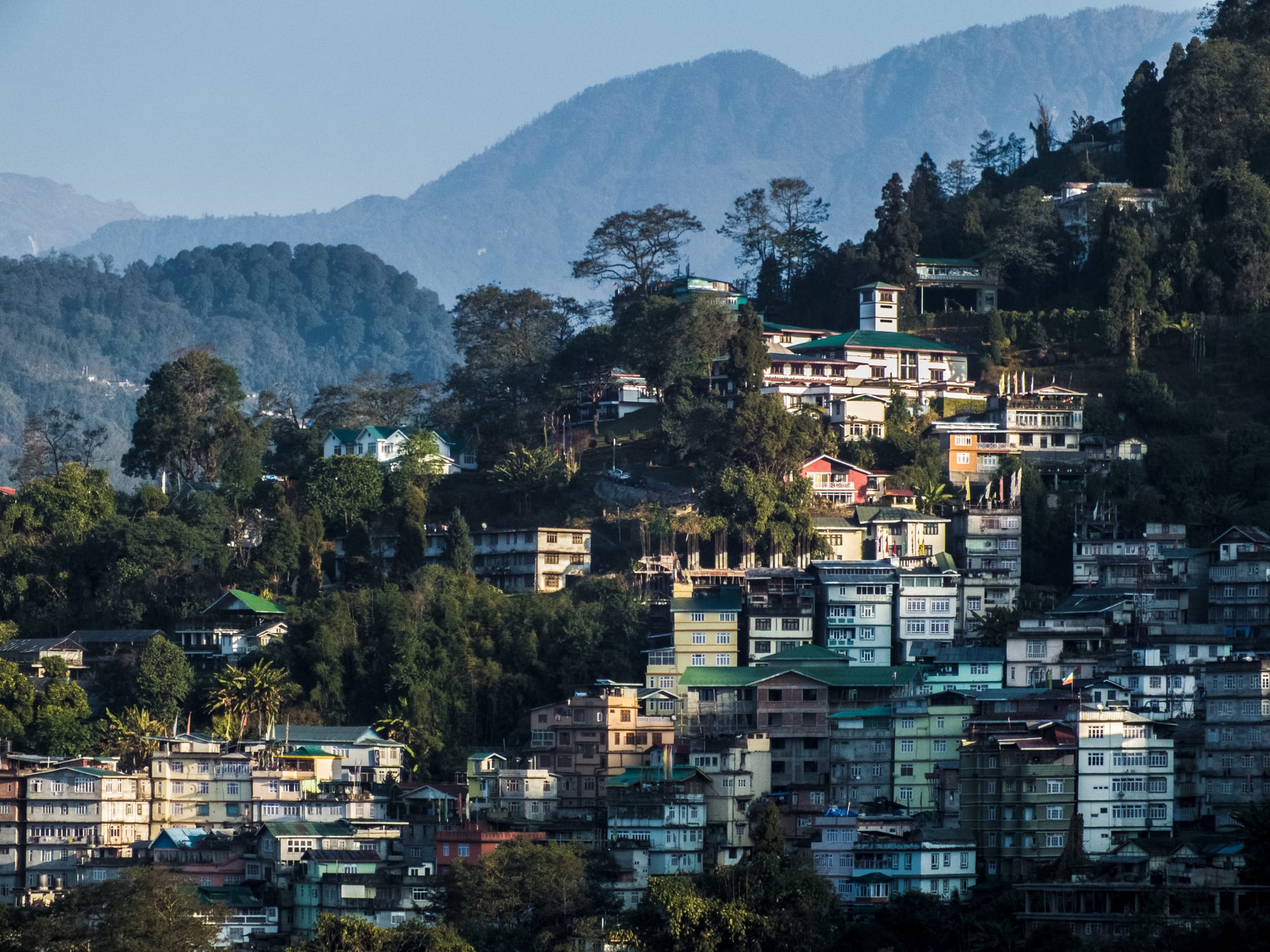
Pale multi-storey houses with green roofs stacked up a forested hillside, with blue Himalayan ridges behind

Kolkata, Darjeeling & the East, India

Gangtok

Gangtok spread across its ridge, seen in the morning from Tibet Road. (Thebrowniris / Wikimedia Commons · CC BY 3.0)

The capital of Sikkim, built along a steep ridge at about 1,650 metres above the Ranipool valley in the eastern Himalaya. A monastery settlement that became the seat of the Namgyal kings and then, after Sikkim joined India in 1975, a state capital, it is a tidy, cool hill town and the base for monasteries, high lakes and treks beneath Kangchenjunga.

Neighbourhoods

  • M.G. Marg and the town centre
    • First-time visitors
    • Best for food
    • Shopping

    A pedestrian boulevard of shops, cafés and benches, kept free of traffic, litter and smoking, which serves as the town's living room. Most hotels, travel agents and restaurants are on it or on the streets stepping down from it.

    Open in Maps
  • Lal Bazaar and the lower market
    • Markets
    • Local life

    The covered market and the roads below the centre, where hill vegetables, fermented greens, cheese and dried fish are sold, busiest on Sunday when villagers come in to trade.

    Open in Maps
  • The Ridge and Development Area
    • Quiet and residential
    • Views
    • Historic district

    The crest above the town, with the Ridge Park, the old palace grounds, the state assembly and government offices among flower beds and pines. Quiet, spacious and several degrees cooler than the market.

    Open in Maps
  • Tadong and Ranipool
    • Close to public transport
    • Quiet and residential

    The strip along the highway below town where the university, hospitals and much of the newer housing sit, together with the shared-jeep stands used for journeys out of Sikkim.

    Open in Maps
  • Deorali and the Institute quarter
    • Museums
    • Quiet and residential

    A slope south of the centre holding the Namgyal Institute of Tibetology, the Do Drul Chorten and the lower ropeway station, with guesthouses among trees.

    Open in Maps

Things to do

Monasteries and Buddhist sites

  • Enchey Monasterylandmark

    A Nyingma monastery above the town, founded in the 19th century, whose courtyard hosts masked cham dances in winter.

    Open in Maps
  • Rumtek Monasterylandmark

    The seat in exile of the Karmapa and the Karma Kagyu school, about 24 kilometres away across the valley, with a golden stupa and an institute of Buddhist studies.

    Open in Maps

Museums and the town

  • Namgyal Institute of Tibetologymuseum

    A research institute and museum inaugurated in 1958 and named after the eleventh Chogyal of Sikkim, holding Tibetan manuscripts, thangkas and ritual objects.

    Open in Maps

Mountains, lakes and passes

  • Tsomgo Lakeattraction

    A glacial lake at about 3,750 metres roughly 38 kilometres east, frozen in winter and edged with prayer flags; a permit is required to visit.

    Open in Maps
  • Nathu Laattraction

    A pass on the old trade route to Tibet at over 4,300 metres, open to Indian nationals with a permit and closed to foreign visitors.

    Open in Maps

Short trips

  • Namchiattraction

    A south Sikkim town about 75 kilometres away, known for the enormous statue of Guru Padmasambhava on Samdruptse hill.

    Open in Maps
  • Pellingattraction

    A village in western Sikkim facing Kangchenjunga, close to Pemayangtse monastery and the ruined royal capital of Rabdentse.

    Open in Maps
  • Khangchendzonga National Parkpark

    A UNESCO World Heritage Site covering the glaciers, forests and high valleys around the world's third-highest mountain in western Sikkim.

    Open in Maps
  • Pemayangtse Monasterylandmark

    One of the oldest and most important Nyingma monasteries in Sikkim, above Pelling in the west, a three-storeyed building with wall paintings and statues of saints and teachers on its floors.

    Open in Maps
  • Rabdentselandmark

    The ruins of Sikkim's second royal capital, reached by a forest path near Pelling, with the remains of the palace on a ridge facing Kangchenjunga.

    Open in Maps
  • Lachungattraction

    A mountain village in north Sikkim, the base for the Yumthang valley and its rhododendrons; north Sikkim needs permits and is visited with a registered operator.

    Open in Maps

Seasonal events

  • LosarFebruary or March

    Tibetan and Bhutia new year, with masked dances at the monasteries and family feasting across the town.

  • Saga DawaMay or June

    The holiest month of the Buddhist calendar, marking the Buddha's birth, enlightenment and death, with processions of scriptures through Gangtok.

  • Pang LhabsolAugust or September

    A distinctly Sikkimese festival honouring Kangchenjunga as the guardian deity of the land, with masked dances at the monasteries.

  • LosoongDecember

    The Sikkimese year-end harvest festival, celebrated with archery contests, cham dances and family gatherings.

  • Dashain and TiharOctober and November

    The main Nepali festivals, when much of the town closes for family visits and the markets fill with sweets and marigolds.

Eat and drink

Long-standing places and food districts in Gangtok. Hours, ratings and directions come from your maps app, always current.

Sikkimese kitchens

  • Momo and thukpa shops on M.G. Margneighborhood

    Steamed and fried momos, thukpa and thenthuk noodle soups served in small dining rooms along and just off the main boulevard.

    Open in Maps
  • Sikkimese restaurants around the town centreneighborhood

    Places serving phagshapa, pork with radish and dried chillies, gundruk soup, nettle broth and buckwheat pancakes alongside the usual Indian menus.

    Open in Maps

Markets and drinks

  • Lal Bazaarmarket

    The multi-storey market where hill vegetables, fermented soybean and greens, chhurpi cheese and the fiery round dalle chilli are sold, busiest on Sundays.

    Open in Maps
  • Tongba and local brewsneighborhood

    Warm millet beer sipped through a bamboo straw from a wooden pot, alongside beer and spirits from Sikkim's own distilleries, served in bars around the centre.

    Open in Maps

Experience Gangtok

History

Gangtok was a small settlement around a monastery until the middle of the 19th century, when the Enchey gompa was established on the ridge above it. Sikkim itself had been a Buddhist kingdom since the 17th century under the Namgyal dynasty, with its capitals in the west at Yuksom and later Rabdentse. British involvement grew after the 1830s, and the kingdom became a protectorate; when trade with Tibet through the Nathu La and Jelep La passes expanded after the Anglo-Tibetan convention of 1904, the town on the trade route grew with it. The capital was moved to Gangtok in 1894.

For the first half of the 20th century the town lived on that trade. Mule caravans carrying wool, borax and cloth came over the passes from Lhasa, and Marwari and Tibetan merchants settled around the bazaar. The route closed after China's annexation of Tibet and the border war of 1962, and Sikkim turned inwards. Tibetan refugees arrived from 1959, among them the Karmapa, who established Rumtek across the valley as the seat of his school in exile.

Politics changed the town again. Popular agitation against the monarchy in the early 1970s led to a referendum in 1975, after which Sikkim became the twenty-second state of India and Gangtok its capital. Statehood brought government offices, roads, schools and, from the 1990s, tourism, which is now the mainstay. Nathu La reopened for limited border trade in 2006. An earthquake in 2011 damaged buildings across Sikkim, and the flood that swept the Teesta valley in 2023 collapsed parts of the highway to the plains and cut the town off from the rest of India.

Culture & Customs

Sikkim's three main communities — the Lepchas, regarded as the earliest inhabitants; the Bhutias, who came from Tibet from the 14th century onward; and the Nepali-speaking majority who settled from the 19th century — give Gangtok its particular mixture. Nepali is the common language, with Bhutia, Lepcha and English also in use, and Buddhist and Hindu practice run side by side, often in the same family. Prayer flags, chortens and mani walls stand along the roads above town.

The festival calendar is unusually rich for a place of this size. Losar and Losoong bracket the winter with masked cham dances and archery; Saga Dawa fills the streets with processions in early summer; Pang Lhabsol, which honours Kangchenjunga as the protector of Sikkim, is the state's own festival; and Dashain, Tihar, Diwali and Christmas are all marked. Archery is the traditional sport, football the popular one, and the state has produced well-known Indian footballers.

Gangtok is also known for a certain civic discipline. Public smoking is restricted, plastic bags were banned early, the main street is pedestrianised and swept, and Sikkim has promoted itself as fully organic in agriculture. Visitors find people reserved but courteous; greetings are namaste or tashi delek, elders are addressed respectfully, and Himalayan etiquette around monasteries and sacred mountains is taken seriously, including the promise, kept by climbers since the first ascent, that the summit of Kangchenjunga itself would remain untrodden.

Daily Life

About 100,000 people live in Gangtok, which makes it a small capital even by Indian standards, though it holds a large share of Sikkim's population of roughly 600,000. Government is the biggest employer, followed by tourism, transport and trade; the university at Tadong, hospitals and schools bring people in from the districts, and many households let rooms or run vehicles during the season.

Building on a near-vertical ridge shapes everything. Houses stand on stilts and retaining walls, streets are stacked in tiers linked by stairways, and water, drainage and landslide protection are constant municipal concerns. Growth has pushed development down towards Ranipool and along the highway, where most new housing is being built.

The day starts early and ends early: offices and shops open in the morning, the market is busiest before noon, and by mid-evening M.G. Marg fills with families and students walking before dinner. Cardamom, ginger, oranges and organic vegetables come up from the villages, and much of the town has relatives farming in the districts. Road connections to the plains, damaged repeatedly by floods and landslides, are the standing preoccupation, along with the effect of tourist numbers on the high lakes and passes.

Food

Gangtok eats Himalayan food with Nepali and Tibetan roots. Momos are the staple snack, steamed or fried and filled with pork, chicken, beef or vegetables and served with a chilli and tomato dip; thukpa and thenthuk, noodle and dough-flake soups, are the winter warmers. Phagshapa, strips of pork fat stewed with radish and dried chillies, is a Bhutia dish particular to Sikkim, and sha phaley, a fried meat pastry, comes from the same tradition.

Fermentation is central. Gundruk and sinki, leaves and radish fermented and dried, are cooked into sour soups; kinema, fermented soybean, gives a strong savoury base to curries; and chhurpi, milk cheese, appears both soft in soups and as a hard chew. Nettle soup, buckwheat pancakes and the round dalle khursani chilli, one of the hottest in India, belong to the same hill kitchen. Everyday meals are dal bhat with vegetables, and sel roti, a fried ring of rice batter, marks festivals.

Drinks are a local speciality. Tongba, warm millet beer drunk through a bamboo straw from a wooden pot, is the Himalayan classic, and chhaang is its close relative; Sikkim also brews and distils its own beer and spirits, which are cheaper here than in neighbouring states. Tea is drunk plain, sweet or in the Tibetan style with salt and butter, and large cardamom, one of the state's main cash crops, scents much of the cooking.

Planning tools

Budget

Gangtok is affordable, though slightly dearer than the West Bengal hills because most goods are carried up from the plains. Permits themselves cost little, but organised trips to Tsomgo Lake, Nathu La and north Sikkim are sold as shared or private vehicle packages and are the main expense. Rates rise in the spring and autumn holiday seasons.

Daily Budget Midrange
USD 40–95 (mid-range hotel, restaurant meals, a car with driver in the hills)
Daily Budget Shoestring
USD 15–28 (guesthouse, momos and thalis, shared jeeps)

Join a shared vehicle for the high lakes rather than hiring one alone, and arrange permits through a registered agency in town, which usually takes a day.

Best Time to Visit

October and November for clear mountain views and dry roads, and March to May for rhododendron and magnolia in the valleys, though spring brings more cloud. The monsoon from June to September is heavy, with landslides and road closures. Winter is cold and quiet, with snow on the passes and the lakes frozen.

Suggested Number of Days

Two days cover the town, its monasteries and museum. Five to seven allow the high lakes, western Sikkim or the north, each of which needs permits and long drives on mountain roads. Altitude and weather both argue for spare time.

First Visit
2 days
With Surroundings
5–7 days

Transportation

Shared jeeps and taxis are the only public transport of consequence, running from stands in the lower town to Siliguri, Darjeeling, Pelling and the district headquarters. Within Gangtok taxis work on set routes, and a cable car runs along the ridge between Deorali and the upper town. Private vehicles from outside the state generally need local drivers for the restricted routes.

Book seats in shared jeeps a day ahead in the busy seasons, and expect mountain roads to be slow, single-lane in places and subject to closure after rain.

Airport & Station Connections

Most visitors come up from the plains through Siliguri: Bagdogra airport and New Jalpaiguri railway station are about 120 to 125 kilometres away, four to five hours by shared jeep or taxi along the Teesta valley. Pakyong airport, about 31 kilometres south of the town, has had no scheduled commercial flights in recent years. Foreign nationals need a permit for Sikkim, issued at the border checkpost, at the airport or through an agency, and further permits for restricted areas.

Walkability

The centre is compact and pleasant on foot, with M.G. Marg closed to traffic and lined with benches, but the town is built on a very steep slope and almost everything else involves stairways or long climbs between levels. Distances on a map are misleading. Taxis fill the gap, and the ropeway saves one of the steeper ascents.

Safety

The town is orderly and generally feels safe, including at night, and crime is not the main worry for visitors. The real risks are geological and meteorological: landslides in the monsoon, roads damaged by the glacial lake flood that struck the Teesta valley in 2023, earthquakes, and altitude sickness on trips to Tsomgo Lake and the passes, which rise above 3,700 metres from a town at 1,650.

Ascend to the high lakes slowly and descend if headaches or breathlessness worsen, carry permits and identification on restricted routes, travel mountain roads in daylight, and check conditions after heavy rain. Check current official travel advice before travelling.

Climate

A temperate monsoon climate set by altitude. Rain is very heavy from June to September, autumn is clear and settled, winter is cold but rarely snowy in the town itself, and cloud frequently covers the ridge in the afternoons even in the dry months.

Summer
mild and wet — 18–25°C from June to September, with persistent cloud and heavy monsoon rain
Winter
cold and dry — days of 8–14°C, nights close to freezing, with snow on the passes above the town

Local Customs

Sikkim mixes Nepali, Bhutia and Lepcha communities, and Buddhist practice shapes public manners: shoes are removed in monasteries, prayer wheels turned clockwise and chortens walked around the same way, and photography inside prayer halls is often not allowed. The state takes cleanliness seriously — plastic bags are banned, smoking is restricted, and littering is fined.

Photographs of monks and ceremonies should be taken only with permission, the Sikkim permit carried at all times, plastic bottles left out of the high-altitude areas where they are restricted, and warm modest clothing worn for monastery visits.

Common Payment Methods

The currency is the Indian rupee. Cards are taken in hotels and larger restaurants, and UPI mobile payments are common in the town, but cash is needed for shared jeeps, market stalls and anywhere outside Gangtok, where ATMs are few and can be empty. Mobile signal is patchy on the mountain roads.