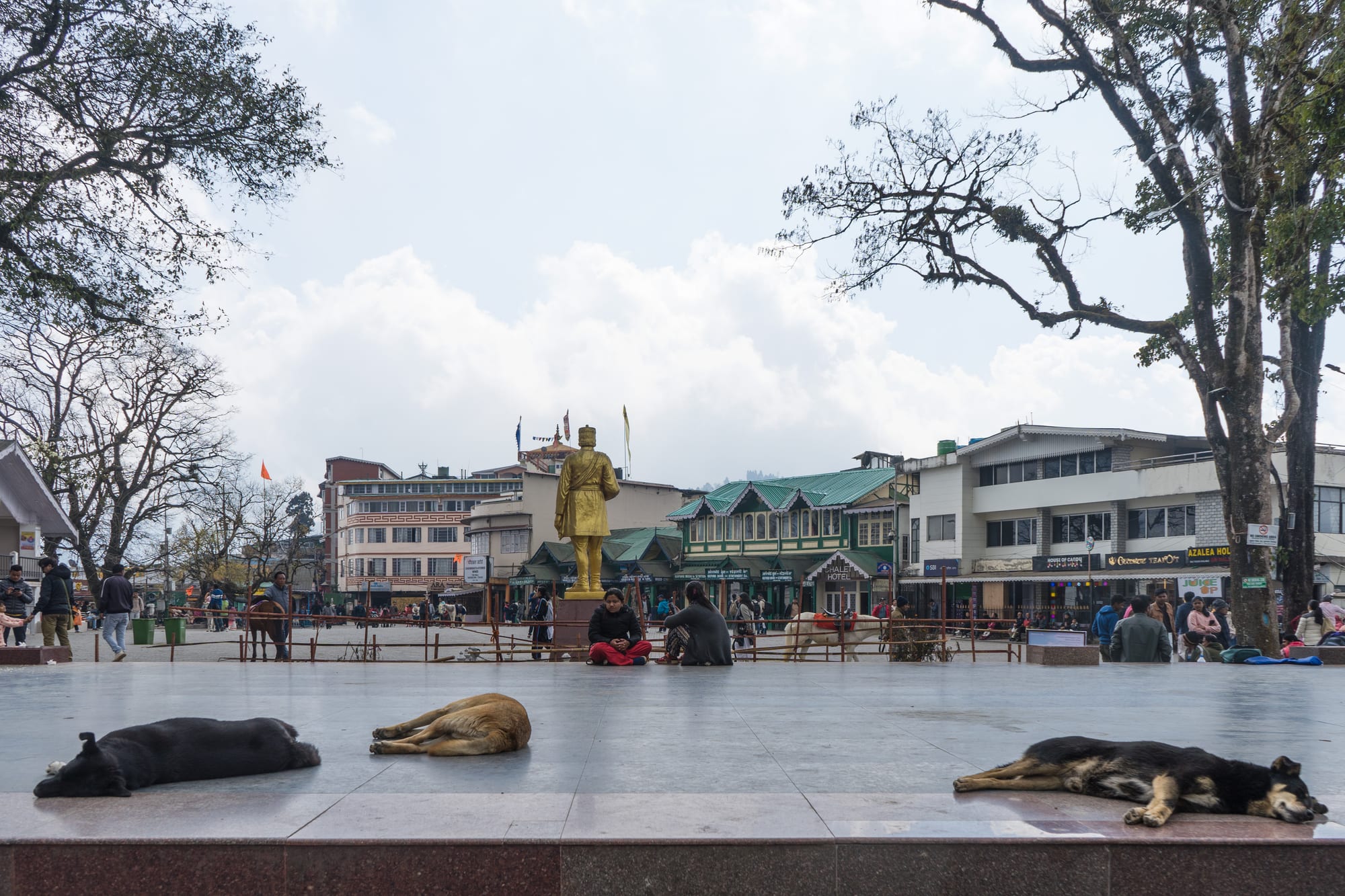
A wide paved square in a hill town with a bronze statue, green-roofed shops and bare trees, and dogs asleep in the foreground

Kolkata, Darjeeling & the East, India

Darjeeling

Chowrasta, the open square at the top of the Mall in Darjeeling. (Alexkom000 / Wikimedia Commons · CC BY 4.0)

A hill town in northern West Bengal, strung along a ridge at about 2,000 metres with the Kangchenjunga massif on the horizon. Leased to the British by Sikkim in 1835 and developed as a sanatorium and tea district, it keeps its steep bazaar, Victorian churches, monasteries and the narrow-gauge railway that climbs to it from the plains.

Neighbourhoods

  • Chowrasta and the Mall
    • First-time visitors
    • Views
    • Cafés

    The flat open square at the top of the town, closed to traffic, where the Mall road runs out along the ridge to a loop through pine woods. Bookshops, tea rooms, curio stalls and pony rides surround it, and on clear mornings Kangchenjunga appears above the rooftops.

    Open in Maps
  • Chowk Bazaar and the lower town
    • Markets
    • Local life
    • Best for food

    The working town below the ridge, a steep tangle of stairways and lanes around the market and the jeep stands, where vegetables, spices, cloth and cheap meals are sold. It is noisy and congested, and most of the town's traffic ends up here.

    Open in Maps
  • The Hill Cart Road and the station area
    • Close to public transport
    • Historic district

    The road and railway climb together through the middle of town, with the toy train running down the main street past shopfronts and the small Darjeeling station at the top. Hotels, travel agents and bus offices concentrate along this stretch.

    Open in Maps
  • Jalapahar and the upper ridge
    • Quiet and residential
    • Views

    The wooded crest above the town, with army cantonment land, the Mountaineering Institute, older bungalows and boarding schools. It is quieter and cooler than the centre, with long views on both sides of the ridge.

    Open in Maps
  • Ghum
    • Quiet and residential
    • Historic district

    A separate settlement a few kilometres up the line at the highest point of the railway, with the old Yiga Choeling monastery, a railway museum and the turning for Tiger Hill and the Batasia Loop.

    Open in Maps

Things to do

The railway and viewpoints

  • Darjeeling Himalayan Railwayattraction

    The two-foot narrow-gauge line opened in 1881 and listed by UNESCO, climbing from the plains by loops and zig-zags; steam joy rides run between Darjeeling and Ghum.

    Open in Maps
  • Batasia Loopviewpoint

    A spiral of track below Ghum commissioned in 1919, where the train turns through a full circle around a memorial to the Gorkha soldiers of the Indian Army, with Kangchenjunga behind it.

    Open in Maps
  • Tiger Hillviewpoint

    A summit of 2,590 metres above the town where crowds gather before dawn for sunrise over Kangchenjunga, with Everest visible in the distance on the clearest mornings.

    Open in Maps

Tea and institutions

  • Happy Valley Tea Estateattraction

    A tea garden founded in the mid-19th century on the slope just below the town, one of the closest estates to the centre and open to visitors.

    Open in Maps
  • Himalayan Mountaineering Institutemuseum

    Founded in 1954 after the first ascent of Everest and long associated with Tenzing Norgay, with a museum of expedition equipment and Himalayan mountaineering history.

    Open in Maps
  • Padmaja Naidu Himalayan Zoological Parkpark

    A high-altitude zoo sharing a site with the Mountaineering Institute, known for its breeding programmes for snow leopards and red pandas.

    Open in Maps

Monasteries and quiet corners

  • Yiga Choeling Monasterylandmark

    The old Ghum monastery of 1850, a Yellow Hat Tibetan Buddhist gompa holding a large gilded image of the future Buddha.

    Open in Maps
  • Senchal Wildlife Sanctuarypark

    Forested hills south-east of the town around the lakes that supply Darjeeling's water, with walking tracks through oak and rhododendron.

    Open in Maps

Short trips from the town

  • Kurseongattraction

    A smaller hill town about 30 kilometres down the line, warmer than Darjeeling, with tea estates and the railway running through its main street.

    Open in Maps
  • Mirikattraction

    A quiet lake town about 50 kilometres to the south-west, surrounded by tea gardens and orange orchards, with a path around the water.

    Open in Maps
  • Kalimpongattraction

    A town on the far side of the Teesta valley, once a trading post on the route to Tibet, known for its nurseries, churches and Buddhist monasteries.

    Open in Maps
  • Singalila National Parkpark

    A high ridge park along the Nepal border, rich in rhododendron and red pandas, and the route of the best-known trek in the district.

    Open in Maps
  • Sandakphuviewpoint

    The highest point in West Bengal, on the Singalila ridge, from which Everest, Lhotse, Makalu and Kangchenjunga can all be seen together.

    Open in Maps

Seasonal events

  • LosarFebruary or March

    Tibetan and Bhutia new year, marked with masked dances and ceremonies at the monasteries around the town.

  • First flush tea seasonMarch to May

    The first plucking of the year on the estates, the most prized of Darjeeling's teas, when the gardens and tasting rooms are at their busiest.

  • Dashain and TiharOctober and November

    The main Nepali festivals of the hills, filling the bazaars with sweets, lights and family gatherings over several weeks.

  • Buddha PurnimaApril or May

    The full-moon day marking the Buddha's birth, enlightenment and death, kept with processions and prayers at Ghum and the other monasteries of the district.

Eat and drink

Long-standing places and food districts in Darjeeling. Hours, ratings and directions come from your maps app, always current.

Hill kitchens

  • Momo and thukpa shops of Chowk Bazaarneighborhood

    Small steamy kitchens in the market lanes serving pork and vegetable momos, thukpa noodle soup and plates of chow mein to shoppers and jeep drivers.

    Open in Maps
  • Glenary'srestaurant

    A bakery and cafe of the Raj era, started by an Italian family in the 1880s and counted among the oldest eating houses in the hill station, known for its bread, pastries and windows over the valley.

    Open in Maps
  • Keventer'srestaurant

    A terrace above the top of the Mall carrying the name of the dairy business Edward Keventer built up in Darjeeling in the early 20th century, known for cooked breakfasts with a view.

    Open in Maps

Tea and markets

  • Tea rooms around Chowrastaneighborhood

    Shops and tasting rooms selling first and second flush Darjeeling by the estate, where the tea is brewed without milk and drunk from small cups.

    Open in Maps
  • Chowk Bazaar marketmarket

    The town's produce market, with hill vegetables, dried fish, fermented greens, chhurpi cheese and stacks of oranges in winter.

    Open in Maps

Experience Darjeeling

History

Until the 19th century the ridge on which Darjeeling stands was a thinly settled part of Sikkim, fought over by Sikkim, Nepal and Bhutan and known by a name usually explained as the place of the thunderbolt. In 1835 Sikkim granted the tract to the East India Company, which wanted a sanatorium where British officials and soldiers could escape the heat of Bengal. A road was cut, a settlement laid out along the ridge, and by the 1850s the town had hotels, churches, boarding schools and a growing population drawn from Nepal and the surrounding hills.

Tea transformed it. The first commercial gardens were planted in the 1840s and 1850s using Chinese seed, which suited the altitude and thin mountain air, and within a generation the district was exporting a tea that fetched premium prices in London. Labour came overwhelmingly from Nepal, and the Nepali-speaking population that arrived to work the gardens became the majority community of the hills. The Darjeeling Himalayan Railway, completed to the town in 1881, carried the tea down and the visitors up, and made the journey itself famous.

After independence the town remained a summer resort, a schooling centre and the capital of the tea trade, and from the 1950s a base for Himalayan mountaineering; Tenzing Norgay lived here and led the institute founded after his ascent of Everest. Demands for a separate Gorkhaland state for the Nepali-speaking hills produced a violent agitation in the 1980s and further shutdowns in later decades, which damaged both tourism and the gardens. Autonomous hill councils have administered the district since, and tourism has largely recovered.

Culture & Customs

Darjeeling belongs to the Himalayas rather than to Bengal. Nepali is the everyday language, and the population includes Gorkha, Lepcha, Bhutia, Tibetan, Bengali, Marwari and Anglo-Indian families, with Hindu temples, Buddhist gompas, mosques and a set of 19th-century churches all within a short walk of one another. Tibetan refugees settled here after 1959 and run the Self Help Centre, whose carpet weaving and handicrafts are part of the town's trade.

The festival calendar reflects that mixture: Dashain and Tihar in the autumn, Losar in late winter, Buddha Purnima in spring, Christmas in the churches and schools, and Durga Puja among Bengali residents. Masked cham dances are performed at the monasteries on their festival days, and Nepali folk music and the madal drum are heard at weddings and public programmes.

Education has shaped the town since the 19th century: boarding schools founded for the children of the Raj still take pupils from across India and from neighbouring countries, and their old buildings and playing fields occupy much of the upper ridge. Mountaineering is a second point of pride, with a long list of local climbers and Sherpa families. Manners are quieter and less demonstrative than on the plains, bargaining is gentler, and residents are used to visitors but weary of being treated as scenery.

Daily Life

About 120,000 people live in the town itself, with many more in the tea estates and villages spread down the ridges around it. Tourism and tea are the two industries, supported by government and army employment, the schools, and small trade; the season runs in two peaks, spring and autumn, and much of the town lives on what those months bring. Many families also have members working in Siliguri, in the Gulf or in the Indian army's Gorkha regiments.

Water is the constant preoccupation. The Victorian supply system from the Senchal lakes has never kept pace with the town's growth, and much of Darjeeling relies on tankers, springs and stored rain, particularly in the dry months before the monsoon. Steep, unstable slopes, heavy construction and landslides add to the strain, and traffic on the single main road through town is slow at almost any hour.

Days are shaped by the weather and the light. Work begins early, the market is busiest in the morning, cloud often rolls up the valley by midday, and evenings are quiet and cold, with shops shutting sooner than in the plains. The tea gardens below follow their own calendar of plucking rounds from spring to autumn, and the estates' labour conditions and wages are a recurring political issue in the hills.

Food

The food is Himalayan and eaten hot. Momos, steamed or fried dumplings filled with pork, chicken or vegetables, come with a fiery tomato and chilli sauce and are sold everywhere from market stalls to restaurants; thukpa, a noodle soup with meat and greens, is the other staple. Shyaphaley, a fried Tibetan meat pastry, and thenthuk, a soup of hand-pulled dough pieces, belong to the same tradition, and plates of chow mein have been absorbed into it.

Nepali home cooking supplies the rest. Dal bhat — rice, lentils and vegetable curries — is the everyday meal; gundruk and sinki are fermented leaf and radish preparations turned into sour soups; aloo dum, potatoes in a spiced gravy, is a common snack; and sel roti, a sweet ring of fried rice batter, is made at festivals. Chhurpi, hard cheese from cow or yak milk, is chewed for hours or cooked into soups. Millet beer is drunk in the hills as tongba, poured hot into a wooden pot and sipped through a bamboo straw.

Then there is the tea. Darjeeling's estates produce a light, aromatic leaf graded by flush — the delicate first flush of spring, the fuller second flush with its muscatel character, and the autumn plucking — and it is drunk here without milk or sugar so that the flavour survives. The town also keeps a colonial appetite for bakeries, with bread, cakes and breakfasts that belong to the era of the sanatorium and the boarding schools.

Planning tools

Budget

Darjeeling is inexpensive, although prices rise in the Indian holiday seasons of April to June and October to November, when rooms are scarce and rates can double. Shared jeeps keep transport costs very low; hiring a whole vehicle for Tiger Hill or a day of sightseeing is the main discretionary expense, along with heritage hotels and steam train tickets.

Daily Budget Midrange
USD 40–95 (mid-range or colonial-era hotel, restaurant meals, a car with driver in the hills)
Daily Budget Shoestring
USD 15–25 (guesthouse, momos and thalis, shared jeeps and the local train)

Share jeeps on the main routes rather than hiring one, check whether heating is provided in winter, and book the steam joy ride in advance in high season.

Best Time to Visit

October and November give the clearest mountain views and settled weather, and March to May brings rhododendron and magnolia flower and the first flush of tea. The monsoon from June to September is very wet, with cloud hiding the peaks and a real risk of landslides. December to February is cold and quiet, with occasional snow and often sharp, clear air.

Suggested Number of Days

Two or three days are enough for the town, a tea estate and a dawn viewpoint, allowing for the slow roads. Four to six suit the wider district or a trek along the Singalila ridge. Cloud can hide the mountains for days at a time, so extra nights improve the odds.

First Visit
2–3 days
With Surroundings
4–6 days

Transportation

Shared jeeps are the backbone of hill transport, leaving from stands in the lower town for Kurseong, Siliguri, Kalimpong, Mirik and Gangtok when full. Within Darjeeling most travel is on foot, since the centre is small and steep and many lanes are stairways; taxis work the main roads. The toy train runs local services and joy rides between the station and Ghum.

Roads in the hills are narrow and slow — allow far more time than the distance suggests — and check conditions after heavy rain, when landslides close routes.

Airport & Station Connections

Bagdogra airport and New Jalpaiguri railway station, both near Siliguri on the plains, are the gateways, around 90 kilometres away but three to four hours by road up the hill. Shared jeeps and taxis make the climb; the toy train covers the same route far more slowly and is usually taken for pleasure rather than transport. Sikkim and Gangtok are reached by road from the same junction.

Walkability

The town is small enough to cross on foot in half an hour, but it is built on a steep ridge and almost every route involves stairs or a sustained climb; the difference in height between Chowrasta and the bazaar is considerable. The Mall around Observatory Hill is level and pleasant, and walking is the only practical way to see the lanes. The thin air at 2,000 metres makes slopes feel harder than they look.

Safety

The main hazards are the roads and the weather rather than crime, which is low. Landslides and road closures are common in the monsoon, and a glacial lake flood devastated the nearby Teesta valley in 2023. The Darjeeling hills have a long history of agitation for a separate Gorkhaland state, which has produced strikes and shutdowns in the past. Cold, damp and altitude affect visitors more than anything else.

Travel the hill roads in daylight, check for closures after heavy rain, carry warm layers even in spring and autumn, and allow a day to adjust before strenuous walking. Check current official travel advice before travelling.

Climate

A temperate highland climate governed by altitude and the monsoon. Rain is very heavy from June to September, autumn is clear and dry, winter is cold with frost and occasional snow, and cloud can cover the ridge at any time of year, often lifting in the early morning.

Summer
mild and wet — 15–20°C from June to September, with persistent cloud, mist and heavy monsoon rain
Winter
cold and dry — days of 5–10°C, nights near or below freezing, with occasional snow in January

Local Customs

The hills are Nepali-speaking, with Lepcha, Bhutia and Tibetan communities alongside Bengali and other Indian residents, and the culture is Himalayan rather than that of the plains. Greetings are namaste or tashi delek. Shoes are removed at monasteries, prayer wheels are turned clockwise and stupas walked around the same way, and photography inside temples is often restricted.

Ask before photographing people and monks, dress warmly and modestly, and be aware that the Gorkhaland question is a sensitive local subject. Tipping is modest and not expected in small eating houses.

Common Payment Methods

The currency is the Indian rupee. Cash matters more here than in the cities: shared jeeps, market stalls and small guesthouses take it, and ATMs in the town can run out of money during holidays and strikes. UPI mobile payments are widely accepted, and cards work in hotels and larger restaurants.