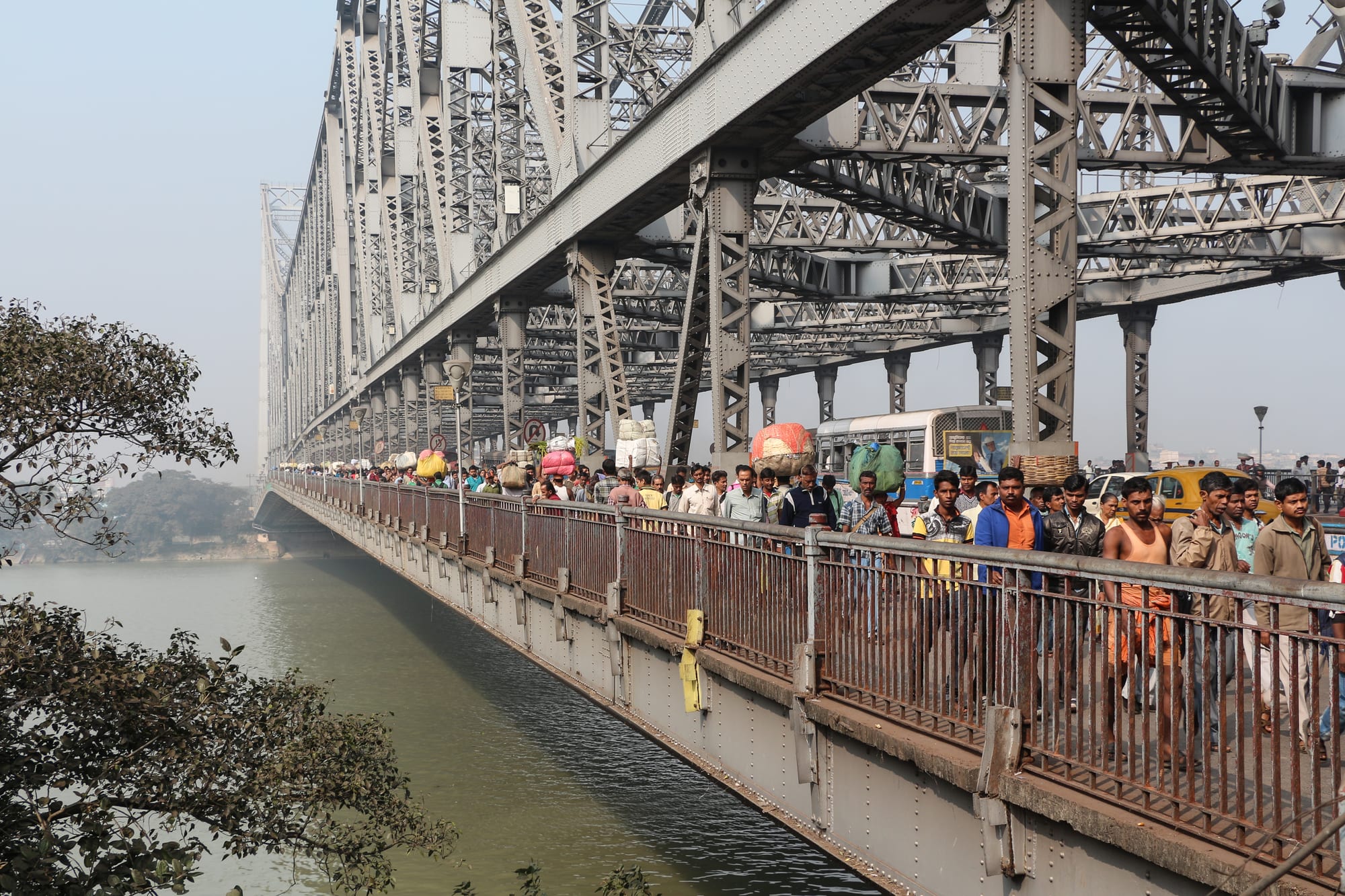
The steel cantilever span of Howrah Bridge above a crowded pedestrian walkway, with the Hooghly river below

Kolkata, Darjeeling & the East, India

Kolkata

Pedestrians crossing the Howrah Bridge over the Hooghly river in Kolkata. (Bernard Gagnon / Wikimedia Commons · CC BY-SA 3.0)

The capital of West Bengal, on the east bank of the Hooghly, grew from an East India Company trading post into the capital of British India and the centre of the 19th-century Bengal Renaissance. It keeps a dense inheritance of colonial buildings, trams, printing houses and coffee houses, and is known across India for its literature, its politics and its food.

Neighbourhoods

  • B. B. D. Bagh and the old business district
    • Historic district
    • Architecture
    • Close to public transport

    The colonial core around the tank once called Dalhousie Square, with the Writers' Building, the General Post Office, banks and shipping offices in heavy Victorian stone. It is packed with office workers by day and almost empty at night, and the river ghats and the Howrah Bridge are a short walk away.

    Open in Maps
  • Park Street and Chowringhee
    • Best for food
    • Nightlife
    • First-time visitors

    The city's restaurant and bar street, running east from the Maidan past old cabaret-era establishments, bakeries and music venues, with the Indian Museum and most central hotels nearby. The lights strung along it at Christmas are a Kolkata institution.

    Open in Maps
  • North Kolkata
    • Historic district
    • Local life
    • Markets

    The older Bengali city of narrow lanes, courtyard mansions and family temples, taking in College Street's booksellers, the idol-makers of Kumortuli and the Jorasanko house where Rabindranath Tagore was born. Crowded, worn and the best part of the city for walking.

    Open in Maps
  • South Kolkata and Ballygunge
    • Quiet and residential
    • Cafés
    • Shopping

    The leafier southern districts of flats, clubs and parks, with lakes for morning walkers, small galleries, and a concentration of cafés and modern Bengali restaurants around Ballygunge and Gariahat's pavement market.

    Open in Maps
  • Alipore and the Maidan's southern edge
    • Parks
    • Quiet and residential
    • Museums

    A district of large houses, consulates and old colonial bungalows next to the racecourse, the zoo and the botanical end of the city, with the Victoria Memorial and the Maidan immediately to the north.

    Open in Maps
  • Salt Lake and New Town
    • Business
    • Close to public transport
    • Quiet and residential

    Planned suburbs north-east of the centre built on reclaimed marsh, holding the technology parks, the big stadium and a good deal of newer housing. Wide roads and low buildings make it feel unlike the rest of the city, and the airport is close.

    Open in Maps

Things to do

Famous landmarks

  • Victoria Memoriallandmark

    A white marble hall of 1921 standing in gardens at the south end of the Maidan, built to commemorate Queen Victoria and now a museum of the city and the Raj.

    Open in Maps
  • Howrah Bridgelandmark

    The cantilever bridge of 1943 across the Hooghly, carrying enormous streams of pedestrians and traffic between Kolkata and Howrah station.

    Open in Maps
  • St Paul's Cathedrallandmark

    The Gothic revival Anglican cathedral of 1847 beside the Maidan, its tower rebuilt after the 1934 earthquake on the model of the Bell Harry tower of Canterbury Cathedral.

    Open in Maps
  • Marble Palacelandmark

    A private mansion of 1835 in north Kolkata, crowded with European statuary, chandeliers and paintings, still owned by the family that built it.

    Open in Maps
  • Jorasanko Thakur Barilandmark

    The ancestral house of the Tagore family in north Kolkata, the birthplace of Rabindranath Tagore, now a museum of the family and the Bengal Renaissance.

    Open in Maps

Temples and places of worship

  • Dakshineswar Kali Templelandmark

    A large riverside temple of 1855 north of the city, associated with the mystic Ramakrishna, with twelve Shiva shrines along the ghat.

    Open in Maps
  • Kalighat Kali Templelandmark

    A Kali temple in a dense quarter of south Kolkata, one of the most visited Kali shrines in India and one of the sources often suggested for the city's name.

    Open in Maps
  • Belur Mathlandmark

    The headquarters of the Ramakrishna Mission on the west bank of the Hooghly, its main temple deliberately fusing Hindu, Buddhist and Christian art and motifs.

    Open in Maps

Museums and galleries

  • Indian Museummuseum

    Founded in 1814 and the oldest museum in India, with Bharhut Buddhist railings, Gandhara sculpture, fossils and a large natural history collection around a colonnaded courtyard.

    Open in Maps
  • Netaji Bhawanmuseum

    The family house of Subhas Chandra Bose, from which he escaped British surveillance in 1941, now a museum and research centre about his life.

    Open in Maps
  • Science Citymuseum

    A large science centre in the east of the city with a space theatre, dioramas and hands-on galleries, popular with families.

    Open in Maps

Parks, the river and sport

  • Maidanpark

    The vast open green at the centre of the city, kept clear since the 18th century for the guns of Fort William, now full of football matches, cricket nets and grazing horses.

    Open in Maps
  • Prinsep Ghatviewpoint

    A Palladian memorial of 1841 on the riverbank with a promenade beneath the Vidyasagar Setu bridge, busy with families and boat trips at sunset.

    Open in Maps
  • Eden Gardensattraction

    One of the largest and oldest cricket grounds in the world, in use since the 1860s and the home of Bengal cricket.

    Open in Maps
  • Alipore Zoological Gardenspark

    India's oldest formally established zoo, opened in 1876 in the Alipore district south of the Maidan.

    Open in Maps
  • Acharya Jagadish Chandra Bose Indian Botanic Gardenpark

    Across the river at Shibpur, a botanic garden of 1787 whose Great Banyan spreads over several acres from a ring of aerial roots.

    Open in Maps

Markets and street life

  • College Streetmarket

    A long street of second-hand bookstalls and publishers beside the university, known in Bengali as Boi Para, the book quarter.

    Open in Maps
  • Kumortulineighborhood

    The riverside lanes in the north where clay images of Durga and other deities are modelled, painted and shipped out in the weeks before the pujas.

    Open in Maps
  • New Marketmarket

    A red-brick Victorian market hall of 1874 near Esplanade, with hundreds of stalls selling cloth, spices, flowers and cakes.

    Open in Maps
  • Gariahat marketmarket

    A south Kolkata crossing where saris, fish and household goods are sold in shops and from pavement stalls, busiest in the evening.

    Open in Maps

Short trips from the city

  • Sundarbans National Parkpark

    The mangrove delta south of the city, a UNESCO World Heritage Site reached by road and boat, where Bengal tigers, crocodiles and river dolphins live among tidal creeks.

    Open in Maps
  • Chandannagarattraction

    A former French settlement about 35 kilometres up the Hooghly, with a tree-shaded riverside promenade, a church and a museum of the French period.

    Open in Maps
  • Barrackporeattraction

    An old cantonment town about 20 kilometres north on the river, with Gandhi memorials, colonial buildings and gardens along the bank.

    Open in Maps

Seasonal events

  • Durga PujaSeptember or October

    Five days when the whole city is given over to temporary pavilions, lights and processions, listed by UNESCO as intangible cultural heritage.

  • Kali Puja and DiwaliOctober or November

    The city's own autumn festival of lamps and firecrackers in honour of Kali, held a few weeks after Durga Puja.

  • Poila Boishakhmid-April

    Bengali New Year, when shops open new account books, families eat out and cultural programmes fill the halls.

  • Kolkata International Book Fairlate January to early February

    One of the largest book fairs in the world by attendance, a fixture of the city's literary calendar.

  • Kolkata International Film FestivalNovember or December

    A week of world cinema in the city's cinemas and cultural centres, with retrospectives of Bengali directors.

  • Christmas on Park StreetDecember

    Lights strung the length of Park Street, carol services at the churches and queues outside the old bakeries.

Eat and drink

Long-standing places and food districts in Kolkata. Hours, ratings and directions come from your maps app, always current.

Kolkata classics

  • Indian Coffee Housecafe

    The high-ceilinged hall on College Street where students, writers and political arguments have gathered over coffee and cutlets for generations.

    Open in Maps
  • Fluryscafe

    A Park Street tearoom opened in 1927 by two Swiss partners, known for its confectionery, breakfasts and rum-soaked Christmas cake.

    Open in Maps
  • Nahoum and Sonscafe

    A Jewish bakery inside New Market, founded in 1902 and one of the last traces of Kolkata's Baghdadi Jewish community, known for its fruit cake and cheese samosas.

    Open in Maps

Food districts and markets

  • Tiretta Bazaarneighborhood

    The old Chinatown in the centre, much reduced by emigration but still known for Chinese and Indian-Chinese cooking sold in small restaurants and from stalls.

    Open in Maps
  • Park Street restaurantsneighborhood

    Continental, Mughlai and Chinese kitchens in a row of long-established dining rooms, several of them dating from the mid-20th century.

    Open in Maps
  • Gariahat and Ballygunge eatingneighborhood

    Traditional Bengali thali houses, sweet shops and newer cafés in the southern neighbourhoods, alongside the pavement stalls of the Gariahat crossing.

    Open in Maps
  • Phuchka and roll stalls of Esplanadeneighborhood

    Crisp phuchka shells filled with tamarind water, kathi rolls of kebab wrapped in paratha, and fried snacks sold from carts around the tram terminus.

    Open in Maps

Experience Kolkata

History

Kolkata's recorded history begins in 1690 with the arrival of the East India Company, which established a trading post beside the Hooghly among the villages of Sutanuti, Gobindapur and Kalikata. Job Charnock is often named as its founder, although a court ruling in 2003 held that the city has no founder. Fort William was built to defend it; the Nawab of Bengal, Siraj ud-Daulah, captured the settlement in 1756, and the Company's victory at Plassey the following year made Bengal the base of British power in India. Calcutta became the capital of British India and, through the 19th century, one of the great port cities of the empire, exporting jute, tea and opium and building the offices, churches and mansions that still stand in the centre.

Wealth brought a remarkable intellectual flowering. Rammohan Roy, Vivekananda, Jagadish Chandra Bose and Rabindranath Tagore, who won the Nobel Prize in Literature in 1913, all worked here, and Bengali reformers, scientists and writers reshaped Indian public life. The city was also the cradle of anti-colonial politics, which was among the reasons the capital was moved to Delhi in 1911.

The 20th century was harsh. The Bengal famine of 1943 killed millions and drove the starving into the city; communal violence in 1946 preceded Partition in 1947, which cut Bengal in two and sent waves of refugees from East Pakistan; and the 1971 war brought more. Industry declined, the port silted, and from 1977 to 2011 the state was governed by a Communist-led coalition. The city was renamed Kolkata in 2001. Since then service industries, a technology sector in Salt Lake and New Town, and an expanding metro have slowly changed it, although it has not matched the growth of India's western and southern cities.

Culture & Customs

Kolkata regards itself as India's cultural capital and makes the case relentlessly. Bengali literature, Rabindra Sangeet — Tagore's songs, known by heart in most households — the films of Satyajit Ray, Mrinal Sen and Ritwik Ghatak, and a theatre tradition that ranges from commercial halls to street performance all belong here. College Street's bookstalls, the Indian Coffee House, the winter book fair and a dense calendar of recitals and lectures keep that life visible in a way few cities manage.

Durga Puja is the centre of the year. For five days in autumn neighbourhoods compete to build elaborate temporary pavilions, artists and craftsmen work for months on the idols in Kumortuli, and the whole city walks the streets at night to see them before the images are carried to the river. Kali Puja, Saraswati Puja and Poila Boishakh follow their own rhythms, and Christmas on Park Street, Eid in the central and eastern quarters and the Chinese New Year of the small Chinatown community add to them.

Politics and football are the other constants. The rivalry between the Mohun Bagan and East Bengal clubs traces back to the 1920s and maps onto old divisions between west Bengal families and those who came from the east. Street processions, strikes and wall graffiti are ordinary features of civic life. Manners are formal but warm: guests are fed, arguments are enjoyed, and Bengalis of all communities share a pride in the language that outsiders quickly notice.

Daily Life

About 4.5 million people live within the city's municipal limits and roughly 15 million in the wider metropolitan area, which stretches along both banks of the Hooghly. Density is extreme in the north and centre, where families live in subdivided old houses and low-rise blocks along lanes too narrow for cars, while the south and the planned suburbs of Salt Lake and New Town are more spacious and newer.

The economy is dominated by services, trade and government. Jute and engineering, which made the city, have largely gone; the port has moved much of its business downstream to Haldia; and information technology, hospitals, education and retail employ the middle class. Many young Bengalis leave for Bengaluru, Delhi or abroad, and West Bengal's growth has trailed India's richer states, which is a steady subject of local complaint.

Daily rhythms start early, with the fish market and the morning walk, and run late, with tea stalls, sweet shops and restaurants busy until well after dark. Tea in small clay cups, the evening adda on a rooftop or at a corner, and the Sunday mutton curry are common to most households. Flooding in the monsoon, worsening winter air quality, ageing buildings and the long-running expansion of the metro are the recurring civic issues.

Food

Bengali cooking is built on rice, freshwater fish and mustard oil, and the Kolkata version adds layers from the city's many communities. Machher jhol is the everyday fish curry; shorshe ilish is hilsa in a pungent mustard paste, the monsoon delicacy; chingri malai curry uses prawns in coconut milk; and kosha mangsho, slow-fried mutton, is eaten with luchi, the puffed fried bread of feast days. Vegetable dishes such as shukto and the lentil-and-vegetable ghonto fill out a meal served in courses, ending with chutney and papad.

The street food is a cuisine of its own. Phuchka, crisp hollow shells filled with spiced potato and tamarind water, are the best-known item; kathi rolls, invented in the city, wrap kebab, egg and onion in a paratha; and Kolkata biryani, brought by the exiled Nawab of Awadh in the 19th century, is distinguished by the whole potato and boiled egg buried in the rice. Chinese food cooked Indian-style began in Tiretta Bazaar and the Tangra district, and is now eaten across India.

Sweets carry the greatest weight. Rosogolla, spongy cheese balls in syrup, whose invention Bengal and Odisha both claim; sandesh, pressed fresh cheese flavoured with jaggery in winter; and mishti doi, sweetened yoghurt set in small clay pots, are sold by long-established shops in every neighbourhood. Tea, brewed strong and sweet with milk and served in disposable clay cups, punctuates the whole day.

Planning tools

Budget

Kolkata is markedly cheaper than Delhi, Mumbai or Bengaluru for hotels, food and transport, and the metro and shared taxis keep daily costs low. Mid-range hotels cluster around Park Street, Esplanade and Salt Lake. Prices rise steeply during Durga Puja, when rooms sell out weeks ahead.

Daily Budget Midrange
USD 40–95 (mid-range hotel, restaurant meals, taxis and a car for day trips)
Daily Budget Shoestring
USD 15–25 (guesthouse near Sudder Street, street food and thalis, metro and buses)

Use the metro for north–south journeys, which is far quicker than the roads, and book well ahead for the puja season and the winter festival weeks.

Best Time to Visit

October to March. Durga Puja, in September or October, is the most extraordinary time to be in the city but also the most crowded, and the cool dry weeks from November to February are the easiest for walking. The monsoon from June to September brings heavy rain and street flooding, and April and May are hot and very humid.

Suggested Number of Days

Three days suit a first visit to a city whose interest lies in its districts as much as its monuments. Five or six allow the river towns and a trip into the Sundarbans, which takes at least two days in itself. Festival crowds slow everything down.

First Visit
3 days
With Surroundings
5–6 days

Transportation

The metro, the oldest in India, is the fastest way to move north to south, and newer lines now run east to west, including a section under the Hooghly to Howrah. Yellow Ambassador taxis are slowly disappearing in favour of app-based cabs and autorickshaws, which run fixed routes and are shared. Ferries cross the river between Kolkata and Howrah, and the tram network, once running dozens of routes, is down to two lines into Esplanade, though the state government announced a revival programme in 2026.

Traffic in the old business district is heavy from mid-morning to early evening; the metro, the ferries and walking are usually faster than a taxi in the centre.

Airport & Station Connections

Netaji Subhas Chandra Bose International Airport at Dum Dum, about 16 kilometres north-east of the centre, has flights across India, South-East Asia and the Gulf, and is linked by taxi and bus. Howrah, across the river, and Sealdah, in the city, are two of the busiest railway stations in India, with overnight trains to Delhi, Varanasi and the north-east and services to New Jalpaiguri for the hills.

Walkability

Kolkata rewards walking more than most Indian cities: the colonial district, the Maidan, Park Street, College Street and the northern lanes are all compact and full of detail at street level. Pavements are uneven and often occupied by stalls, crossings are chaotic and the summer heat and humidity are punishing, so walks are best kept to the mornings and evenings and linked by short metro rides.

Safety

Kolkata is generally regarded as one of the safer large Indian cities, with a low rate of violent crime and a strong street life late into the evening. The everyday risks are traffic, pickpocketing in crowded markets and at festivals, air pollution in winter, and heat and flooded streets in the monsoon. Political demonstrations and general strikes can close roads at short notice.

Keep valuables secure in New Market, Gariahat and puja crowds, avoid political rallies and blockades, and drink bottled or filtered water. Check current official travel advice before travelling.

Climate

A tropical climate with a long hot season, a heavy monsoon from June to September that can flood low-lying streets, and a short mild winter. The city sits near the delta, so humidity is high for most of the year, and pre-monsoon squalls known as kalbaisakhi bring sudden evening storms in spring.

Summer
hot and very humid — 33–38°C from April to June, with high moisture making it feel hotter
Winter
mild and dry — days of 22–27°C, nights around 12–15°C, with haze and poor air quality in December and January

Local Customs

Bengali social life is built on adda, long unhurried conversation, and visitors are quickly drawn into it. Shoes come off at temples and in many homes, and modest dress is expected at religious sites. Food is offered insistently and refusing outright can cause offence. Fish and sweets are matters of local pride, and criticism of either is taken seriously, if usually in good humour.

Tipping is modest — rounding up taxi fares and about ten per cent in restaurants. Ask before photographing people, particularly in Kumortuli's workshops and at religious ceremonies, and dress conservatively at the Kali temples.

Common Payment Methods

The currency is the Indian rupee. Cards are accepted in hotels, malls and larger restaurants, and UPI mobile payments are used almost everywhere by residents, including small shops and taxis. Cash is still needed for autorickshaws, markets and street food; ATMs are plentiful in the centre and in Salt Lake.