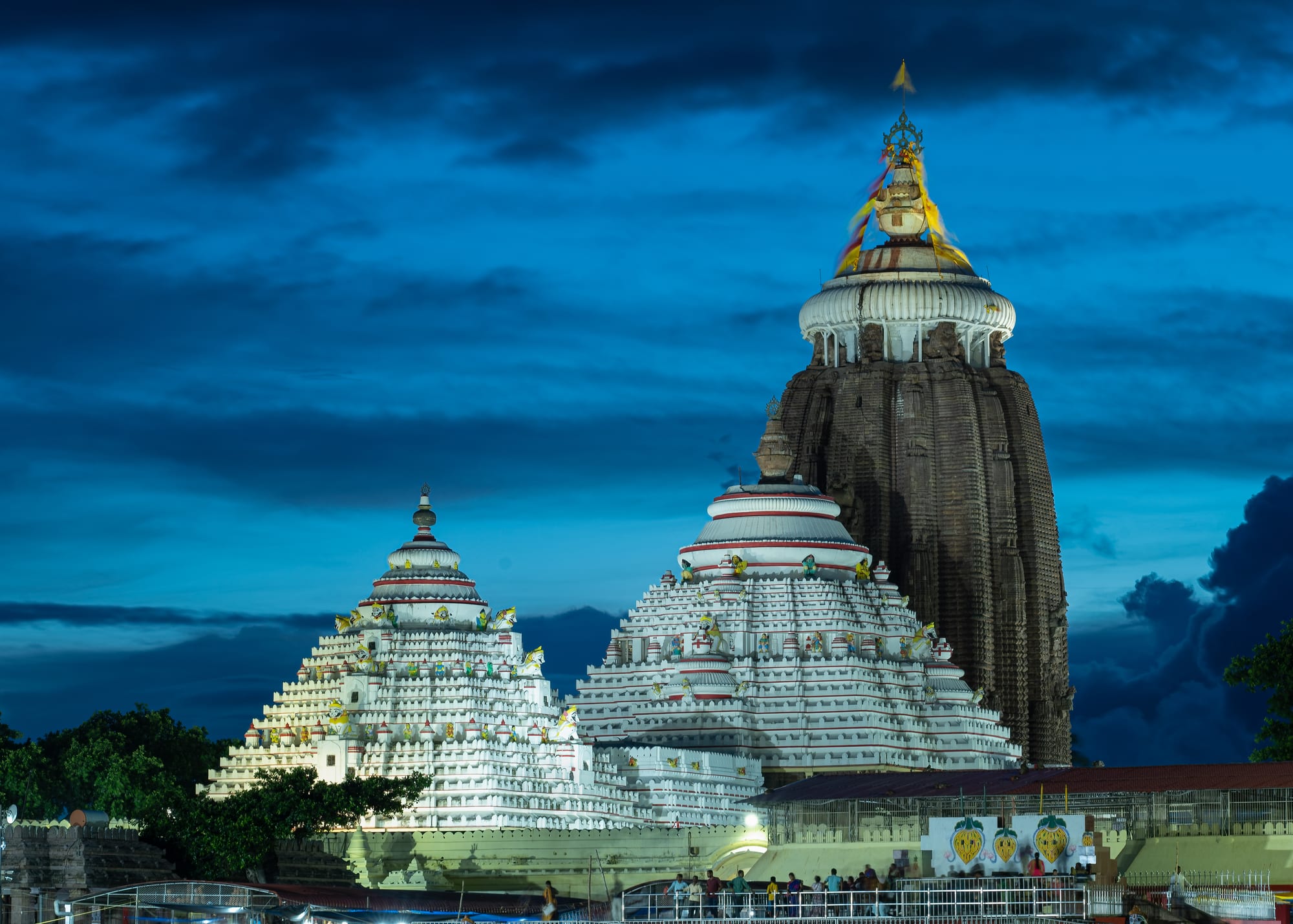
Floodlit white stepped temple towers and a tall dark stone spire with a flag, against a deep blue evening sky

Kolkata, Darjeeling & the East, India

Puri

The Jagannath Temple in Puri lit up at dusk, its stone spire rising above the white-plastered halls. (Kalyanpuranand / Wikimedia Commons · CC BY-SA 4.0)

A temple town on the Bay of Bengal in the Indian state of Odisha, built around the 12th-century Jagannath temple and counted among Hinduism's four holiest pilgrimage centres. Its wide processional avenue fills each summer for the Rath Yatra chariot festival, while a long sandy beach, seafood stalls and the Sun Temple at Konark draw visitors year round.

Neighbourhoods

  • The temple quarter and Bada Danda
    • First-time visitors
    • Historic district
    • Pilgrims

    The heart of Puri, around the walled Jagannath temple and the broad avenue known as Bada Danda, the Grand Road, that runs from it to the Gundicha temple. Lodging houses, sweet shops, brass and conch sellers and pilgrim crowds fill the lanes, and the street becomes the stage for the chariot festival.

    Open in Maps
  • Swargadwar and the beach front
    • Beaches
    • Best for food
    • Evening strolls

    The stretch of shore closest to the old town, where the main cremation ground gives the area its name — the gate to heaven. Pilgrims bathe at dawn, hawkers sell tea and fried fish in the evening, and a line of hotels and guesthouses backs the sand.

    Open in Maps
  • Chakratirtha Road
    • Budget travellers
    • Quiet and residential

    A road running parallel to the eastern beach, long favoured by foreign and backpacking visitors for its small hotels and guesthouses. It is quieter than the temple lanes and a short walk from the fishing settlements at the eastern end of the sand.

    Open in Maps
  • New Puri and Baliapanda
    • Quiet and residential
    • Beaches

    The newer western side of town, laid out in wider streets behind a broad and emptier beach. Government offices, larger hotels and residential colonies are here, along with the casuarina plantations that screen the shore.

    Open in Maps

Things to do

Temples and pilgrimage

  • Jagannath Templelandmark

    The great 12th-century temple of Jagannath, Balabhadra and Subhadra, begun under the Eastern Ganga king Anantavarman Chodaganga; entry is restricted to Hindus, but the compound is visible from surrounding rooftops.

    Open in Maps
  • Gundicha Templelandmark

    The garden temple at the far end of the Grand Road where the three deities stay for several days during the Rath Yatra.

    Open in Maps

Around the town

  • Puri Beachbeach

    A long shallow-shelving beach on the Bay of Bengal, busy with bathing pilgrims at sunrise, fishing boats, camel rides and sand sculptors.

    Open in Maps
  • Atharanalalandmark

    A laterite bridge of eighteen arches at the entrance to the town on the Bhubaneswar road, begun under the Eastern Ganga kings in the 13th century and rebuilt in the Maratha period, long the formal gateway for pilgrims.

    Open in Maps
  • Puri railway stationtransit hub

    The terminus of the branch line from Khurda Road, where most pilgrims arrive, a short distance north of the Grand Road.

    Open in Maps

Short trips from the town

  • Konark Sun Templelandmark

    A UNESCO World Heritage Site about 35 kilometres up the coast: a 13th-century temple built as the sun god's chariot, with huge carved stone wheels and teams of horses.

    Open in Maps
  • Chandrabhaga Beachbeach

    The wide beach a short distance from the Sun Temple, a bathing place associated with the sun god and the setting for the Magha Saptami fair.

    Open in Maps
  • Raghurajpurattraction

    A heritage crafts village of painted houses about 14 kilometres inland, where families work in Pattachitra cloth painting, palm-leaf engraving and masks.

    Open in Maps
  • Pipiliattraction

    A roadside town on the way to Bhubaneswar known for applique work — bright stitched canopies, umbrellas and lampshades made for temples and homes.

    Open in Maps
  • Chilika Lakeattraction

    Asia's largest brackish coastal lagoon, reached from Satapada south-west of Puri, with Irrawaddy dolphins and large numbers of migratory birds in winter.

    Open in Maps
  • Dhaulilandmark

    A hill on the river Daya near Bhubaneswar, widely believed to be the site of the Kalinga war that turned Ashoka to Buddhism, with a white peace pagoda built in 1972 above it.

    Open in Maps
  • Nandankanan Zoological Parkpark

    A zoo and botanical garden in forest on the edge of Bhubaneswar, known for its white tigers and its breeding programmes.

    Open in Maps

Seasonal events

  • Rath YatraJune or July

    The chariot festival in which the three deities are drawn along the Grand Road on towering wooden chariots pulled by crowds of devotees.

  • Chandan YatraApril and May

    A long hot-season ritual, running over several weeks, in which representative deities are taken out in decorated boats on a temple tank.

  • Snana YatraJune

    The public bathing of the deities with pots of water, after which they are kept from view for a fortnight.

  • Konark Dance FestivalDecember

    An open-air festival of Indian classical dance staged near the Sun Temple at Konark, up the coast from Puri.

Eat and drink

Long-standing places and food districts in Puri. Hours, ratings and directions come from your maps app, always current.

Puri classics

  • Mahaprasad at Ananda Bazarmarket

    Food cooked in earthen pots in the temple kitchens and sold in the market inside the compound, the best known of Odisha's temple offerings; it is eaten by Hindu pilgrims, as access follows the temple's entry rules.

    Open in Maps
  • Khaja and Odia sweetsmarket

    Layered pastry fried and soaked in syrup, sold by the box along the Grand Road together with chhena poda and other cheese sweets.

    Open in Maps

Food streets and markets

  • Bada Danda stallsneighborhood

    Carts and small kitchens along the processional avenue selling dahi bara aloo dum, ghuguni, tea and fried snacks to a constant stream of pilgrims.

    Open in Maps
  • Swargadwar beach stallsneighborhood

    Fried fish, prawns and crab cooked to order at the beach end of town, where the catch is landed a short way along the sand.

    Open in Maps
  • Chakratirtha Road cafesneighborhood

    Small restaurants and cafes along the eastern beach road serving Odia thalis alongside the pancakes, pasta and Tibetan dishes aimed at long-staying visitors.

    Open in Maps

Experience Puri

History

Puri's history is the history of its temple. The town, known in older texts as Purushottama Kshetra, grew around the worship of Jagannath, a form of Vishnu whose wooden images are carved in a distinctive abstract style and are renewed in a ceremony held only in certain years. The present temple was begun in the 12th century by the Eastern Ganga king Anantavarman Chodaganga and finished under his successors, and its spire has served ever since as a landmark for sailors on the Bay of Bengal.

The temple made the town wealthy and vulnerable in equal measure. It became one of the four dhams, the cardinal pilgrimage centres of Hinduism, drawing pilgrims from across the subcontinent along routes that entered the town through the Atharanala bridge. Medieval Odisha's rulers tied their legitimacy to the deity, and the Gajapati king of Puri still performs the ceremonial sweeping of the chariots at the Rath Yatra. Raids and wars repeatedly threatened the shrine, and its images were moved and hidden more than once.

The Marathas took control of the region in the 18th century, and the British East India Company followed in 1803, administering the temple's pilgrim tax before handing management back under pressure from missionary opinion at home. British accounts of the chariot festival gave English the word juggernaut. The railway reached Puri in 1897 and turned the pilgrimage town into a seaside resort for Bengal as well, a double identity it keeps today. Cyclones have shaped the modern town too: Fani, in 2019, tore off roofs and stripped trees across Puri before the state's evacuation system was widely credited with limiting deaths.

Culture & Customs

Life here is organised around the temple calendar. The daily cycle of rituals, the dressing of the deities and the cooking of offerings employ thousands of servitors in hereditary roles, and the rhythms of the year — the bathing festival, the fortnight of seclusion, the chariot procession, the return journey — set the pattern of the town's public life. The Gajapati of Puri retains a ceremonial place in these rites, and the temple's hierarchy of priests, cooks and attendants forms a community in itself.

Odisha's classical dance, Odissi, has deep roots in the temple tradition of this coast, and its poses echo the sculpture of Odishan shrines; the annual dance festival at Konark keeps the connection visible. Pattachitra painting, made on cloth stiffened with tamarind paste and depicting Jagannath and scenes from the epics, is produced in the village of Raghurajpur nearby and sold in Puri's shops, along with palm-leaf engraving, appliqué from Pipili and stone and wood carving.

Puri is also a beach town, and the two sides sit together comfortably: families bathe at Swargadwar at dawn as an act of devotion and return in the evening for ice cream and camel rides. Odia is the everyday language, Bengali is widely understood because of the long flow of visitors from Kolkata, and Hindi and some English serve in hotels. Visitors are asked to treat the temple quarter as a sacred space rather than a sight, and to be careful about photographing rituals and mourners.

Daily Life

About 200,000 people live in Puri, making it a medium-sized town by Indian standards but one whose population swells hugely at festivals, when visitor numbers can exceed the resident count several times over. The economy runs on pilgrimage and tourism: hotels and lodging houses, restaurants, transport, guiding and the trade in flowers, sweets, brassware, conch shells and souvenirs. A second economy of temple service, with hereditary duties and long-established priestly families, overlaps it.

Fishing remains important along the shore, where boats are drawn up on the sand and the catch is sold in the early morning, and there is farming of rice, coconut and betel in the villages inland. The craft villages of the Puri district — painters at Raghurajpur, appliqué workers at Pipili, stone carvers towards Konark — supply the town's shops and export well beyond Odisha. Puri is also a district headquarters, so government offices and schools employ a good share of the town.

The day begins before dawn with bathing and temple queues and ends late along the seafront. The main pressures are familiar ones for a small town carrying very large crowds: water supply and drainage, waste on the beach, traffic on a street plan built for processions, and the periodic damage of cyclones. Conservation work on the temple and its precinct, and schemes to widen and clear the area around it, have reshaped parts of the old centre in recent years.

Food

Puri's most distinctive food is mahaprasad, the offerings cooked in the Jagannath temple's kitchens — said to be among the largest traditional kitchens anywhere — in stacked earthenware pots over wood fires, then sold in the Ananda Bazar inside the compound. The spread is largely vegetarian and free of onion and garlic: rice, dal, vegetable dishes such as dalma, lentils simmered with vegetables, and sweet preparations including khaja. Eating it is an act of devotion as much as a meal, shared without regard to caste.

Beyond the temple, the town eats Odia home cooking. Dahi bara aloo dum, lentil fritters soaked in spiced yoghurt and served with a potato curry, is the classic breakfast and street snack. Pakhala, rice fermented in water and eaten with fried fish, badi and greens, is the hot-weather staple. Santula and besara are vegetable dishes lightly seasoned with mustard, and chhena poda, baked caramelised cottage cheese, is Odisha's best-known sweet, sold alongside rosogolla and the syrup-soaked layers of khaja.

The sea supplies the other half of the table. Pomfret, prawns, crab and the mud-flat catch are fried in semolina or cooked in mustard gravies at the beach stalls and in the hotels, and the fishing settlements at the eastern end of the sand sell direct. Tea stalls run all day on the Grand Road, green coconuts are opened on the seafront, and the tourist restaurants along Chakratirtha Road add North Indian, Chinese and Western dishes for longer-staying visitors.

Planning tools

Budget

Puri is one of the cheaper places to stay on the Indian coast. Pilgrim lodging houses near the temple cost very little, beach hotels are modest by Indian standards, and food is inexpensive. Prices climb steeply around Rath Yatra, at the winter holidays and during the Odia new year, when rooms in the centre can be hard to find at all.

Daily Budget Midrange
USD 40–90 (beach hotel, restaurant meals, a car with driver for Konark and Chilika)
Daily Budget Shoestring
USD 12–25 (pilgrim lodge or guesthouse, thalis and street food, buses and shared autos)

Rooms on the seafront cost more than those a street or two behind it, and the buses and shared autos to Konark and Bhubaneswar are cheap enough that a hired car is only worth it for a full day out.

Best Time to Visit

October to February, when the coast is warm and dry and the sea is calmest. March to May is hot and sticky, though it carries the Chandan Yatra; the monsoon from June to September brings heavy rain and rough surf, but also the Rath Yatra, the biggest event of the year and by far the most crowded time to be in town.

Suggested Number of Days

Two days covers the temple town and the beach at an unhurried pace. Three or four allow for Konark, the craft villages inland and the lagoon to the south-west. Pilgrims often stay longer, and festival periods need extra time for crowds and closed roads.

First Visit
2 days
With Surroundings
3–4 days

Transportation

The town is small and most journeys are made on foot, by cycle rickshaw or by shared auto-rickshaw, which run along the Grand Road and the seafront. Buses leave from the bus stand for Bhubaneswar, Konark and Satapada, and the coastal road to Konark is a pleasant drive. Cars with drivers are easy to arrange through hotels for day trips.

Agree the fare with a cycle rickshaw or auto-rickshaw before setting off, as fares are not metered.

Airport & Station Connections

Puri is the terminus of a railway branch and has direct trains from Kolkata, Bhubaneswar and several cities across India, which is how most pilgrims arrive. The nearest airport is at Bhubaneswar, about 60 kilometres away, roughly an hour and a half by road; buses and shared taxis run frequently between the two cities.

Walkability

The centre is easy to walk: the Grand Road runs about three kilometres from the temple to Gundicha, and the beach is a few minutes from the temple quarter. Pavements are irregular and the mixture of pilgrims, rickshaws and cattle makes for slow going near the temple. Sand and sun make the seafront hard work in the middle of the day in the hot months.

Safety

Puri is a calm pilgrimage town, and the main risks are crowds, surf and weather rather than crime. The sea has strong currents and undertow, and drownings happen each year; lifeguards patrol parts of the main beach. Festival crowds on the Grand Road are enormous. The Odisha coast is exposed to cyclones, mainly in spring and autumn, and cyclone Fani caused severe damage in the town in 2019.

Swim only where lifeguards are posted and others are bathing, follow cyclone warnings and evacuation instructions in season, and keep an eye on belongings in festival crowds. Check current official travel advice before travelling.

Climate

A hot, humid tropical coastal climate, with the sea keeping temperatures a little steadier than inland Odisha. The monsoon runs from June to September, and the cyclone risk is highest in the months either side of it. Winter is warm, dry and the pleasantest season.

Summer
hot and humid, generally 30–38°C, with sea breezes in the afternoon and heavy monsoon rain from June
Winter
warm and dry, generally 15–28°C, with clear skies and calm seas

Local Customs

This is above all a place of pilgrimage, and the temple's rules are taken seriously: entry to the Jagannath temple is restricted to Hindus, shoes and leather items are left outside temples, and photography inside them and of the deities is not allowed. Modest dress covering shoulders and knees is expected in the temple quarter, and swimwear belongs on the beach rather than in the streets.

Ask before photographing pilgrims, bathers or cremation rites at Swargadwar; tipping is not expected but small change is welcome, and mobile phones are among the items left at the temple gate.

Common Payment Methods

The currency is the Indian rupee. Cards are accepted at hotels and larger restaurants, and the UPI mobile payment system is used almost everywhere, but pilgrim lodges, rickshaws, beach stalls and market sellers work in cash. ATMs cluster around the Grand Road and Chakratirtha Road, and it is worth carrying small notes.