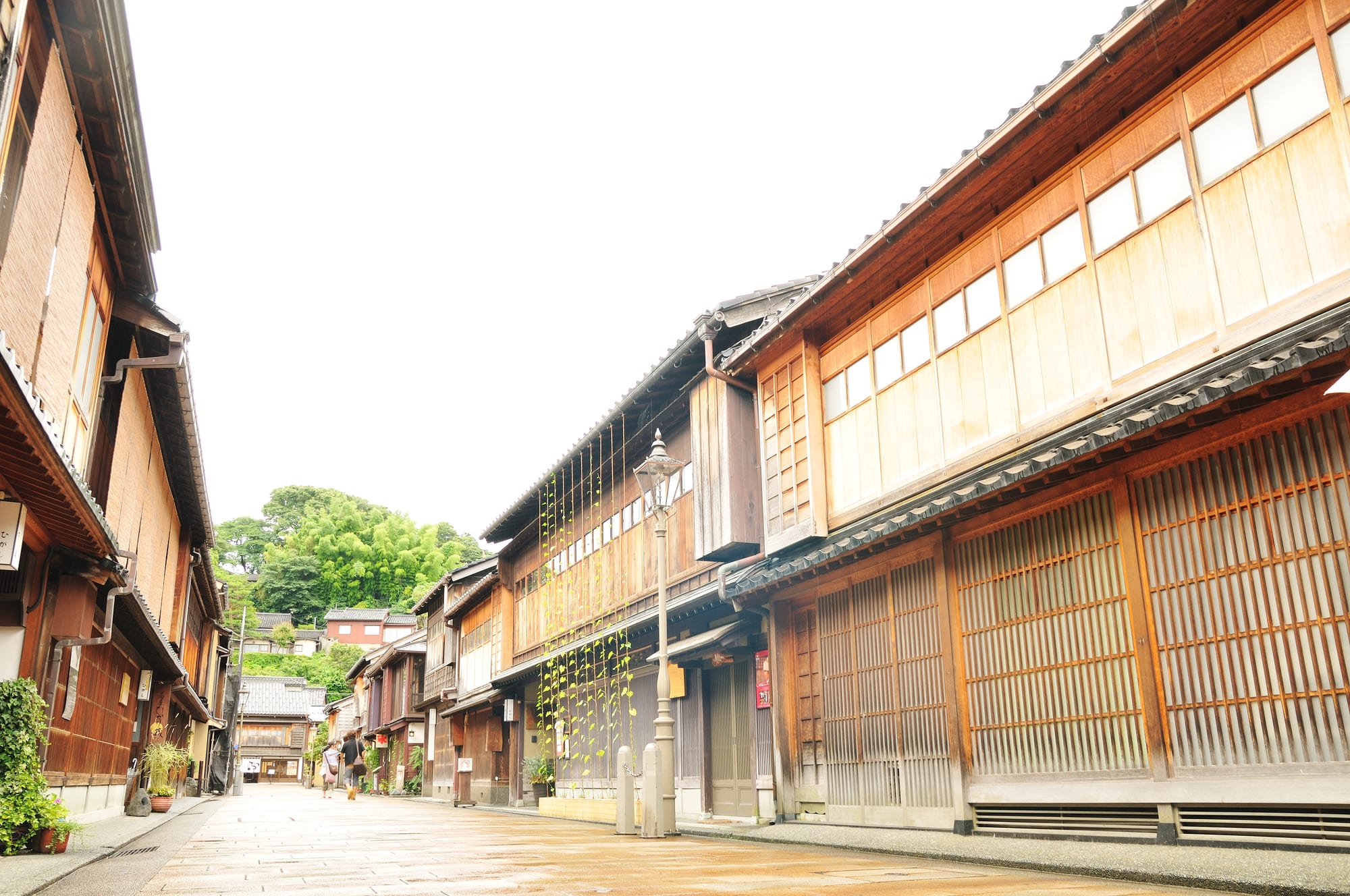
A stone-paved lane between two-storey wooden teahouses with fine lattice screens and tiled roofs, a hill of trees at the end

Chubu: the Japanese Alps & Mount Fuji, Japan

Kanazawa

A lane of wooden teahouses in the Higashi Chaya district of Kanazawa. (ajari / Wikimedia Commons · CC BY 2.0)

The capital of Ishikawa prefecture, on the Sea of Japan coast between two rivers. It grew as the castle town of the Maeda lords, whose Kaga domain was the richest in Japan after the shogun's own, and their patronage of crafts left the Kenroku-en garden, teahouse and samurai quarters, gold leaf and lacquer workshops. It escaped wartime bombing, so much of the old plan survives.

Neighbourhoods

  • The castle and Kenroku-en
    • First-time visitors
    • Historic district
    • Parks

    The green heart of the city, where the reconstructed castle gates and storehouses face the great garden across a road bridge. Museums, the prefectural art gallery and a modern art museum stand within a few minutes' walk, and the ground is high enough for views over the roofs.

    Open in Maps
  • Higashi Chaya
    • Historic district
    • Crafts
    • Tea houses

    A preserved quarter of two-storey wooden teahouses north-east of the centre, laid out in the Edo period, where geisha still perform. The lattice-fronted buildings now also hold gold-leaf shops, cafés and small museums, and the lanes are quietest early in the morning.

    Open in Maps
  • Nagamachi
    • Historic district
    • Quiet and residential
    • Walks

    The old samurai quarter behind the main shopping street, a grid of earthen walls, water channels and gateways, with one restored retainer's house open to visitors. In winter the walls are wrapped in straw mats against the snow.

    Open in Maps
  • Korinbo and Katamachi
    • Shopping
    • Nightlife
    • Best for food

    The modern city centre south of the castle, with department stores, covered arcades and the dense bar and restaurant lanes of Katamachi, including the narrow alleys of the old entertainment quarter. Most of the city's evening life is here.

    Open in Maps
  • Teramachi and Nishi Chaya
    • Temples
    • Quiet and residential
    • Walks

    Across the Sai River to the south, a district of dozens of temples on grid streets, with a smaller teahouse quarter beside it. It is residential, little visited and good for slow walking.

    Open in Maps
  • Kanazawa station area
    • Close to public transport
    • Shopping

    The transport hub about two kilometres north-west of the castle, marked by a large wooden drum gate and a glass dome. Hotels, bus stands and a big shopping complex cluster around it, and every city bus route starts here.

    Open in Maps

Things to do

Gardens and the castle

  • Kenroku-enpark

    One of the three great gardens of Japan, laid out by the Maeda lords over two centuries, with ponds, a hillside stream, teahouses and the pines propped and roped against snow each winter.

    Open in Maps
  • Kanazawa Castlelandmark

    The Maeda stronghold from 1583, with gates, turrets and long white storehouse rebuilt in timber using traditional joinery, standing in a park of lawns and stone walls of many different styles.

    Open in Maps
  • Seisonkakulandmark

    An elegant villa of 1863 built by a Maeda lord for his mother beside the garden, with painted sliding doors, imported glass and unusually bright interiors.

    Open in Maps
  • Oyama Shrinelandmark

    The shrine to Maeda Toshiie, founder of the domain, entered through a gate of 1875 that mixes Japanese, Chinese and European design and carries stained glass in its upper storey.

    Open in Maps

Old quarters

  • Higashi Chaya Districtneighborhood

    The best known of the city's teahouse districts, a protected street of wooden façades where gold leaf, sweets and tea are sold and some houses are open to look inside.

    Open in Maps
  • Nagamachi samurai districtneighborhood

    Lanes of mud-walled samurai residences with water channels running beside them, including the restored Nomura family house and its small garden.

    Open in Maps
  • Myōryū-jilandmark

    Known as the Ninja Temple, a 17th-century temple in Teramachi riddled with hidden stairs, concealed rooms and trick doors, built when defensive building was restricted.

    Open in Maps
  • Kazuemachineighborhood

    A small teahouse district on the bank of the Asano River, reached by an old wooden bridge, with restaurants behind its lattice fronts and lanterns lit in the evening.

    Open in Maps

Museums and crafts

  • 21st Century Museum of Contemporary Artmuseum

    A circular glass building by SANAA beside the castle park, where the permanent works include Leandro Erlich's Swimming Pool, seen from above and from below the surface.

    Open in Maps
  • D. T. Suzuki Museummuseum

    A spare concrete and water building honouring the Zen philosopher born in Kanazawa, arranged around a shallow mirror pond for sitting quietly.

    Open in Maps
  • Ishikawa Prefectural Museum of Artmuseum

    The main collection of Kaga art, strong in Kutani porcelain, lacquer and dyed silk, and holding works from the Maeda family collection.

    Open in Maps
  • Ishikawa Prefectural Museum of Traditional Arts and Craftsmuseum

    A survey of the traditional crafts of the prefecture, from gold leaf and Kaga yuzen dyeing to lacquer and ceramics, in a building beside Kenroku-en.

    Open in Maps
  • Kanazawa Phonograph Museummuseum

    A museum of phonographs and old records, where machines from the early decades of recorded sound are played to visitors.

    Open in Maps

Markets and walks

  • Omicho Marketmarket

    The city's food market since the Edo period, originally open-air and now covered, with stalls of crab, yellowtail, sweet shrimp and Kaga vegetables, and small restaurants serving seafood bowls.

    Open in Maps
  • Utatsuyamaviewpoint

    The wooded hill above the Asano River, with temple paths, a craft workshop centre and a lookout over the city towards the sea.

    Open in Maps
  • Teramachi temple districtneighborhood

    Dozens of temples gathered south of the Sai River, laid out as a defensive belt for the castle town and now a quiet grid of gates and graveyards.

    Open in Maps

Short trips from the city

  • Shirakawa-gōattraction

    A UNESCO-listed village of steep thatched farmhouses in a mountain valley south-east of the city, reached by direct bus.

    Open in Maps
  • Kaga Onsenattraction

    A group of hot-spring villages about 40 kilometres south, including Yamanaka and Yamashiro, long linked to lacquer and Kutani pottery.

    Open in Maps
  • Eihei-jilandmark

    One of the two head temples of Soto Zen, founded in 1244 in cedar forest in Fukui prefecture, where visitors can watch or join monastic practice.

    Open in Maps

Seasonal events

  • Hyakumangoku Festivalearly June

    The city's biggest festival, marking Maeda Toshiie's entry into the castle in 1583 with an armoured procession, lantern floats on the river and dancing in the streets.

  • Yukitsuri in Kenroku-enNovember to March

    Ropes are strung from poles to support the garden's pine branches against wet snow, a piece of practical engineering that has become a winter emblem of the city.

  • Cherry blossom in the castle parkearly April

    Blossom fills the castle grounds and the garden, which open in the evening with lighting during the flowering week.

  • Winter crab seasonNovember to March

    Snow crab from the Sea of Japan dominates the market and restaurant menus through the cold months.

Eat and drink

Long-standing places and food districts in Kanazawa. Hours, ratings and directions come from your maps app, always current.

Kanazawa classics

  • Jibunirestaurant

    The city's signature dish, made with duck or chicken dusted in flour and simmered with wheat gluten and vegetables in a thickened broth, eaten with wasabi, and a standard course in Kaga cuisine restaurants.

    Open in Maps
  • Seafood bowls at the marketmarket

    Stalls and small dining rooms in the covered market serve kaisendon, rice topped with sweet shrimp, sea urchin, crab and the prized blackthroat seaperch known as nodoguro.

    Open in Maps
  • Kanazawa odenrestaurant

    The simmered dish of fish cakes, wheat gluten, egg and vegetables in a light broth, ladled out at counters and izakaya in the bar lanes.

    Open in Maps
  • Wagashi and Kaga bochacafe

    Kanazawa is one of Japan's main centres of sweet making, a legacy of the tea ceremony; dry sweets and bean-paste confections are eaten with matcha or with the roasted stem tea of Kaga.

    Open in Maps

Districts to eat and drink in

  • Katamachi and the alleysneighborhood

    The main nightlife quarter south of the river bend, with izakaya, sushi counters, sake bars and narrow lantern-lit alleys of tiny drinking places.

    Open in Maps
  • Higashi Chaya tea housesneighborhood

    Teahouses, sweet shops and cafés in converted wooden buildings, several serving matcha with sweets in rooms looking onto small gardens, and gold leaf sprinkled on ice cream.

    Open in Maps

Experience Kanazawa

History

Kanazawa began not with a lord but with a religious league. In 1488 followers of the Jodo Shinshu sect overthrew the provincial governor and ran Kaga province for close to a century as a commoners' domain, with their fortified temple on the bluff where the castle now stands. Oda Nobunaga's armies broke that rule in 1580, and in 1583 Maeda Toshiie entered the castle as lord.

Under the Maeda the domain was assessed at more than a million koku of rice, making it the wealthiest in Japan after the Tokugawa's own holdings. Careful to avoid appearing a military threat, the family spent on culture instead: they imported Noh actors, tea masters, lacquerers, dyers and gold beaters, founded workshops and schools, and laid out the garden of Kenroku-en over generations beside the castle. Merchants filled the streets below, temples were grouped into defensive districts at Teramachi and Utatsuyama, and licensed teahouse quarters were laid out in the Edo period.

The castle burned repeatedly; the Ishikawa gate of 1788 and a long storehouse survive from the Edo period, and turrets and a long warehouse were rebuilt in timber, by traditional methods, in 2001. After 1871 the domain ended and the army took over the castle, and Kanazawa University occupied the site from 1949 to 1989. The city was not bombed in the Second World War, which is why so much of the old fabric and street plan remain. Tourism grew sharply after the Hokuriku Shinkansen arrived from Tokyo in 2015, and the line was extended south to Tsuruga in 2024.

Culture & Customs

Kanazawa's identity is built on craft. Almost all of Japan's gold leaf is beaten here, in sheets thin enough to be blown away by a breath, and used on temple altars, lacquer and, by modern custom, on ice cream and sweets. Kaga yuzen dyeing puts painted flowers and leaves on silk kimono, Kutani porcelain is known for deep green, yellow and red overglaze, and Wajima lacquer from the Noto coast is sold in the city's shops. Workshops offer short introductions to gilding, dyeing and gold-leaf pressing.

Performing arts follow the same aristocratic inheritance. Noh drama, patronised by the Maeda, is still taught and performed in the city, and the teahouse districts support geisha who perform dance and the shamisen at private parties, with occasional public performances. The tea ceremony is widespread, and with it a sweet-making tradition for which the city's wagashi are admired across Japan.

Local manners are those of a snowy, conservative provincial capital: polite, reserved and proud of the city's escape from bombing and its distance from Tokyo. Winter shapes the year — straw mats on garden walls, ropes on the pines, and a calendar of festivals from the June procession for Maeda Toshiie to the lantern boats of the Asano River. Students from the city's universities keep the nightlife of Katamachi busy.

Daily Life

About 460,000 people live in Kanazawa, in a prefecture of roughly a million. It is the administrative, university and hospital centre of the Hokuriku coast, and its economy mixes public employment, education, textiles and machinery with a tourist trade that grew heavily after the Shinkansen arrived. Craft industries employ far fewer people than they once did but remain central to how the city presents itself.

Most residents live in the flat districts spreading towards the sea and along the two rivers, the Sai and the Asano, in a city where cars are normal and the bus is the only public transport. Everyday shopping is at the covered arcades of Korinbo, the malls near the station and the suburban roadside stores, while Omicho market is used by restaurants and by older households.

The weather governs the rhythm. Rain falls on about half the days of the year, snow tyres go on in December, and the first sunny day in March is an event. Local concerns include the strain of visitor numbers on the small teahouse districts, an ageing and slowly shrinking population like most of provincial Japan, and the recovery of the Noto peninsula after the earthquake of January 2024, which drew many volunteers and evacuees to the city.

Food

Kanazawa eats extremely well, and the reason is geography: a cold sea in front and a wet mountain province behind. Winter brings snow crab from the Sea of Japan, with the small roe-bearing females sold in the market for a few weeks each year, along with kanburi, fatty yellowtail, sweet shrimp, and nodoguro, blackthroat seaperch, usually grilled or salted. Sushi counters here are highly regarded, and the market sells the same fish in bowls over rice.

Kaga cuisine, the formal cooking of the old domain, is served on Kutani and lacquer ware, and its emblem is jibuni: duck or chicken coated in flour and simmered with wheat gluten, mushrooms and vegetables until the sauce thickens, finished with a dab of wasabi. Kaga vegetables — a fat cucumber, a thick-skinned pumpkin, lotus root and sweet potatoes grown on the sandy coast — have protected local names, and fermented specialities include kaburazushi, turnip slices stuffed with yellowtail and fermented in rice.

Sweets are the other half of the story. Centuries of tea ceremony left the city with hundreds of confectioners making moulded dry sweets, bean-paste cakes and seasonal shapes, eaten with matcha or with Kaga bocha, a roasted stem tea. Gold leaf is scattered over sweets, sake and ice cream. Oden is eaten here in a local style, and Ishikawa's sake breweries supply the izakaya of Katamachi.

Planning tools

Budget

Kanazawa costs less than Tokyo or Kyoto but more than most provincial Japanese cities, and rates climb in the crab and cherry blossom seasons and over New Year. Ryokan meals and sushi counters are the main expense; the castle park, the teahouse streets and much of the modern art museum's outdoor work cost nothing, and a market lunch is inexpensive.

Daily Budget Midrange
USD 110–210 (central hotel or modest ryokan, sushi or Kaga cuisine dinner, museum and garden entry, buses and taxis)
Daily Budget Shoestring
USD 50–85 (hostel or business hotel, market bowls and noodles, buses and walking)

A one-day city bus pass pays for itself on the loop routes, and combined tickets cover the garden with the castle or the villa.

Best Time to Visit

April for blossom in the castle park and May for fresh greenery are the most comfortable months. Autumn brings colour in Kenroku-en and the start of the crab season in November. Winter is grey, wet and snowy, but that is when the garden's snow ropes, the seafood and the hot springs nearby are at their best. Summer is hot, humid and prone to heavy rain.

Suggested Number of Days

Two days is the usual length for the central districts, which lie close together. Three or four allow the mountain villages, hot springs and coast within reach of the city, and slower travel between them by bus.

First Visit
2 days
With Surroundings
3–4 days

Transportation

The city has no subway or tram. Buses do the work: loop services circle the main sights from the station every ten to fifteen minutes, and ordinary city buses cover the rest. Distances between the old quarters are short enough to walk or cycle, and a public bicycle scheme has docking points across the centre. Taxis are easy to find at the station and in Korinbo.

Buses are boarded at the rear door with a ticket, and fares are paid on leaving; the loop buses run in both directions, so check which way round is shorter.

Airport & Station Connections

The Hokuriku Shinkansen reaches Kanazawa from Tokyo in about two and a half hours, and since March 2024 has run on to Fukui and Tsuruga. Trains from Kyoto and Osaka now end at Tsuruga, where passengers change to the Shinkansen. Limited express trains also run along the coast, and express buses connect Nagoya, Takayama and Tokyo. Komatsu Airport, about 30 kilometres south-west, has flights from Tokyo, Fukuoka and Sapporo, with an airport bus of roughly 40 minutes.

Walkability

The historic city is compact and walkable: the castle park, Kenroku-en, the art museums, Nagamachi and Omicho lie within a kilometre or so of each other, and Higashi Chaya is a pleasant riverside walk beyond. The station is further out, about two kilometres from the castle. Streets are flat apart from the hills above the rivers, and pavements can be slushy in winter.

Safety

Kanazawa is a very safe city with little street crime. The practical concerns are weather rather than people: slippery snow and ice in winter, heavy rain, summer heat, and earthquakes — the Noto peninsula north of the city was struck in January 2024, though Kanazawa itself came through with limited damage.

Carry an umbrella in any season, wear shoes with grip in winter, and confirm access and accommodation before travelling on to the Noto peninsula, which is still recovering. Check current official travel advice before travelling.

Climate

A Sea of Japan climate with very high rainfall spread through the year and grey, wet winters. Snow falls heavily but often melts quickly at sea level; the saying that one should not forget an umbrella even when forgetting one's lunch box is local.

Summer
hot and humid — days of 30–33°C, with muggy nights and downpours
Winter
cold, grey and wet — days around 5°C with frequent sleet and snow, and few clear skies

Local Customs

Manners follow national norms: shoes off in temples, teahouses and tatami rooms, quiet on buses, no tipping. In the teahouse districts the buildings are homes and workplaces, and geisha walking to engagements should not be followed or photographed. Craft workshops often welcome visitors, but touching work in progress is not done.

Ask before photographing inside shops and teahouses, keep out of private entrances in Nagamachi and Higashi Chaya, and remove shoes where a step and a shelf mark the threshold.

Common Payment Methods

The currency is the Japanese yen. Hotels, department stores, museums and most restaurants take cards, and IC cards work on buses and in chain shops, but market stalls, small craft shops and older izakaya often want cash. Convenience-store and post office machines accept foreign cards.