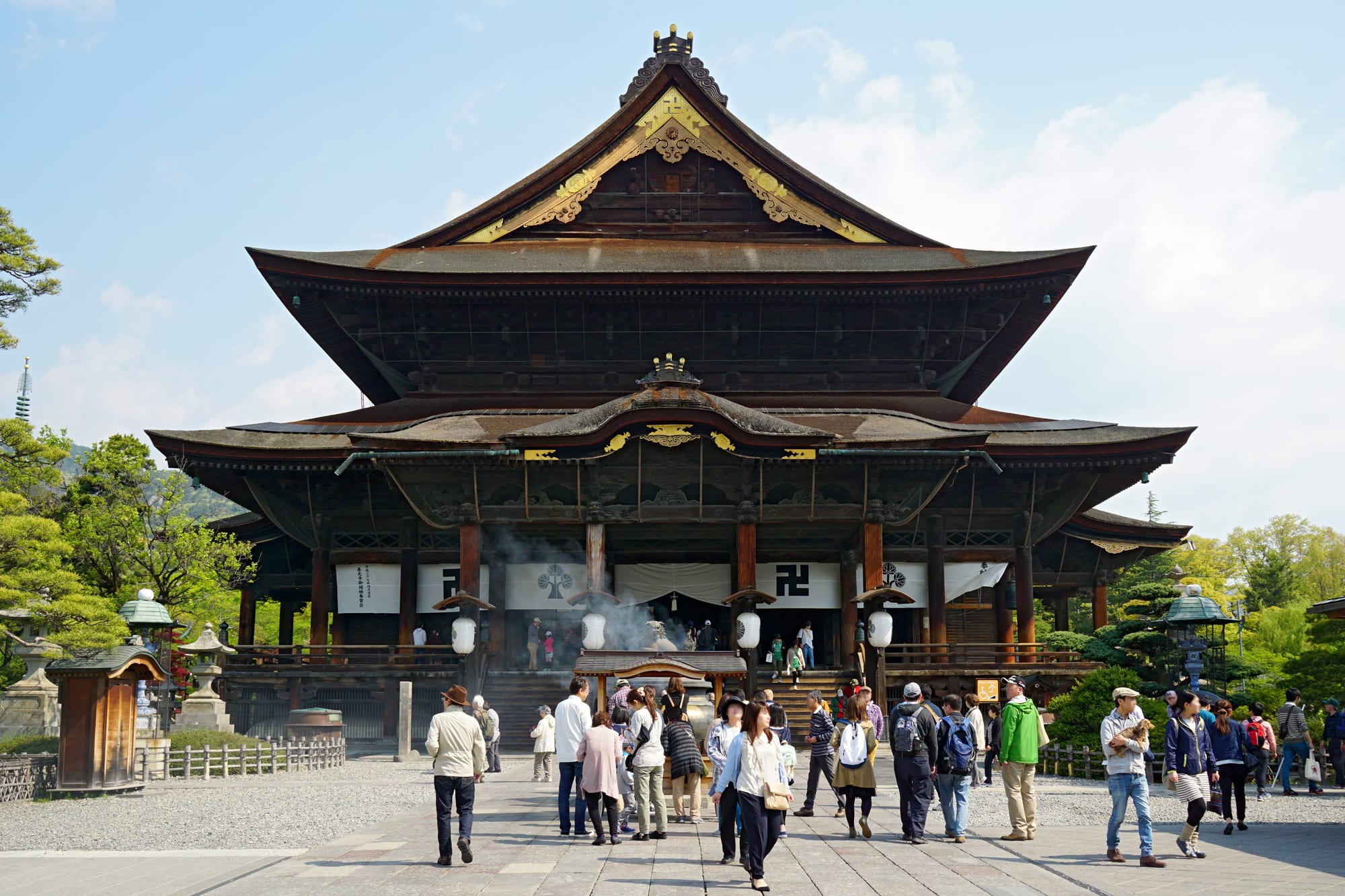
A vast wooden temple hall with a double hipped roof and gilded gables, incense smoke rising before its steps

Chubu: the Japanese Alps & Mount Fuji, Japan

Nagano

The main hall of Zenko-ji, the temple around which the city of Nagano grew. (663highland / Wikimedia Commons · CC BY 2.5)

The capital of Nagano prefecture, in a basin where the Saigawa meets the Chikuma river among mountains in northern Honshu. The city grew as the temple town of Zenko-ji, a pilgrimage site open to all sects and to women for well over a thousand years, and it hosted the 1998 Winter Olympics. Ski slopes, hot springs and the Jigokudani macaques lie close by.

Neighbourhoods

  • Zenkoji-mae and the temple approach
    • First-time visitors
    • Historic district
    • Best for food

    The old pilgrim quarter at the top of the town, where a long stone-paved street of inns, soba houses, sweet shops and lodging temples climbs to the great hall. Quiet at dawn, when residents and pilgrims attend the morning service, and busy by mid-morning.

    Open in Maps
  • Around Nagano Station
    • Close to public transport
    • Shopping
    • Budget stays

    The Shinkansen station and the modern centre, with department stores, business hotels and the bus terminal for the ski resorts and the monkey park. Chuo-dori runs straight uphill from here towards the temple, about a twenty-minute walk.

    Open in Maps
  • Gondo and the central arcades
    • Nightlife
    • Local life

    Covered shopping streets and the bar district between the station and the temple, where the city eats and drinks in the evening. Small izakaya, ramen counters and standing bars, with little aimed at visitors.

    Open in Maps
  • Matsushiro
    • Historic district
    • Quiet and residential

    A separate castle town in the south of the city, reached by bus in about half an hour, with the remains of the Sanada family's castle, samurai residences, a domain school and wartime tunnels dug into the hillside.

    Open in Maps
  • Togakushi
    • Walks and viewpoints
    • Quiet

    A mountain district an hour north-west by bus, with a shrine in five parts spread along an old pilgrimage route, an avenue of giant cedars, highland soba and a ski field in winter.

    Open in Maps

Things to do

The temple town

  • Zenko-jilandmark

    A temple founded in the 7th century around what is said to be the oldest Buddhist statue in Japan, kept hidden from view, with a main hall of 1707 that is a National Treasure; a pitch-dark passage under the altar is walked in search of a key to salvation.

    Open in Maps
  • Nakamise-dorineighborhood

    The stone-paved approach to the temple, lined with pilgrim inns, soba restaurants, sweet shops and the lodging temples that still house visiting congregations.

    Open in Maps
  • Daikanjin and Daihonganlandmark

    The two head temples that jointly administer Zenko-ji, one led by an abbot and the other by an abbess, each with its own garden and halls beside the approach.

    Open in Maps
  • Nagano Stationtransit hub

    The region's main railway hub, 222 kilometres from Tokyo on the Hokuriku Shinkansen, where JR East, the Shinano Railway and the Nagano Electric Railway meet below the temple hill.

    Open in Maps

Museums and Olympic venues

  • M-Waveattraction

    The speed-skating arena of the 1998 Winter Olympics, opened in 1996 under one of the world's largest hanging wooden roofs, shaped like a wave and still used for skating, exhibitions and concerts.

    Open in Maps
  • Nagano City Museummuseum

    A museum of the Chikuma river basin's history and folk life in Kawanakajima, on the plain where the Takeda and Uesugi armies fought in the 16th century.

    Open in Maps
  • Matsushiro Castlelandmark

    Stone bases, gates and moats of the castle held by the Sanada family for more than two centuries, in a quarter that keeps samurai houses and the domain school.

    Open in Maps
  • Matsushiro Underground Imperial Headquartersattraction

    Kilometres of tunnels dug into the hills in 1944 and 1945 by mostly Korean labourers to shelter the government and imperial family; a section is open with displays on the forced labour.

    Open in Maps

Mountains and hot springs

  • Jigokudani Monkey Parkattraction

    A steep valley north-east of the city where wild Japanese macaques come down to bathe in a hot spring, most reliably in the cold months, reached by a footpath of about two kilometres through forest.

    Open in Maps
  • Togakushi Shrinelandmark

    A shrine in five parts on the flank of Mount Togakushi, its upper hall reached through an avenue of cedars several hundred years old, long associated with mountain asceticism and with ninja tradition.

    Open in Maps
  • Iizuna Kogentrail

    A highland of ski runs, ponds and walking paths on Mount Iizuna north of the city, used for Olympic events and open for hiking in summer.

    Open in Maps
  • Shibu Onsenattraction

    A hot-spring village of wooden inns and nine public baths on the Yokoyu river near the monkey park, with stone streets walked in wooden clogs and cotton robes.

    Open in Maps

Short trips from the city

  • Obuseattraction

    A small town about half an hour north by train, known for chestnut confectionery and for a museum of the works Hokusai made here late in life.

    Open in Maps
  • Yamanouchi and the Shiga Kogen slopesattraction

    A large high-altitude ski area east of the city, a venue of the 1998 Games, lying inside a national park and open for walking in summer.

    Open in Maps
  • Nozawa Onsenattraction

    A ski and hot-spring village north-east of the city, known for its public bathhouses and for a fire festival held on 15 January.

    Open in Maps

Seasonal events

  • New Year at Zenko-jiJanuary

    Hundreds of thousands of people come for the first temple visit of the year, filling the approach and the main hall in the first days of January.

  • Gokaichospring, once every seven years

    The temple's great opening, when a substitute of the hidden principal image is shown and a tall wooden pillar is raised before the hall, drawing pilgrims from across Japan over several weeks.

  • Autumn apple harvestOctober and November

    The orchards on the basin floor and the slopes around Obuse sell the prefecture's apples at roadside stands, with colour on the surrounding mountains.

Eat and drink

Long-standing places and food districts in Nagano. Hours, ratings and directions come from your maps app, always current.

Shinshu classics

  • Togakushi sobaneighborhood

    Buckwheat noodles from the Togakushi highlands, served cold in small coiled bunches on a woven basket with wasabi and mountain vegetables; many shops on the temple approach serve it too.

    Open in Maps
  • Oyakineighborhood

    Wheat or buckwheat dumplings stuffed with pickled greens, aubergine, pumpkin or mushroom, steamed or seared on an iron plate — the everyday snack of northern Nagano.

    Open in Maps
  • Miso and picklesneighborhood

    Shinshu miso, a pale, salty rice miso made in this basin, is sold with nozawana pickled greens in shops along the temple approach.

    Open in Maps

Streets and markets

  • Nakamise-dori food shopsneighborhood

    Soba houses, sweet shops, sake sellers and stalls of chestnut and bean confectionery along the paved approach to the temple.

    Open in Maps
  • Gondo and the central arcadesneighborhood

    The covered shopping streets between station and temple, where the city's izakaya, ramen counters and small bars are concentrated.

    Open in Maps
  • Shinshu sake breweriesneighborhood

    Nagano is one of Japan's largest sake-producing prefectures, and several breweries in and around the city sell and pour their own, some with tasting counters near the temple.

    Open in Maps

Experience Nagano

History

Nagano exists because of a statue. Tradition holds that an image of Amida Buddha, said to be the oldest Buddhist statue in Japan, caused a dispute between clans and was thrown into a canal, then rescued and carried to this valley by Honda Yoshimitsu, whose name read in Chinese characters gives Zenko-ji. A temple stood here by the 7th century, and because it was founded before Japanese Buddhism divided into schools, it has always admitted worshippers of every sect — and, unusually, women, at a time when many mountain temples refused them.

Pilgrimage built the town. Inns, shops and lodging temples lined the approach, and travelling preachers carried copies of the image around the country to raise funds. The plain below was fought over in the 16th century by Takeda Shingen and Uesugi Kenshin at Kawanakajima, and the temple's image was moved repeatedly for safety during those wars. Under the Tokugawa the Sanada family held the neighbouring castle town of Matsushiro.

Disaster and modernity followed. The earthquake of 1847 destroyed much of the town and killed thousands, many of them pilgrims. After 1868 the temple town became the prefectural capital; silk and later precision industry grew, and in 1944 tunnels were dug at Matsushiro to shelter the wartime government, largely by conscripted Korean workers. The 1998 Winter Olympics brought the Shinkansen from Tokyo, new arenas and international attention, and the city has since traded on the mountains, the temple and the macaques that bathe in a valley to the north-east.

Culture & Customs

The temple sets the city's rhythm. A service is held each morning before dawn, and the abbot and abbess pass along the paved approach blessing those kneeling there; local people as well as visitors attend. Beneath the main altar runs a completely dark passage where pilgrims feel along the wall for a metal key said to grant salvation. Once in roughly seven years the Gokaicho opens a substitute image to view and raises a tall wooden pillar before the hall, and the city fills for weeks.

Mountain religion is the other strand. Togakushi's shrine, strung along a pilgrimage path under giant cedars, belongs to the old tradition of ascetics in the peaks and is tied in folklore to a school of ninja and to the myth of the sun goddess's cave.

The 1998 Games left a visible legacy — the wave-roofed skating arena, the Shinkansen line from Tokyo, and a habit of hosting winter events — and the prefecture's identity as Shinshu, a highland province of soba, miso, apples and hardy people, is asserted strongly against Tokyo. Locals are said to be plain-spoken and educationally ambitious; Nagano has a long tradition of rural schooling and of literary and study societies.

Manners follow the national pattern with a pilgrimage overlay: quiet in the temple grounds, patience in queues, shoes off indoors, and a general expectation that visitors treat Zenko-ji as a place of worship first.

Daily Life

About 370,000 people live in the city, which since mergers in the 2000s stretches from the basin floor up to the Togakushi highlands and the border with Niigata. The population is slowly declining, as across rural Nagano, and the outlying mountain districts are ageing fastest.

The economy rests on prefectural government, hospitals and schools, precision manufacturing inherited from the wartime dispersal of industry into the mountains, food processing — miso above all — and tourism through the temple and the ski valleys. The Zenkoji plain is farmland: rice on the flats and apples, peaches and grapes on the slopes, with roadside stands through the autumn.

Life is organised around the straight street from the station to the temple and the covered arcades beside it. Cars are normal for anything beyond it, snow tyres go on in late autumn, and roof and pavement clearing occupy the winter. Households in the valleys keep vegetable plots and make their own pickles.

Recent issues are those of a provincial capital: shops closing on the arcades as trade moves to roadside malls, the cost of maintaining a great wooden temple, flood defences on the Chikuma after the 2019 typhoon damage, a shortage of workers in the resorts, and managing the crowds that the macaques and the temple now attract.

Food

Soba is the food of Shinshu, and Togakushi soba is its best-known form: cold buckwheat noodles laid in small coiled bunches on a woven bamboo basket, with grated wasabi, a dipping broth and often mountain vegetables. Many shops on the temple approach mill and cut their own, and the coarse, dark country style is served alongside the refined one.

Northern Nagano's snack is oyaki, a dumpling of wheat or buckwheat dough stuffed with nozawana pickled greens, aubergine, pumpkin, mushroom or sweet bean, seared on an iron plate and then steamed. Sansai, the wild greens of spring, are pickled, boiled or fried as tempura, and preserved foods carry the winter: nozawana greens, dried persimmons and miso.

Shinshu miso, pale and salty and brewed from rice and soybeans, is made in this basin and flavours soup, grilled skewers and vegetables; shops on Nakamise-dori sell it by weight. Freshwater fish — iwana, ayu and carp, the last stewed in miso in the Saku area — appear on local menus, and inago, grasshoppers simmered in soy and sugar, are a traditional protein still sold in the old shops.

Chestnut sweets come from Obuse, apples from the surrounding orchards, and the prefecture is one of Japan's larger sake producers, using highland rice and snowmelt water. Roasted soba tea and soba-flour confectionery round out a local menu that leans on grain, pickles and the mountains rather than on the sea.

Planning tools

Budget

Nagano is inexpensive for a prefectural capital. Business hotels near the station are plentiful, soba and set lunches are cheap, and Zenko-ji's grounds cost nothing to enter. The expenses to plan for are the ski season, when lift passes and resort lodging are dear, the buses out to the monkey park and Togakushi, and a night in a hot-spring inn with dinner.

Daily Budget Midrange
USD 110–200 (mid-range hotel or hot-spring inn, restaurant dinners, bus excursions and entries)
Daily Budget Shoestring
USD 50–80 (guesthouse or business hotel, soba and oyaki, local buses)

Bus passes covering the monkey park, Togakushi or the ski valleys usually beat single fares; rooms and inns are tight during the temple's Gokaicho years and at New Year.

Best Time to Visit

Autumn, from October into November, is the clearest season, with colour on the mountains and the apple harvest. Spring brings blossom around the temple and green in the Togakushi cedars. Winter is cold and snowy and is the season for skiing and for the macaques in their hot spring, and summer is warm in the basin but cool on the highlands.

Suggested Number of Days

A day covers the temple town and the central streets, and two make for an unhurried visit. Three or four days take in the mountain valleys, hot springs and the smaller towns on the plain. Skiers generally base themselves in the resorts rather than the city.

First Visit
1–2 days
With Surroundings
3–4 days

Transportation

The centre is walked or covered by a loop bus along Chuo-dori between the station and the temple. City and regional buses leave the station for Togakushi, Matsushiro and the ski valleys, and the private Nagaden railway runs north-east towards Obuse, Yudanaka and the monkey park. One short subway-like section of that line runs underground beneath the centre.

Mountain bus routes thin out in the off-season and some Togakushi and highland services stop in winter, so check the timetable for the day before setting out.

Airport & Station Connections

The Hokuriku Shinkansen reaches Nagano from Tokyo in about eighty minutes and from Kanazawa in around an hour; limited-express trains and local lines connect to Matsumoto in about an hour. Express buses run from Shinjuku in Tokyo and from Nagoya and Osaka. There is no airport in the city, and air travellers arrive through Tokyo.

Walkability

The spine of the city is a single straight street from the station up to Zenko-ji, about two kilometres long and gently uphill, with wide pavements, arcades and shops the whole way. Around the temple the lanes are stone-paved and level. Outlying districts such as Matsushiro and Togakushi need a bus. Snow and ice make winter walking slow.

Safety

Crime is very low and the city is safe at all hours. The hazards are seasonal: deep snow and ice in winter, heat in midsummer, and typhoon rain — the Chikuma river flooded parts of the basin in 2019. Mountain weather changes quickly in the highlands, black bears live in the forests around the city, and earthquakes are possible anywhere in Japan.

Wear boots with grip in winter, keep a safe distance from the macaques and never feed or touch them, and make noise on wooded trails in bear country. Check current official travel advice before travelling.

Climate

An inland basin climate with cold, snowy winters and warm summers, drier and sunnier than the Sea of Japan coast beyond the mountains. The rainy season falls in June and early July, and autumn is the most settled time.

Summer
warm and humid in the basin, daytime highs around 30–31°C, noticeably cooler on the highlands
Winter
cold — January days around 2°C, nights well below freezing, with regular snow in the city and heavy snow in the valleys

Local Customs

Zenko-ji is a working temple, not a monument: visitors may join the early morning service and receive a blessing from the abbot or abbess along the approach, and quiet, patience in the queue and no photography of the inner hall are expected. Shoes come off inside the halls and in inns. Tipping is not practised anywhere in Japan, and hot-spring baths are entered naked after washing thoroughly.

Move slowly and stay silent in the dark passage under the altar, keep bags away from the macaques at Jigokudani, and carry cash for temple offerings and small shops.

Common Payment Methods

The currency is the Japanese yen. Hotels, department stores and larger restaurants take cards and IC cards, while temple offices, soba houses, stalls and mountain inns often take only cash. Convenience-store and post office machines dispense yen to foreign cards.