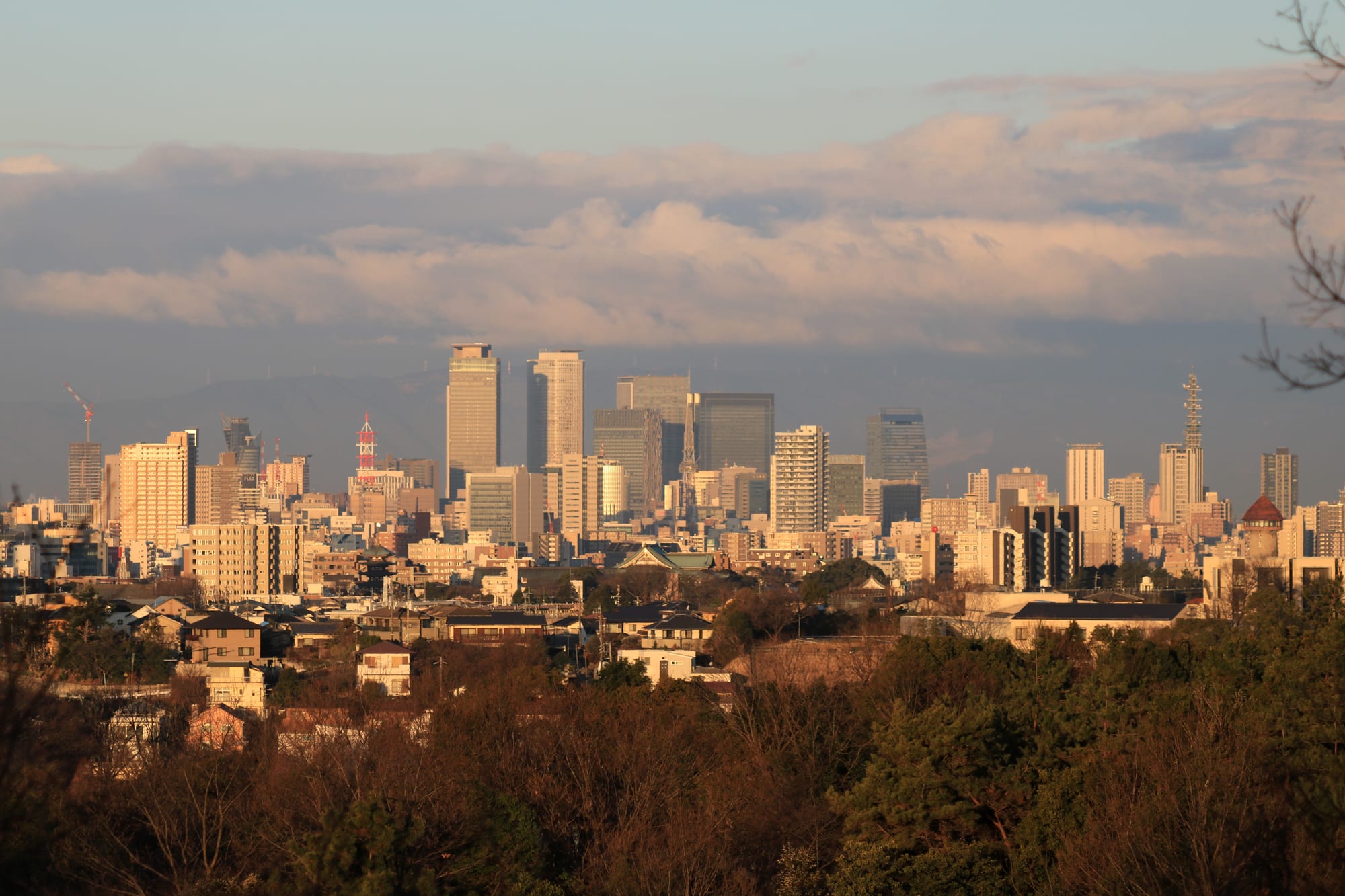
Nagoya's cluster of tall towers catching low sunlight above low-rise houses and winter trees

Chubu: the Japanese Alps & Mount Fuji, Japan

Nagoya

The towers of central Nagoya seen from Heiwa Park on the eastern hills. (Alpsdake / Wikimedia Commons · CC BY-SA 4.0)

Japan's fourth-largest city, on the Nobi plain at the head of Ise Bay and the capital of Aichi prefecture. Built by the Tokugawa around a great castle and rebuilt on wide boulevards after wartime bombing, it is the centre of the country's car industry, and is known for its museums of engineering, its shrine at Atsuta and a distinctive miso-based cooking.

Neighbourhoods

  • Meieki and Nagoya Station
    • First-time visitors
    • Close to public transport
    • Shopping

    The business quarter around a station complex once listed as the world's largest by floor area, where the Shinkansen, private lines and two subway lines meet under a cluster of towers. Department stores, hotels and underground shopping streets fill the blocks, and the dining floors above the station are a destination in themselves.

    Open in Maps
  • Sakae
    • Nightlife
    • Shopping
    • Museums

    The city's central district, a kilometre east of the station along Hirokoji Avenue, built around the wide Hisaya-odori park and the television tower. Department stores, the science museum, bars and clubs are concentrated here, and it is where the city goes out in the evening.

    Open in Maps
  • Osu
    • Best for food
    • Street life
    • Budget shopping

    A grid of covered arcades around the Osu Kannon temple, mixing second-hand clothes, electronics, anime shops and cheap eating places of a dozen nationalities. The least formal part of central Nagoya and the liveliest on foot.

    Open in Maps
  • Atsuta and Kanayama
    • Historic district
    • Close to public transport

    The southern approach to the city, where the great shrine of Atsuta stands in its wood of camphor trees beside an old post-road district. Kanayama, a stop to the north, is a busy interchange with a cluster of hotels, restaurants and bars.

    Open in Maps
  • Higashiyama and Kakuozan
    • Quiet and residential
    • Parks
    • Cafés

    The eastern hills along the subway's Higashiyama line, with the zoo and botanical gardens, university campuses and the temple of Nittai-ji. Kakuozan's sloping lanes hold small cafés, galleries and craft shops in a well-off residential area.

    Open in Maps
  • Nagoya Port
    • Families
    • Waterfront

    The reclaimed waterfront south of the centre, at the end of its own subway line. The aquarium, an icebreaker and a training ship are moored along a garden pier, with container terminals and steelworks stretching away on either side.

    Open in Maps

Things to do

Castles, shrines and landmarks

  • Nagoya Castlelandmark

    The Tokugawa stronghold of 1612, its keep crowned by golden dolphin ornaments and rebuilt in concrete in 1959; the Honmaru palace beside it was rebuilt in wood between 2009 and 2018, with reproductions of its painted screens.

    Open in Maps
  • Atsuta Shrinelandmark

    One of the most revered shrines in Japan, set in a wood of ancient camphor trees, traditionally the home of the sacred sword among the imperial regalia.

    Open in Maps
  • Osu Kannonlandmark

    A Buddhist temple moved here on Tokugawa orders in the 17th century, whose library holds very old manuscripts and whose forecourt fills for a flea market.

    Open in Maps
  • Nagoya TV Towerviewpoint

    The oldest television tower in Japan, completed in 1954 in the middle of Hisaya-odori park and now named the Chubu Electric MIRAI TOWER, with an observation deck over Sakae.

    Open in Maps
  • Oasis 21landmark

    A bus terminal and shopping level in Sakae roofed by an oval glass basin holding a shallow film of water, walkable at night above the street.

    Open in Maps
  • Nittai-jilandmark

    A temple in the eastern hills founded in 1904 to house ashes of the Buddha given to Japan by the royal family of Thailand, its chief priest sent in turn by nineteen Buddhist sects.

    Open in Maps

Museums

  • Toyota Commemorative Museum of Industry and Technologymuseum

    The firm's old red-brick textile factory near the station, where working looms and machine tools trace the move from weaving to cars.

    Open in Maps
  • SCMaglev and Railway Parkmuseum

    JR Central's railway museum on the waterfront, with steam locomotives, early Shinkansen sets and the record-breaking maglev test vehicles.

    Open in Maps
  • Tokugawa Art Museummuseum

    The heirlooms of the Owari branch of the Tokugawa family — armour, tea utensils, no costumes and the 12th-century illustrated handscrolls of The Tale of Genji, a National Treasure shown only in part.

    Open in Maps
  • Nagoya City Science Museummuseum

    A Sakae museum built around a giant globe housing one of the world's largest planetarium domes, with tornado and deep-freeze demonstration rooms.

    Open in Maps
  • Nagoya City Art Museummuseum

    A Kisho Kurokawa building in Shirakawa Park holding the School of Paris, Mexican modernism and artists of the Nagoya region.

    Open in Maps
  • Toyota Automobile Museummuseum

    In Nagakute east of the city, a collection of cars from Europe, America and Japan arranged as a history of the motor car, with Toyota's own models among them.

    Open in Maps

Parks, gardens and the waterfront

  • Tokugawaenpark

    A stroll garden beside the Tokugawa Art Museum, built around a large pond with waterfalls, tea houses and seasonal displays of peonies, irises and maples.

    Open in Maps
  • Higashiyama Zoo and Botanical Gardenspark

    A zoo on the eastern hills keeping more species than any other in Japan, with extensive glasshouses and a sky tower above the trees.

    Open in Maps
  • Hisaya-odori Parkpark

    A green strip running two kilometres through Sakae along a boulevard laid out after the war, with lawns, shops and the television tower along its spine.

    Open in Maps
  • Port of Nagoya Public Aquariumattraction

    A large aquarium on the port garden pier, known for belugas and orcas and for a hall on the seas between Japan and Antarctica.

    Open in Maps
  • Shirotori Gardenpark

    A Japanese stroll garden near Atsuta laid out for a world design exposition, its stream representing the rivers of the Nobi plain.

    Open in Maps

Markets, arcades and nights out

  • Osu shopping arcadesneighborhood

    Several covered streets of second-hand clothing, electronics, anime shops, temples and street food, busiest at weekends.

    Open in Maps
  • Yanagibashi Central Marketmarket

    A working fish and produce market near the station, with wholesalers, knife shops and small counters serving breakfast to the trade.

    Open in Maps
  • Vantelin Dome Nagoyaattraction

    The domed stadium of the Chunichi Dragons baseball team in the north-east of the city, also used for large concerts.

    Open in Maps
  • Aichi Prefectural Art Theaterattraction

    The concert hall, theatre and art museum complex in Sakae, home of the Nagoya Philharmonic and a major venue for opera and dance.

    Open in Maps

Short trips from the city

  • Inuyama Castlelandmark

    One of twelve surviving pre-modern keeps, dated to about 1601, above the Kiso river some 23 kilometres north, and one of five designated a National Treasure.

    Open in Maps
  • Museum Meiji-muramuseum

    An open-air museum near Inuyama of more than sixty relocated buildings from Japan's westernising Meiji era, including the entrance hall of Frank Lloyd Wright's Imperial Hotel.

    Open in Maps
  • Tokonameattraction

    A pottery town on the Chita peninsula, one of Japan's oldest kiln centres, with a walking route past kilns, chimneys and walls of stacked pipes.

    Open in Maps
  • Setoattraction

    A ceramic town in the hills east of the city whose name became the general Japanese word for pottery, with kilns, museums and shops along a river.

    Open in Maps

Seasonal events

  • Nagoya Grand Sumo TournamentJuly

    One of the six annual tournaments of professional sumo, held in the city over fifteen days in midsummer.

  • World Cosplay Summitsummer, July to August

    An international costume competition based in Nagoya, with a parade through Osu and Sakae and teams from dozens of countries.

  • Nagoya FestivalOctober

    The city's main autumn parade, led by figures representing the three warlords from this region who unified Japan, with floats and mechanical puppets.

  • Cherry blossom in the parkslate March to early April

    Blossom along the castle moats, in Tsuruma Park and on the Yamazaki river draws evening crowds for about a fortnight.

Eat and drink

Long-standing places and food districts in Nagoya. Hours, ratings and directions come from your maps app, always current.

Nagoya-meshi classics

  • Hitsumabushineighborhood

    Grilled eel chopped over rice in a lacquered tub, eaten in three stages — plain, with condiments, then with broth poured over — a speciality of the old restaurants around Atsuta.

    Open in Maps
  • Miso katsu and miso nikomi udonneighborhood

    Pork cutlet under a dark sauce of hatcho miso, and thick udon noodles simmered in miso broth in a clay pot, the two dishes that define the city's taste.

    Open in Maps
  • Tebasakineighborhood

    Chicken wings marinated in a sweet sauce and dusted with pepper and sesame, the standard order in the city's izakaya.

    Open in Maps

Food districts and markets

  • Osu arcadesneighborhood

    Covered streets of snack stalls, Taiwanese, Korean and Brazilian kitchens and small Japanese restaurants around the Kannon temple.

    Open in Maps
  • Yanagibashi Central Marketmarket

    A wholesale fish and produce market a short walk from Nagoya Station, with seafood counters and standing bars among the traders.

    Open in Maps
  • Nagoya Station dining floorsneighborhood

    The upper floors and basements of the station towers hold branches of most of the city's specialities, the usual place to try them between trains.

    Open in Maps

Cafés

  • Coffee shops and morning servicecafe

    Nagoya's old-style coffee houses serve a morning set of toast, boiled egg and coffee at one price, a local institution; ogura toast, spread with sweet red bean paste, was born in them.

    Open in Maps

Experience Nagoya

History

Nagoya's history begins outside the modern centre, at Atsuta, where a shrine said to hold the sacred sword Kusanagi has stood since antiquity beside the old Tokaido highway and the shallow head of Ise Bay. The surrounding province of Owari produced the first of the three unifiers of Japan: Oda Nobunaga, born in what is now Nagoya and later master of Kiyosu, and the peasant-born Toyotomi Hideyoshi, from a village now inside the city.

The city proper was created by decree. In 1610 Tokugawa Ieyasu ordered a great castle built on a bluff above the plain, with stone hauled by allied lords and a keep finished in 1612 under golden dolphin ornaments, and had the entire town of Kiyosu — houses, temples, people and all — moved on to the new grid below it. The Owari Tokugawa, the senior branch of the shogunal family, ruled from here for two and a half centuries, and their collections survive in the Tokugawa Art Museum.

Industry followed the Meiji reforms: ceramics, clocks, bicycles, and the looms of Sakichi Toyoda, whose son turned the family firm to cars in the 1930s. That industry made Nagoya a target, and air raids in 1945 destroyed much of the city including the castle keep. Reconstruction cut exceptionally wide boulevards, among them Hisaya-odori. The keep was rebuilt in concrete in 1959 and the Honmaru palace in wood between 2009 and 2018; the Shinkansen arrived in 1964, and the city grew into the manufacturing capital of Japan.

Culture & Customs

Nagoya's reputation in Japan is for making things and for holding on to money — an old joke says its families spend nothing except on weddings, which are famously lavish. The self-image is practical and unshowy, and the city is sometimes teased by Tokyo and Osaka for it, which local people repeat with some pride.

Craft traditions run deep across the region: Seto and Tokoname pottery, Arimatsu shibori tie-dyeing on the old highway in the south of the city, cloisonné, and the mechanical karakuri puppets that ride the festival floats of Aichi and Gifu. The same instinct for mechanism shows in the industrial museums, in a large model and model-railway culture, and in the region's engineering schools.

Popular culture is strong here. Nagoya hosts the World Cosplay Summit, its arcades in Osu are a centre for anime and second-hand trade, and the city has produced idol groups and comedians who trade on a broad local accent. Baseball sets the summer mood, with the Chunichi Dragons followed closely, and the July sumo tournament fills the arena for a fortnight; football's Nagoya Grampus play in the prefecture.

Religious life centres on Atsuta, which draws large crowds at New Year, and on Osu Kannon, whose grounds hold flea markets. Manners follow the national pattern — quiet trains, bowing, shoes off indoors — with the regional quirk that people stand on the left of escalators, as in Tokyo but unlike Osaka.

Daily Life

About 2.3 million people live in the city and about ten million in the surrounding Chukyo region, which takes in Toyota, Gifu and much of Mie. It is the manufacturing heart of Japan: Toyota's headquarters and plants lie east and south of the city, with thousands of component suppliers, alongside aerospace, machine tools, ceramics and chemicals, and the Port of Nagoya is the largest and busiest trading port in the country.

The prosperity is quiet and suburban. Households are more likely to own a car than in Tokyo, homes are larger, and the commuter belt spreads across a flat plain of low-rise housing, factories and rice fields. A significant foreign population works in the region's plants, including long-established Brazilian and Peruvian communities of Japanese descent, and Filipino, Vietnamese and Chinese residents; their shops and restaurants are visible in Osu and in the industrial suburbs.

Days run to office and factory hours, with the coffee-house morning set before work and the izakaya after it. Underground shopping streets carry much of the central foot traffic. Current concerns are those of industrial Japan: the shift to electric vehicles and what it means for a supply chain built on engines, an ageing workforce, the long-delayed maglev line to Tokyo, and preparation for a Nankai Trough earthquake.

Food

Nagoya-meshi is one of the few genuinely distinct city cuisines in Japan, and its foundation is hatcho miso, a dark, dense soybean paste aged in wooden vats in nearby Okazaki. It sauces miso katsu, a breaded pork cutlet; it thickens miso nikomi udon, hard-textured noodles simmered in a clay pot with egg and spring onion; and it is brushed on grilled skewers of pork offal.

The city's grandest dish is hitsumabushi: eel grilled over charcoal, glazed, chopped and spread over rice in a lacquered tub, eaten plain, then with wasabi and spring onion, then with dashi poured over as a soup. Tebasaki, chicken wings marinated in a sweet sauce and dusted with pepper and sesame, are the standard izakaya order. Kishimen, flat wheat noodles in a light broth, are sold even on railway platforms, and tenmusu — a rice ball wrapped around a prawn tempura — is the local snack.

Later inventions belong just as firmly to the city: ankake spaghetti, thick noodles in a peppery, starchy tomato sauce; Taiwan ramen, a fiercely spicy bowl topped with minced pork, garlic and chilli; and doteni, pork or beef offal stewed in soybean miso.

Coffee culture is a local institution. Kissaten serve a morning set — toast, a boiled egg, sometimes a small salad, thrown in with the coffee — and ogura toast, thick toast with sweet red bean paste and butter, comes from the same tradition. Shiro noir, a warm pastry under soft-serve ice cream, is the signature of a coffee chain founded in the city.

Planning tools

Budget

Nagoya is a business city with a large stock of hotels and is usually cheaper than Tokyo, Kyoto or Osaka for a room of the same standard. Food is inexpensive: the local specialities are diner and izakaya food rather than fine dining. The costs that add up are museum entries, which are modest individually, and day trips out to Inuyama, Seto or Tokoname.

Daily Budget Midrange
USD 110–200 (mid-range hotel, restaurant meals, museums, some taxis and a day trip)
Daily Budget Shoestring
USD 50–80 (hostel or business hotel, noodles and arcade food, subway day tickets)

A subway and bus day ticket pays for itself quickly, and it is cheaper at weekends; rooms are tight during the July sumo tournament and big trade fairs.

Best Time to Visit

Spring and autumn are the comfortable seasons: blossom along the castle moats from late March, and clear, mild weather with autumn colour from late October into early December. Midsummer on the Nobi plain is genuinely hot and humid, though it is also the season of the sumo tournament and the cosplay summit. Winter is cool, dry and bright, with occasional light snow.

Suggested Number of Days

Two days covers the central districts and the main museums without hurrying. Three or four allow the towns and kilns of the surrounding prefecture. Travellers interested in industry and engineering can fill longer, since the factory and railway museums take half a day each.

First Visit
2 days
With Surroundings
3–4 days

Transportation

Six subway lines cover the city, with the Higashiyama and Meijo lines doing most of the work; the Meijo line runs as a loop. Suburban trains on JR, Meitetsu and Kintetsu lines reach the prefecture and beyond, and city buses fill the gaps, including a guided busway on the north-eastern corridor. IC cards such as Manaca, Suica and Icoca work on all of them. Roads are unusually wide and traffic is heavy at peak hours.

Distances between districts are longer than they look on the map, so the subway is usually faster than walking between Meieki, Sakae and Osu.

Airport & Station Connections

Nagoya Station is on the Tokaido Shinkansen, about 100 minutes from Tokyo and 50 from Shin-Osaka, and is the terminus of limited-express lines to Takayama, Ise and Nagano. Chubu Centrair International Airport sits on an artificial island in Ise Bay, about 35 kilometres south, reached in around half an hour by Meitetsu train from Meitetsu Nagoya station beside the main station. Express buses serve Tokyo, Kyoto, Osaka and the mountain towns.

Walkability

Each district is walkable, but the distances between them are long — about a kilometre and a half from the station to Sakae along Hirokoji Avenue — and the boulevards laid out after the war are exceptionally wide. Vast underground shopping streets connect buildings around the station, Sakae and Kanayama and are the comfortable route in summer heat or rain. Pavements are wide and level almost everywhere.

Safety

Crime is very low and the city is safe to walk at night, including around the station and the nightlife streets of Sakae. The practical hazards are summer heat and humidity, typhoon rain in late summer, and earthquakes: the Nobi plain lies on the Pacific side of Japan and the region prepares for a future Nankai Trough earthquake with public drills and tsunami signs near the coast.

Carry water and use the underground streets in midsummer, learn the drop-cover-hold drill for earthquakes, and follow staff instructions during typhoon disruption. Check current official travel advice before travelling.

Climate

A humid subtropical climate, hot in summer and mild in winter, with a rainy season in June and early July and a typhoon season through September. The plain is sheltered from the heavy snow that falls on the far side of the mountains.

Summer
hot and humid, daytime highs around 33–35°C, with warm nights and heavy showers
Winter
mild and dry — January days around 9°C, nights near freezing, occasional light snow on a north-west wind

Local Customs

Tipping is not practised. Shoes come off in traditional restaurants, inns and temple buildings, and hats and coats at shrines. Nagoya has a reputation within Japan for thrift and plain speaking and for a strong attachment to its own food and its own ways; people are direct by Japanese standards and pleased when visitors take the local dishes seriously. On escalators in this region people stand on the left.

Keep phone calls off trains, queue at the marks on platforms, carry rubbish away, and at Atsuta bow at the torii, wash hands at the basin and keep cameras away from the inner precincts.

Common Payment Methods

The currency is the Japanese yen. Cards and IC cards are accepted at hotels, department stores, chains and the transport system, but small restaurants, market stalls and temple offices often take cash only. Convenience-store and post office cash machines accept foreign cards.