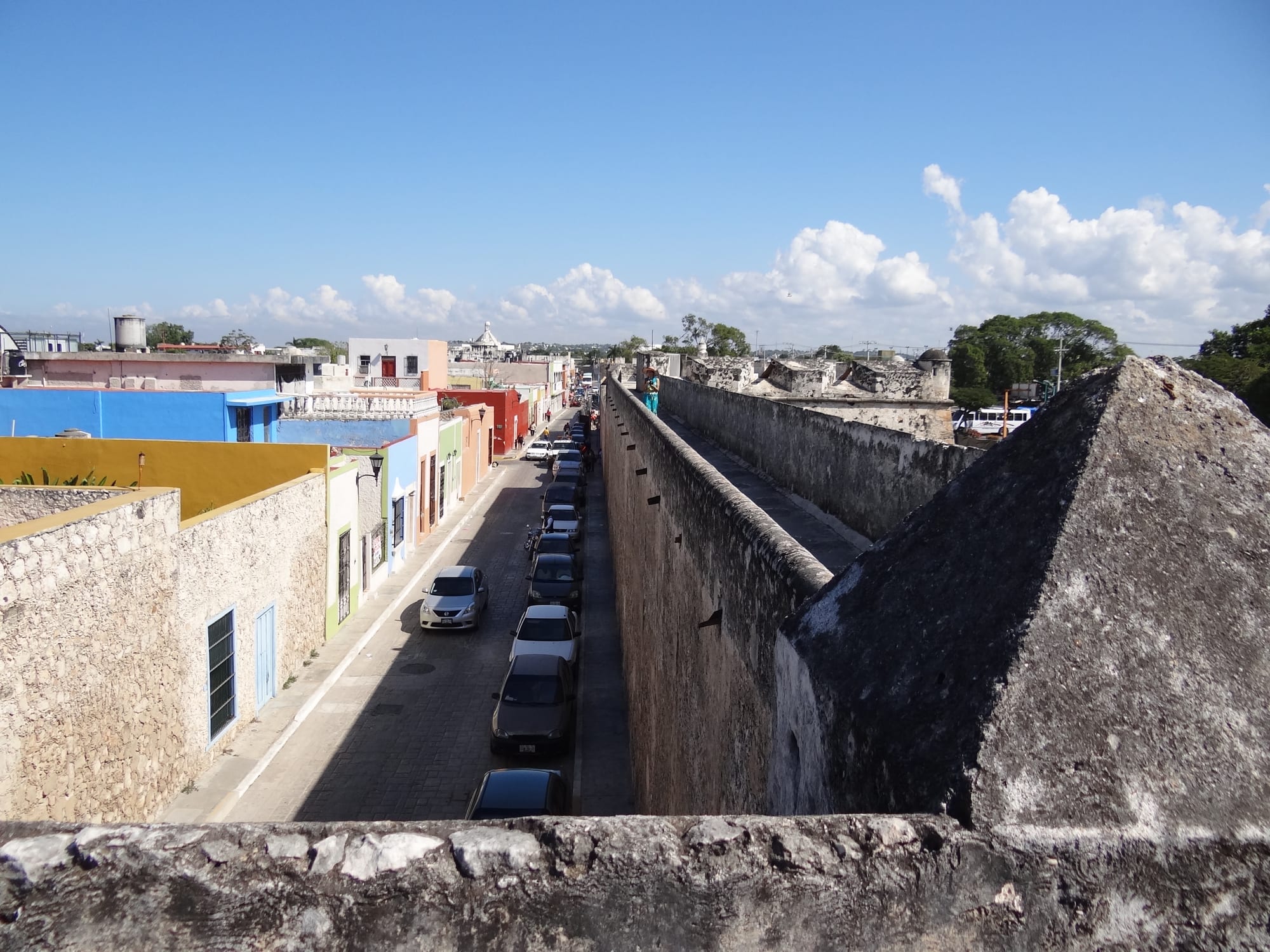
A thick stone city wall running beside a narrow street of brightly painted houses and parked cars under a blue sky

The Yucatán Peninsula, Mexico

Campeche

The old city walls of Campeche beside a street of painted houses in the historic centre. (Adam Jones, Ph.D. / Wikimedia Commons · CC BY-SA 3.0)

The capital of Campeche state, on the Bay of Campeche facing the Gulf of Mexico. Founded by the Spanish in 1540 on the Maya town of Can Pech, it was the peninsula's colonial port and a target for pirates until walls and bastions were built around it; the fortified old town, with its painted houses, has been a UNESCO World Heritage Site since 1999.

Neighbourhoods

  • Centro Histórico
    • First-time visitors
    • Historic district
    • Best for food

    The fortified old town on a grid plan around the main square and the cathedral, entered through the Puerta de Tierra and the Puerta de Mar. Its straight streets are lined with houses painted in strong colours, some with 18th-century Moorish and Spanish details, and Calle 59 is partly pedestrian, with restaurants.

    Open in Maps
  • San Román
    • Local life
    • Historic district

    A historic barrio outside the walls, first settled by the Naborío Indigenous people who came with the conquistadors. Its church keeps the Black Christ at the centre of the city's September fair.

    Open in Maps
  • Guadalupe and San Francisco
    • Historic district
    • Quiet and residential

    Two old barrios where the Indigenous Maya population lived in colonial times. Each keeps its original church; Guadalupe's is almost 500 years old, and in San Francisco the Franciscans began a church and convent in 1540.

    Open in Maps
  • The Malecón
    • Walks
    • Sunsets
    • Seafood

    The seafront avenue that runs the whole length of the city along the Gulf, with a promenade, a few hotels, a lit fountain in the evenings and seafood restaurants towards its northern end.

    Open in Maps

Things to do

The walls and bastions

  • Puerta de Tierralandmark

    The Land Gate, built in 1732 as the main landward entrance to the walled city, now the backdrop for a light and sound show of pirate tales and local history.

    Open in Maps
  • Puerta de Marlandmark

    The Sea Gate, the walled city's other main entrance, on the side facing the Gulf.

    Open in Maps
  • Baluarte de la Soledadmuseum

    A 17th-century bastion guarding the Sea Gate, now a museum of archaeological, ethnographic and historical pieces.

    Open in Maps
  • Baluarte de San Franciscolandmark

    One of the bastions that protected the Land Gate.

    Open in Maps
  • Fort San Miguelmuseum

    A fort outside the old town, built to bombard approaching pirate ships, now a museum of Maya archaeology with finds from Calakmul, Edzná and other sites.

    Open in Maps

The old town and the waterfront

  • Campeche Cathedrallandmark

    The cathedral facing the main square of the old town, laid out by the Spanish beside the seat of royal government and the houses of the highest officials.

    Open in Maps
  • Calle 59neighborhood

    A street of colonial houses through the old town, partly closed to traffic, with restaurants and cafés.

    Open in Maps
  • Malecóntrail

    The seafront promenade along the Gulf of Mexico, where the city faces the sunset and the 'Poesía del Mar' fountain lights up with coloured spray in the evening.

    Open in Maps

Markets

  • Central marketmarket

    A small market by Mexican standards, where vendors outside sell hammocks, a speciality of the peninsula.

    Open in Maps

Short trips from the city

  • Los Petenes Biosphere Reservepark

    Coastal mangroves and 'petenes' — islands of vegetation around freshwater springs in salt marsh — bordering the city to the north, with birdwatching and tarpon fishing.

    Open in Maps
  • Edználandmark

    A Maya city inhabited from about 400 BC, with a large five-storey building on a great platform and a network of canals and reservoirs that drained and watered its valley.

    Open in Maps

Seasonal events

  • Carnaval de CampecheFebruary

    Celebrated for more than 450 years and called the oldest carnival in Mexico, it opens with a mock funeral procession and the burning of a rag doll representing bad humour.

  • Feria de San RománSeptember

    The fair of the San Román barrio, which begins with the Black Christ being brought down from the barrio's church.

Eat and drink

Long-standing places and food districts in Campeche. Hours, ratings and directions come from your maps app, always current.

Campeche classics

  • Coctelerías on the Malecónneighborhood

    Seafood cocktail bars at the northern end of the seafront, about 4 km from the old town, serving the freshest shrimp and fish at lunchtime.

    Open in Maps
  • Calle 59neighborhood

    The partly pedestrian street through the old town, with restaurants serving Campeche dishes such as pan de cazón.

    Open in Maps

Food districts and markets

  • Avenida Gobernadoresneighborhood

    A busy avenue outside the historic centre lined with everyday eating places.

    Open in Maps
  • Central marketmarket

    The city's small central market, with produce and food stalls.

    Open in Maps

Experience Campeche

History

Before the Spanish arrived, Can Pech was the capital of a Maya chiefdom, in a region once dominated by the city of Edzná. The expedition of Francisco Hernández de Córdoba landed here in March 1517 to take on water, among the first Europeans on the peninsula, and left when Maya warriors gathered. Francisco de Montejo founded San Francisco de Campeche in 1540, and the town became the base for the conquest of the rest of Yucatán, including the founding of Mérida in 1542. Spanish residents lived around the main square, Indigenous Maya in the old settlements that became the barrios of San Francisco and Siete de Agosto, Naborío allies in San Román, and enslaved Africans in Santa Ana and Santa Lucía.

As the peninsula's main port, Campeche shipped salt and palo de Campeche, a dyewood, and was known for its shipyards. Its wealth drew pirates — among them Henry Morgan and Laurens de Graaf, who took the town in 1685 — and it was sacked in 1633 and 1663. The walls and bastions were begun in 1686 and finished in 1704, and the Puerta de Tierra followed in 1732. In 1777 King Carlos III raised the town to the rank of city.

The old town's fortifications and colonial architecture survived largely intact, and in 1999 they were listed as a UNESCO World Heritage Site; with Quebec City, Campeche is one of the few cities in North America to keep most of its walls. The Tren Maya station opened in December 2023, and the Tren Ligero linking it to the old town in July 2025.

Culture & Customs

Campeche's identity is bound up with its walls and its barrios. San Román, Guadalupe, San Francisco and the other old neighbourhoods outside the fortifications each grew around a church, and their festivals are the city's own. The biggest is the Feria de San Román in the second half of September, which begins when the Black Christ is brought down from the barrio church.

The city claims the oldest carnival in Mexico, celebrated in February for more than 450 years. It opens with a mock funeral and the burning of a rag doll standing for bad humour before the parades begin, and was ranked among the country's most important carnivals. The traditional women's costume uses a huipil embroidered in black, with motifs of onion and pumpkin flowers.

Pirates remain part of the city's story, retold in the light and sound show at the Puerta de Tierra and in the museums inside the bastions. Hammocks are sold outside the market, and in the Maya community of Bécal the making of Panama-style palm hats is the main craft. The Malecón is where the city gathers in the evening, walking along the sea as the sun sets over the Gulf.

Daily Life

About 250,000 people lived in the city at the 2020 census, making it the largest in the state. As the state capital it runs on services — government, commerce, tourism and public services — with textile maquiladoras and small firms processing local products, while fishing keeps the primary sector alive. Universities, including the Universidad Autónoma de Campeche, bring students to the city.

Most residents live outside the walls, in the old barrios and in newer districts along avenues such as López Portillo and Gobernadores, the city's main artery, where large stores and supermarkets are found. The edge of the city borders the mangroves of the Los Petenes Biosphere Reserve.

Life follows the heat: busy mornings, a quiet middle of the day and evenings outdoors along the Malecón and in the squares of the old town. Transport has changed quickly since the Tren Maya arrived in 2023 and the Tren Ligero began running in 2025, and tourism, long modest compared with the Caribbean coast, has received a strong boost in recent years.

Food

Campeche's kitchen is built on the sea. Pan de cazón is its signature: tortillas layered with black beans and shredded cazón, a small shark or dogfish, topped with fried tomato sauce and a habanero chilli. Shrimp is eaten in many forms, and coctel de mariscos, a seafood cocktail, is a local favourite, as is pescado en escabeche, fish in a vinegar marinade. Coctelerías at the northern end of the Malecón serve the day's catch at lunchtime.

The rest of the table is shared with the wider peninsula: cochinita pibil, pork marinated in achiote and sour orange and slow-cooked; poc chuc, grilled marinated pork; sopa de lima; and panuchos and salbutes, fried tortillas with beans and toppings. Everyday eating places line Avenida Gobernadores outside the centre, and the old town's restaurants cluster along the partly pedestrian Calle 59.

To drink there are fresh fruit waters, horchata and cold beer, and the peninsula's anise and honey liqueur, xtabentún.

Planning tools

Budget

Campeche is one of the cheaper cities on the peninsula, with prices closer to those of ordinary Mexican towns than of the Caribbean coast. Guesthouses in colonial houses, seafood lunches and zone-priced taxis cost little; a hire car or tour to Edzná and the southern ruins is the main extra.

Daily Budget Midrange
USD 90–180 (colonial hotel, seafood restaurants, museum entries, a hire car or tour to Edzná)
Daily Budget Shoestring
USD 35–60 (hostel or guesthouse, market and street food, taxis or the Tren Ligero)

Taxis charge by zone, so ask the fare before setting off.

Best Time to Visit

November to April, the dry season, is the most comfortable. April and May are the hottest months across the peninsula. The rainy season runs from June to October, with heavy showers and the risk of tropical storms, most often in September and October. Carnaval falls in February, and the San Román fair in the second half of September.

Suggested Number of Days

Two days are enough for the walled city and the waterfront at an easy pace. Allow three or four with trips to the ruins and the coast nearby; the southern Maya sites need longer.

First Visit
2 days
With Surroundings
3–4 days

Transportation

The old town is small and easy to walk, and taxis are charged by zone. The Tren Ligero, a guided electric bus line opened in July 2025, links the historic centre with the airport and the Tren Maya station. A hire car is the simplest way to reach Edzná.

Use the Tren Ligero between the train station or airport and the old town.

Airport & Station Connections

Campeche International Airport is small, with limited flights. The Tren Maya station, opened in December 2023 on the city's ring road, is on the line between Mérida and Palenque, and ADO buses run from Mérida in about two and a half hours and to other cities of the south-east.

Walkability

Inside the walls the grid of straight streets is flat and compact, and the Malecón makes a long, open walk along the sea. Beyond the old town and the nearest barrios distances grow. Heat is the main obstacle; early mornings and evenings are the best times to walk.

Safety

Safety varies enormously by state and even neighbourhood. Campeche is generally calm, and the historic centre is busy and orderly. The natural risks matter more: heat, and in the rainy season heavy storms and the chance of hurricanes.

Use official taxis at night, carry water in the heat, and follow official instructions when a storm approaches. Check current official travel advice before travelling.

Climate

A tropical savanna climate, with most rain falling in the wet season from June to October. The figures below are the region's, from the Yucatán Peninsula page.

Summer
hot and humid — 32–38°C inland across the region and around 32°C on the coast, with afternoon storms
Winter
warm and dry — 26–30°C by day across the region, occasionally cooler when northern fronts arrive

Local Customs

Tipping follows Mexican practice in restaurants and is less expected at street stalls. The traditional women's dress of Campeche is a huipil embroidered in black with motifs of onion and pumpkin flowers. Dress modestly in the cathedral and barrio churches, and ask before photographing people.

Ask before photographing people in the barrio churches and at fiestas.

Common Payment Methods

The currency is the Mexican peso. Hotels and larger restaurants take cards, but taxis, the market and small eateries want cash. ATMs are found in the centre and at supermarkets; use those inside banks or stores.