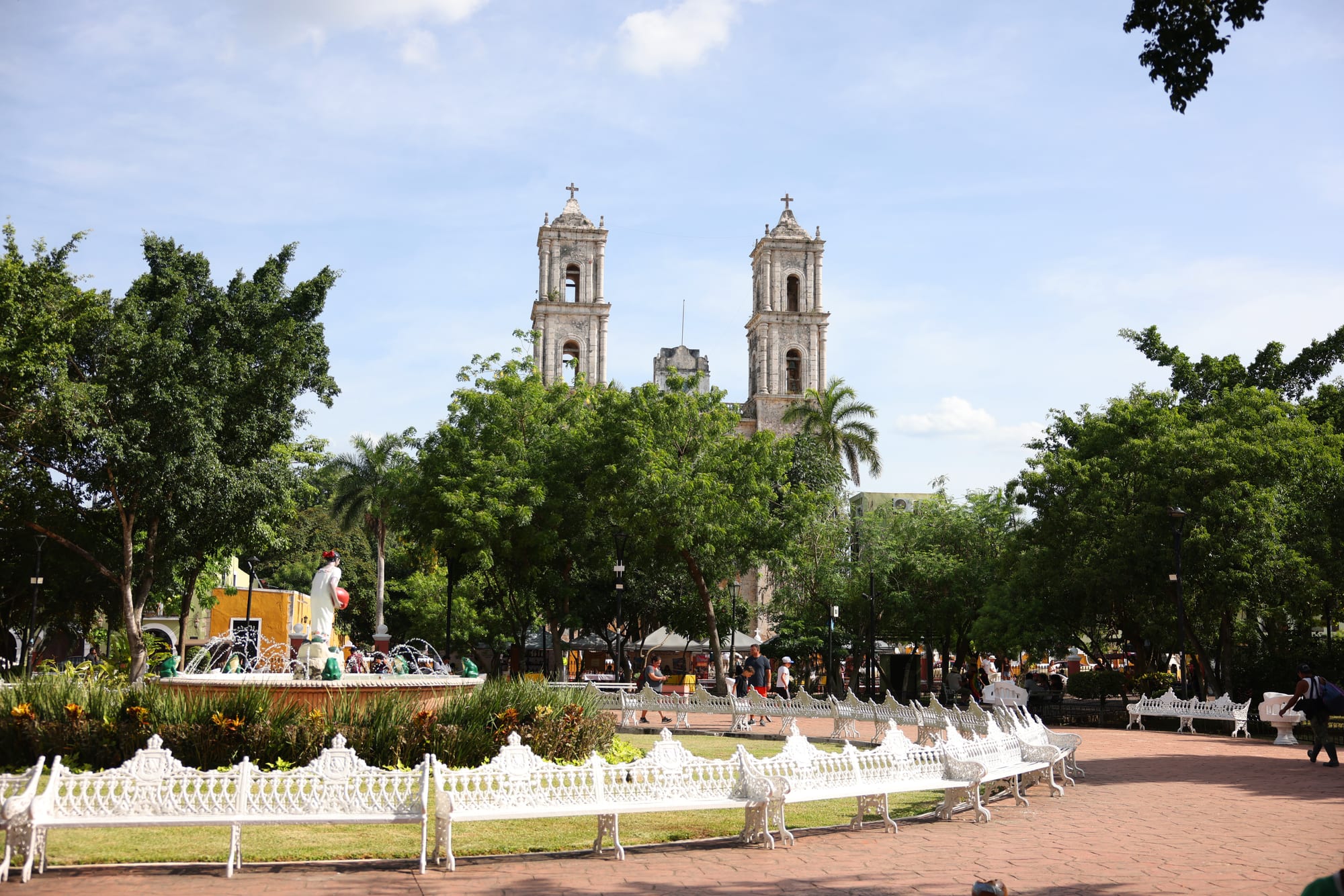
A tree-lined square with white wrought-iron love seats and a fountain, and the twin stone towers of a church rising behind

The Yucatán Peninsula, Mexico

Valladolid

Parque Francisco Cantón Rosado, Valladolid's main square, with the towers of the Church of San Servacio. (Gage Skidmore / Wikimedia Commons · CC BY-SA 4.0)

A colonial town in eastern Yucatán, built by the Spanish in 1545 on the Maya town of Zací, around a cenote that was once its water supply. Sacked in the Caste War and long known as the Sultana of the East, it is now a quiet town of painted streets and a base for Chichén Itzá, Ek' Balam and the cenotes, with a Tren Maya station since 2023.

Neighbourhoods

  • Centro
    • First-time visitors
    • Historic district
    • Close to public transport

    The grid of streets around the main square, Parque Francisco Cantón Rosado, with the Church of San Servacio, restaurants, shops and the ADO bus station. Colonial mansions of the town's old criollo families line the nearby streets, and craft sellers set up on the square.

    Open in Maps
  • Sisal
    • Historic district
    • Quiet and residential

    The old barrio around the Franciscan convent of San Bernardino de Siena and its park, reached along the Calzada de los Frailes, a restored 16th-century colonial street, a 10–15 minute walk from the main square.

    Open in Maps
  • Santa Ana
    • Local life
    • Cenotes

    A barrio close to the centre, around its church and plaza, where a Maya leader was hanged in 1847 on the eve of the Caste War. Cenote Zací lies within it.

    Open in Maps
  • La Candelaria
    • Quiet and residential
    • Local life

    A barrio around the church and park of Nuestra Señora de la Candelaria, the focus of the town's big fiesta in February.

    Open in Maps

Things to do

The colonial town

  • Church of San Servaciolandmark

    The main parish church on the south side of the main square, rebuilt after a revolt in 1705 and, unusually for Yucatán, facing north; it keeps the image of the Virgin of Candelaria, the town's patron.

    Open in Maps
  • Parque Francisco Cantón Rosadopark

    The main square, surrounded by colonial buildings, restaurants and shops and furnished with the paired 'tú y yo' chairs found across the peninsula.

    Open in Maps
  • Calzada de los Fraileslandmark

    A preserved 16th-century street of restored houses linking the centre with the convent of San Bernardino.

    Open in Maps
  • Convent of San Bernardino de Sienalandmark

    A Franciscan church and former convent in the Sisal barrio, built between 1552 and 1560.

    Open in Maps

Cenotes

  • Cenote Zacíattraction

    A landscaped cenote close to the centre, once the town's water source and named after the Maya settlement that stood here; visitors can swim, and there is a restaurant and craft stalls on the site.

    Open in Maps
  • Cenotes X'keken and Samuláattraction

    Two cenotes about 7 km west of town, reached by colectivo, taxi or a paved cycle path — X'keken a large vaulted pool with an opening in its roof.

    Open in Maps

Short trips from the town

  • Ek' Balamlandmark

    A Maya city about 25 km north of Valladolid, far less crowded than Chichén Itzá.

    Open in Maps
  • Chichén Itzálandmark

    The great Maya city of El Castillo, the ball court and the Sacred Cenote, a UNESCO World Heritage Site, for which Valladolid is the closest base with a full range of services.

    Open in Maps
  • Ik Kilattraction

    A deep, open cenote near Chichén Itzá, with steps down to the water.

    Open in Maps

Seasonal events

  • Fiesta de la Candelariaearly February

    The feast of the Virgin of Candelaria, the town's patron, on 2 February, centred on the Candelaria barrio.

Eat and drink

Long-standing places and food districts in Valladolid. Hours, ratings and directions come from your maps app, always current.

Food streets and squares

  • Restaurants around the main squareneighborhood

    The square and the streets off it hold most of the town's restaurants, serving Yucatecan dishes such as lomitos de Valladolid and longaniza.

    Open in Maps
  • Calzada de los Frailesneighborhood

    The restored colonial street towards the convent, with restaurants and shops in its old houses.

    Open in Maps
  • Restaurant at Cenote Zacírestaurant

    A restaurant beside the cenote in the middle of town.

    Open in Maps

Experience Valladolid

History

The Spanish town was founded on 27 May 1543 by a nephew of the conquistador Francisco de Montejo, at a lagoon called Chouac-Ha in what is now the municipality of Tizimín, and named after Valladolid in Spain, then the Spanish capital. The settlers complained of mosquitoes and damp, and on 24 March 1545 the town was moved inland to Zací, the capital of the Maya chiefdom of the Cupul, whose name means "white hawk". Its buildings were taken apart and the stone used for the colonial town, and the cenote at its heart supplied water. The Maya revolted the next year, and again in 1705, when rebels killed town officials who had sheltered in the church; the building was considered profaned and replaced by the present Church of San Servacio.

By 1840 Valladolid had about 15,000 people and was the peninsula's third city after Mérida and Campeche, with a well-off criollo class living in Spanish-style mansions. In 1847 a Maya leader, Manuel Antonio Ay, was hanged in the plaza of Santa Ana, and the uprising that followed became the Caste War. The town was besieged, and on 14 March 1848 its defenders abandoned it; about half were killed in ambushes on the road to Mérida, and the rebels sacked the town before it was retaken.

In May 1910 a call to revolt against the Díaz dictatorship, the Plan de Dzelkoop, was signed in the municipality. Valladolid was declared a Pueblo Mágico on 30 August 2012, the second in Yucatán after Izamal, and the Tren Maya arrived in 2023.

Culture & Customs

Valladolid was long called the Sultana of the East, and its identity rests on its colonial barrios — Sisal, Santa Ana, La Candelaria and others — each grown up around its own church and park. In Maya the town is Sakiꞌ, the old Zací, and its coat of arms shows the white hawk standing for the Maya town alongside symbols of the Spanish one.

Religious fiestas punctuate the year, above all the feast of the Virgin of Candelaria, the town's patron, on 2 February. At regional fiestas people dance the jarana, the Yucatecan folk dance, often in competitions between couples. The town's main square, with its paired 'tú y yo' love seats, is the social centre in the evenings.

Crafts are sold on the square and at the Cenote Zací: wood carvings, traditional clothing, bags made from henequen fibre and handmade shoes and sandals. Valladolid has become far more tourist-oriented in recent years, and many sights now carry signs in Spanish and English.

Daily Life

About 56,000 people lived in the city at the 2020 census, and about 85,000 in the municipality — the third-largest community in Yucatán state after Mérida and Kanasín, and its largest outside the Mérida metropolitan area. The town is the service centre for the east of the state, with hospitals, schools and the main bus station for the surrounding villages, and many residents work in commerce, services, small industry and farming.

Tourism has grown quickly as visitors use the town as a base for Chichén Itzá, Ek' Balam and the cenotes, and the Tren Maya station north of town has added to the flow. Restaurants, guesthouses and shops now fill the centre and the Calzada de los Frailes.

The rhythm is that of a small Yucatecan town: early starts, a slow middle of the day in the heat, and evenings on the square. There are no city buses; people walk, cycle or take colectivos to the villages around.

Food

Valladolid has dishes of its own. Lomitos de Valladolid is pork cooked in a fresh tomato sauce, and the town's longaniza is a pork sausage seasoned in the local way. Alongside them come the classics of the peninsula: cochinita pibil, pork marinated in achiote and spices, wrapped in banana leaf and cooked in a pit; lechón al horno, roast pork; bistec de cazuela, a stewed beef dish; and relleno negro, turkey in a black paste of charred chillies.

Sweets are made from local ingredients such as honey, coconut and corn, and traditional ice cream is popular, in flavours such as coconut, corn and tropical fruits including guanábana and mamey sapote. Restaurants around the main square and along the Calzada de los Frailes serve most of these dishes, though as visitor numbers grow, plainer local places have become harder to find in the centre. Honey is an important product across the peninsula, where the Maya have kept stingless melipona bees for centuries, and it goes into xtabentún, the region's anise liqueur; horchata and fresh fruit waters are drunk against the heat.

Planning tools

Budget

Valladolid is one of the cheaper bases on the peninsula, with guesthouses in colonial houses, Yucatecan restaurants and market prices far below those on the Caribbean coast. Entry fees for Chichén Itzá, Ek' Balam and the cenotes, and taxis or a hire car to reach them, are the main costs.

Daily Budget Midrange
USD 90–180 (colonial guesthouse or small hotel, restaurants, ruins entry, taxis or a hire car)
Daily Budget Shoestring
USD 35–60 (hostel bed, local restaurants, colectivos and bike hire, a cenote or two)

Visit Chichén Itzá early from here, before the tour buses from Cancún arrive.

Best Time to Visit

November to March is the most comfortable time, warm and mostly dry. April and May are the hottest months, often passing 38°C in the afternoon. The rainy season runs from June to October, with heavy showers and the chance of tropical storms. The Candelaria fiesta falls at the start of February.

Suggested Number of Days

A day or two is enough for the town itself. Many visitors stay longer to use it as a base for the ruins and cenotes around it, which adds a day or two more.

First Visit
1–2 days
With Surroundings
3–4 days

Transportation

There are no city buses: the town is small enough to walk, and bikes can be hired cheaply. Taxis wait around the centre, and colectivos — shared vans — leave from stands near the centre for Chichén Itzá, Ek' Balam and the surrounding villages. A hire car is the easiest way to see several sites in a day.

Ask where the colectivo for a particular site leaves from; each route has its own stand in the centre.

Airport & Station Connections

The nearest major airport is Cancún, about 150 km east; Mérida is about 170 km west. ADO buses from the station near the main square take around two hours to Cancún, a little more to Mérida and about an hour and a half to Playa del Carmen. The Tren Maya station is about 5 km north of town, and the toll highway between Cancún and Mérida passes close by.

Walkability

Valladolid is compact, flat and easy on foot, with a numbered grid of streets: the convent and the cenote are each a short walk from the main square. The heat makes the early morning and evening the best times to walk; pavements in the older barrios are narrow.

Safety

Safety varies enormously by state and even neighbourhood. Yucatán state, and Mérida in particular, has some of the lowest crime rates in Mexico, and Valladolid is a quiet town. The main risks are natural: heat, tropical storms in the rainy season, and cave diving in cenotes without a guide.

Carry water and sun protection to the ruins, swim in cenotes only where it is permitted, and use licensed taxis at night. Check current official travel advice before travelling.

Climate

A hot tropical wet and dry climate, a few degrees hotter than the coast because the town lies inland. Rain falls mainly from June to October, when easterly waves and tropical storms can reach the area.

Summer
hot — average highs reach about 36°C in May, the hottest month, and afternoons often pass 38°C
Winter
warm — average highs around 28°C in January, with nights near 18°C

Local Customs

Yucatec Maya is still the mother tongue of a large part of the population across the state, alongside Spanish. Tipping follows Mexican practice in restaurants and is less expected at stalls. Dress modestly in churches and the convent, and ask before photographing people.

At fiestas the jarana is danced competitively — watch, and join in only if invited.

Common Payment Methods

The currency is the Mexican peso. Hotels and larger restaurants accept cards, but taxis, colectivos, cenote entries and craft sellers usually want cash. ATMs are found around the centre; use those inside banks or stores.