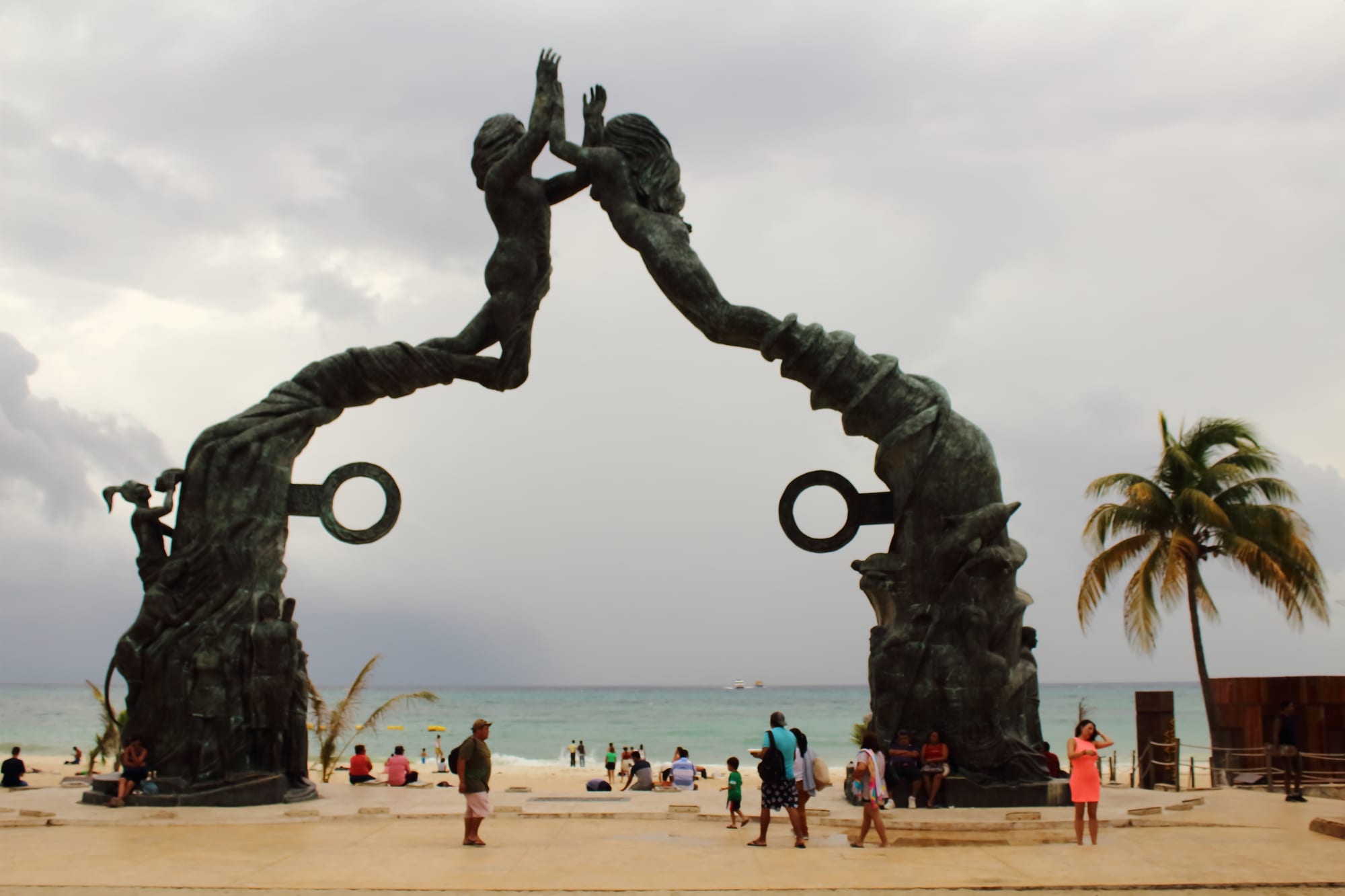
A huge dark bronze sculpture of two figures reaching towards each other above a beach, with turquoise sea and a palm tree beyond

The Yucatán Peninsula, Mexico

Playa del Carmen

The large sculpture in Parque Fundadores, the park on the beach in central Playa del Carmen. (Adrián Cerón / Wikimedia Commons · CC BY-SA 4.0)

A resort city on the Caribbean coast of Quintana Roo, facing the island of Cozumel across a narrow channel. A fishing and chicle village of fewer than 1,500 people until the mid-1980s, it grew on the Cozumel ferry and the Riviera Maya boom into a city of about 300,000, built around a long pedestrian avenue, Quinta Avenida, one block from the beach.

Neighbourhoods

  • Centro and Quinta Avenida
    • First-time visitors
    • Nightlife
    • Beaches

    The town centre between the beach and the highway, around the Zócalo at the foot of Avenida Juárez, where the Cozumel ferry docks and the tourist bus terminal stand. Quinta Avenida, the street nearest the sea, is closed to traffic and lined with hotels, restaurants, bars and shops.

    Open in Maps
  • La Nueva Quinta
    • Best for food
    • Bars

    The newer stretch of Quinta Avenida north of Avenida Constituyentes, which locals call the 'Nueva Quinta' — the newer part of the avenue, with a more bohemian feel than the busy southern blocks.

    Open in Maps
  • The inland avenues
    • Local life
    • Budget travellers

    The avenues parallel to the beach are numbered in fives — 10, 15, 20 and onwards — and prices fall a few blocks inland from Quinta Avenida. Avenida 30, five blocks back, has the large stores where residents shop.

    Open in Maps
  • Playacar
    • Resorts
    • Quiet and residential
    • Golf

    A gated resort development just south of the centre, with a first phase of villas near the sea and a second built around a golf course, lined with all-inclusive resorts and private homes. Small Maya ruins stand among its streets.

    Open in Maps

Things to do

The town and the beach

  • Quinta Avenidaneighborhood

    The pedestrian avenue nearest the beach, running north from the Zócalo — the town's main street for shopping, eating and nightlife, and busiest in the evening.

    Open in Maps
  • Parque Fundadorespark

    One of the town's first public spaces and its only public park on the beach, beside the Zócalo, with a large sculpture known as the Portal Maya.

    Open in Maps
  • The town beachbeach

    White sand runs the length of the town in front of Quinta Avenida, with beach clubs and bars in places and fishing boats drawn up on the sand.

    Open in Maps

Cenotes and parks

  • Río Secretopark

    A semi-flooded limestone cave system near the town, with 38 km of passages, about a tenth of them open to visitors, protected as a nature reserve.

    Open in Maps
  • Cenote Chaak Tunattraction

    A cenote with guided swimming tours through its caverns, a short drive from the town.

    Open in Maps
  • Xcaret Parkpark

    A large privately run theme park about 6.5 km south of the town, with an archaeological site, underground rivers for snorkelling, a beach and an evening show of Mexican music and dance.

    Open in Maps

Short trips from the town

  • Cozumelattraction

    The diving island across the Cozumel Channel, reached by passenger ferry from the dock in the town centre.

    Open in Maps
  • Puerto Morelosattraction

    A former fishing village north of the town, about halfway to Cancún, with a protected stretch of the Mesoamerican Barrier Reef just offshore.

    Open in Maps
  • Akumalattraction

    A small beach community to the south, between Playa del Carmen and Tulum, famous for snorkelling in its bays.

    Open in Maps
  • Tulumlandmark

    The walled Maya port on a cliff above the Caribbean, one of the most visited ruins in Mexico.

    Open in Maps

Seasonal events

  • Fiesta de la Virgen del CarmenJuly

    The feast of the town's patron saint, one of the most important events of the year in the municipality.

Eat and drink

Long-standing places and food districts in Playa del Carmen. Hours, ratings and directions come from your maps app, always current.

Food districts

  • Taco stands of the inland avenuesneighborhood

    Carts and small taquerías away from Quinta Avenida serve seafood tacos, carnitas, al pastor and cochinita pibil, alongside tortas and empanadas, at local prices.

    Open in Maps
  • Street food on Calle 2 Norteneighborhood

    In the evening, stalls along Calle 2 Norte sell tacos, tortas, burritos and gringas.

    Open in Maps
  • Seafood on the beachneighborhood

    Simple beach restaurants in the centre serve ceviche and fried fish with cold beer.

    Open in Maps

Bars

  • Calle 8 and Calle 12neighborhood

    The two side streets where most late bars and clubs are found — Calle 8, between Quinta and Avenida 10, popular with locals and backpackers for live music and cheap beer, and Calle 12, busier with tourists, down towards the beach clubs.

    Open in Maps

Experience Playa del Carmen

History

Before the Spanish arrived the site was Xaman Há, "Water of the North" in Maya, a departure point for Maya pilgrims crossing to the shrine of the goddess Ixchel on Cozumel. Spanish forces under Francisco de Montejo reached this coast in the 1520s, and one of his lieutenants, Alonso Dávila, camped at Xaman Há, describing it as a fishing village. The area then fell quiet for centuries.

The modern settlement dates from the early 20th century, when a community of fishermen, coconut growers and chicle gatherers grew up here; in 1908 a chicle company won a concession from the government of Porfirio Díaz to exploit the forests of the coast. Tourism began with the passenger ferry to Cozumel, already a diving destination, but until the mid-1980s Playa del Carmen remained a stopping point with fewer than 1,500 inhabitants.

Then the Riviera Maya took off. The population reached about 10,000 by 1996 and 49,000 by 2003, as people came from across Mexico for work in hotels and construction, and Guinness World Records listed it among the fastest-growing communities in Latin America. Playacar, a gated resort and golf development, grew to the south. In October 2005 Hurricane Wilma passed directly over the town and stayed nearby for two days, causing heavy but mostly superficial damage. The town is now the seat of its own municipality, and in 2024 the Tren Maya opened a station here.

Culture & Customs

Playa del Carmen is a young town, and most of its people were born elsewhere — in other Mexican states or abroad — so its culture is a mix rather than a single tradition. The town's cultural centre runs workshops in literature, painting, music, dance and theatre for residents.

The feast of the Virgen del Carmen, the town's patron saint, in July, is the main traditional celebration. Music festivals have long been part of the town's identity, among them the Riviera Maya Jazz Festival, launched in 2003. Football is followed through Inter Playa del Carmen, founded in 1999, and a PGA Tour golf tournament was played at the Mayakoba resort's El Camaleón course from 2007 to 2023.

The town's public life happens on the beach, in Parque Fundadores and along Quinta Avenida, which fills in the evening. Most residents work in tourism and live inland from the beachfront. Conservation is a growing concern: the coast's forests, reefs and cenotes are under pressure from development and pollution, and in 2026 the city strengthened its 'zero plastic' policies.

Daily Life

The city had about 305,000 people at the 2020 census, and its municipality about 334,000, making it the second-largest city in Quintana Roo after Cancún. Growth has been very fast, driven by migration from other states in search of tourism jobs; tourism is the main activity, and construction, fed by the boom, the second most important sector.

Life divides between the tourist strip along the beach and the residential districts that spread inland, where most residents live and shop at the supermarkets and stores of the wider avenues. Colectivo vans run along Highway 307 between Cancún and Tulum, linking the town with the rest of the coast. A campus of the Universidad Autónoma de Quintana Roo serves the Riviera Maya.

The day starts early and the town is liveliest after dark, when Quinta Avenida and the side streets near the beach fill up. Current issues include the strain of rapid growth on water, housing and transport, sargassum on the beaches in many summers, and the impact of the Tren Maya, whose station here opened in 2024.

Food

The town's everyday food is the taco. Carts and small taquerías away from Quinta Avenida serve seafood tacos, carnitas, al pastor and stuffed poblano peppers, and the peninsula's own dishes appear everywhere: cochinita pibil, pork marinated in achiote and sour orange and slow-cooked; poc chuc, pork grilled after soaking in sour orange; and panuchos, fried tortillas stuffed with black beans and topped with meat, and salbutes, tortillas with similar toppings. Because so many residents come from elsewhere, food from other Mexican regions and from abroad is common too.

On the beach, simple restaurants serve ceviche and fried fish, and in the evening the stalls along Calle 2 Norte sell tacos, tortas and burritos. Prices on Quinta Avenida are much higher than a few blocks inland, where residents eat.

To drink there are fresh fruit waters and horchata against the heat, Mexican beer on the beach, and xtabentún, the peninsula's anise and honey liqueur. The bars of Calle 8 and Calle 12 and the beach clubs keep the town busy late into the night.

Planning tools

Budget

Playa del Carmen is priced for international tourists, and Quinta Avenida is the most expensive part of it. Food and lodging get much cheaper a few blocks inland, where taco stands and small guesthouses serve residents. Entry fees for cenotes, theme parks and dive trips add up quickly, and prices peak in the winter and summer holidays.

Daily Budget Midrange
USD 150–300 (mid-range hotel near the beach, restaurants, a cenote or park entry, ferry or dive trip)
Daily Budget Shoestring
USD 50–85 (hostel bed, taco stands and street food, colectivos along the coast, a public beach)

Eat a few blocks inland from Quinta Avenida, and pay in pesos rather than US dollars.

Best Time to Visit

The weather is hot all year. The dry season from about November to April is the most comfortable, and peak tourist demand comes with the winter and summer holidays. Rain falls mostly from June to November, the hurricane season, and masses of sargassum seaweed have washed onto the Caribbean beaches in many summers since the 2010s.

Suggested Number of Days

Three or four days suit a beach stay in the town itself. Allow a week or more to use it as a base for the cenotes, islands and ruins along the coast, which are easy to reach by bus, colectivo or ferry.

First Visit
3–4 days
With Surroundings
6–8 days

Transportation

The centre is compact and walkable, and taxis wait at ranks called sitios. Colectivos — cheap, government-regulated shared vans — run frequently along Highway 307 between Cancún and Tulum, picking up and dropping off along the highway, and ADO buses serve the coast and the theme parks. Bikes and hire cars are available at the north end of Quinta Avenida.

Agree the taxi fare before setting off.

Airport & Station Connections

Cancún International Airport is around 70 km to the north, and ADO buses run from its terminals to the tourist bus station on Quinta Avenida; the airport on Cozumel is another option, a ferry ride away. Playa del Carmen station on the Tren Maya opened in 2024, outside the town centre. Passenger ferries to Cozumel leave from the dock at the south end of the centre, and vehicle ferries also cross to the island.

Walkability

Very walkable: from the Zócalo to Avenida Constituyentes takes about ten minutes, Quinta Avenida is closed to traffic, and the grid of numbered streets and avenues is easy to follow. The heat is the main problem, and the newer districts inland are spread out along wide roads.

Safety

Safety varies enormously by state and even neighbourhood. On the Caribbean coast, Cancún, Playa del Carmen and Tulum have seen shootings linked to rival drug-selling groups, occasionally in bars and near hotels, as well as scams, overcharging taxis and petty theft on the beaches. Natural risks include hurricanes, heat and strong currents on some beaches.

Avoid buying drugs, use official taxis and ATMs inside banks or malls, and swim only on beaches without warning flags. Check current official travel advice before travelling.

Climate

A tropical savanna climate, hot all year with warm nights, tempered by sea breezes. Most rain falls between June and November, the hurricane season; Hurricane Wilma passed directly over the town in 2005. The figures below are the region's, from the Yucatán Peninsula page.

Summer
hot and humid — around 32°C on the coast across the region, with afternoon storms
Winter
warm and dry — 26–30°C by day across the region, occasionally cooler when northern fronts arrive

Local Customs

Most residents were born elsewhere, in other Mexican states or abroad, so the town's customs are a mix rather than a single local tradition. The feast of the Virgen del Carmen, the town's patron saint, in July is the main traditional celebration.

Ask the taxi fare before setting off, and carry small change in pesos for street stalls and colectivos.

Common Payment Methods

The currency is the Mexican peso. Cards are widely accepted in hotels, restaurants and shops in the centre; taxis, colectivos and street stalls want cash. Exchange offices line Quinta Avenida, and ATMs inside banks or malls are the safest.