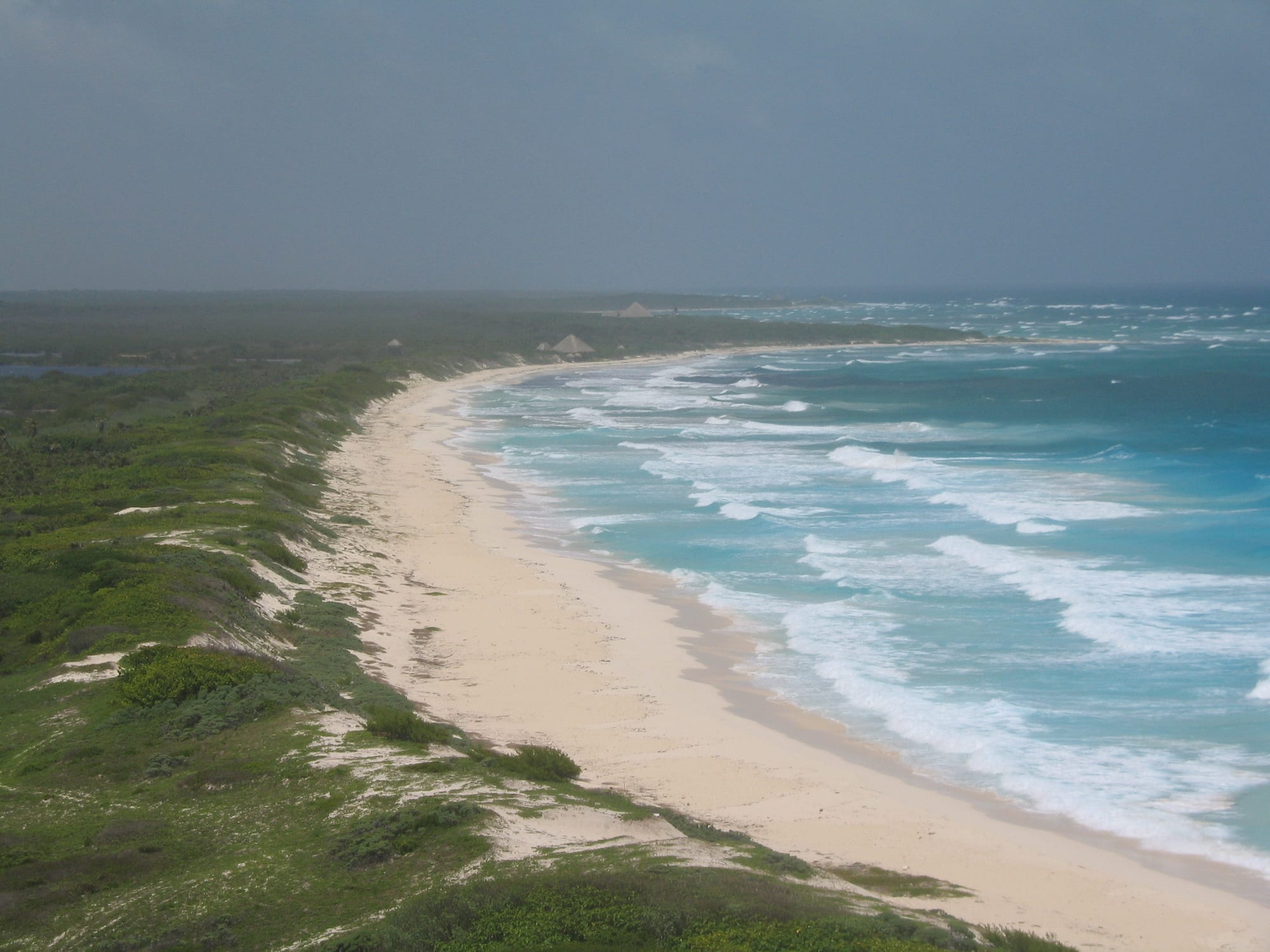
A long curving white-sand beach backed by low green scrub, with turquoise surf breaking under a grey sky

The Yucatán Peninsula, Mexico

Cozumel

A beach on the southern tip of Cozumel, seen from the Punta Sur lighthouse. (gren or Rydia / Wikimedia Commons · Public domain)

Mexico's largest Caribbean island, about 19 km off Playa del Carmen across the Cozumel Channel. Once a Maya pilgrimage centre of the goddess Ixchel, it was resettled by refugees from the Caste War and is now one of the world's best-known diving destinations and Mexico's busiest cruise port, with almost all its people in the single town of San Miguel.

Neighbourhoods

  • San Miguel
    • First-time visitors
    • Best for food
    • Nightlife

    The island's only town, on the north-west coast, where nearly all Cozumeleños live. The main plaza, ringed by shops, has a stage where residents and visitors gather for music and dancing on Sunday evenings; the passenger ferry from Playa del Carmen docks at the pier in the centre, and restaurants, bars and dive shops fill the streets around.

    Open in Maps
  • The south-west coast
    • Diving
    • Beaches
    • Resorts

    The sheltered shore south of town, facing the mainland, with the cruise piers, beach clubs and parks, dive resorts, and the reefs of the marine park offshore.

    Open in Maps
  • The east coast
    • Wild beaches
    • Scenery

    The windward side of the island, which locals call 'the other side' — undeveloped beaches facing the open Caribbean, with rougher seas and warning flags marking where it is safe to swim. There is no public transport, so it is reached by hire car, scooter or taxi.

    Open in Maps

Things to do

Reefs and diving

  • Arrecifes de Cozumel National Parkpark

    The marine park protecting the reefs of the island's south side, part of the Mesoamerican Barrier Reef System; selected reefs are closed in rotation to let them recover from coral disease.

    Open in Maps
  • Palancar Reefattraction

    A large reef off the south-west coast, popular with divers, with depths of about 15 to 34 metres and coral swim-throughs.

    Open in Maps

Beaches and parks

  • Punta Surpark

    An ecological park at the island's southern tip covering reefs, beaches, lagoons and low forest, with a lighthouse and El Caracol, a small Maya temple.

    Open in Maps
  • Chankanaabpark

    A beach park on the west coast about 9 km south of town, used for snorkelling.

    Open in Maps
  • East coast beachesbeach

    Long empty beaches on the windward side, where flags show how safe the sea is for swimming on a given day.

    Open in Maps

Maya Cozumel

  • San Gervasiolandmark

    The most important Maya city on the island, in its northern third, a centre of worship of the goddess Ixchel, with groups of buildings linked by raised roads called sacbés.

    Open in Maps
  • El Cedralattraction

    A small village in the south of the island, one of the first two settlements founded by Caste War refugees, with a chapel, a small Maya site nearby and an annual fair.

    Open in Maps

The town

  • San Miguel main plazalandmark

    The square at the heart of the town, surrounded by shops, with a fixed stage for Sunday evening music and dancing.

    Open in Maps

Seasonal events

  • Carnaval de Cozumelthe weeks before Lent

    One of the oldest carnivals in Mexico, long a centre of island family life, named in 2007 among the country's most important carnivals.

  • Fiestas de la Santa Cruz and Feria del Cedrallate April to early May

    A fair in the village of El Cedral honouring the Holy Cross, kept since 1848, when Caste War refugees vowed to honour it, and one of the oldest celebrations on the peninsula.

Eat and drink

Long-standing places and food districts in Cozumel. Hours, ratings and directions come from your maps app, always current.

Food in San Miguel

  • Restaurants around the main squareneighborhood

    The densest choice of restaurants on the island, serving Yucatecan specialities such as slow-cooked marinated pork alongside tacos and other Mexican dishes.

    Open in Maps
  • Municipal marketmarket

    The town market, with simple food stalls nearby where residents eat breakfast and lunch.

    Open in Maps

On the coast

  • Beach bars of the south and eastneighborhood

    Bars and restaurants along the coast road serve ceviche, fish tacos and guacamole beside the beach.

    Open in Maps

Experience Cozumel

History

The Maya called the island Cuzamil, "island of swallows", and more than 30 archaeological sites show it was occupied from the Late Preclassic period, about 300 BCE. From around 1250 CE it flourished as a port on the trade route along the peninsula's coast and as a pilgrimage centre where merchants and pilgrims worshipped Ixchel, goddess of the moon, childbirth and weaving; San Gervasio was its chief city.

Juan de Grijalva's expedition landed in 1518, and Hernán Cortés stopped in 1519, when the Maya received the Spanish peacefully. Smallpox, brought in 1520 by members of the Narváez expedition, devastated a population of perhaps 10,000; by 1570 only a few hundred people survived. Pirate raids followed, and in 1650 and 1688 most of the remaining islanders were moved to the mainland. The island was resettled in 1848 by families fleeing the Caste War, mostly from Valladolid and nearby towns, who founded El Cedral and San Miguel; San Miguel was officially recognised in 1849. In 1861 the United States explored buying the island to resettle freed slaves, an idea Benito Juárez rejected.

An airport built during the Second World War, the arrival of cruise ships from 1968 and the fame of its reefs turned Cozumel into a major destination. Hurricanes have repeatedly struck it — Beulah in 1967, Gilbert in 1988, and Emily and Wilma in 2005, which together cut live coral cover by more than half. The reefs of the south became a national marine park in 1996, and in 2023 Cozumel was named a Pueblo Mágico.

Culture & Customs

Cozumel's people descend largely from the Yucatecan families who settled the island after 1848, and the island keeps a strong small-town identity despite the millions of visitors who pass through. Its flag shows a swallow, for the meaning of its Maya name, and Benito Juárez is still honoured here for refusing to sell the island to the United States.

Two celebrations anchor the year. The Carnaval de Cozumel is among the oldest in Mexico; for more than a century, when the island was a small community, it was the high point of family and social life, and in 2007 it was named one of the country's eight most important carnivals. The Fiestas de la Santa Cruz and Feria del Cedral, held in the village of El Cedral since 1848, honour the Holy Cross that the first refugees vowed to venerate, and are among the oldest celebrations on the peninsula.

Week to week, life gathers on the main plaza, where residents and visitors meet for music and dancing on Sunday evenings. Diving culture is everywhere in San Miguel, and conservation of the reefs is a public cause: in 2025 plans for a fourth cruise pier met fierce opposition from residents worried about further damage to the coral.

Daily Life

About 89,000 people lived in the municipality at the 2020 census, nearly all of them — about 85,000 — in the town of San Miguel. The island is flat limestone, covered in mangrove and low forest, and the rest of it is almost empty apart from the coast road, beach parks and a few small settlements such as El Cedral.

The economy depends on tourism: cruise passengers who come ashore for the day, divers, snorkellers and anglers who stay longer, and the restaurants, hotels, dive shops and souvenir sellers that serve them. Cozumel is one of the world's leading cruise destinations and the first in Mexico, and on busy days several large ships are in port at once, with the town crowded around the piers.

Everyday life follows the ferry and the ships: passenger ferries cross constantly from Playa del Carmen, and freight and cars come by ferry from Calica. Hurricanes are a fact of life, with storms in 2020 and 2021 and a warning for Beryl in 2024, and the health of the reefs, hit by coral disease since 2019, is a constant concern.

Food

Cozumel eats like the rest of the Yucatán Peninsula, with seafood added. The classics are cochinita pibil, pork marinated in achiote and sour orange and slow-cooked; poc chuc, pork marinated in sour orange and grilled; sopa de lima, chicken broth with the local lime; and panuchos and salbutes, fried tortillas with beans and toppings. Habanero chillies come with almost everything.

Fish and shellfish come fresh from the surrounding sea. Ceviche, fish tacos and fried fish are the standard beach food, served at bars along the coast road, often with guacamole and cold beer. In town, restaurants around the main square serve Yucatecan specialities alongside tacos and enchiladas, and simpler places near the municipal market cook breakfast and lunch for residents. Bottled liquor gets a little cheaper away from the centre.

To drink there are fresh fruit waters, horchata and Mexican beer, and the peninsula's honey liqueur, xtabentún. Honey has a long history on the island: in Maya times the pilgrim trade encouraged local honey and wax industries.

Planning tools

Budget

Cozumel's prices are comparable with other Mexican beach destinations and far above those of inland towns. Diving and snorkelling trips, park entries and transport around the island are the main costs. Restaurants and shops near the piers are busiest on cruise days.

Daily Budget Midrange
USD 150–300 (mid-range hotel, restaurants, a two-tank dive or a hire car)
Daily Budget Shoestring
USD 50–85 (guesthouse room, tacos and market food, walking and shared taxis, shore snorkelling)

Avoid the busiest cruise days for the beach parks, and pay in pesos rather than US dollars.

Best Time to Visit

The short dry season runs from February to April, and December to April is the busiest cruise season. September and October are the wettest months and the peak of the hurricane season, which runs from June to November. Carnaval comes before Lent, and the El Cedral fair at the end of April.

Suggested Number of Days

Three or four days suit a first visit, with time on the water and on the far side of the island. Divers often stay a week or more. Add days for trips across to Playa del Carmen and the mainland coast.

First Visit
3–4 days
With Surroundings
5–7 days

Transportation

There is no public transport outside San Miguel. Taxis are always available, and hire cars, jeeps and scooters are the usual way to reach the beaches, ruins and the east coast. The town itself is easy on foot.

Most traffic accidents involving tourists are on scooters — hire one only with real riding experience.

Airport & Station Connections

Cozumel International Airport serves San Miguel with domestic and international flights; Cancún International Airport, on the mainland, has more flights. Passenger ferries from Playa del Carmen dock at the pier in the centre of San Miguel, and car and freight ferries from Calica use a terminal south of town. Cruise ships berth at three piers along the west coast.

Walkability

San Miguel is compact and walkable, with the plaza, the waterfront, the ferry pier and most restaurants close together. Beyond the town distances grow quickly: the island is about 48 km long, and the beaches, parks and ruins need a vehicle.

Safety

Safety varies enormously by state and even neighbourhood. On the Caribbean coast, Cancún, Playa del Carmen and Tulum have seen shootings linked to rival drug-selling groups, as well as scams, overcharging taxis and petty theft on the beaches; Cozumel's streets are generally safe. The real risks are scooter accidents, strong currents on the east coast, and hurricanes, which have struck the island repeatedly.

Swim only where the beach flags allow, especially on the east coast, and follow official instructions when a storm approaches. Check current official travel advice before travelling.

Climate

A tropical climate with little change through the year, humid because the sea is all around. The dry season is short, from February to April; the wet season covers most of the year, with September and October the wettest months. Summer figures below are the region's, from the Yucatán Peninsula page.

Summer
hot and humid — around 32°C on the coast across the region, with afternoon storms
Winter
warm — December to February are the coolest months, and January averages about 23°C

Local Customs

Tipping follows Mexican practice in restaurants. Beachwear belongs on the beach and in the water; cover up in town and in churches. The reefs are protected: nothing may be touched or taken.

Never touch or stand on coral, and take nothing from the reefs.

Common Payment Methods

The currency is the Mexican peso. US dollars are widely taken near the cruise piers but at poor rates. Cards are accepted in hotels, dive shops and larger restaurants; taxis, small eateries and the market prefer cash. ATMs are in the town centre, including near the ferry pier.