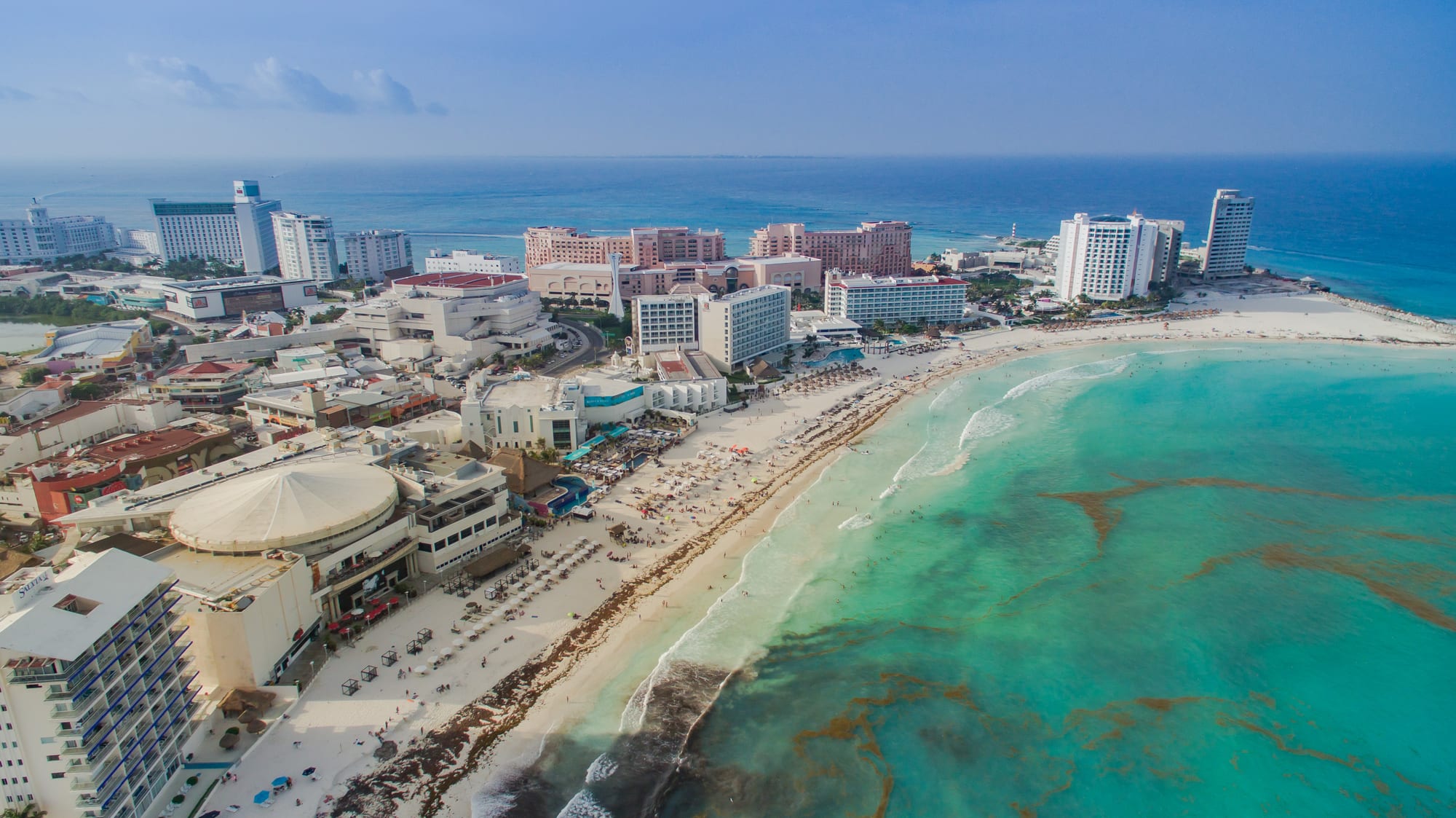
Aerial view of high-rise hotels along a white beach curving round a point, with turquoise water and dark patches of seaweed offshore

The Yucatán Peninsula, Mexico

Cancún

Hotels and beaches of Cancún's Hotel Zone seen from the air. (dronepicr / Wikimedia Commons · CC BY 2.0)

A planned resort city on the north-east tip of the Yucatán Peninsula, begun by the Mexican government in 1970 where a coconut plantation and a fishing village stood. A 7-shaped strip of hotels and beaches between the Caribbean and Nichupté Lagoon faces a fast-growing mainland city of nearly 900,000, home to Mexico's busiest international airport.

Neighbourhoods

  • Hotel Zone
    • Beaches
    • Nightlife
    • First-time visitors

    A barrier island just over 22 km long, shaped like a 7, between the Caribbean and Nichupté Lagoon, lined with resorts, beaches, shopping centres, restaurants and nightclubs along Kukulcán Boulevard. Spring break is its busiest season.

    Open in Maps
  • El Centro
    • Local life
    • Best for food
    • Budget travellers

    The mainland city where most residents live, laid out in numbered superblocks. Mercado 28 is a handy reference point for its centre, with the Parque de las Palapas, Avenida Tulum and the bus terminal close by, and Avenida Yaxchilán has bars and clubs where locals go out.

    Open in Maps
  • Puerto Juárez
    • Ferries
    • Quiet and residential

    The old fishing village 2 km north of the centre that predates the resort, now a district with ferry piers for Isla Mujeres and a stretch of developing waterfront towards Punta Sam.

    Open in Maps
  • Puerto Cancún
    • Upmarket stays
    • Golf and marina

    A large upscale development by the sea, with a marina, private canals, a golf course, a shopping mall, condominiums and hotels.

    Open in Maps

Things to do

Beaches and the sea

  • Playa Delfinesbeach

    One of the best-known beaches of the Hotel Zone, a stretch of white sand on the Caribbean.

    Open in Maps
  • Playa Tortugasbeach

    One of the quickest beaches to reach from downtown, in the Hotel Zone, with a ferry pier for Isla Mujeres.

    Open in Maps
  • Cancún Underwater Museumattraction

    About 500 sculptures sunk 3–6 metres deep in the marine national park off Cancún and Isla Mujeres from 2009 as artificial reefs, drawing divers and snorkellers away from damaged natural reefs; visited by boat.

    Open in Maps

Maya sites and museums

  • Mayan Museum of Cancúnmuseum

    An archaeology museum in the Hotel Zone, opened in 2012, with more than 350 Maya artefacts from across the Yucatán Peninsula.

    Open in Maps
  • El Reylandmark

    Small Maya ruins in the middle of the Hotel Zone, named after a sculpture of a ruler found here in 1909; the site was most populous in the Early Classic period.

    Open in Maps
  • El Mecolandmark

    A Maya port and trading town about 8 km north of Cancún whose temple-pyramid, El Castillo, is the tallest Maya building on the Quintana Roo coast.

    Open in Maps

Downtown

  • Mercado 28market

    An open-air market of craft shops and eateries in downtown Cancún, established in the 1980s and now a local landmark.

    Open in Maps
  • Parque de las Palapaspark

    A downtown square where food stalls set up in the evening.

    Open in Maps

Short trips from the city

  • Isla Mujeresattraction

    A narrow island about 10 km from Puerto Juárez, reached by ferry from Puerto Juárez and the Hotel Zone, with Playa Norte at its northern tip and a rocky windward shore; in Maya times it was sacred to the goddess Ixchel.

    Open in Maps
  • Isla Contoypark

    A small island national park about 30 km north of Isla Mujeres, a nesting ground for sea turtles and a refuge for seabirds, visited only on a limited number of licensed tours.

    Open in Maps
  • Puerto Morelosattraction

    A small seaside town and port about 36 km south of Cancún, with tourist-oriented shops, restaurants and cafés.

    Open in Maps

Eat and drink

Long-standing places and food districts in Cancún. Hours, ratings and directions come from your maps app, always current.

Food districts and markets

  • Mercado 28market

    Alongside its craft stalls, the downtown market has many small eateries, one of the best places for a wide range of local food.

    Open in Maps
  • Parque de las Palapasmarket

    With Mercado 28, the downtown square is the place for a wide range of local food, and its evening food stalls.

    Open in Maps
  • Mercado 23market

    A second downtown market, a short walk from the Parque de las Palapas.

    Open in Maps

Cancún classics

  • Seafood taquerías downtownneighborhood

    Downtown taquerías and seafood restaurants serve fried-fish and shrimp tacos, ceviche and Yucatecan dishes at local prices.

    Open in Maps
  • Avenida Yaxchilánneighborhood

    A downtown avenue of restaurants, bars and clubs where Cancún's own residents eat and go out.

    Open in Maps

Experience Cancún

History

The island strip where the resort stands was known to the Maya as Nizuc, and small settlements such as El Rey, whose ruins sit among the hotels, flourished here in the Early Classic period; El Meco, just to the north, was a port on the coastal trade route. The name Cancún, from Maya words usually translated as "nest of snakes", first appears on 18th-century maps. After the Spanish conquest, disease, war and famine emptied most of the coast, leaving only small communities on Isla Mujeres and Cozumel.

Cancún was chosen by the Mexican government as a site for a new tourist centre. In 1967 a fund was given to the Bank of Mexico to find places with no other viable development, and work began on 23 January 1970, when the island had only three residents, caretakers of a coconut plantation, and about 117 people lived in the fishing village of Puerto Juárez. Investors were wary, so the government financed the first nine hotels; the first hotel opened in September 1974, and the project became the pioneer of the national tourism fund FONATUR. From 1970 to 1980 the population grew by an average of more than 60 per cent a year, and in 1981 the city hosted the North–South Summit of world leaders.

Hurricanes have tested it repeatedly. Gilbert hit directly in September 1988, forcing hotels to be rebuilt; Wilma passed just west of the city in 2005; and Dean in 2007 stripped sand from the beaches. By 2005 the Hotel Zone had about 27,000 rooms, against 2,000 in 1974; sargassum has arrived every summer since 2015, and in 2023 the city received a record 21 million tourists. The Tren Maya began running from Cancún in December 2023.

Culture & Customs

Cancún is younger than most of its residents' parents. Most Cancunenses came from Yucatán and other Mexican states, drawn by work in tourism, and a growing number come from elsewhere in the Americas and Europe. The result is a city with little colonial past but a mix of regional cultures: Yucatecan food and Maya words alongside newcomers from across Mexico and beyond.

Two worlds sit side by side. The Hotel Zone is an international resort, known for spring-break partying by college students, with big nightclubs, bars and all-inclusive hotels. Downtown is an ordinary Mexican city, whose life centres on the Parque de las Palapas, the markets and the avenues of superblocks; its landmarks are modest, among them the Ceviche Fountain at the junction of Cobá and Tulum avenues, whose sculpture was remade after hurricane damage, and a replica of the old airport control tower, a memorial to the city's founding.

Sport has a following: the city has professional football teams and the Tigres de Quintana Roo baseball team, and in 2023 it hosted the WTA Finals in women's tennis. The surrounding Maya heritage is presented at the Mayan Museum of Cancún, opened in 2012.

Daily Life

In the 2020 census the city had about 889,000 people, the most populous in Quintana Roo. It is the seat of the municipality of Benito Juárez and still growing fast as workers arrive for jobs in hotels, restaurants, construction and transport.

Tourism is almost the whole economy, and the Hotel Zone is its engine. Daily life for most residents is on the mainland, in neighbourhoods laid out in numbered superblocks, and many commute by bus along Kukulcán Boulevard to work shifts in the resorts. Growth has outrun services: the city has long struggled to provide them for the constant influx of new residents, and irregular settlements spread on the mainland.

Current issues include drug-related violence, with homicides above the national average since 2018; the annual arrival of sargassum on the beaches; erosion, which has meant replenishing the beaches with dredged sand many times; and the pressure of record visitor numbers on water, lagoons and reefs. The Tren Maya and new road links have brought the rest of the peninsula closer.

Food

Cancún's cooking borrows from all over Mexico, but its roots are Yucatecan and Caribbean. Downtown, the markets and the stalls around the Parque de las Palapas serve tacos and tortas at local prices. The peninsula's own dishes, such as cochinita pibil, pork marinated in citrus juice and achiote and slow-roasted, and sopa de lima, chicken soup with the local lime, appear on many menus.

Seafood is everywhere. Fried-fish and shrimp tacos are the everyday staples of downtown taquerías, alongside ceviche, fish and shellfish cooked with lime, and shrimp in many forms; tacos al pastor, spit-roasted pork, are as popular here as in the rest of the country.

The Hotel Zone has international restaurants and the big party bars, while Mercado 28 and the downtown streets are where residents eat. Fresh fruit waters, horchata and cold beer are the drinks of the heat; xtabentún, a honey liqueur of Maya origin made in Yucatán, is the regional spirit.

Planning tools

Budget

Cancún has two price levels. The Hotel Zone is priced in line with US and European resorts, while downtown taquerías, markets and buses charge ordinary Mexican prices. Since 2020 Quintana Roo has charged a visitor fee, the VisiTAX, to international visitors, and boat trips, the underwater museum, diving and day tours add up quickly.

Daily Budget Midrange
USD 150–350 (Hotel Zone or downtown hotel, restaurants, a ferry to Isla Mujeres, diving or snorkelling trips)
Daily Budget Shoestring
USD 45–75 (downtown hostel, market and street food, city buses, a beach day)

Pay in pesos rather than US dollars, and eat downtown rather than in the Hotel Zone to cut costs.

Best Time to Visit

November to April is the dry season and the most popular time, with peak prices from December to March; February to early May is usually driest. Spring break brings crowds and parties to the Hotel Zone. Sargassum seaweed has washed onto the beaches every summer since 2015, the tropical storm season runs from May to December, and rain peaks in October.

Suggested Number of Days

Three or four days cover the beaches, the city and a boat trip. Six to eight allow for the islands and the coast to the south; the city is also the main arrival point for the rest of the peninsula.

First Visit
3–4 days
With Surroundings
6–8 days

Transportation

Kukulcán Boulevard runs the length of the Hotel Zone from downtown to the airport, and frequent buses run along it; the main routes, R-1 and R-2, run every few minutes between Avenida Tulum and the end of the zone, and in 2024 the operators brought in new air-conditioned buses on those routes. Combis and city buses cover downtown, taxis are plentiful, and car hire is easy for trips down the coast.

Agree the taxi fare before setting off; Hotel Zone fares depend on distance along the boulevard.

Airport & Station Connections

Cancún International Airport, less than 10 km south-west of the Hotel Zone, is Mexico's second-busiest airport and its busiest for international passengers, with about 29 million passengers in 2025. ADO buses run from the airport to downtown, and from the downtown bus terminal to Playa del Carmen, Tulum and Mérida. A Tren Maya station opened beside the airport in 2023, linked to it by a free shuttle, with trains around the peninsula. Ferries cross to Isla Mujeres from Puerto Juárez and the Hotel Zone.

Walkability

The Hotel Zone is long and built for cars and buses, though stretches of beach make good walks. Downtown's superblocks are easy enough on foot around Mercado 28, the Parque de las Palapas and Avenida Tulum, but heat and distance make the bus the practical way between the two halves of the city.

Safety

Safety varies enormously by state and even neighbourhood. On the Caribbean coast, Cancún, Playa del Carmen and Tulum have seen shootings linked to rival drug-selling groups, occasionally in bars and near hotels, as well as scams, overcharging taxis and petty theft on the beaches. Since 2018 Cancún's homicide rate has been above the national average, with most killings linked to drug trafficking. Hurricanes and strong currents on some beaches are the main natural risks.

Avoid buying drugs, use official taxis and ATMs inside banks or malls, and swim only on beaches without warning flags. Check current official travel advice before travelling.

Climate

A tropical wet and dry climate, hot all year with an annual mean of about 27°C, tempered by onshore trade winds; sea breezes keep most afternoons below 36°C, and the Hotel Zone is a degree or two cooler than the mainland. Annual rain is about 1,340 mm, heaviest in autumn, and the sea stays warm all year.

Summer
hot and humid, with storms; the sea reaches about 29°C, and sargassum often washes ashore
Winter
warm and drier, with occasional cooler northern fronts; the sea stays around 26°C

Local Customs

Cancún is a young city of migrants, most from Yucatán and other Mexican states and a growing number from abroad, and English is widely spoken in the Hotel Zone. Tipping is expected in restaurants, bars and hotels. Swimwear belongs on the beach and at the pool; cover up in town and in churches.

Respect the rules at Maya sites and in the marine park, including bans on touching or standing on coral, and ask before photographing people.

Common Payment Methods

The currency is the Mexican peso. US dollars are accepted in the Hotel Zone, usually at poor rates. Cards are widely accepted in hotels, restaurants and malls; markets, street food, buses and some taxis need cash. Use ATMs inside banks or malls.