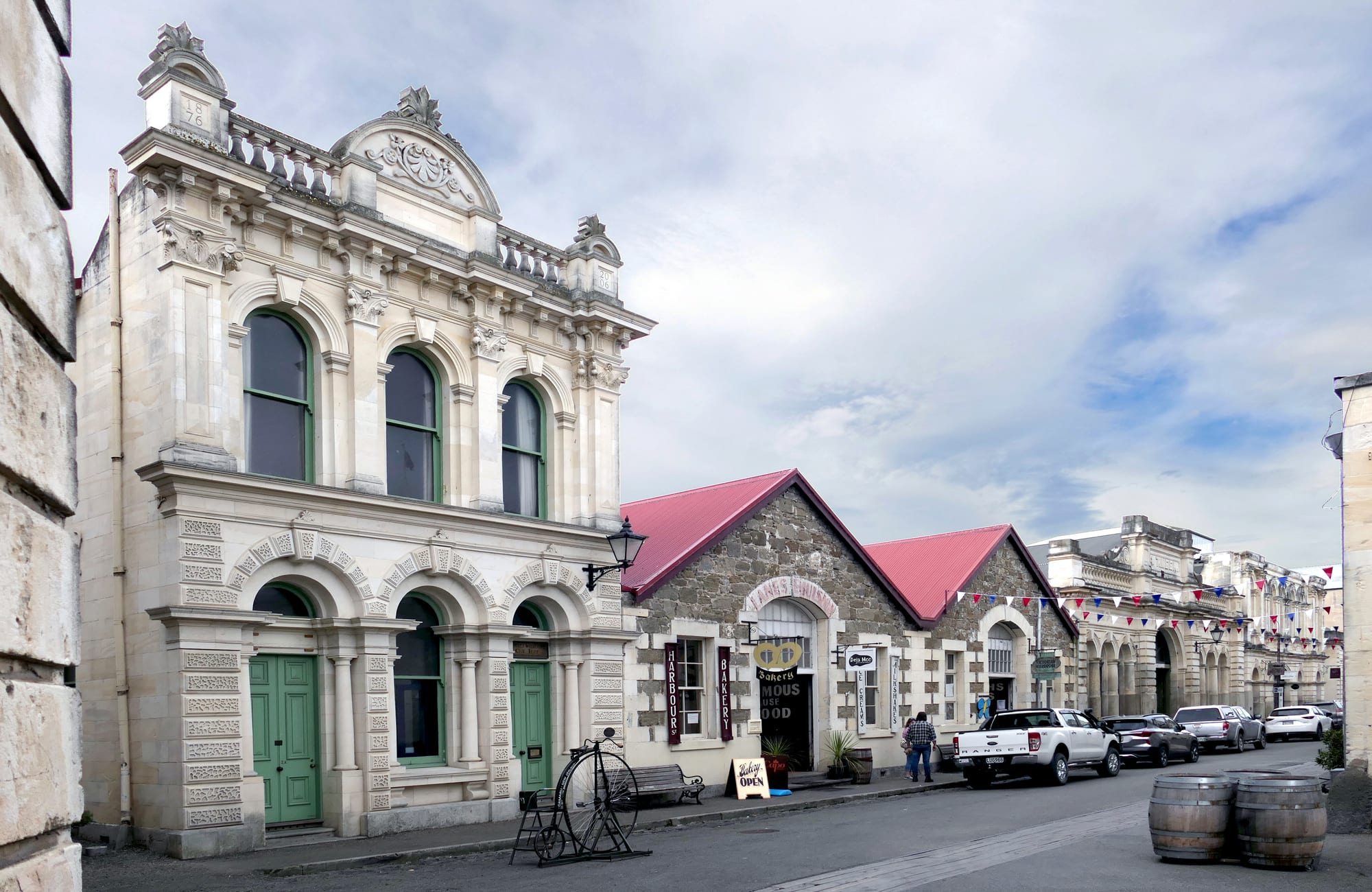
A street of ornate cream limestone Victorian commercial buildings with green doors, a red-roofed stone store and bunting strung across the road

Queenstown, Otago & Southland, New Zealand

Oamaru

Harbour Street in Oamaru's Victorian precinct, built from local whitestone limestone. (Bernard Spragg. NZ / Wikimedia Commons · Public domain)

The main town of North Otago, on the coast between Dunedin and Timaru, with about 14,000 people. Grain, wool and refrigerated meat built it in the late 19th century, and its merchants spent the money on a business district of creamy local limestone. Today that Victorian precinct, a steampunk museum and penguins coming ashore at dusk carry the town.

Neighbourhoods

  • The Victorian precinct
    • First-time visitors
    • Historic district
    • Bars and galleries

    Harbour and Tyne streets, the town's original commercial quarter, where limestone warehouses, grain stores and bank buildings of the 1870s and 1880s survive almost unbroken. They now hold galleries, a bookbinder, craft and antique shops, cafés and the steampunk museum.

    Open in Maps
  • Thames Street and the town centre
    • Shops
    • Close to public transport

    The unusually wide main street, lined with limestone civic buildings, banks, the opera house and everyday shops. Long-distance coaches to Dunedin, Christchurch and the Mackenzie Country leave from Eden Street a block away, and most of the town's services are within a few blocks.

    Open in Maps
  • Oamaru Harbour and Friendly Bay
    • Families
    • Waterfront walks
    • Wildlife

    The artificial harbour behind its long breakwater, now used by small boats rather than grain ships, with lawns, a playground and a shoreline path at Friendly Bay. The little blue penguin colony is in a disused quarry beside the harbour.

    Open in Maps
  • South Hill and Bushy Beach
    • Wildlife
    • Quiet and residential
    • Views

    The bluff above the harbour, with houses looking north over the town and a road out to Bushy Beach, where yellow-eyed penguins come ashore in the late afternoon. Walking tracks link the hill to the waterfront.

    Open in Maps
  • Weston and the quarry country
    • Quiet and residential
    • Industry and heritage

    A village a few kilometres inland among the limestone quarries that supplied the stone for Oamaru's buildings and for churches and banks across New Zealand. Stone is still cut here, and the surrounding downs are sheep and cropping country.

    Open in Maps

Things to do

The whitestone town

  • Victorian precinctneighborhood

    Two blocks of limestone commercial buildings from the 1870s and 1880s, among the best-preserved Victorian streetscapes in New Zealand, kept in use rather than reconstructed.

    Open in Maps
  • Steampunk HQmuseum

    A museum of steampunk sculpture, machines and light installations that opened in 2011 in the former Meeks grain elevator, with a modified locomotive that breathes fire at the door.

    Open in Maps
  • Oamaru Opera Houselandmark

    An Edwardian theatre of 1907 with a restored auditorium and an ornate limestone facade on Thames Street.

    Open in Maps
  • St Patrick's Basilicalandmark

    A Roman Catholic basilica in Oamaru stone designed by Francis Petre, with a domed and colonnaded interior unusually grand for a town of this size.

    Open in Maps
  • Forrester Gallerymuseum

    The town's public art gallery, opened in 1983 in one of the precinct's limestone buildings and named after Thomas Forrester, the local architect whose designs shaped much of Victorian Oamaru.

    Open in Maps

Wildlife and the coast

  • Oamaru Blue Penguin Colonyattraction

    A managed colony in a disused quarry beside the harbour where little blue penguins, kororā, come ashore at dusk and are watched from grandstands set back from the nest boxes; it is the town's largest visitor attraction.

    Open in Maps
  • Bushy Beachbeach

    A bay just south of the town where a colony of yellow-eyed penguins, hoiho, comes ashore in the afternoon, watched from viewing points set back from the sand.

    Open in Maps
  • Oamaru Public Gardenspark

    The town's public gardens, with mature trees and lawns a short walk from the centre; the Alps 2 Ocean cycle trail enters Oamaru through them.

    Open in Maps

Short trips from the town

  • Moeraki Bouldersattraction

    Large spherical grey boulders, some close to two metres across, exposed by the surf on a beach to the south of the town.

    Open in Maps
  • Totara Estatemuseum

    A limestone farm complex 8 kilometres south of Oamaru where the meat for New Zealand's first frozen shipment to London was prepared in 1882, opened to the public by Heritage New Zealand a century later.

    Open in Maps
  • Elephant Rocksattraction

    Large weathered limestone rocks on farmland in the Maerewhenua Valley a few kilometres from Duntroon, inland from Oamaru, in country known for its fossil sites.

    Open in Maps
  • Alps 2 Ocean Cycle Trailtrail

    A cycle route of more than 300 kilometres from Aoraki / Mount Cook down the Waitaki Valley, finishing at Friendly Bay beside Oamaru's Victorian precinct.

    Open in Maps

Seasonal events

  • Victorian Heritage CelebrationsNovember

    Several days of Victorian dress, a fête and street entertainment among the limestone buildings.

  • Steampunk NZ Festivalearly June

    Three days of costume, contraptions, a fashion show and a ball over Queen's Birthday weekend, centred on Steampunk HQ and the Victorian precinct.

  • Midwinter MasqueradeJuly

    An annual mask festival, owing something to the work of Janet Frame, held in the depths of the southern winter.

Eat and drink

Long-standing places and food districts in Oamaru. Hours, ratings and directions come from your maps app, always current.

North Otago specialities

  • Whitestone Cheesemarket

    A cheesemaker founded in Oamaru in 1987, known across New Zealand for its Windsor Blue and for brie, camembert and feta made with local milk, with its factory in Torridge Street.

    Open in Maps
  • Cheese rollscafe

    The southern snack of bread spread with a cheese and onion mixture, rolled and toasted, sold in most cafés and bakeries in town.

    Open in Maps

The precinct and the harbour

  • Harbour and Tyne streetsneighborhood

    Cafés and small restaurants occupying limestone warehouses in the Victorian quarter.

    Open in Maps
  • Riverstone Kitchenrestaurant

    A country restaurant north of the town on the main highway, cooking from its own market garden, and a supreme winner of the Cuisine magazine restaurant of the year awards.

    Open in Maps
  • Waitaki Valley wineneighborhood

    New Zealand's newest wine district, a narrow strip of limestone soils on the south bank of the Waitaki River inland from Oamaru, planted since 2001 and known for pinot noir.

    Open in Maps

Experience Oamaru

History

The coast here was used by Kāi Tahu and earlier southern Māori, who fished, gathered shellfish and moved along the shore between the Waitaki and Otago harbours; rock shelters and early drawings survive in the limestone country inland. Europeans arrived in the 1850s to run sheep on the North Otago downs, a port of sorts was opened for the wool trade, and the provincial surveyor John Turnbull Thomson laid out the town in 1858, naming its streets after British rivers. Landing cargo through the surf was difficult and dangerous, and a breakwater designed after a run of wrecks was built between 1871 and 1884 to give ships shelter.

Wool, and then grain from the newly ploughed downs, made Oamaru rich in the 1870s and 1880s. Local limestone, soft enough to cut with a saw and hardening on exposure, was quarried at Weston and used with confidence: banks, stores, churches, a courthouse and an athenaeum went up in classical dress, and for a while the town's public borrowing was as ambitious as its architecture. In 1882 sheep killed and frozen at Totara Estate, just south of the town, were shipped from Port Chalmers to London in the first successful cargo of frozen meat sent from New Zealand, a trade that reshaped the country's farming.

The boom did not last. Railways, larger ports and the shift of trade elsewhere left the harbour quiet and the stone buildings under-used through much of the 20th century, which is why so many of them survived. From the 1980s a restoration movement took hold in the Harbour and Tyne street area, and heritage tourism, penguins and, from 2011, a steampunk museum gave the old warehouses new work.

Culture & Customs

Oamaru's identity is built on its stone. The Victorian precinct is not a museum village but a working street, and residents speak of the whitestone with proprietorial interest, distinguishing quarries, weathering and repairs. That heritage feeling comes out each November in the Victorian Heritage Celebrations, when the town dresses in bustles and top hats for a fête and street entertainment — an event that mixes genuine local pride with self-aware humour.

Alongside it sits an odder tradition. Steampunk, the Victorian-industrial science fiction aesthetic, found a home here in the old grain stores, and the sculpture museum and its June festival have made a small town in North Otago a recognised point on an international subculture's map. Locals have taken it up with the same willingness to dress up, and in 2016 the town set a Guinness world record for the largest gathering of steampunks.

The town also has a literary claim. Janet Frame, one of New Zealand's most important writers, grew up in Oamaru, and her fiction turns the town into the Waimaru of her first novel, Owls Do Cry, and her account of a Depression-era childhood and later years in psychiatric hospitals is part of how the place understands itself. Rugby, netball, the A&P show and volunteer work at the penguin colonies fill out an ordinary provincial calendar, and the district's Kāi Tahu connections are marked in place names and in the rock art sites of the Waitaki.

Daily Life

About 14,000 people live in Oamaru, making it the largest town in the Waitaki District and the service centre for North Otago. The economy rests on farming — sheep, beef and increasingly dairy on irrigated land — with meat processing, engineering, the limestone quarries, Whitestone's cheese factory and a growing tourism trade. Irrigation from the Waitaki River has changed the surrounding countryside markedly, turning dry downland into green paddocks and bringing debate about water use with it.

Most residents live in single-storey houses on flat streets north and west of the centre, or on South Hill above the harbour, with the older cottages of the harbour district now often restored or let to visitors. Housing is inexpensive by national standards, which has drawn retirees and people priced out of Dunedin, Christchurch and Queenstown, and the population has slowly grown after decades of stagnation.

The day is provincial in rhythm: early starts on farms and at the works, a busy main street in the morning, quiet by evening except in the precinct. The hospital, schools and the council are significant employers, and many families have been in the district for generations. Local concerns include water allocation, seasonal labour for the meat and dairy industries, keeping the heritage buildings earthquake-strengthened and in use, and managing visitor pressure on the penguin colonies.

Food

North Otago's best-known product is cheese. Whitestone Cheese, founded in the town in 1987 by a farming family after drought and a rural downturn, makes more than twenty cheeses from local milk — among them the award-winning Windsor Blue, brie, camembert and feta — and sells them across the country. With them go the cheese rolls found in every southern café — bread spread with a cheese and onion filling, rolled and toasted — which are treated as a light meal rather than a snack.

The sea provides blue cod, groper and crayfish, landed at Moeraki and Kakanui to the south, and the catch from those small harbours reaches kitchens well beyond the district. Market gardens at Kakanui grow tomatoes and summer vegetables, and roadside stalls and honesty boxes sell stone fruit, walnuts and eggs through the warmer months.

Inland, the Waitaki Valley is the country's newest and one of its coolest wine districts, a narrow strip of limestone soils first planted in 2001 and best known for pinot noir. Cafés and small restaurants in the limestone warehouses of the Victorian precinct account for much of the town's eating out. Otherwise the cooking is plain and generous: lamb from the downs, venison, roast dinners, and the pies and slices of a New Zealand country bakery.

Planning tools

Budget

Oamaru is one of the cheaper stops in the south, with motels, a holiday park, hostels and bed-and-breakfasts in converted stone houses. Prices firm up in midsummer and during the Victorian and steampunk festivals. Most sights cost little: the precinct and the harbour are free to walk, and the penguin colonies and the steampunk museum are modest admissions.

Daily Budget Midrange
USD 140–250 (motel or bed-and-breakfast, restaurant meals, a hire car, penguin viewing)
Daily Budget Shoestring
USD 50–85 (hostel bed or holiday park, supermarket and bakery food, walking)

Evening penguin viewing is the fixed point of a visit, so plan the rest of the stay around dusk rather than the other way round.

Best Time to Visit

November to April is the mildest and busiest time, with long evenings, blue penguins in numbers through their breeding season and the heritage festival in November. Autumn is settled and quiet. Winter is cold and often frosty, with the steampunk weekend in early June, shorter penguin-viewing waits and the lowest accommodation prices of the year.

Suggested Number of Days

One full day and an evening covers the town itself, and about three days suit those adding the coast to the south and the valley inland. Cyclists finishing the long-distance trail often add a rest day. An overnight stay is needed to see penguins come ashore.

First Visit
1–2 days
With Surroundings
3 days

Transportation

The town is small enough to manage without a car, and its main sights lie within a couple of kilometres of each other. There is no urban bus network to speak of; taxis are few and should be arranged in advance. Long-distance coaches to Dunedin, Christchurch and the Mackenzie Country leave from Eden Street in the centre. A car is needed for Moeraki, the Waitaki Valley and the inland limestone country, and bicycles can be hired for the coastal trail.

State Highway 1 through the town carries heavy truck traffic, so use the marked crossings on Thames Street.

Airport & Station Connections

Oamaru lies on State Highway 1 about 120 kilometres north of Dunedin, a drive of roughly an hour and a half, and around 250 kilometres south of Christchurch, some three hours. Long-distance buses between the two cities stop in the centre. The nearest airports with scheduled flights are Dunedin and Christchurch; there is no passenger rail service, though freight trains still pass through.

Walkability

Very walkable. Thames Street, the Victorian precinct and the harbour are flat and joined by a few minutes' walk, and a shoreline path runs from Friendly Bay towards the penguin colony. South Hill is a short but steep climb, and Bushy Beach is a couple of kilometres further on. Pavements are wide and traffic light away from the highway.

Safety

A quiet town with low crime, where the usual care with valuables left in cars is the main precaution. Coastal hazards matter more: the open beaches have cold water and rips and are not patrolled, cliff edges on South Hill are unfenced, and wildlife rules exist for the animals' sake — sea lions occasionally haul out on local beaches and need a wide berth.

Keep well back from penguins and sea lions and out of closed beach areas in the late afternoon, and take care on the highway through town. Check current official travel advice before travelling.

Climate

Cool temperate and relatively dry, sheltered from the west by the ranges, with sea breezes, clear skies and cold nights. Rainfall is low by New Zealand standards and snow at sea level is unusual. In the southern hemisphere summer falls in December to February and winter in June to August.

Summer
warm and often calm — daytime highs usually 19–23°C, cooling quickly when the sea breeze turns
Winter
cold and clear — highs around 11–13°C, with regular overnight frosts

Local Customs

Small-town manners: people say hello in the street, and shopkeepers expect a conversation. Tipping is not expected. Dress is practical and layered, since the wind off the sea is cold even in summer. The town enjoys dressing up — Victorian costume in November, goggles and brass in June — and visitors joining in are welcomed. Wildlife viewing has firm etiquette, set by the colonies rather than by custom.

No flash photography or noise at the penguin colonies, buying alcohol needs photo identification with a legal age of 18, and many shops close early on Sundays outside the summer season.

Common Payment Methods

The currency is the New Zealand dollar. Cards and contactless payment are accepted almost everywhere, with banks and ATMs on Thames Street. A small amount of cash is handy for honesty boxes at farm gates and the occasional small craft shop in the precinct.