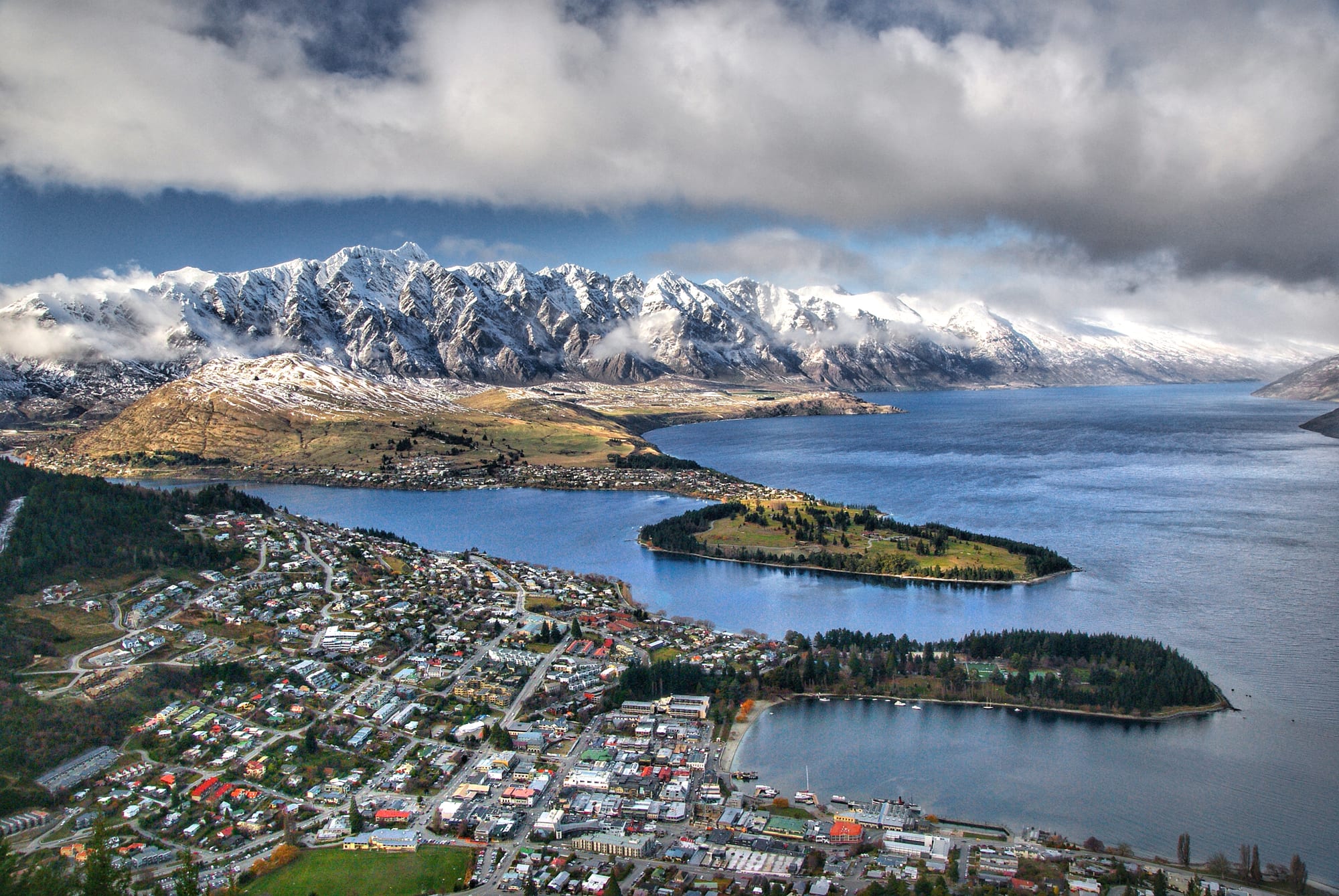
A lakeside town on a green slope above a blue bay, with a snow-covered jagged mountain range and heavy cloud behind it

Queenstown, Otago & Southland, New Zealand

Queenstown

Queenstown on Lake Wakatipu, with snow on The Remarkables behind the lake. (Bernard Spragg. NZ / Wikimedia Commons · CC0)

A resort town in the mountains of the South Island, built around a bay on Lake Wakatipu beneath the serrated ridge of The Remarkables. It grew out of the Otago gold rush of the 1860s and was remade by commercial bungy jumping and jet boating in the late 20th century, and now lives almost entirely on adventure tourism, skiing and nearby vineyards.

Neighbourhoods

  • The town centre and the bay
    • First-time visitors
    • Nightlife
    • Best for food

    A few blocks of pedestrian mall, bars and tour desks between the lake and the hill, with the Steamer Wharf, the beach at Queenstown Bay and the gondola base all within a short walk. Almost everything commercial happens here, and it stays busy late.

    Open in Maps
  • Queenstown Gardens and the peninsula
    • Walks
    • Quiet and residential

    The wooded spit that closes the bay, laid out as public gardens with big conifers, a disc-golf course, tennis courts and a shoreline path. Hotels and apartments line the road out to it, a few minutes from the mall.

    Open in Maps
  • Fernhill and Sunshine Bay
    • Lake views
    • Quiet and residential

    A steep residential shelf west of the centre, stacked with apartments, motels and holiday rentals looking out over the lake. It is a walk of fifteen to twenty minutes downhill into town and a stiff climb back.

    Open in Maps
  • Frankton and Remarkables Park
    • Close to the airport
    • Shopping
    • Families

    The flat land at the eastern end of the bay, where the airport, the main supermarkets and a retail park sit beside the Kawarau River outlet. It is the practical side of Queenstown, about eight kilometres from the centre by road or lakeside cycleway.

    Open in Maps
  • Kelvin Heights
    • Quiet and residential
    • Golf
    • Views

    A wooded peninsula on the far side of the bay with houses, a golf course and lake tracks, reached by road around the head of the bay or by a short ferry across the water to the town.

    Open in Maps
  • Arthurs Point and the Shotover
    • Adventure activities
    • Quiet and residential

    A small settlement about five kilometres north of the centre where the road crosses the Shotover River gorge. Jet boats run from here, a canyon swing operates a little upriver, and the roads to Coronet Peak and Skippers Canyon climb from the junction.

    Open in Maps
  • Arrowtown
    • Historic district
    • Families
    • Autumn colour

    A gold-rush village about 20 kilometres from Queenstown, with a main street of 1860s miners' cottages, the restored Chinese settlement on Bush Creek, a museum, and avenues of trees that turn gold in April.

    Open in Maps

Things to do

The lake and the mountains

  • Lake Wakatipuattraction

    New Zealand's longest lake at 80 kilometres, a glacial trough in a reversed-N shape and as much as 420 metres deep, its level rising and falling some 200 millimetres every 27 minutes.

    Open in Maps
  • TSS Earnslawattraction

    A coal-fired steamship launched in 1912 that still crosses the lake from Steamer Wharf to a high-country sheep station at Walter Peak.

    Open in Maps
  • The Remarkablesviewpoint

    The saw-toothed range across the lake from the town, rising above 2,300 metres, with a ski field in a basin on its western side.

    Open in Maps
  • Skyline Queenstownviewpoint

    A gondola up Bob's Peak to a terrace, restaurant, luge track and paragliding launch directly above the town, with the classic view over the bay to The Remarkables.

    Open in Maps
  • Ben Lomondtrail

    The peak behind the town, reached by a long day walk from the gondola or on the track up from the town, with views down the whole lake.

    Open in Maps

Adventure on the rivers

  • Kawarau Gorge Suspension Bridgelandmark

    The 1880 bridge over the Kawarau River where commercial bungy jumping began in 1988, about 20 kilometres east of the town.

    Open in Maps
  • Shotover Riverattraction

    The gold-bearing river north of the town, now known for jet boats that run its narrow canyon walls and for rafting and canyoning trips.

    Open in Maps
  • Skippers Canyonattraction

    A gorge above the Shotover reached by a narrow, unsealed gold-rush road cut into the cliffs, with the remains of mining settlements and a high bridge.

    Open in Maps

Gold-rush history

  • Arrowtown Chinese Settlementattraction

    Restored huts and stone shelters on Bush Creek, a tributary of the Arrow River, where Chinese miners lived from the gold rush of the 1860s; five huts have been rebuilt as they were lived in.

    Open in Maps
  • Lakes District Museummuseum

    Arrowtown's museum of the gold rush and of the lakes district's settlement, on the old main street.

    Open in Maps
  • Queenstown Mallneighborhood

    The pedestrian heart of the town, where some 19th-century buildings survive among the bars and shops, including Eichardt's on the lake front, descended from the Queen's Arms of the gold-rush years.

    Open in Maps

Skiing and winter

  • Coronet Peakattraction

    The closest ski field, on an open bowl about 18 kilometres from the town, with night skiing in season and views over the basin.

    Open in Maps
  • The Remarkables ski areaattraction

    A ski field in a high basin above the lake, reached by a switchback road from the highway south of Frankton.

    Open in Maps

Vineyards and short trips

  • Gibbstonattraction

    A valley along the Kawarau River, the coolest and highest of the Central Otago wine sub-regions, planted mainly in pinot noir, with cellar doors linked by the Gibbston River Trail.

    Open in Maps
  • Lake Hayespark

    A small, still lake between Queenstown and Arrowtown, circled by an easy walking and cycling track known for its reflections.

    Open in Maps
  • Glenorchyattraction

    A tiny settlement at the head of Lake Wakatipu, about 45 kilometres away by a lakeside road, and the gateway to the Routeburn Track and the Dart Valley.

    Open in Maps
  • Moke Lakepark

    A quiet mountain lake in the hills north-west of the town, with a campsite and a loop track, reached by an unsealed road.

    Open in Maps
  • Cromwell and Bannockburnattraction

    Central Otago orchard and vineyard country an hour east, with a relocated historic precinct beside Lake Dunstan and cherry stalls in summer.

    Open in Maps

Seasonal events

  • Queenstown Winter FestivalJune

    Held each June from 1975 to open the ski season, with street parties, races and fireworks, cancelled in 2023 because of its running costs and being revived from 2026, beginning with a smaller programme of events.

  • Arrowtown Autumn FestivalApril

    A village festival in Arrowtown when the poplars and larches turn, with a parade, market stalls and gold-rush dress.

  • Winter PrideAugust to September

    A week of skiing, parties and events billed as the largest winter pride festival in the southern hemisphere.

  • Ski seasonJune to September

    Coronet Peak, The Remarkables and the Wānaka fields open in turn as the snow builds, filling the town with skiers and seasonal workers.

Eat and drink

Long-standing places and food districts in Queenstown. Hours, ratings and directions come from your maps app, always current.

Queenstown classics

  • Fergburgerrestaurant

    A burger shop on Shotover Street that began in a garage off Cow Lane in February 2001 and has since added a bakery and a bar alongside.

    Open in Maps
  • Eichardt'srestaurant

    A hotel and bar on the lake front descended from one of the town's original gold-rush hotels, with a small bar looking over Queenstown Bay.

    Open in Maps
  • Ferg Baker and the mall bakeriescafe

    Pies, pastries and flat whites in and around the pedestrian mall — the standard Queenstown breakfast before a day on the mountain.

    Open in Maps

Food districts and markets

  • Shotover Street and Beach Streetneighborhood

    The town's densest run of restaurants and bars, from Thai, Japanese and Indian kitchens to steakhouses and late-night bars, a few minutes from the waterfront.

    Open in Maps
  • Steamer Wharfneighborhood

    Restaurants and bars in and around the old lake-freight wharf buildings, where the Earnslaw berths, most of them with tables facing the water.

    Open in Maps
  • Gibbston cellar doorsneighborhood

    Vineyard restaurants and tasting rooms strung along the Kawarau River east of the town, pairing Central Otago pinot noir with platters of local cheese and meat.

    Open in Maps
  • Arrowtown's main streetneighborhood

    Cafés, a bakery, a historic pub and several restaurants in the gold-rush cottages of Buckingham Street, quieter than Queenstown in the evening.

    Open in Maps

Experience Queenstown

History

Kāi Tahu knew the lake as Whakatipu Waimāori and travelled the valleys to hunt and to reach the pounamu of the west, and Kāti Māmoe had a settlement, Te Kirikiri Pā, where the Queenstown Gardens now are, disused by the 1860s. In 1860 the runholder William Gilbert Rees took up a pastoral lease and built a homestead and woolshed where the town now stands. Two years later gold was found in the Arrow and Shotover rivers, and the quiet sheep run was overwhelmed: thousands of miners poured in, the Shotover became known as one of the richest gold-bearing rivers in the world, and Rees's woolshed became a hotel, the Queen's Arms. Steamers were built to carry stores up a lake with no roads around it.

The rush passed within a decade, leaving stone cottages, water races, sluiced hillsides and the dredging that continued on the rivers into the 20th century. Chinese miners worked the tailings the Europeans had abandoned and formed a community at Arrowtown whose huts have been restored. Queenstown then spent seventy years as a small, remote town living on farming and a modest holiday trade, with the steamer Earnslaw as its lifeline to the stations around the lake.

Tourism grew slowly after the Second World War: New Zealand's first commercial ski field opened on Coronet Peak in 1947 and jet boats appeared on the rivers in the 1960s. In 1988 A. J. Hackett and Henry van Asch began charging people to bungy jump from the Kawarau Gorge Suspension Bridge, the world's first commercial bungy site. Adventure tourism, skiing and filming in the mountains made Queenstown an international resort, and its population and property prices have climbed since.

Culture & Customs

Queenstown's culture is built on doing things outdoors and on the transient population that services them. Ski and snowboard instructors, raft guides, bungy crews, chefs and bartenders arrive for a season and often stay for several, which gives the town a young, mobile, largely international character and a nightlife out of proportion to its size. Winter and summer each have their own social calendar, and the Winter Festival, run each June from 1975 until it was cancelled in 2023 and now being revived, was the closest thing to a town-wide tradition.

Underneath that is an older Central Otago culture of high-country stations, gold-rush families and Kāi Tahu history. Arrowtown, Glenorchy and the farming valleys keep a quieter rural identity, with A&P shows, sheepdog trials and rugby, and several district families trace their arrival to the 1860s. The restored Chinese settlement is now treated as an important part of that story rather than a curiosity.

The mountains themselves shape local manners. Talk turns on snow depth, river levels and road conditions; people dress for the weather rather than for town; and there is an unforced expectation that visitors will respect the backcountry — carry warm clothing, tell someone where they are going, and take advice from guides seriously. Residents are also candid about the strains of success: the cost of housing, traffic on the two roads into town, and the question of how many visitors the basin can hold.

Daily Life

Queenstown's urban area has about 29,000 residents, and the Queenstown-Lakes District, which includes Wānaka and Arrowtown, about 53,800 — among the fastest growth rates in the country. The daytime population is far larger, since visitor numbers in peak season can exceed residents several times over and many staff commute from Frankton, Arrowtown, Cromwell or even Alexandra.

Almost every job is connected to visitors: hotels, restaurants, bars, activity operators, retail, construction and the airport, which has grown into one of the country's busiest. Wages in hospitality are modest against some of New Zealand's highest rents, and the shortage of worker accommodation is the town's defining social problem, with staff sometimes living in vans or sharing rooms in numbers. Schools, health services and council services have struggled to keep pace with the growth.

The daily rhythm follows the season. In winter the first shuttles leave for the ski fields before eight and the bars fill by five; in summer the tracks and the lake take the evenings and the light lasts until late. Weekends mean Arrowtown, the Central Otago rail trail, a boat, or a drive to Wānaka over the Crown Range. Local debate centres on housing, traffic, airport noise and flight caps, and on how to keep the lake's water quality as the district expands.

Food

For a small town Queenstown eats unusually well and unusually late, a consequence of high visitor numbers and a kitchen workforce drawn from around the world. Restaurants concentrate on Central Otago produce: lamb and merino mutton from the high country, red deer venison farmed in the district, salmon from the Mackenzie canals, blue cod and Bluff oysters brought up from Southland in autumn, and cherries, apricots and stone fruit from Cromwell and Alexandra in summer.

The everyday food is New Zealand casual — pies from a bakery, fish and chips by the lake, brunch built on eggs and sourdough, and burgers eaten standing up on Shotover Street, where the burger shop that started in a garage off Cow Lane in 2001 has become a fixture of the town. The pedestrian mall has Thai, Japanese, Korean, Indian and Italian kitchens within a few doors of one another, and coffee culture is strong, with flat whites the default order.

Drink is the region's real speciality. Gibbston, Bannockburn and the Cromwell basin form part of Central Otago, the world's southernmost commercial wine region, in which pinot noir accounts for more than 80 per cent of plantings, and its cellar doors are within half an hour of the town; riesling, pinot gris and sparkling wines are made alongside. Craft breweries, cider from Central Otago orchards and distilleries producing gin and whisky complete the list, and a hot chocolate at the top of the gondola is a winter tradition.

Planning tools

Budget

Queenstown is the most expensive town in New Zealand for visitors. Beds cost more here than in the cities, and prices peak twice — in the December-to-February holidays and in the July and August ski season. Activities are the other big cost: a bungy jump, a jet-boat run, a helicopter flight or a lift pass can each cost more than a night's accommodation. Hostels, holiday parks and cooking for oneself make a large difference.

Daily Budget Midrange
USD 180–330 (hotel or motel, restaurant meals, a hire car, one paid activity a day)
Daily Budget Shoestring
USD 65–105 (hostel bed or holiday park, supermarket food, buses and walking tracks)

Book accommodation months ahead for January and for the ski season, and compare the price of staying in Frankton, Arrowtown or Cromwell, which is usually lower.

Best Time to Visit

Two clear seasons. December to March is warm and long-dayed, best for walking, biking, the lake and the vineyards, and busiest at New Year. June to September is the ski season, cold and often clear, with the Winter Festival revived from 2026 in June. April brings gold and red foliage around Arrowtown and quieter prices, and the shoulder weeks of May and October are the cheapest.

Suggested Number of Days

Three or four days is the usual length of a first stay. A week suits those adding the lake's far end, the old gold towns, the Central Otago vineyards and a trip into Fiordland. Weather and the number of paid activities change the total more than distance does.

First Visit
3–4 days
With Surroundings
6–7 days

Transportation

The centre is small and crossed on foot in fifteen minutes. Local buses run from the town to Frankton, the airport, Arrowtown and Kelvin Heights at a flat fare, and a passenger ferry crosses the bay. Activity operators collect passengers from the centre, and the ski fields are served by shuttles in winter. A car is useful for Glenorchy, Gibbston and Central Otago but a liability in the centre, where parking is scarce and largely paid.

Snow chains may be required on the Coronet Peak and Remarkables access roads in winter, and hire-car agreements often exclude the unsealed Skippers Canyon road.

Airport & Station Connections

Queenstown Airport at Frankton is about eight kilometres from the centre, with flights to the main New Zealand cities and to eastern Australia, and a bus and shuttle link into town. Approaches by road are long and scenic: roughly six hours from Christchurch, three from Dunedin and about four each way to Milford Sound through Te Anau, while Wānaka is reached over the Crown Range or by the Cromwell highway. Long-distance buses use the town as a hub.

Walkability

The centre is compact, flat along the waterfront and easy without a car: the mall, the wharf, the gondola base and Queenstown Gardens are all within a kilometre of one another. Beyond that the town climbs steeply, and suburbs such as Fernhill and Queenstown Hill mean long uphill walks. A lakeside and river trail network links the centre to Frankton and Arrowtown for walkers and cyclists.

Footpaths in the centre freeze on winter mornings.

Safety

Crime is low, and the usual problems are alcohol-related disorder around the bars late at night and theft from parked cars at trailheads and lookouts. The serious risks are outdoors: cold, deep water, rapid weather changes in the mountains, avalanche terrain in winter and the inherent hazards of adventure activities, which are regulated and audited but not risk-free.

Nothing should be left visible in a parked car, the lake is very cold whatever the air temperature, avalanche and track forecasts are worth checking before going into the mountains, and long walks should be logged with someone. Check current official travel advice before travelling.

Climate

A dry, sunny inland climate with big daily swings, sheltered from the west by the main divide. Summer is December to February in the southern hemisphere; the lake keeps mornings cool, and a hot afternoon can turn cold within an hour when the wind changes. Snow settles on the ranges from May.

Summer
warm and dry, with days often 20–26°C and cool nights; long evenings until after nine o'clock
Winter
cold and frequently clear, with days around 5–10°C, hard frosts, some snow in the town and much more on the ski fields

Local Customs

Queenstown is young, informal and highly international: much of the workforce is on a working holiday, and accents from across the world are normal behind the bar. Dress is outdoor casual almost everywhere. Booking restaurants and activities in advance is the local habit in high season, and queueing is taken seriously. Māori place names across the district — Wakatipu, Tāhuna, Whakatipu — belong to Kāi Tahu, whose traditions explain the lake's shape as the burnt hollow left by a giant.

Tipping is not expected. Identification is required to buy alcohol, drinking in public streets is restricted in the centre, and drone rules are strict over the town and the ski areas.

Common Payment Methods

The currency is the New Zealand dollar. Cards and contactless payment work everywhere, including on local buses with a tag-on card, and a surcharge on card payments is sometimes added. ATMs are in the mall and at Frankton. Cash is rarely needed beyond markets and some backcountry campsites.