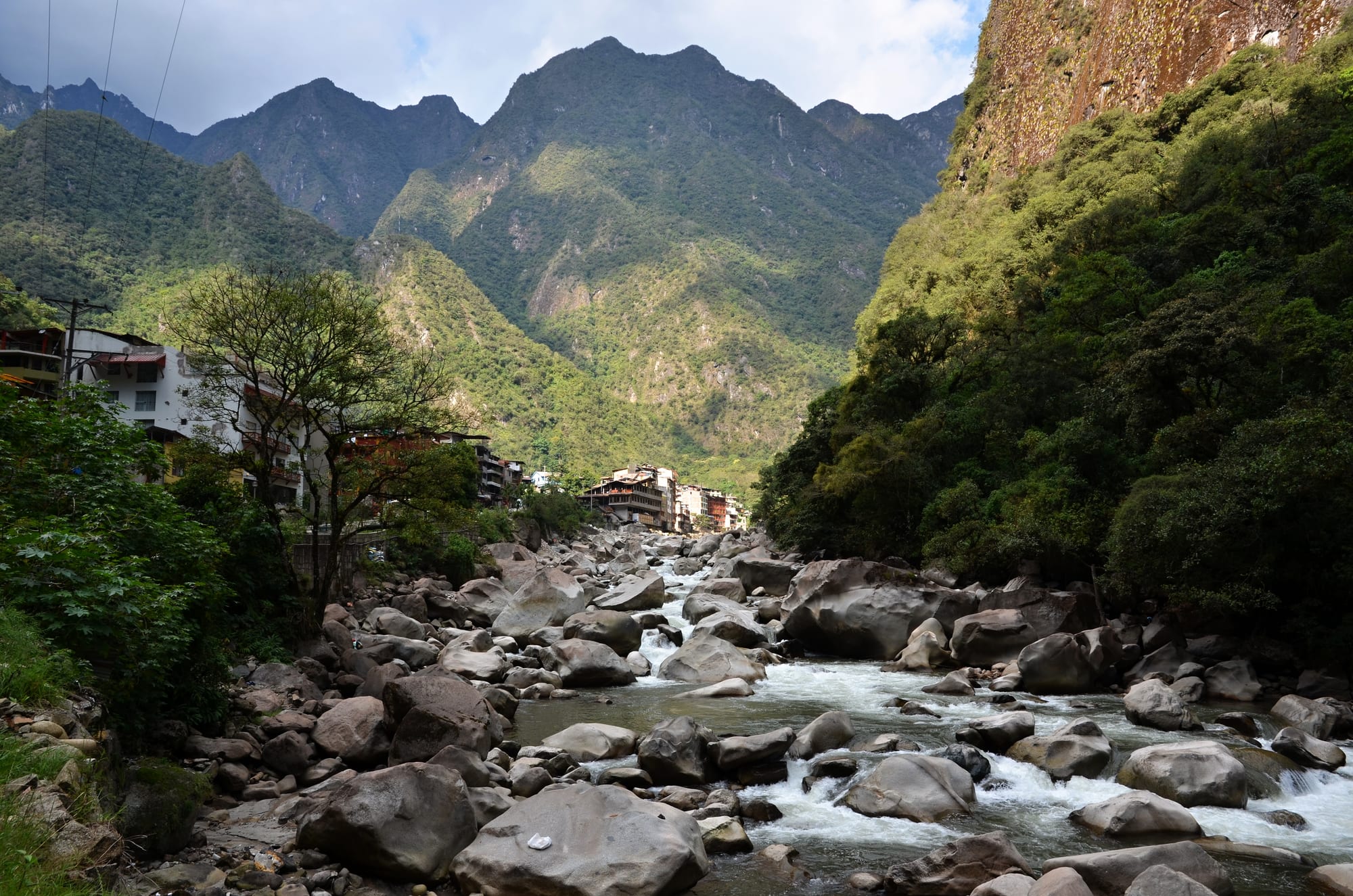
A boulder-strewn river rushing through a deep green gorge, with hotels and houses along the bank below steep forested peaks

Cusco, Machu Picchu & the Sacred Valley, Peru

Aguas Calientes

Aguas Calientes on the Urubamba river, in the gorge below Machu Picchu. (Pavel Špindler / Wikimedia Commons · CC BY 3.0)

The small town below Machu Picchu, officially Machupicchu Pueblo, squeezed into the cloud-forest gorge of the Urubamba. Born as a railway workers' camp and reached only by train or on foot, it now lives almost entirely from the visitors who stay here before going up to the ruins, with hot springs, markets and the buses to the citadel.

Neighbourhoods

  • The station and the main square
    • First-time visitors
    • Close to public transport
    • Markets

    The lower town where the trains arrive, entered through a warren of market stalls and the big handicraft market in front of the station. Across the creek is the main square with the Ministry of Culture office that sells Machu Picchu tickets.

    Open in Maps
  • Avenida Pachacútec
    • Hot springs
    • Restaurants

    The town's main street, climbing from the square beside the creek up to the thermal baths, lined with restaurants, massage parlours, guesthouses and shops. Almost all of the town is pedestrian-only, so it is quiet apart from the crowds.

    Open in Maps

Things to do

Machu Picchu

  • Machu Picchuattraction

    The 15th-century Inca citadel on the mountain saddle above the town, a UNESCO World Heritage Site since 1983, reached by an 8.6-kilometre bus ride or a steep walk of about an hour and a half.

    Open in Maps
  • Huayna Picchutrail

    The steep peak behind the citadel, climbed on an Inca trail to temples and terraces at the top, with the Temple of the Moon on its flank; it needs its own ticket.

    Open in Maps
  • Inti Punkuattraction

    The Sun Gate, once the main entrance to Machu Picchu from the direction of Cusco, where the Inca Trail first looks down on the citadel.

    Open in Maps

Walks around the town

  • Putucusitrail

    The round mountain across the Urubamba from Machu Picchu, a holy mountain to local Quechua people, climbed on a steep path with vertical wooden ladders for views of the citadel.

    Open in Maps
  • Mandor gardenspark

    Private gardens downstream along the railway towards Hidroeléctrica, with orchids, rainforest trails and a waterfall.

    Open in Maps
  • Machu Picchu museum and botanical gardenmuseum

    A site museum and botanical garden across the river at the foot of the road up to the ruins.

    Open in Maps
  • Historic Sanctuary of Machu Picchupark

    The protected area of more than 35,000 hectares around the town and the ruins, spanning cloud forest and snow peaks, where torrent ducks, white-capped dippers and the Andean cock-of-the-rock can be seen.

    Open in Maps

In the town

  • The thermal bathsattraction

    The hot springs that gave the town its name, about 800 metres up from the centre and credited locally with medicinal properties — a set of pools much like a public swimming pool, often crowded.

    Open in Maps
  • Handicraft marketmarket

    The large craft market in front of the railway station, selling textiles, souvenirs and goods to travellers arriving and leaving.

    Open in Maps

Short trips from the town

  • Wiñay Waynaattraction

    An Inca site of houses, fountains and terraces on a steep hillside above the Urubamba, beside the last campsite of the classic Inca Trail.

    Open in Maps
  • Llaqtapataattraction

    An Inca site high on a ridge about 5 kilometres west of Machu Picchu, between the Ahobamba and Santa Teresa valleys.

    Open in Maps

Eat and drink

Long-standing places and food districts in Aguas Calientes. Hours, ratings and directions come from your maps app, always current.

Food districts and markets

  • Avenida Pachacútec restaurantsneighborhood

    Most of the town's many restaurants for travellers line the main street and the lanes off the square; supplies come in by train, so prices run higher than in Cusco.

    Open in Maps
  • The market on the Machu Picchu roadmarket

    The big market along the road towards Machu Picchu sells snacks, fruit and basics, where prices are not much above Cusco's.

    Open in Maps

Experience Aguas Calientes

History

There was no town here before the railway. The gorge of the Urubamba below Machu Picchu held only a few farm families, who settled in 1901, until the railway from Cusco towards the forest was pushed through in the late 1920s. The construction camp, known as Maquinachayoq, "the place with a little train", housed the workers and their equipment until the line was completed in 1931. The settlement took its colloquial name, Aguas Calientes, from the hot springs above it.

Machu Picchu had become world famous after Hiram Bingham's 1911 expedition, and once the trains ran, foreign visitors began arriving. Local people opened restaurants and small hotels for them, while those who could afford luxury stayed at the hotel up by the ruins. A hydroelectric plant was built nearby on the Urubamba between 1958 and 1965 and expanded in the 1980s; a landslide in February 1998 shut it down until 2001. In 1983 UNESCO listed Machu Picchu as a World Heritage Site, and visitor numbers kept rising.

The town, now officially Machupicchu Pueblo, grew into a dense strip of hotels along the river and its creek. Machu Picchu closed for eight months in 2020 during the pandemic, reopening in November that year to a few hundred visitors a day, and the protests of 2022–2023 again closed the railway and the site. In 2024 the daily limit for the citadel was raised to 4,500 visitors, with up to 5,600 allowed in the peak season.

Culture & Customs

Aguas Calientes is a town built for travellers, and its culture is the culture of the trail and the train. Most people in town work in tourism, and Spanish and Quechua are both spoken. Walkers arriving from the Inca Trail and the Salkantay route pass through.

The surrounding mountains are sacred. Machu Picchu, the "old peak", Huayna Picchu, the "young peak", and Putucusi across the river are honoured as apus, holy mountains, by the local Quechua people. The citadel is believed to have served as an estate for the Inca emperor Pachacuti.

The town has its own twin towns, among them Petra in Jordan, Haworth in England, Fukushima in Japan and, since 2020, Ollantaytambo in the Sacred Valley. Its official name, Machupicchu Pueblo, was set by law in 1941, but Aguas Calientes, "hot waters", remains the name preferred internationally. Many visitors get up before dawn to be at the ruins early.

Daily Life

Machupicchu Pueblo had about 4,500 people at the 2017 census, but on most days the number of visitors passing through is far larger. The town is the seat of the Machupicchu District, and almost its entire economy comes from tourism: about 95 per cent of the municipal budget is raised from transport companies, the hot springs and the entrance to the citadel, with only about 5 per cent from central government. Every household has piped water, sewerage and electricity, and rubbish is collected daily.

Life follows the trains. The first trains bring day visitors in the morning, the buses up to Machu Picchu run in a constant shuttle, and the tourist trains return in the afternoon; supplies, too, arrive by rail. Because there is no road, everything is carried on foot within the town.

The nearby Machupicchu hydroelectric plant on the Urubamba, rebuilt after the 1998 landslide, generates about 90 megawatts for the Cusco, Puno and Apurímac regions. International bodies have warned of congestion, problems with waste management and unplanned urban growth in the town.

Food

Aguas Calientes has many restaurants, nearly all aimed at travellers, along Avenida Pachacútec and around the square. Because supplies have to come in by train, prices run higher than in Cusco or the Sacred Valley, and travellers on a budget often bring snacks and water with them.

The town sits within the food culture of the Cusco region, whose cooking is Andean: soups are central, chuño, freeze-dried potato, keeps through the year, and guinea pig roasted whole, cuy al horno, is the celebration dish. Coca tea is offered across the region for the altitude, though at about 2,000 metres the town is far lower than Cusco. Lechón, roast suckling pig, and adobo, pork marinated in chicha and spices, are other Cusco favourites.

For cheaper eating, the big market along the road towards Machu Picchu sells snacks, fruit and basics at prices close to Cusco's. Snacks at the ruins themselves are expensive, so many visitors carry water and a packed lunch up the mountain.

Planning tools

Budget

Aguas Calientes is expensive for Peru. Rooms, meals and bottled water cost more than in Cusco because everything arrives by train, and the trip itself — train, bus up to the ruins and the Machu Picchu ticket — is the main cost. Walking up to the ruins instead of taking the bus saves money.

Daily Budget Midrange
USD 120–220 (mid-range hotel, restaurants, the bus and the hot springs; trains and Machu Picchu extra)
Daily Budget Shoestring
USD 45–75 (hostel, market food and snacks from Cusco; trains and Machu Picchu extra)

Buy Machu Picchu tickets and trains before anything else, and check the current rules on circuits, time slots and the separately ticketed climbs when booking.

Best Time to Visit

The dry season, from about May to September, has the clearest views of the ruins and the most visitors; April and October are quieter. The wet season, from about November to March, brings heavy rain, morning cloud and occasional landslides. The Inca Trail closes each February.

Suggested Number of Days

Most visitors spend one or two nights, which allows an early start and time for the climbs that need separate tickets. A second or third night leaves room for the walks around the town or a spare day if trains are disrupted.

First Visit
1–2 days
With Surroundings
2–3 days

Transportation

There are no roads into the town and almost no vehicles in it: everything is on foot except the buses that climb 8.6 kilometres to the entrance of Machu Picchu. The alternative is the steep footpath, about an hour and a half. Walking on the railway tracks is prohibited and dangerous.

Carry printed train tickets and a passport, which is asked for when buying Machu Picchu tickets in town.

Airport & Station Connections

PeruRail and Inca Rail run trains from Cusco and from Ollantaytambo. From Poroy station, about 20 minutes by taxi from central Cusco, the journey takes about 3 hours 45 minutes; from Ollantaytambo about 1 hour 45 minutes. In the rainy season PeruRail has run trains only from Ollantaytambo, with buses from Cusco. The cheaper route is by road to Hidroeléctrica and then a walk of 2½–3 hours along the river, and the Inca Trail arrives on foot.

Walkability

The town is compact and almost entirely pedestrian, and everything is within a short walk — from the station across the creek to the square and up Avenida Pachacútec to the hot springs. Streets and stairs are steep and slippery in the rain.

Safety

The standard tourist circuit — Lima's Miraflores and Barranco, Cusco, the Sacred Valley, Arequipa, Puno — is generally safe with urban precautions, but crime has risen. The town itself is small and calm. The main risks are natural and political: landslides in the rains, and the protests and blockades that since late 2022 have closed rail lines and Machu Picchu itself, sometimes stranding visitors for days.

Follow the news for strikes and blockades, keep a spare day around the visit, and stay off the railway tracks. Check current official travel advice before travelling.

Climate

A mild, humid subtropical mountain climate, with an average temperature of about 16°C, rains from November to March, and mornings that often begin in cloud.

Summer
December–February is the wet season, warm and humid, with heavy rain; the yearly average temperature is about 16°C
Winter
June–August is drier, with clearer skies; across the year days reach about 20–22°C and nights fall to about 8–11°C

Local Customs

Spanish and Quechua are spoken, and nearly everyone in town works in tourism. A polite greeting goes a long way. Tipping guides, porters and restaurant staff is customary. Inside Machu Picchu, visitors keep to the marked routes, and the surrounding peaks are treated as holy mountains by local Quechua people.

Respect the rules at Machu Picchu on routes and behaviour, and dress modestly away from the hot springs.

Common Payment Methods

The currency is the sol (PEN). Hotels and many restaurants take cards, though card acceptance can be patchy and some places take only certain cards; markets, massage parlours and small shops want cash. Carrying enough soles from Cusco is sensible.