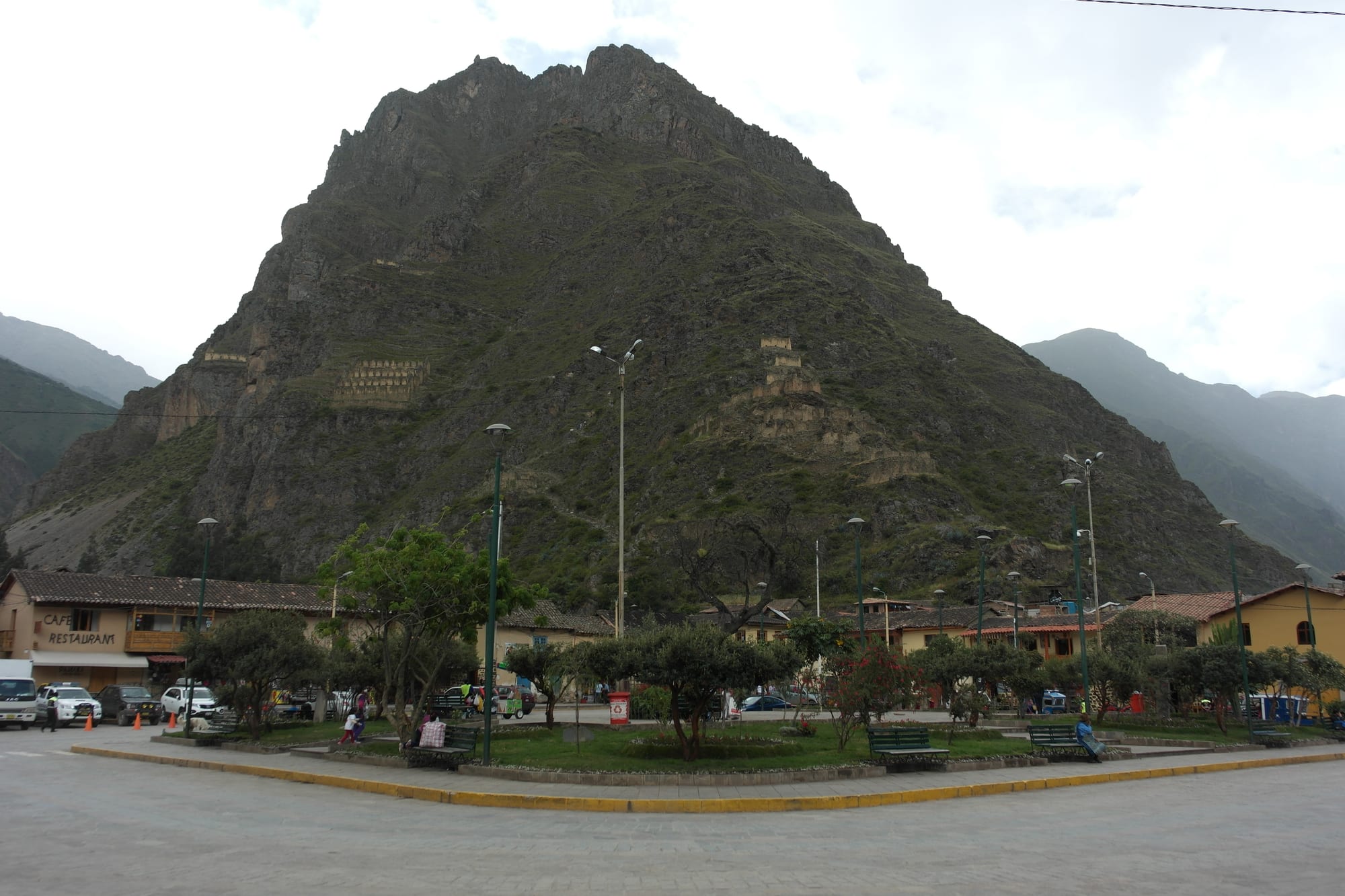
A town square with trees and benches below a steep mountain dotted with the stone ruins of Inca storehouses

Cusco, Machu Picchu & the Sacred Valley, Peru

Ollantaytambo

The Plaza de Armas of Ollantaytambo, with the Inca storehouses of Pinkuylluna on the mountainside above. (CarlosE Duarte / Wikimedia Commons · CC BY 3.0)

A small town at the lower end of the Sacred Valley, about 72 km by road north-west of Cusco, laid out by the Inca emperor Pachacuti as a royal estate in the 15th century. People still live in houses built on Inca walls along the original street grid, below the terraced Temple Hill, and the town is a main departure point for trains to Machu Picchu.

Neighbourhoods

  • The Inca town and the Plaza de Armas
    • First-time visitors
    • Historic district

    The main settlement on the left bank of the Patakancha keeps its Inca grid of four long streets crossed by seven, and many houses stand on Inca stone walls. Restaurants, guesthouses and tour agencies cluster around the main square.

    Open in Maps
  • Araqhama and the foot of Temple Hill
    • Historic district
    • Close to the ruins

    The older compound across the Patakancha, around the square called Manyaraki with its church, lived in continuously since Inca times. The entrance to the Temple Hill ruins and the craft stalls below them are a couple of minutes' walk from the main plaza.

    Open in Maps
  • The station road
    • Close to public transport
    • Cafés

    The road running down from the plaza to the railway station, about 400 metres long, lined with restaurants, cafés and lodgings used by travellers on the Machu Picchu trains.

    Open in Maps

Things to do

Inca sites in the town

  • Temple Hilllandmark

    The ceremonial centre on Cerro Bandolista, often called the Fortress, where stairways climb the Pumatallis terraces to the unfinished Sun Temple and its Wall of the Six Monoliths in rose rhyolite.

    Open in Maps
  • Pinkuyllunaviewpoint

    The mountain facing Temple Hill across the town, with Inca storehouses built high on its slopes, where wind and cold kept their contents from decaying; a steep path climbs to them.

    Open in Maps
  • The Inca street gridneighborhood

    Walled kancha compounds, narrow stone streets and water channels in the town centre.

    Open in Maps
  • Ollantaytambo stationtransit hub

    The railway station below the town, where tourist trains run along the Urubamba to Aguas Calientes, the town below Machu Picchu.

    Open in Maps

Weaving and the Patacancha valley

  • Patacancha valley weaving communitiesattraction

    Quechua communities in the side valley above the town, where women weave with natural fibres and dyes; visits and workshops are arranged through a non-profit weaving project with a shop in the town.

    Open in Maps

Short trips from the town

  • Salt Mines of Marasattraction

    Thousands of small salt evaporation ponds stepped down a mountain slope, worked since before Inca times and still owned and harvested by local families.

    Open in Maps
  • Moraylandmark

    Inca terraces built in deep circular hollows on the plateau near Maras, where the temperature differs by as much as 15°C from top to bottom; their purpose is uncertain.

    Open in Maps
  • Machu Picchulandmark

    The 15th-century Inca estate on a mountain saddle above the Urubamba, reached from Ollantaytambo by train to Aguas Calientes and then by bus or on foot.

    Open in Maps

Eat and drink

Long-standing places and food districts in Ollantaytambo. Hours, ratings and directions come from your maps app, always current.

Ollantaytambo classics

  • Restaurants around the Plaza de Armasneighborhood

    Restaurants on and around the main square serve Andean and international dishes, with trout and alpaca common on menus and views towards the ruins.

    Open in Maps
  • Station road cafésneighborhood

    Cafés and restaurants line the road down to the station, catering to travellers before and after the Machu Picchu trains.

    Open in Maps
  • Chicha housesneighborhood

    Homes where local people drink chicha, maize beer; it is sometimes made in unhygienic conditions, so it is worth trying with caution.

    Open in Maps

Experience Ollantaytambo

History

Ollantaytambo stands where the Patakancha stream meets the Urubamba, at the lower end of the Sacred Valley. Around the middle of the 15th century the Inca emperor Pachacuti conquered and razed an earlier town here and rebuilt it as his royal estate, with fine buildings for the Inca nobility and extensive terracing and irrigation along the valley, farmed by the emperor's retainers, the yanakuna. After his death the estate passed to his panaqa, his family clan. Storehouses were built on the surrounding hills, and roads linked the town with Machu Picchu to the west and Pisac to the east.

During the Spanish conquest it became a temporary capital for Manco Inca, leader of the Inca resistance. In January 1537, at the Battle of Ollantaytambo, his forces held off a Spanish expedition led by Hernando Pizarro from a set of high terraces and flooded the plain below by channelling water. Manco Inca still judged the position impossible to hold and the following year withdrew to Vilcabamba, where the Neo-Inca State held out. The work on Temple Hill was never finished, and the stone blocks still lying around the site show that construction and remodelling were under way when it was abandoned.

In 1540 the native population was assigned in encomienda to Hernando Pizarro. Much of the town kept its Inca layout, and families continued to live in the Inca blocks. Hiram Bingham passed through in 1911 on his journey along the Urubamba in search of Machu Picchu. Today the town is an important tourist centre and lies on the route to a starting point of the four-day Inca Trail.

Culture & Customs

Ollantaytambo's identity rests on continuity. The main settlement keeps the grid the Inca laid out — four long streets crossed by seven — and its southern blocks are still divided into kanchas, walled compounds of one-room buildings around a courtyard. Araqhama, across the stream, has been lived in since Inca times, and its church stands on the edge of its old plaza. Modern houses are built on top of pre-Hispanic walls, and only the ruins on the hills around the town are uninhabited.

Quechua is spoken across the district, and the town shares the Andean customs of the wider region: offerings to Pachamama and the apus, the mountain spirits, and communal work in the villages. Weaving is the most visible craft. In the Patacancha valley above the town, Quechua women weave cloth with natural fibres and dyes, and a non-profit fair-trade project in Ollantaytambo sells their work and runs visits and workshops in the communities.

Chicha, maize beer, is brewed and drunk in local houses, a long-standing social custom in the Andean valleys. Visitors are welcome at the ruins and in the market, but the town is also a working community, and residents appreciate being asked before they are photographed.

Daily Life

Ollantaytambo is a small town at about 2,800 metres, lived in by Quechua-speaking families whose houses are built into the Inca town. Tourism is the main business: the ruins, the station for the Machu Picchu trains and the route towards the Inca Trail bring a steady flow of visitors, and many residents work as guides, cooks, drivers, hotel staff or weavers. The streets between the station and the plaza are lined with restaurants, guesthouses and tour agencies, and moto-taxis wait for each train.

The day follows the trains and the tour buses. Early departures for Aguas Calientes fill the station road before dawn, coaches from Cusco arrive at the ruins during the day, and the town quietens in the evening once the day visitors leave. Away from the centre, life in the side valleys is farming, herding and weaving.

The pressures are those of the whole Sacred Valley: traffic and coaches in narrow Inca streets, crowding at the ruins in the dry season, and dependence on a single industry. Protests and road blockades in the southern Andes since late 2022 have at times stopped the trains and cut incomes sharply.

Food

Ollantaytambo eats as the Cusco highlands do. Cuy al horno, guinea pig roasted whole, is the dish for celebrations; soups built on potatoes, maize and chuño, freeze-dried potato, are everyday food; and trout from Andean rivers and lakes is common on restaurant menus, often beside alpaca steak. Restaurants around the plaza and along the station road serve these Andean dishes alongside pizza and international cooking aimed at travellers.

Chicha de jora, the maize beer of the Andes, is sold in local houses, and frutillada is its sweet strawberry version. Coca tea is offered everywhere as a remedy for the altitude, and cafés by the station serve espresso and baked goods to passengers on early trains. Menú lunches, set meals of soup and a main course, are the cheap everyday option in the town. The terraces around Ollantaytambo were built so that crops from lower altitudes could be grown here, and maize, potatoes and quinoa from the valley remain the base of local cooking, above all in soups and stews.

Planning tools

Budget

Ollantaytambo is cheaper than Cusco for rooms and meals, but most visitors pass through on the way to Machu Picchu, and the train, the bus up to the site and the entry ticket are the biggest costs of a stay. Guided visits to Moray, Maras and the weaving communities add to the bill.

Daily Budget Midrange
USD 100–200 (mid-range hotel, restaurants, guided tours; Machu Picchu train and ticket extra)
Daily Budget Shoestring
USD 35–60 (hostel or guesthouse, menú lunches, colectivos; Machu Picchu costs extra)

Book the Machu Picchu train and entry ticket before anything else, and check the current rules on circuits and time slots when booking.

Best Time to Visit

May to September, the dry season, brings sunny days, cold nights and the busiest trains. April and October are quieter and still mostly dry. The wet season from about November to March brings afternoon rain and green hills, and the Inca Trail closes each February.

Suggested Number of Days

The town and its ruins need a day or two. Allow three or four to include the surrounding valley as well, and add a spare day in case the trains or roads are disrupted.

First Visit
1–2 days
With Surroundings
3–4 days

Transportation

The town is small enough to cross on foot. Moto-taxis and taxis wait at the station, and colectivos and taxis run along the valley towards Urubamba and Cusco. Moray and Maras are reached by taxi or on a tour, and cycling and horse-riding tours leave from the streets around the plaza.

Spend a night or two in the lower Sacred Valley before Cusco to acclimatise.

Airport & Station Connections

The nearest airport is Alejandro Velasco Astete International in Cusco, about 72 km away by road, with flights from Lima. Buses, colectivos and taxis run from Cusco through the Sacred Valley. Tourist trains connect Ollantaytambo with Aguas Calientes for Machu Picchu, and some also run to and from the Cusco area.

Walkability

The centre is compact: the main plaza is about 400 metres from the station and a couple of minutes from the entrance to Temple Hill. The streets are narrow, stone-paved and uneven, with water channels running beside them, and the climb up the terraces is steep at an altitude of about 2,800 metres.

Safety

The standard tourist circuit — Lima's Miraflores and Barranco, Cusco, the Sacred Valley, Arequipa, Puno — is generally safe with urban precautions, but crime has risen. Protests and road blockades in the southern Andes have at times closed the railway to Machu Picchu and the roads through the valley.

The standard tourist circuit — Lima's Miraflores and Barranco, Cusco, the Sacred Valley, Arequipa, Puno — is generally safe with urban precautions, but crime has risen. Use licensed operators for treks, follow the news for strikes and blockades, and take care on the steep terrace stairways. Check current official travel advice before travelling.

Climate

A highland valley climate at about 2,800 metres, milder than Cusco's, with a dry season of sunny days and cold nights from about May to September and a wet season of afternoon rain from about November to March.

Summer
the wet season, from about November to March, with afternoon rain; daytime highs are about 18–23°C all year
Winter
the dry season, from about May to September, with sunny days and cold nights; lows range from about 5°C to 11°C over the year

Local Customs

Quechua is widely spoken alongside Spanish, and many families live in houses built into Inca walls: ask before photographing people or homes, and greet people with a 'buenos días' before asking a question.

Stay on marked paths at the ruins and do not climb on Inca walls; dress in layers for cold mornings and strong sun.

Common Payment Methods

The currency is the sol (PEN). Hotels and many restaurants take cards, but cash in soles is needed for market stalls, moto-taxis, colectivos and small shops, so it is sensible to carry enough. US dollars are easily exchanged in Cusco.