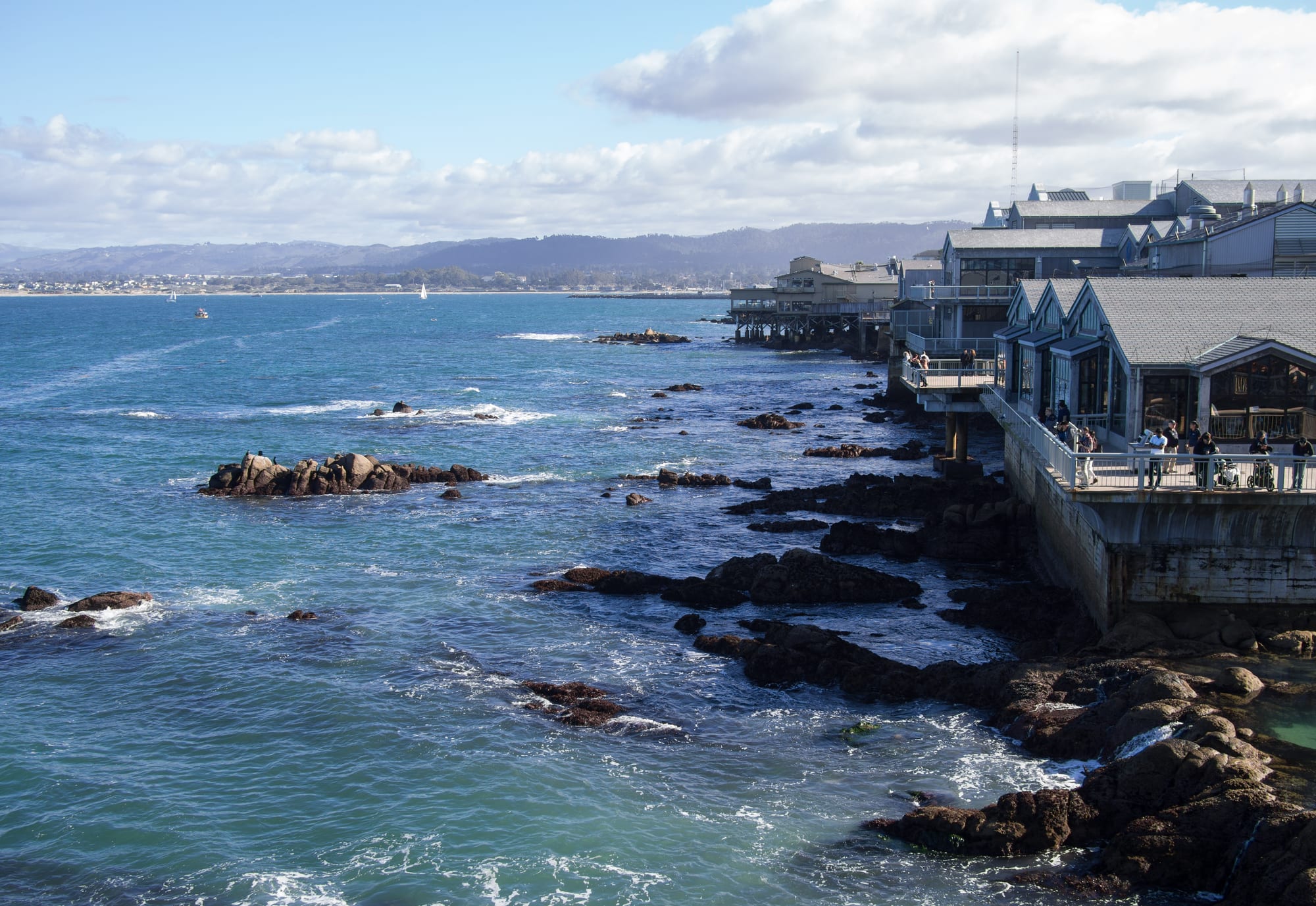
Grey-roofed buildings of Cannery Row on piers above dark rocks and blue water, with the curve of Monterey Bay behind

California, United States

Monterey

The back of Cannery Row seen from the Monterey Bay Aquarium, looking across Monterey Bay. (Rhododendrites / Wikimedia Commons · CC BY-SA 4.0)

A small city on the southern edge of Monterey Bay, on California's Central Coast. It was the capital of Spanish and Mexican California and the site of the state's first constitutional convention, then a sardine-canning town made famous by John Steinbeck. Today the old canneries hold the Monterey Bay Aquarium and Cannery Row's shops, at the northern end of the Big Sur coast.

Neighbourhoods

  • Downtown and Old Monterey
    • First-time visitors
    • Historic district
    • Best for food

    The old capital's core around Alvarado Street, the town's main street of restaurants, bars and shops. The adobes of the state historic park, Colton Hall and the Custom House stand a few blocks apart, linked by the yellow plaques of the Path of History, and the Old Fisherman's Wharf is at the bottom of the street.

    Open in Maps
  • Cannery Row and New Monterey
    • Families
    • Waterfront
    • Sightseeing

    The former sardine-canning street on the bay north-west of downtown, where old cannery buildings now hold the aquarium, shops, restaurants and hotels. Behind it, New Monterey climbs the hill as a mainly residential district.

    Open in Maps
  • Fisherman's Wharf and the harbour
    • Seafood
    • Boat trips
    • Wildlife

    The old wooden wharf by the marina, lined with seafood restaurants, souvenir shops and the booths of whale-watching and sailing boats. Harbour seals and sea lions often rest on the rocks and jetties nearby.

    Open in Maps
  • Pacific Grove
    • Quiet and residential
    • Coastal walks
    • Butterflies

    A separate small city just west of Cannery Row, founded as a Methodist retreat in the 1870s, with Victorian houses, a rocky shoreline and a grove where monarch butterflies spend the winter.

    Open in Maps

Things to do

Historic Monterey

  • Monterey State Historic Parklandmark

    A group of restored adobes and historic buildings in the old town, including the Custom House, where the American flag was first raised over California, and California's first theatre.

    Open in Maps
  • Colton Hallmuseum

    The stone building of 1847–49 where delegates drafted California's first constitution in 1849, now a small museum beside the city offices.

    Open in Maps
  • Cathedral of San Carlos Borromeolandmark

    Also known as the Royal Presidio Chapel, built in 1791–94 — the oldest stone building in California and one of the oldest and smallest cathedrals in the United States.

    Open in Maps
  • Cannery Rowlandmark

    The waterfront street of sardine canneries immortalised by John Steinbeck; the last cannery closed in 1973 and the old buildings now house shops, restaurants and the aquarium.

    Open in Maps

The aquarium and museums

  • Monterey Bay Aquariumattraction

    Built on the site of a cannery and opened in 1984, the first aquarium to show a living kelp forest, known for its jellyfish, its sea otters and its displays of the bay's marine life.

    Open in Maps
  • Monterey Museum of Artmuseum

    A museum of California art from the 19th century to the present, in eight galleries on Pacific Street in historic downtown.

    Open in Maps

The waterfront and parks

  • Old Fisherman's Wharfattraction

    A wholesale fish market into the 1960s and now a visitor wharf of restaurants and shops, the departure point for whale-watching trips.

    Open in Maps
  • Monterey Bay Coastal Recreation Trailtrail

    A walking and cycling path along the bay for 18 miles between Castroville and Pacific Grove, passing Fisherman's Wharf, Cannery Row and the aquarium.

    Open in Maps
  • Lake El Esteropark

    A U-shaped lake at the heart of a city park near Del Monte Beach, with sports fields, a skatepark and a well-known children's playground.

    Open in Maps

Motor sport

  • Laguna Secaattraction

    A road-racing circuit built in 1957 in the hills between Monterey and Salinas, famous for the downhill 'Corkscrew' turn, used for car and motorcycle racing.

    Open in Maps

Short trips from the city

  • Monarch Grove Sanctuarypark

    An urban nature preserve in Pacific Grove where migrating monarch butterflies overwinter, arriving from October.

    Open in Maps
  • 17-Mile Driveviewpoint

    A scenic toll road through Pebble Beach and Pacific Grove that follows the coast past golf courses, the Lone Cypress, Bird Rock and the Del Monte Forest.

    Open in Maps
  • Carmel-by-the-Seaattraction

    A small town on the Monterey Peninsula, just south of Monterey, an art colony and seaside resort since the early 20th century, known for its scenery and its beach.

    Open in Maps
  • Carmel Missionlandmark

    The mission moved here from Monterey by Junípero Serra in 1771, headquarters of the Alta California missions until 1833, carefully restored from the 1930s.

    Open in Maps
  • Point Lobos State Natural Reservepark

    A state reserve just south of Carmel at the northern end of the Big Sur coast, with ocean-side trails, coves and some of the coast's best diving.

    Open in Maps
  • Bixby Bridgelandmark

    The concrete arch bridge of 1932 on Highway 1, 13 miles south of Carmel, one of the most photographed bridges in California.

    Open in Maps
  • Big Surattraction

    The mountainous, thinly settled coast south of Carmel, where the Santa Lucia Mountains rise straight from the Pacific, followed by Highway 1 for about 71 miles.

    Open in Maps
  • Elkhorn Sloughpark

    California's second-largest estuary, at Moss Landing on the bay, a protected tidal marsh known for its birds, harbour seals and sea otters.

    Open in Maps

Seasonal events

  • Monterey Car WeekAugust

    A week of car auctions, rallies, races and shows around the peninsula, ending with the Pebble Beach Concours d'Elegance, one of the most prestigious car shows in the world.

  • Monterey Jazz FestivalThe third full weekend of September

    A jazz festival at the county fairgrounds since 1958, which claims to be the longest-running in the world, with several stages, talks and workshops.

Eat and drink

Long-standing places and food districts in Monterey. Hours, ratings and directions come from your maps app, always current.

Monterey classics

  • Old Fisherman's Wharfneighborhood

    A wharf of seafood restaurants and fish counters above the harbour, the place for the local catch, including sanddabs, a small flatfish usually served fried.

    Open in Maps
  • Castroville artichokesneighborhood

    The farm town up the coast that calls itself the artichoke centre of the world; artichokes turn up fried, grilled or in soup on menus all over Monterey.

    Open in Maps

Food districts

  • Alvarado Streetneighborhood

    Downtown's main street, with restaurants, bars and cafés in and around the old capital's historic buildings.

    Open in Maps
  • Cannery Rowneighborhood

    Seafood restaurants and bars in the converted canneries, many with tables looking straight over the bay.

    Open in Maps

Experience Monterey

History

The Rumsen, one of the Ohlone peoples, lived around the bay for thousands of years, with villages at Point Lobos, Moss Landing and Carmel, and shell middens show that mussels and abalone were central to their diet. Sebastián Vizcaíno named the bay in 1602; Gaspar de Portolá, arriving overland in 1769, failed to recognise it. He returned the next year, built the Presidio, and on 3 June 1770 Junípero Serra founded a mission inside its walls; the mission moved to Carmel in 1771, and its chapel later became the present cathedral. In 1777 Monterey became the capital of the Californias, and all shipments into California by sea later had to pass through the Custom House, begun in 1814.

Monterey stayed the capital under Mexico. In 1846, during the Mexican–American War, Commodore John Sloat raised the American flag over the Custom House and claimed California for the United States, and in 1849 delegates meeting in Colton Hall drafted the state's first constitution in English and Spanish. New England whalers had already left a whalebone pavement, which survives in front of the Old Whaling Station. The Gold Rush then drew much of the population north, and later in the century writers and artists, Robert Louis Stevenson among them, came to the peninsula.

The first sardine cannery opened in 1902. Sicilian and Japanese fishermen supplied the boats, Sicilian, Portuguese, Hispanic and Chinese workers, many of them women, packed the fish, and by the early 1940s more than 30 canneries and reduction plants lined the shore. John Steinbeck's novel Cannery Row appeared in 1945, just as overfishing brought the sardine collapse; the last cannery closed in 1973. The Monterey Bay Aquarium, opened on the site of the Hovden Cannery in 1984, turned the street into the town's main attraction.

Culture & Customs

Monterey's identity is bound up with the bay. The Monterey Bay Aquarium, its research and its Seafood Watch guide, the marine reserves offshore and the sea otters, seals and passing whales give the town a strong conservation culture. Steinbeck is the town's literary patron, along with his friend the marine biologist Ed Ricketts, whose laboratory still stands on Cannery Row; Stevenson and the poet Robinson Jeffers also lived and wrote in the area.

Music has a distinguished history. The Monterey Jazz Festival, first held in 1958, presented Louis Armstrong, Dizzy Gillespie and Billie Holiday and still fills the county fairgrounds every September, and the same fairgrounds hosted the Monterey Pop Festival in June 1967, one of the opening events of the Summer of Love. The car is the other passion: Monterey Car Week each August brings auctions, races at Laguna Seca and the Pebble Beach Concours d'Elegance, drawing an estimated 100,000 people in 2024.

The town's Spanish and Mexican past is kept visible through the adobes of the old capital, the Path of History and the Royal Presidio Chapel, and the hillside of Spaghetti Hill is named after its first Italian American residents. The Defense Language Institute and the Naval Postgraduate School bring military students to the town.

Daily Life

About 30,000 people lived in Monterey at the 2020 census, part of a wider peninsula of small towns that includes Pacific Grove, Carmel, Seaside and Marina, with the farm city of Salinas inland. Old Monterey holds the downtown business district and the hillside of Spaghetti Hill, named after its first Italian American residents; New Monterey, behind Cannery Row, is mainly residential; and the Naval Postgraduate School occupies the grounds of a former resort hotel on the east side.

Tourism is the biggest visible industry — the aquarium alone receives around two million visitors a year — but the federal institutions are important employers and strongly associated with the city: the Defense Language Institute at the Presidio of Monterey teaches foreign languages to members of the armed forces, and the Naval Postgraduate School trains officers. The Middlebury Institute of International Studies and California State University, Monterey Bay add students and staff. The Census Bureau estimated a median household income of about $104,000 in 2023, and housing costs are high.

Life follows the weather and the water: morning fog that often burns off by afternoon, runners and cyclists on the coastal trail, kayaks in the harbour, and summer weekends crowded with visitors from the Bay Area. Winter storms bring landslides that cut Highway 1 to the south, a recurring problem for the communities of Big Sur.

Food

Seafood comes first, as it did long before the canneries: the shell middens around the bay show that mussels and abalone were staples of the Rumsen Ohlone diet. Old Fisherman's Wharf, a wholesale fish market until the 1960s, is now lined with restaurants and fish counters, and fishermen still sell the day's catch near the harbour. The local specialities are sanddabs, a small Pacific flatfish usually served fried, and calamari, a reminder that the last cannery survived into the 1970s by canning squid. The aquarium's Seafood Watch programme, begun in 1999, has made many local restaurants think about where their fish comes from.

Artichokes are the other local signature. Castroville, a few miles up the coast, calls itself the artichoke centre of the world, and artichokes appear on menus all over town — fried, grilled, steamed, in soup or on pizza.

Downtown's Alvarado Street has a mix of restaurants and bars, while the converted canneries of Cannery Row hold seafood restaurants and bars with tables looking over the water.

Planning tools

Budget

Monterey is expensive, like most of the California coast. Hotel prices climb in summer, at weekends and above all during Car Week in August, when rooms across the peninsula are scarce. Aquarium tickets and boat trips are the main paid sights; the coastal path, the historic adobes from outside and the views along 17-Mile Drive's free stretches of shore in Pacific Grove cost little or nothing.

Daily Budget Midrange
USD 260–480 (mid-range hotel, seafood dinners with tax and tips, the aquarium or a whale-watching trip, a hire car for Big Sur)
Daily Budget Shoestring
USD 120–190 (motel or hostel bed, takeaway seafood and supermarkets, MST buses and the summer trolley)

Avoid Car Week unless it is the reason for the trip, and stay downtown, where parking and walking are easier than on Cannery Row.

Best Time to Visit

Monterey is mild all year, and summers are often cool and foggy, so September and October tend to be the warmest, clearest months. Summer is the busiest season, with the free trolley running to the aquarium. Gray whales pass in winter and early spring, monarch butterflies winter in Pacific Grove from October, and the winter rains can close Highway 1 in Big Sur.

Suggested Number of Days

Two days are enough for the town and the aquarium. Three or four allow time for the neighbouring towns and the coast to the south as well. Road closures to the south and the weather can change how much of the coast is reachable.

First Visit
2 days
With Surroundings
3–4 days

Transportation

Monterey-Salinas Transit (MST) runs buses around town and to Pacific Grove, Carmel, Salinas and Big Sur, and a free trolley links downtown and the aquarium daily in summer. The coastal recreation trail is the easy way to walk or cycle between the wharf, Cannery Row and Pacific Grove. A car is needed for most of Big Sur and the surrounding valleys; parking enforcement around Cannery Row is strict.

Check Caltrans for Highway 1 closures before driving south into Big Sur, as landslides close the road in places, especially after heavy winter storms.

Airport & Station Connections

Monterey Regional Airport, in the city, has flights to a number of western US hubs. Because fares there are high and schedules limited, many visitors fly into San Jose or San Francisco instead and continue by car or airport shuttle. Amtrak's Coast Starlight stops in Salinas, inland, with buses on to Monterey. Drivers arrive on Highway 1 along the bay, on Highway 68 from Salinas, or from the south through Big Sur.

Walkability

Downtown, the wharf and Cannery Row are close together and joined by the flat waterfront trail, so the main sights can be covered on foot. Pacific Grove is a pleasant walk or ride further along the shore. Carmel, Point Lobos and Big Sur need a car or bus.

Safety

For most visitors the US is safe, with the main risks being petty theft and car break-ins in tourist areas of some cities, road accidents over long distances, extreme weather, and the hazards of the outdoors. Monterey is a quiet town; the larger risks are on the coast and the road — cold water and strong surf on exposed beaches, and the narrow, winding Highway 1 through Big Sur, which landslides have closed more than 55 times.

Keep valuables out of sight in parked cars at viewpoints and trailheads, stay back from the edge on cliff paths, and do not approach sea otters or seals. Check current official travel advice before travelling.

Climate

A mild, cool coastal climate. Average highs range only from about 58°F in December to about 68°F in September, and days above 90°F or nights below freezing are rare. Summers are often cool and foggy, and most rain falls in winter.

Summer
cool and often foggy, with highs mostly in the 60s °F; September is usually the warmest month
Winter
mild and wetter, with average highs around 58–60°F and frost very rare

Local Customs

Tipping of roughly 18–22 per cent in restaurants is expected, and sales tax is added at the till. Dress is casual, with layers for the fog. The Defense Language Institute and the Naval Postgraduate School give the town a strong military presence. Wildlife is protected: sea otters, seals and sea lions are watched from a distance.

The legal drinking age is 21, and identification is asked for when buying alcohol.

Common Payment Methods

The currency is the US dollar. Cards and contactless payment are accepted almost everywhere, and ATMs are easy to find downtown and on Cannery Row. A little cash is useful for small fish counters and tips.