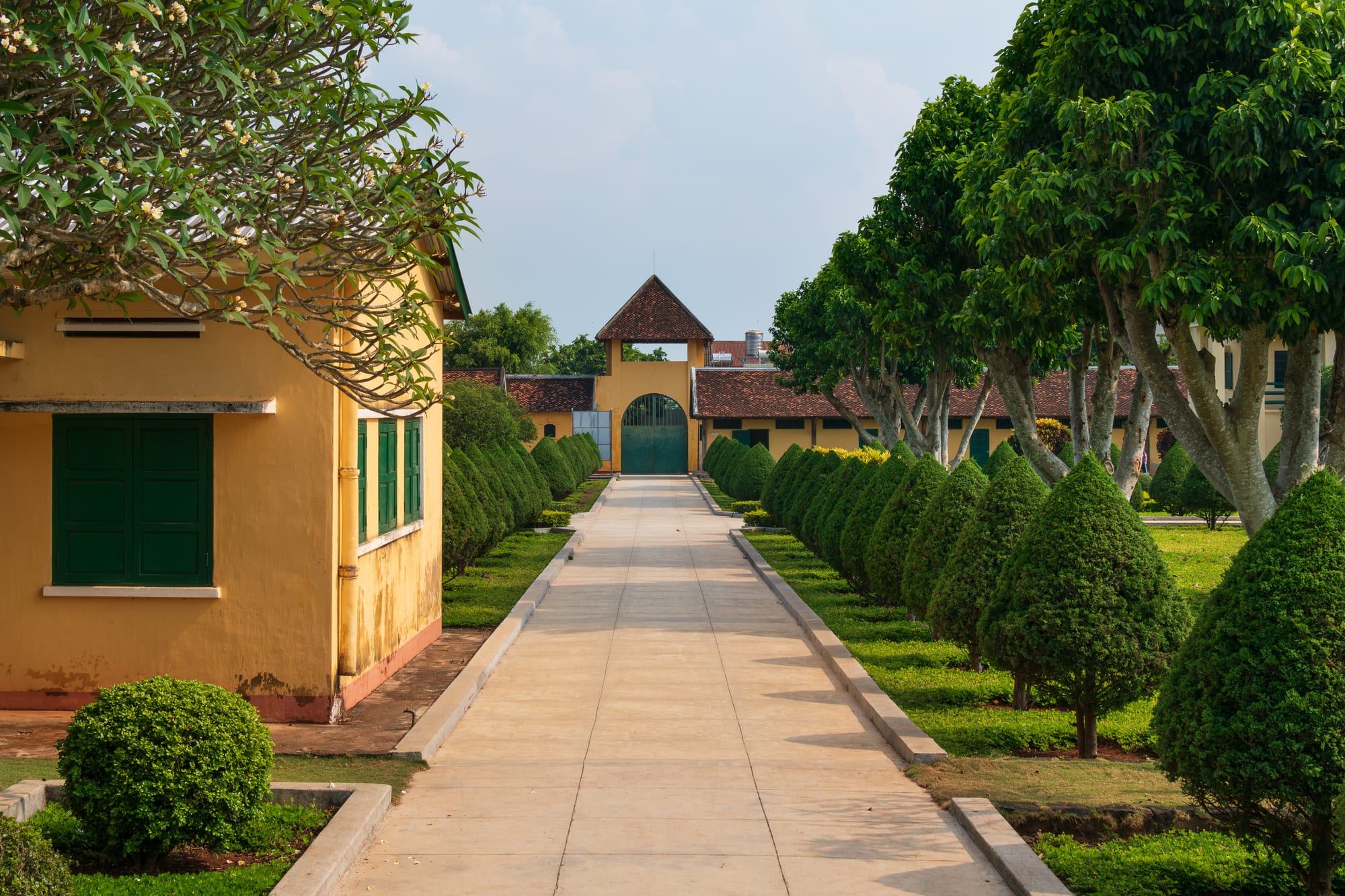
A paved path lined with clipped conical shrubs leading to a green gate in a yellow wall, with a low ochre building and flowering tree on the left

Da Nang, Hoi An & Central Vietnam, Vietnam

Buon Ma Thuot

The grounds of the Buôn Ma Thuột Exile House, a French colonial prison in the centre of the city. (Dominic Nelson / Wikimedia Commons · CC BY-SA 4.0)

The largest city of Vietnam's Central Highlands, set on a red basalt plateau at around 500 metres and built on coffee. Once a small French administrative post among Ê Đê villages, it fell in March 1975 in the battle that opened the final offensive of the war, and is now a spread-out provincial capital of coffee warehouses, wide boulevards and waterfalls in the surrounding forest.

Neighbourhoods

  • The central wards
    • First-time visitors
    • Close to public transport

    The grid of wide streets around the Victory Monument roundabout, where the main roads from the coast and from Ho Chi Minh City meet. Most hotels, banks, coffee shops and the central market are here, and the city's museums and the old prison are within walking distance of each other.

    Open in Maps
  • Ako Dhong
    • Quiet and residential
    • Ê Đê heritage
    • Cafés

    A village of Ê Đê longhouses absorbed by the growing city on its northern side, set among coffee gardens and streams. Wooden stilt houses stand beside modern villas, and several large garden coffee houses have opened along its lanes.

    Open in Maps
  • The coffee belt on the edges
    • Local life
    • Day trips

    Beyond the built-up wards the city dissolves into red-earth coffee and pepper farms, processing yards and roadside drying floors. Most visitors pass through on the way to the waterfalls, the national parks or Lak Lake.

    Open in Maps

Things to do

City sights

  • The World Coffee Museummuseum

    A museum of coffee history, culture and production, opened in 2018, with a collection of more than 11,000 objects gathered from coffee-growing countries.

    Open in Maps
  • Khải Đoan Pagodalandmark

    The city's main Buddhist temple, named Sắc tứ Khải Đoan by the emperor Bảo Đại in 1953 and the last pagoda in Vietnam to receive a royal decree of recognition; it has been the seat of the provincial Buddhist association since 1986.

    Open in Maps
  • Buôn Ma Thuột Prisonlandmark

    The French colonial prison in the centre of the city, built around 1930 to hold political prisoners exiled from central Vietnam, and one of the city's main historic sites.

    Open in Maps

Rivers and lakes

  • Srepok Riverattraction

    The river that drains the plateau west into the Mekong, running past the city and dropping over the waterfalls south-west of it.

    Open in Maps
  • Lak Lakeattraction

    The largest freshwater lake in the Central Highlands, about 55 kilometres south by road, ringed by M'Nông villages and rice fields, with a hilltop villa built for Bảo Đại.

    Open in Maps
  • Dray Nur waterfallattraction

    A broad fall on the Srepok river system about 30 kilometres south of the city, reached on foot across a bridge below the lip.

    Open in Maps
  • Dray Sap waterfallattraction

    The neighbouring fall a short walk from Dray Nur, part of the same chain of cascades on the plateau's southern edge.

    Open in Maps
  • Gia Long waterfallattraction

    A quieter fall in forest a few kilometres upstream of Dray Sap, named after the first Nguyễn emperor.

    Open in Maps

Short trips from the city

  • Yok Don National Parkpark

    One of Vietnam's largest protected areas, established in 1991, a dry dipterocarp forest that is an important refuge for elephants, tigers and gaur.

    Open in Maps
  • Buon Donattraction

    A district of villages on the Srepok River long associated with the capture and keeping of elephants, and with Lao and M'Nông as well as Ê Đê settlement.

    Open in Maps
  • Chu Yang Sin National Parkpark

    A mountain park around a peak of more than 2,400 metres, with pine and evergreen forest and long walking routes.

    Open in Maps
  • Yang Prong Towerlandmark

    A brick Cham tower standing in forest near the Cambodian border, far from the Cham heartland on the coast.

    Open in Maps

Seasonal events

  • Buon Ma Thuot Coffee Festivalin alternate years, usually in March

    The city's main event, first held in 2005 and repeated every other year, with coffee competitions, street processions, trade exhibitions and highland gong performances.

  • Victory of Buon Ma Thuot anniversaryMarch

    Marches, ceremonies and displays around the Victory Monument recalling the capture of the city in March 1975.

  • Tếtlate January or February

    The lunar new year, when the coffee farms go quiet, families return home and the streets fill with flower sellers.

Eat and drink

Long-standing places and food districts in Buon Ma Thuot. Hours, ratings and directions come from your maps app, always current.

Highland classics

  • Bún đỏ stalls in the centreneighborhood

    Evening stalls serving the city's own noodle dish — thick rice noodles stained red with annatto and crab paste, topped with pork crackling and quail eggs.

    Open in Maps
  • Phở khô and grilled meatsneighborhood

    Highland cooking runs to grilled chicken, bamboo-tube rice and smoky pork, with the two-bowl dry phở of the plateau served in many small restaurants.

    Open in Maps

Markets and coffee

  • Buon Ma Thuot central marketmarket

    The city's main covered market, stacked with green and roasted coffee, pepper, durian, avocados and highland herbs.

    Open in Maps
  • Garden coffee houses in Ako Dhongcafe

    Large open-air cafés set among trees and longhouses on the city's northern edge, where the local robusta is brewed dark in a metal phin filter.

    Open in Maps

Experience Buon Ma Thuot

History

The plateau around the city was Ê Đê country, farmed and hunted from longhouse villages, and the name Buôn Ma Thuột means the village of Ama Thuột — the father of Thuột, a local headman. The French reached the highlands late, establishing an administrative post here in the first years of the 20th century and making it the centre of Darlac province. They laid out a small colonial town, opened roads down to the coast, planted rubber and then coffee on the red basalt soil, and built a prison in the 1930s for political prisoners from central Vietnam, among them future leaders of the communist party.

Under the Republic of Vietnam the city was a garrison town and the base for programmes aimed at the highland peoples, whose movement for autonomy, known by its French acronym FULRO, pressed for land and political rights. On 10 March 1975 North Vietnamese forces attacked and took the city within two days. The loss led the southern command to abandon the highlands altogether, and the retreat turned into a rout that ended with the fall of Saigon seven weeks later; the battle is commemorated by the tank and monument at the main roundabout.

After the war the government resettled large numbers of lowland Vietnamese on the plateau and pushed coffee planting hard. Output grew enormously through the 1990s, and Buôn Ma Thuột became the centre of the trade, with warehouses, processing plants and a provincial capital's institutions. The expansion also brought lasting disputes over land and forest with the original highland communities, and unrest in the early 2000s. In June 2025 Phú Yên province on the coast was merged into Đắk Lắk, which kept its name.

Culture & Customs

The city is a meeting point rather than a single culture. Ê Đê people, whose society is matrilineal and whose longhouses are entered by a carved wooden stair, live in villages now inside and around the built-up area; M'Nông, Jarai and other highland groups live further out, and the majority of residents are Kinh Vietnamese whose families moved up from the coast and the delta. Vietnamese is the common language, and Protestant and Catholic churches are prominent alongside Buddhist pagodas.

Gong music is the strongest thread of highland identity. The Space of Gong Culture of the Central Highlands is recognised by UNESCO as intangible cultural heritage, and sets of tuned gongs are played at harvest ceremonies, house blessings and funerals, with rice wine drunk from tall jars through long bamboo straws. Weaving in dark indigo with red and white patterning, wood carving and epic chanting belong to the same tradition, and are performed at the museum, at village cultural houses and during festivals.

Coffee shapes everyday manners as much as any of this. Meetings, courtship and business all happen over small glasses of dark robusta, iced or with condensed milk, in gardens full of tables. The city's calendar turns on the crop: white blossom in the early months of the year, picking from around November, and drying floors spread across yards and roadsides afterwards.

Daily Life

About 434,000 people lived in the city in 2023. It is the largest in the Central Highlands and the seat of provincial government. Coffee dominates the economy — growing, buying, drying, roasting and shipping — alongside pepper, rubber, cashew, durian and avocado, timber and the trade and services a regional capital supports. Small factories process farm produce, and the university and teacher training college bring students from across the highlands.

The built-up wards are modern and low-rise, with shophouses along the main roads and newer suburbs of villas behind them; longhouse villages survive as quarters within the city. Days start very early, with markets busy before dawn and cafés full by seven, and slow through the hottest hours. The afternoon rain in the wet season empties the streets for an hour at a time.

Prices for coffee and pepper set the mood of the whole province, and swings in them are felt immediately in the shops. Water is a recurring worry, since irrigation for coffee draws heavily on wells and streams through the dry season, and deforestation on the plateau has reduced the flow of the rivers. Land rights and the position of the highland minorities remain sensitive subjects.

Food

Coffee comes first. Đắk Lắk grows mostly robusta, which is roasted dark, often with butter, and brewed in a small metal phin filter that drips into a glass of condensed milk. Cà phê sữa đá, iced with milk, is the standard; cà phê đen is black with sugar; and cà phê trứng, whipped with egg yolk, is drunk here too. Arabica from the higher slopes around Chư Yang Sin is sold as a speciality, and whole beans, green or roasted, fill a corner of every market.

The dish most associated with the city is bún đỏ, red noodles: thick rice noodles in a broth reddened with annatto and crab or shrimp paste, served with pork crackling, quail eggs and greens, and sold mainly in the evening. Highland cooking otherwise favours grilling and smoke — chicken flattened and grilled over charcoal, cơm lam, rice steamed inside a bamboo tube, and pork dried over a hearth — eaten with salt pounded with chilli and wild herbs. Bò nướng, grilled beef, is common, as is canh chua, sour soup, brought up from the lowlands.

Fruit is abundant and cheap: avocado, blended with condensed milk into a thick iced drink, durian, rambutan and jackfruit from the surrounding farms. Rượu cần, rice wine fermented in a jar and drunk communally through straws, is the ceremonial drink of the highland villages, and honey and wild pepper are sold beside the coffee in the market.

Planning tools

Budget

Buon Ma Thuot is one of the cheapest provincial capitals in Vietnam, with few foreign visitors and prices set by domestic business travellers. Rooms, food and coffee cost little; the main expense is transport, since the waterfalls, national parks and Lak Lake all need a car, a driver or a motorbike.

Daily Budget Midrange
USD 55–110 (mid-range hotel, restaurant meals, a car and driver for a day in the countryside)
Daily Budget Shoestring
USD 20–35 (guesthouse room, street food, local buses, a hired motorbike)

Hire a car with a driver for a full day rather than paying separately for each waterfall; entry fees at the falls and parks are small.

Best Time to Visit

November to April, the dry season on the plateau, when the roads and forest tracks are firm and the nights are cool. The coffee flowers white across the farms early in the year, and the coffee festival falls in alternate years. The wet season from about May to October makes the waterfalls far more powerful but the red-earth roads messy.

Suggested Number of Days

A day or two covers the city itself. Three or four allow the waterfalls, a national park and an overnight stay by the lake south of town. Anyone continuing across the highlands by road should allow longer, as distances between the plateau towns are considerable.

First Visit
1–2 days
With Surroundings
3–4 days

Transportation

The city is spread out and built around wide roads, and almost everyone moves by motorbike. Ride-hailing apps and motorbike taxis work in the centre, metered taxis are easy to find, and rental motorbikes and cars with drivers are the usual way to reach the countryside. Local buses run to the district towns from the intercity bus station.

Roads outside town carry heavy lorries loaded with coffee and timber, and red dust or sudden rain makes surfaces slippery; travel between the sights in daylight.

Airport & Station Connections

Buon Ma Thuot has its own airport a short drive south-east of the centre, with daily flights from Ho Chi Minh City and Hanoi. Long-distance and sleeper buses connect the city with Ho Chi Minh City, Da Lat, Nha Trang, Pleiku and Kon Tum over mountain roads; there is no railway. Nha Trang on the coast is a half-day drive east.

Walkability

The central wards around the Victory Monument can be walked, and the museums, prison and market lie close together. Beyond them the blocks are long, the pavements are often used for parking and the heat is strong in the middle of the day, so most residents ride even short distances.

Safety

The city is quiet and petty crime is uncommon. Traffic is the main hazard, along with slippery paths, strong currents and unfenced drops at the waterfalls, which can rise fast after rain in the wet season. Forest tracks in the national parks are best walked with a guide.

Keep well back from the lip of waterfalls and do not swim in the rivers below them. Only ride a motorbike if experienced and licensed, and always with a helmet; hold bags away from the road; drink bottled or filtered water; and check surf conditions before swimming. Check current official travel advice before travelling.

Climate

The plateau's altitude of roughly 500 metres makes the city cooler and less humid than the coast, with a wet season from about May to October and a dry, dusty season from November to April. Nights are cool for Vietnam all year.

Summer
warm and rainy — days around 27–30°C, with heavy afternoon downpours from about May onwards
Winter
dry and pleasant — days around 25–30°C and nights that can drop to 15°C or below

Local Customs

Tipping is not expected, though rounding up a fare or leaving small change is welcome. Coffee is the social currency: invitations to sit and drink are common, and a phin filter is meant to be waited for rather than hurried. The surrounding villages belong to Ê Đê, M'Nông and other highland peoples with their own languages, longhouses and gong music; longhouses are homes, so visitors ask before entering or photographing, and organised village visits are the straightforward way to go.

Dress modestly away from hotel grounds, ask before photographing people or their houses, and accept rice wine offered from a communal jar only if comfortable drinking it.

Common Payment Methods

The currency is the Vietnamese đồng. Cash is used for almost everything outside hotels and supermarkets, market stalls and rural cafés take nothing else, and ATMs are common in the centre but scarce once out of town. QR-code payment by phone is widespread among younger traders.