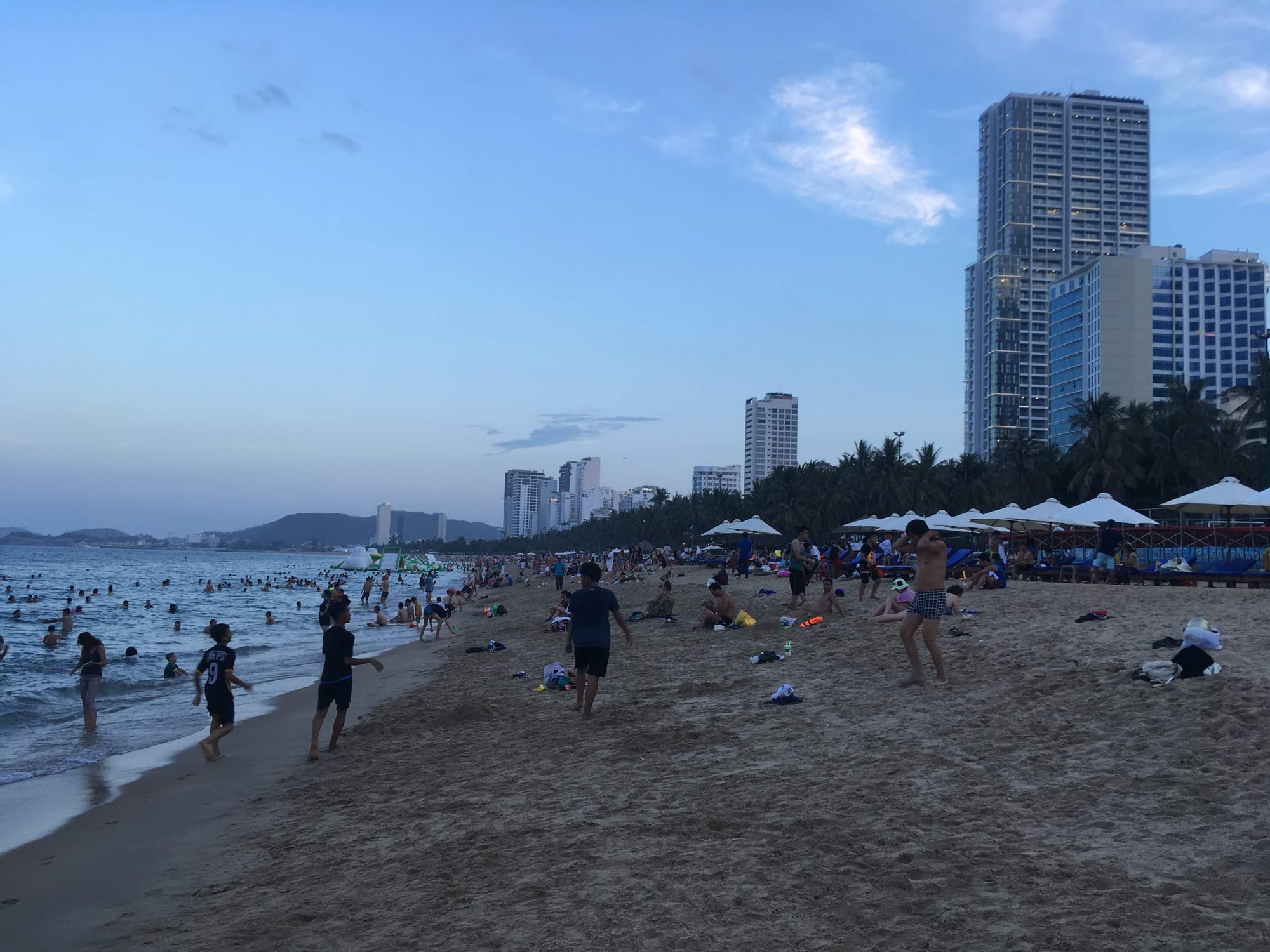
A wide sand beach at dusk with swimmers in the sea, white sun umbrellas and a line of tall hotel towers behind the palms

Da Nang, Hoi An & Central Vietnam, Vietnam

Nha Trang

The city beach at Nha Trang in the evening, with the hotel towers along Trần Phú Street behind it. (Christophe95 / Wikimedia Commons · CC BY-SA 4.0)

Vietnam's best-known beach city, on a sheltered bay of granite islands on the south-central coast. A Cham settlement whose towers still stand above the Cái River, it grew as a French seaside and scientific station and later as a resort. Today a wall of hotels lines the long city beach, with diving, island boats, mud baths and seafood streets behind it.

Neighbourhoods

  • The beach strip on Trần Phú
    • First-time visitors
    • Beaches
    • Nightlife

    The seafront boulevard and the blocks behind it, where most of the hotels, bars, dive shops and tourist restaurants are. The beach is public along its whole length, with a landscaped park between the sand and the road.

    Open in Maps
  • The old centre and Chợ Đầm
    • Markets
    • Best for food
    • Local life

    The grid of streets inland and north of the beach strip, around the city's main market. Vietnamese-run eating houses, wholesalers, the cathedral and the bus offices are here, and prices drop sharply a few blocks from the sea.

    Open in Maps
  • Xóm Bóng and the river mouth
    • Historic district
    • Views
    • Local life

    The northern end of the city where the Cái River meets the sea, with the Po Nagar towers on their hill, a fishing fleet moored under the bridge, and the hot-spring mud bath centres in the valley behind.

    Open in Maps
  • Vĩnh Hòa and Hòn Chồng
    • Quiet and residential
    • Walks and viewpoints

    The coast north of the river, with rock formations on the shore, small local beaches and views back across the bay. Residential, with a scattering of cafés and guesthouses.

    Open in Maps
  • Cầu Đá and the southern headland
    • Close to the islands
    • Seafood

    The port district at the southern end of the bay, where the island boats and the cable car leave and the oceanographic institute stands. Fishing boats, seafood restaurants and the road out towards the southern beaches.

    Open in Maps
  • Hòn Tre and the bay islands
    • Resorts
    • Beaches
    • Families

    The large island across the bay, reached by boat or by a long cable car, with resort beaches and a theme park, and smaller islands around it used for diving and snorkelling trips.

    Open in Maps

Things to do

Temples and landmarks

  • Po Nagarlandmark

    Cham brick towers on a hill above the river mouth, a sanctuary already standing before 781 and rebuilt over the centuries, dedicated to the goddess Yan Po Nagar and still used for worship.

    Open in Maps
  • Long Sơn Pagodalandmark

    A Buddhist temple founded in 1886 and moved to the foot of the hill after a cyclone in 1900, with a road and steps climbing past it to a 24-metre white Buddha of the mid-1960s and a view over the city.

    Open in Maps
  • Nha Trang Cathedrallandmark

    A grey stone church built in 1928 in the Gothic Revival style and consecrated in 1933, standing on a rock outcrop above the railway station in the centre.

    Open in Maps
  • Hòn Chồngviewpoint

    A cluster of huge granite boulders on the shore north of the river, with a small headland park and views along the coast and out to the islands.

    Open in Maps

Museums and science

  • Oceanography Museummuseum

    The aquarium and collection of the oceanography institute at Cầu Đá, established in 1922, with tens of thousands of specimens including an 18-metre whale skeleton.

    Open in Maps
  • Alexandre Yersin Museummuseum

    A small museum in the Pasteur Institute buildings devoted to the Swiss-French bacteriologist, who lived in Nha Trang for some fifty years and died there in 1943.

    Open in Maps

Beaches and the sea

  • Nha Trang Beachbeach

    The long city beach along Trần Phú, with sun loungers, lifeguarded sections and swimmers from before dawn until after dark.

    Open in Maps
  • Hòn Munattraction

    A small island in the bay's marine protected area, among the first such areas recognised by the IUCN, and the main dive and snorkel site.

    Open in Maps
  • Hòn Treattraction

    The largest island in the bay, with resort beaches, a theme park and a long cable car running out to it across the water.

    Open in Maps
  • Tháp Bà hot springsattraction

    Mineral mud and hot-spring bath centres in the valley behind Po Nagar, a local speciality that draws Vietnamese and foreign visitors alike.

    Open in Maps

Markets and city life

  • Chợ Đầmmarket

    The city's central market, selling produce, dried seafood, fish sauce and clothing, with food stalls around its edges.

    Open in Maps
  • Nha Trang railway stationtransit hub

    One of the main stations on the north–south line, in the centre below the cathedral, and the arrival point for many Vietnamese visitors.

    Open in Maps

Short trips from the city

  • Ba Hồ waterfallstrail

    A series of pools and falls on a stream in the hills north of the city, reached by a short scramble through boulders and forest.

    Open in Maps
  • Dốc Lếtbeach

    A long, shallow, white-sand beach on the coast north of the city, quieter than the city beach and popular for day trips.

    Open in Maps
  • Cam Ranh Bayattraction

    A large deep-water bay about 40 kilometres south, long used as a naval base and now flanked by the resort strip of Bãi Dài and the airport.

    Open in Maps

Seasonal events

  • Tháp Bà Po Nagar festivalthe 20th to 23rd days of the third lunar month, usually April

    The largest folk festival of the year in Khánh Hòa, with offerings, processions and folk performances at the Cham towers, drawing Vietnamese and Cham worshippers.

  • Tết Nguyên Đánlate January or February

    Lunar new year fills the pagodas and the market, and flower displays and fireworks appear along the seafront.

  • Nha Trang Sea Festivalevery other year

    A city festival of street parades, boat races, music and beach events staged every couple of years.

  • Mid-Autumn FestivalSeptember or early October

    Lanterns, lion dances and mooncakes in the markets and the residential streets.

Eat and drink

Long-standing places and food districts in Nha Trang. Hours, ratings and directions come from your maps app, always current.

Nha Trang classics

  • Bún cá and bún sứa shopsrestaurant

    Rice noodles in a clear fish broth with cakes of pounded mackerel, and the local variant with strips of cool, crunchy jellyfish — the dish the city is best known for.

    Open in Maps
  • Nem nướng restaurantsrestaurant

    Grilled pork sausage from nearby Ninh Hòa, rolled at the table in rice paper with herbs, green banana and crisp fried pastry, with a thick sweet dipping sauce.

    Open in Maps
  • Bánh căn and bánh xèo stallsrestaurant

    Small rice-flour pancakes cooked in clay moulds, often with a quail egg or squid inside, and the larger crisp turmeric pancake filled with prawns.

    Open in Maps

Markets and seafood

  • Chợ Đầmmarket

    The main market, where dried squid, fish sauce, bird's nest products and fresh produce are sold, with cheap cooked-food stalls nearby.

    Open in Maps
  • Seafood restaurants near Cầu Đáneighborhood

    Open-fronted places near the fishing port serving lobster, mantis shrimp, scallops, snails and whole fish, grilled over charcoal or steamed.

    Open in Maps
  • Food streets behind the beachneighborhood

    The blocks inland from Trần Phú, with Vietnamese grills, Russian and Korean restaurants and cheap noodle shops side by side.

    Open in Maps

Experience Nha Trang

History

The bay was part of the Cham world for more than a thousand years. The towers of Po Nagar on the hill above the Cái River were built from around the 8th century over an older sanctuary, dedicated to the goddess the Vietnamese later worshipped as Thiên Y A Na, and they remained in use as the region passed from Champa to Vietnamese control in the 17th century. The settlement below stayed a fishing and trading village of no great size.

French rule changed it. The colonial administration built a port and a railway along the coast, and in 1895 Alexandre Yersin, the bacteriologist who had isolated the plague bacillus in Hong Kong the year before, founded a Pasteur Institute here; he lived in the town until his death in 1943, introduced rubber and quinine cultivation to the highlands behind it, and is still honoured locally. A seaside resort grew up alongside the laboratories.

During the war the deep-water harbour at Cam Ranh Bay, south of the city, became a major American base, and after 1975 it was leased to the Soviet navy for decades, which left a Russian connection that persists in the city's tourism. Nha Trang itself was developed as a resort from the 1990s: the beach road was landscaped, high-rise hotels went up along Trần Phú, and charter flights brought Russian and then Chinese and Korean visitors in large numbers. The tourism economy collapsed and rebuilt itself after the pandemic years. In June 2025 the province of Khánh Hòa was enlarged by the merger of neighbouring Ninh Thuận, and on 1 July Nha Trang ceased to exist as a municipal city when district-level units were abolished across Vietnam.

Culture & Customs

Nha Trang's public culture is that of a Vietnamese seaside city: early mornings on the sand, evening promenades, karaoke, and large family meals of seafood. It is more cosmopolitan than its size suggests, because of a long succession of foreign communities — French scientists and officials, Soviet and Russian naval families and holidaymakers, and more recently Chinese and Korean visitors — and Cyrillic signs on restaurants are still a common sight.

The older cultural layer is Cham and maritime. Po Nagar is a living temple as well as a monument, and its spring festival is the largest folk festival of the year in Khánh Hòa, bringing Vietnamese Buddhists and Cham families to the same hill. Fishing villages around the bay keep the whale cult of the central coast, with shrines to Ông, the whale spirit, and ceremonies before the season. Khánh Hòa is also famous for the harvesting of swiftlet nests from the island cliffs, an old and closely guarded trade.

Manners are relaxed and commercial. Bargaining is normal in the market, less so in shops; hospitality is warm and direct; and Vietnamese visitors, who now outnumber foreigners, set the tone in the restaurants and on the beach. Religious life mixes Buddhism, ancestor worship and a visible Catholic minority, whose stone cathedral stands on its rock in the middle of the city.

Daily Life

About 535,000 people lived in Nha Trang in 2023, and it is the main city of Khánh Hòa province and a naval as well as a tourist centre. Tourism, fishing, shipbuilding, fish and seafood processing, salt, swiftlet nests and a growing number of service jobs support the population, and the surrounding countryside grows rice, sugar cane and fruit and supplies the markets.

The city wakes very early. Boats come in to the river mouth and the port before dawn, the beach fills with swimmers and exercise groups by six, and the market is busiest in the first hours of the day. Midday is quiet and hot; work resumes in the late afternoon; and the evening belongs to the seafront, where families walk, children play in the park and the restaurants and beer stalls fill.

Most residents live in narrow houses on the grid of streets behind the hotels, where prices and rents are far lower than on the sea front. The pressures are those of a resort city: dependence on visitor numbers that can drop sharply, building on the hillsides and the flooding and landslides that have followed heavy rain, and damage to the coral in the bay, which is a protected area. The sea remains the city's livelihood and its daily routine.

Food

Fish, not meat, is the basis of the local kitchen. Bún cá, rice noodles in a clear broth made from mackerel bones with cakes of pounded fish, is eaten at breakfast, and the city's own version adds sứa — strips of jellyfish, crisp and cool, that give bún sứa its texture. Bánh canh chả cá, with thick tapioca noodles, is a close relative. Seafood is otherwise treated simply: lobster, mantis shrimp, scallops, clams and snails grilled with spring onion oil or steamed with lemongrass.

The inland dishes come from the villages around. Nem nướng Ninh Hòa, grilled pork sausage from a town north of the city, is rolled at the table in rice paper with herbs, green banana, star fruit and a strip of fried pastry, then dipped in a thick sweet-savoury sauce. Bánh căn, little rice-flour pancakes cooked in a clay mould over charcoal, often with quail egg or squid, are sold from pavement grills, and bánh xèo comes filled with prawns or squid.

Khánh Hòa's luxury product is yến sào, the swiftlet nest harvested from the cliffs of the bay's islands and sold as a tonic drink and in sweet soups. The everyday version of indulgence is simpler: iced coffee with condensed milk, sugarcane juice, chè of beans and jelly in coconut milk, and mangoes from the orchards inland. Dried squid, fish sauce and sesame sweets are what visitors carry home.

Planning tools

Budget

Nha Trang is inexpensive for a resort city. Competition keeps hotel prices low outside the summer and holiday peaks, and food a few streets back from the beach costs little. The extras that add up are island boat trips, diving, the cable car and the mud baths, and seafood bought by weight, which should be confirmed before ordering.

Daily Budget Midrange
USD 60–130 (sea-view hotel, restaurant meals, a boat or diving trip, taxis)
Daily Budget Shoestring
USD 20–38 (hostel or guesthouse bed, street food, local buses)

Prices rise sharply during Vietnamese summer holidays and around Tết; confirm the price per kilogram of seafood before it is cooked.

Best Time to Visit

January to August is the dry season here, and this stretch of coast is drier and sunnier than Da Nang or Hội An further north. March to May is warm with calm, clear water, best for diving and island trips. Rain and storms come between about September and December, and the sea turns rough.

Suggested Number of Days

Two or three days are enough for the beach, the towers and one boat trip. Four or five allow for diving, the quieter beaches north and south, and the waterfalls and countryside inland. Divers and long-stay visitors often settle in for much longer.

First Visit
2–3 days
With Surroundings
4–5 days

Transportation

The city is compact and flat along the shore, so the beach strip is walkable end to end. Taxis and ride-hailing apps are cheap, motorbikes and bicycles are easy to hire, and city buses run along the coast road and out to the airport and the northern beaches. Boats from the port and the cable car reach the islands.

Use a metered taxi or an app rather than agreeing a price on the street, and take care crossing the coast road, where traffic moves quickly.

Airport & Station Connections

Cam Ranh International Airport lies about 30 kilometres south of the city, roughly 45 minutes by taxi or airport bus, and handles domestic and regional international flights. The railway station is in the centre on the north–south line, with overnight trains from Ho Chi Minh City, and long-distance buses and the coastal highway link the city in both directions.

Walkability

Along the sea front walking is easy and pleasant, with a continuous park between the beach and the road and pavements the whole way. Inland the blocks are ordinary Vietnamese streets with parked motorbikes on the pavement, and the heat makes longer walks tiring for much of the year. The islands, the waterfalls and the northern beaches all need transport.

Safety

Nha Trang is generally safe, though it has more petty crime than smaller Vietnamese towns: bag-snatching and theft from the beach are the common problems, along with overcharging in some tourist bars and on seafood. The sea brings rip currents and jellyfish in season, and boat trips and diving should be booked with established operators.

Only ride a motorbike if experienced and licensed, and always with a helmet; hold bags away from the road; drink bottled or filtered water; and check surf conditions before swimming. Check current official travel advice before travelling.

Climate

A tropical climate that is drier than most of Vietnam, with a long sunny season and a short, sharp wet season from about September to December. Temperatures vary little through the year and the sea is warm in every month.

Summer
hot and dry, generally 28–34°C, with strong sun and a sea breeze in the afternoon
Winter
warm, about 24–28°C, with most of the year's rain falling between October and December and rougher seas

Local Customs

The city has a long habit of foreign visitors — Russian, Chinese, Korean and Western in turn — and menus and signs often appear in several languages. Beachwear belongs on the beach, not in the market or a restaurant. Shoulders and knees should be covered at Po Nagar and in the pagodas, and shoes are removed where others remove them.

Tipping is not expected but is welcome; bargain politely at the market, and ask before photographing worshippers at the Cham towers, which are an active place of prayer.

Common Payment Methods

The currency is the Vietnamese đồng. Cards are accepted in hotels, dive shops and larger restaurants; markets, street stalls, boats and buses are cash. ATMs are numerous along the beach strip, with per-withdrawal limits and fees, and QR-code payment apps are standard among residents.