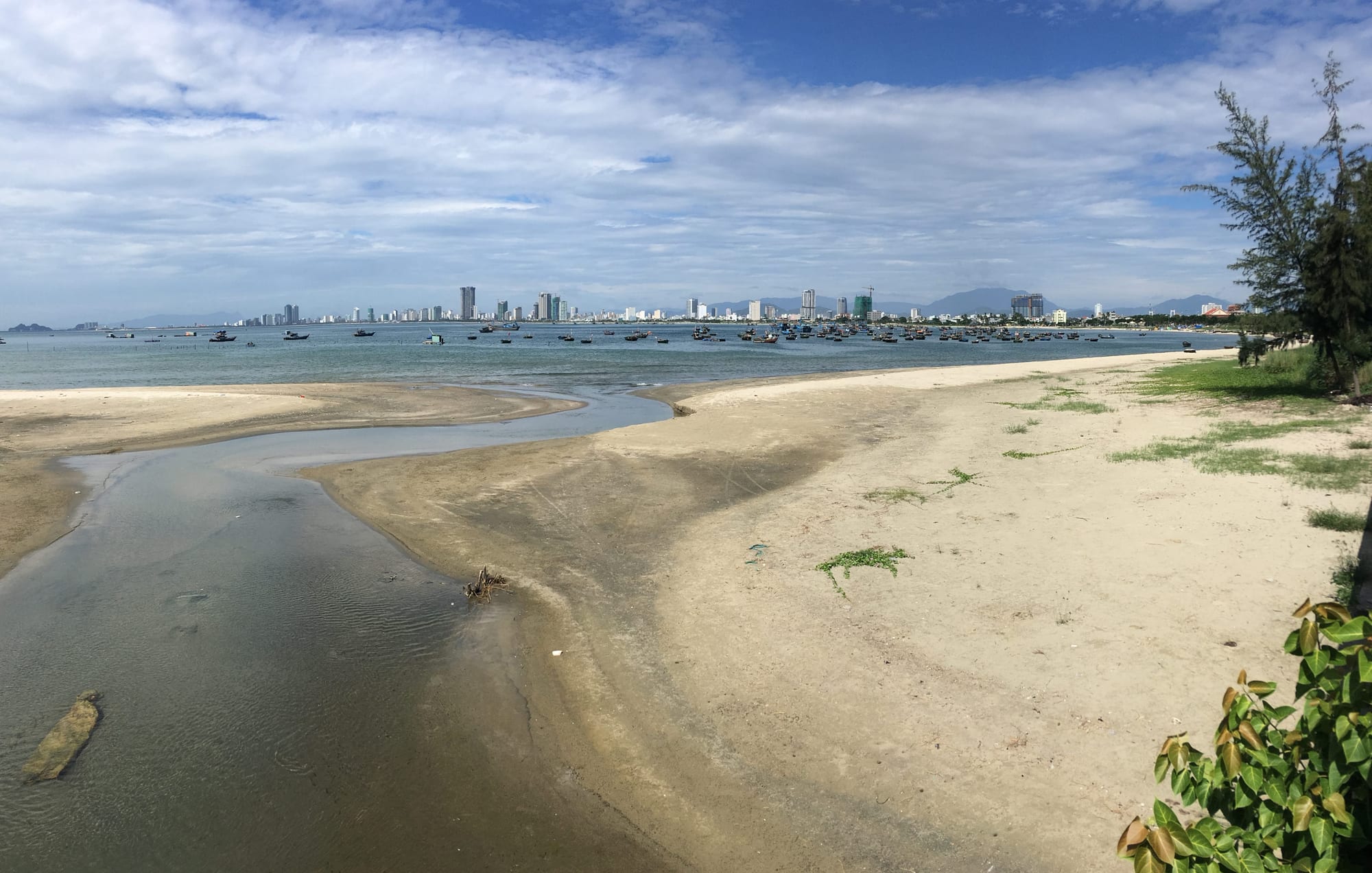
A wide sandy beach with a shallow creek running to the sea, fishing boats moored offshore and a line of high-rise towers along the bay beyond

Da Nang, Hoi An & Central Vietnam, Vietnam

Da Nang

The northern end of Mỹ Khê beach, with the towers of Da Nang across the bay. (Christophe95 / Wikimedia Commons · CC BY-SA 4.0)

The largest city of central Vietnam, built where the Hàn River meets a wide bay between the Hải Vân Pass and the Sơn Trà peninsula. A French colonial port called Tourane, then a huge American base during the war, it has grown since the 2000s into an orderly city of bridges, beach hotels and technology parks, with a long sandy coast on one side and forested mountains on the other.

Neighbourhoods

  • Hải Châu and the riverfront
    • First-time visitors
    • Markets
    • Close to public transport

    The old centre on the west bank of the Hàn River, with the main markets, the cathedral, the Cham sculpture museum, offices and most of the city's older hotels. The riverside promenade and the bridges are the focus of the evening.

    Open in Maps
  • The beach strip at Mỹ Khê
    • Beaches
    • Resorts
    • Seafood

    The east bank facing the open sea, where a straight coast road runs for kilometres past hotels, apartment towers and seafood restaurants. Mornings begin with swimmers and exercise groups on the sand, and everything is a short bridge ride from the centre.

    Open in Maps
  • An Thượng
    • Nightlife
    • Cafés
    • Backpackers

    A grid of small streets a block behind the beach, full of guesthouses, bars, bakeries and restaurants aimed at foreign visitors and long-stay residents. Walkable, informal and busiest in the evening.

    Open in Maps
  • Sơn Trà
    • Quiet and residential
    • Views
    • Nature

    The district running out onto the forested peninsula north-east of the river mouth, with a working fishing harbour, quieter beaches and the road climbing to the pagoda and the viewpoints above the city.

    Open in Maps
  • Ngũ Hành Sơn
    • Beaches
    • Families
    • Close to Hoi An

    The southern coastal district around the Marble Mountains, with large resorts, golf courses, the stone-carving village of Non Nước and the road towards Hội An. Further from the centre and much quieter after dark.

    Open in Maps
  • Thanh Khê and Liên Chiểu
    • Local life
    • Quiet and residential

    The western and northern districts behind the airport and along the bay towards the Hải Vân Pass, where most residents live and work — markets, universities, industrial zones and long stretches of ordinary city street.

    Open in Maps

Things to do

Bridges and city landmarks

  • Dragon Bridgelandmark

    A road bridge opened in March 2013, carried on a steel dragon that runs the length of the span, lit at night and breathing fire and water on Saturday and Sunday evenings.

    Open in Maps
  • Hàn River Bridgelandmark

    A cable-stayed swing bridge opened in March 2000, designed by Vietnamese engineers and paid for in part by donations from local companies and residents, whose deck turns aside late at night to let boats pass.

    Open in Maps
  • Da Nang Cathedrallandmark

    A pink-walled church built in 1923–24 as the church of Tourane, known locally as the rooster church after the weathercock on its bell tower.

    Open in Maps
  • Sun Wheel at Asia Parkattraction

    A large observation wheel on the river's west bank, part of a theme park, and a landmark of the city's night skyline.

    Open in Maps

Museums

  • Museum of Cham Sculpturemuseum

    Founded by the French in 1915, with its first building opened in 1919, it holds the world's largest collection of Cham stone sculpture, gathered from temple sites across central Vietnam.

    Open in Maps
  • Da Nang Museummuseum

    The city museum, covering the region's history from Champa through the French port of Tourane to the war years and the modern city.

    Open in Maps
  • Da Nang Museum of Fine Artsmuseum

    A collection of Vietnamese painting, lacquer, sculpture and folk art, with work by artists from the central provinces.

    Open in Maps

Beaches, mountains and viewpoints

  • Mỹ Khê Beachbeach

    The long city beach on the east side, wide and sandy, with lifeguarded sections, calm water in the dry season and crowds at dawn and dusk.

    Open in Maps
  • Marble Mountainslandmark

    Five marble and limestone hills about 10 kilometres south of the centre, riddled with grottoes and Buddhist and Hindu sanctuaries, with steps up to pagodas and viewpoints over the coast.

    Open in Maps
  • Sơn Trà Peninsulapark

    A forested headland of protected woodland, home to endangered red-shanked douc langurs, with a coast road, small beaches and views back over the city.

    Open in Maps
  • Linh Ứng Pagodalandmark

    The temple on the slopes of Sơn Trà, whose 67-metre white statue of the Bodhisattva of compassion, finished in 2010, was then the tallest in Vietnam.

    Open in Maps
  • Hải Vân Passviewpoint

    The mountain road over the spur that divides central Vietnam's weather, climbing from the bay to an old French and Nguyễn-era gate with long views along the coast.

    Open in Maps

Markets and the riverfront

  • Hàn Marketmarket

    The city's best-known covered market beside the river, selling dried seafood, sweets, fabric and clothes as well as fresh produce.

    Open in Maps
  • Cồn Marketmarket

    A large, mainly local market west of the centre, with a busy cooked-food section that draws Vietnamese visitors for snacks.

    Open in Maps
  • Bạch Đằng riverside promenadeattraction

    The walkway along the west bank between the bridges, used for exercise, night strolling and street stalls, with the lit bridges in view.

    Open in Maps

Short trips from the city

  • Bà Nà Hills and the Golden Bridgeattraction

    A hill resort reached by cable car in the mountains about 25 kilometres west of the city, where a 150-metre walkway opened in 2018, apparently carried by two giant hands, looks out over the valley.

    Open in Maps
  • Hội Anneighborhood

    The preserved trading town on the Thu Bồn River about 25 kilometres south, with its shophouses, assembly halls and beaches.

    Open in Maps
  • Mỹ Sơnlandmark

    The brick temple sanctuary of the Cham kings in a valley about 35 kilometres inland, a UNESCO World Heritage Site and the source of many of the Cham museum's sculptures.

    Open in Maps

Seasonal events

  • Da Nang International Fireworks Festivalsummer

    Teams from several countries compete over successive nights with displays fired from the banks of the Hàn River, a competition the city has run since 2008.

  • Quán Thế Âm festivalthe 17th to 19th days of the second lunar month, usually March

    The city's largest festival, held at the Quán Thế Âm pagoda in the Marble Mountains, its centrepiece a procession bearing the statue of the Bodhisattva of compassion.

  • Tết Nguyên Đánlate January or February

    Lunar new year brings flower displays along the riverfront, fireworks over the bridges and a city that empties of workers heading home.

  • Mid-Autumn FestivalSeptember or early October

    Lion dances, lanterns and mooncakes in the markets and residential streets.

Eat and drink

Long-standing places and food districts in Da Nang. Hours, ratings and directions come from your maps app, always current.

Da Nang classics

  • Bánh tráng cuốn thịt heo restaurantsrestaurant

    The city's signature meal — boiled pork with a layer of fat, rolled at the table in rice paper with herbs and green banana, dipped in mắm nêm, a pungent fermented anchovy sauce.

    Open in Maps
  • Mì Quảng shopsrestaurant

    Wide turmeric-coloured rice noodles with pork and shrimp, peanuts, herbs and a sesame rice cracker, served with only a shallow pool of broth.

    Open in Maps
  • Bún chả cá stallsrestaurant

    Rice noodles in a clear, slightly sweet fish broth with cakes of pounded mackerel, eaten at breakfast and late at night.

    Open in Maps

Markets and food streets

  • Cồn Market food hallmarket

    Rows of stalls selling snacks and sweet soups inside a market where most customers are local — one of the best places in the city to eat cheaply.

    Open in Maps
  • Hàn Marketmarket

    The riverside market, with a small cooked-food section and stalls of dried squid, fish sauce and sesame cakes bought as gifts.

    Open in Maps
  • Seafood restaurants on the beach roadneighborhood

    Large open-fronted places along the coast road where fish, squid, prawns and clams are chosen from tanks and grilled or steamed.

    Open in Maps

Cafés and bars

  • An Thượng cafés and barsneighborhood

    A walkable quarter behind the beach with coffee shops, bakeries, craft-beer bars and restaurants from several countries.

    Open in Maps

Experience Da Nang

History

The bay at the mouth of the Hàn River was Cham territory for a thousand years, part of the kingdom whose religious centre lay inland at Mỹ Sơn, and its sheltered water made it a natural harbour. Vietnamese control came with the southward expansion of the 15th century, and as the river at Hội An silted up, ships moved here. The port grew under the Nguyễn emperors, who restricted foreign trade to it.

In August 1858 a French force under Admiral Rigault de Genouilly, with Spanish support, landed here, the opening act of France's conquest of Vietnam. The colonial government renamed the city Tourane in 1889, laid out a grid of streets and built the port, the railway and, in 1915, the museum of Cham sculpture that remains the city's finest institution. On 8 March 1965 the first American combat troops in Vietnam, some 3,500 Marines, came ashore near here, and Da Nang became one of the largest military bases of the war, with an air base whose land remained heavily contaminated with dioxin from defoliants long afterwards; a joint Vietnamese and American clean-up began in 2012 and was completed in 2018. The city fell to northern forces in March 1975.

For two decades afterwards it was a quiet provincial port. On 1 January 1997 it was separated from Quảng Nam province and made a centrally governed municipality, and from then on it grew fast: bridges across the Hàn River, a new airport terminal, resorts along a coast that had been fishing villages, industrial and software parks, and a reputation for tidy, well-run local government. In 2025 the administrative wheel turned again and the former Quảng Nam province, including Hội An and Mỹ Sơn, was absorbed into the city, with effect from 1 July.

Culture & Customs

Da Nang's culture is coastal and comparatively young. Much of the modern city has been built within living memory, and its people have come from the villages of the central provinces, so village-style social life — extended families, neighbourhood associations, ancestor altars — persists inside a city of towers. The Quảng accent is strong and instantly recognisable elsewhere in Vietnam, and locals are known for directness and for a certain pride in having built something orderly out of a war-damaged port.

The deeper cultural layer is Cham. The sculpture museum, the temple sites inland and the shrines in the Marble Mountains are reminders that this coast was the heart of Champa, and Cham motifs turn up in local design. Buddhism is strong: the Marble Mountains draw pilgrims, and the Quán Thế Âm festival is the largest festival in the city. Fishing communities keep the whale worship of the central coast, with shrines to the whale spirit and ceremonies before the season.

Public life happens outdoors and early. The beach fills before six with swimmers, joggers and exercise groups; evenings belong to the riverside promenade, the lit bridges and the seafood tables. The city has cultivated large-scale spectacle — fireworks over the river, the fire-breathing dragon, illuminated bridges — as a deliberate part of its identity, and it hosts a growing community of foreign residents working in tourism and software.

Daily Life

Da Nang had about 1.27 million residents in 2024 and is the economic centre of central Vietnam; the 2025 merger with the former Quảng Nam province widened its boundaries far beyond the city itself. Tourism, the port, fishing, industrial zones, construction and a fast-growing software and electronics sector provide the work, and the city has drawn young Vietnamese from across the centre with cheaper housing and shorter commutes than Hanoi or Ho Chi Minh City.

The day starts before dawn, with the fish market at the harbour, exercise on the beach and breakfast at street kitchens; offices break for a long early afternoon; and the evening belongs to the river, the beach road and the markets. Most people live in narrow tube houses on grid streets west of the river, with newer apartment blocks going up near the coast, and almost everyone travels by motorbike.

The city's issues are those of rapid growth: coastal land given over to resorts and the disputes about public access that followed, drainage that struggles when autumn storms drop extreme rainfall, pressure on the Sơn Trà forest from development, and a tourist economy that swung sharply with the arrival and departure of Chinese, Korean and Russian visitors. Living costs remain lower than in the two big metropolises, which is much of the attraction.

Food

Da Nang eats from the sea and from the noodle bowl. Its most local meal is bánh tráng cuốn thịt heo — slices of boiled pork layered with fat and skin, rolled at the table in fresh rice paper with lettuce, herbs, cucumber and green banana, and dipped in mắm nêm, a strong fermented anchovy sauce that defines central Vietnamese taste. Mì Quảng, the wide turmeric noodle dish of the surrounding province, is eaten at any hour, with pork and shrimp, peanuts and a crisp sesame rice cracker broken over the top.

Fish and fish cakes run through the rest. Bún chả cá is a clear broth of mackerel and pineapple with noodles and pounded fish cakes; bánh xèo, a small crisp turmeric pancake of rice flour with pork and prawns, is eaten wrapped in rice paper and herbs, usually alongside nem lụi, grilled pork skewers on lemongrass, with a thick peanut and liver sauce. The coast road's restaurants serve squid, mantis shrimp, clams, snails and whole fish straight from the tanks.

Sweet and everyday things fill the markets: chè, sweet soups of beans, jelly and coconut milk; bánh bèo and bánh nậm, small steamed rice cakes borrowed from Huế up the coast; and dried squid, sesame cakes and fish sauce sold as gifts to take home. Coffee is drunk strong and iced with condensed milk, bia hơi is poured fresh at pavement bars, and a small craft-beer scene has grown up behind the beach.

Planning tools

Budget

Da Nang is good value for a city of its size. Beach-front hotels and resorts set the top of the range, but rooms a street or two back are much cheaper, food is inexpensive almost everywhere, and the beaches, bridges and riverfront cost nothing. The main extras are taxis or a hired motorbike, the Bà Nà Hills cable car and day trips.

Daily Budget Midrange
USD 60–130 (beach or city hotel, restaurant meals, taxis, a day trip inland or to the coast)
Daily Budget Shoestring
USD 22–40 (hostel or guesthouse bed, street food, local buses and a hired bicycle)

Rooms a few hundred metres inland from the beach cost a fraction of those on the sea front, and the city's public buses reach the Marble Mountains and Hội An cheaply.

Best Time to Visit

February to August is the dry half of the year, warm and sunny with calm seas; May to August is hot and busy with Vietnamese holidaymakers. The rains set in from about September, and October to early December brings typhoons and flooding. January and February are mild but often grey.

Suggested Number of Days

Two or three days cover the city, its museums and the beach. Four to six make room for the mountains, the passes and the historic towns and temple sites nearby. Many visitors use the city as a base for the whole region rather than moving hotels.

First Visit
2–3 days
With Surroundings
4–6 days

Transportation

Da Nang is spread out but easy to move around: wide roads, several bridges over the Hàn River and light traffic by Vietnamese standards. Ride-hailing apps and metered taxis are cheap and widely used, motorbikes are the local default and are easy to hire, and city buses run to the Marble Mountains, Hội An and the pass. Bicycles work well along the beach road.

Traffic moves fast on the coastal and riverside boulevards; cross at lights where they exist, and be cautious on the Hải Vân Pass and the Sơn Trà road, which are steep and popular with inexperienced riders.

Airport & Station Connections

Da Nang International Airport sits inside the city, a few kilometres west of the river, with domestic flights and a wide range of regional international services; the drive to the beach takes about fifteen minutes. The railway station is central and lies on the north–south line, with the celebrated coastal stretch over the Hải Vân Pass to Huế. Highway 1 and the coast road bring buses from all directions.

Walkability

Individual districts walk well — the riverfront promenade, the market streets of Hải Châu, the lanes of An Thượng and the beach itself — but the distances between them are long, the blocks are big and the heat is heavy for much of the year. Most residents ride for anything over a few hundred metres, and crossing the main boulevards takes care.

Safety

Da Nang is one of Vietnam's safer and more orderly cities, with little crime against visitors and a strong police presence in the tourist areas. The real dangers are traffic, rip currents and sudden shore-break on the open beaches, especially outside the calm season, and autumn typhoons, which can flood streets and close the coast road.

Only ride a motorbike if experienced and licensed, and always with a helmet; hold bags away from the road; drink bottled or filtered water; and check surf conditions before swimming. Check current official travel advice before travelling.

Climate

A tropical monsoon climate sheltered from northern cold by the Hải Vân Pass. The year divides into a long dry, hot season and a sharp wet season from about September to December, when most of the rain falls and typhoons come ashore.

Summer
hot and humid, generally 30–35°C, with sea breezes and short storms
Winter
mild and wet, about 21–26°C, with heavy rain into December and greyer, drier weather in January and February

Local Customs

Central Vietnamese are known for plain speech and hard work, and Da Nang has a reputation among Vietnamese for being clean, orderly and relatively free of the hard sell found elsewhere. Pagodas and temples expect covered shoulders and knees and shoes left at the door. Tipping is not customary, though it is common in resorts and with guides and drivers.

Take shoes off where others do, keep beachwear for the beach, and ask before photographing people at prayer in the pagodas or working at the fishing harbour.

Common Payment Methods

The currency is the Vietnamese đồng. Cards work in hotels, malls, supermarkets and larger restaurants; markets, street food, buses and small cafés are cash. ATMs are everywhere, with a per-withdrawal limit and fee, and QR-code payment apps are used by almost everyone locally.