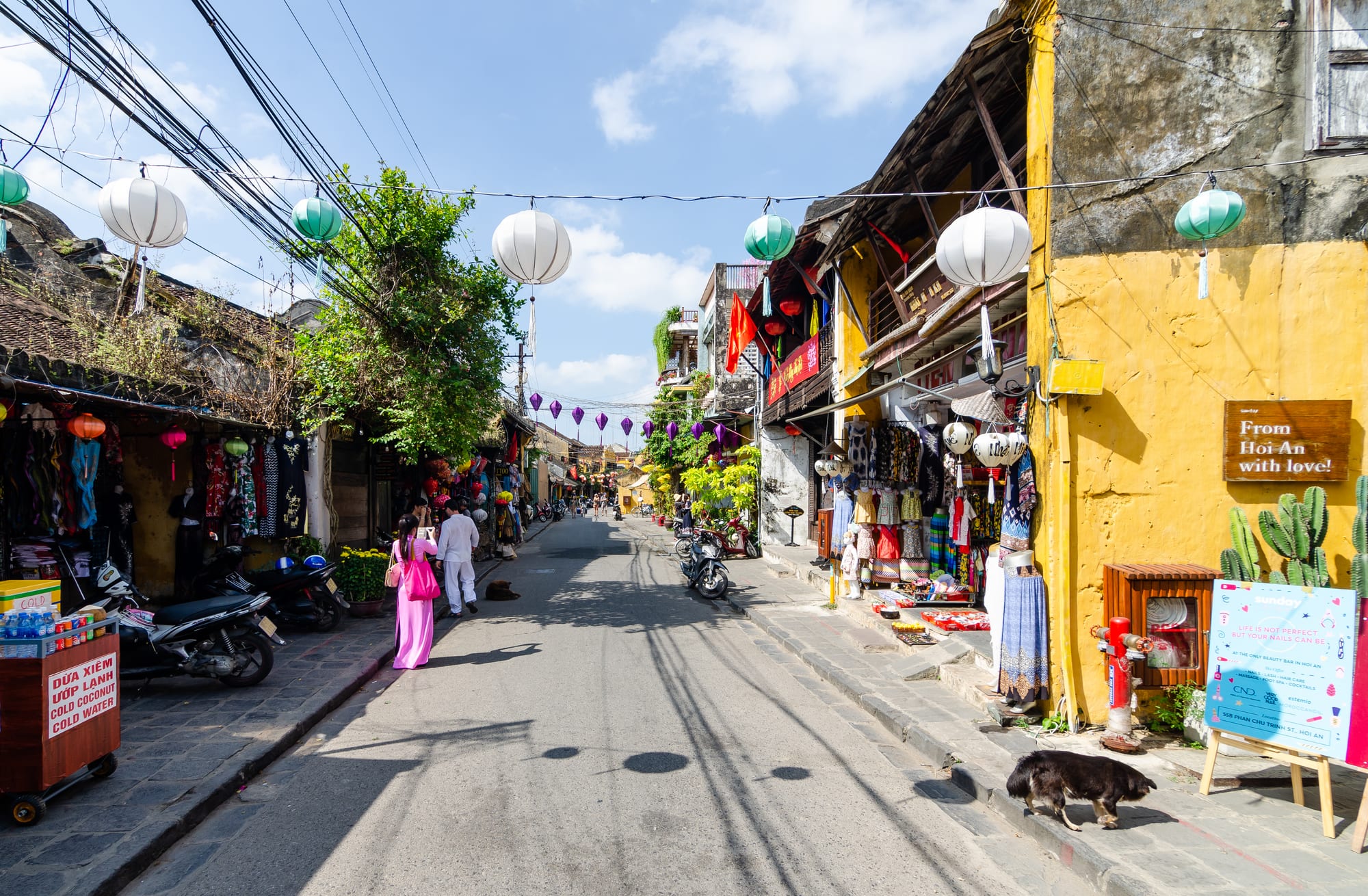
A narrow street of yellow-walled shophouses hung with white and green paper lanterns, with shops spilling goods onto the pavement

Da Nang, Hoi An & Central Vietnam, Vietnam

Hoi An

Trần Phú Street in the old town of Hội An, hung with lanterns. (Steffen Schmitz (more photos) / Wikimedia Commons · CC BY-SA 4.0)

A small town on the Thu Bồn River near the central Vietnamese coast, and one of Southeast Asia's best-preserved early trading ports. Japanese, Chinese, Portuguese and Dutch merchants met here from the 16th century; when the river silted and trade moved to Da Nang, the wooden shophouses were left standing. The old town is a UNESCO World Heritage Site, and tailoring, lanterns and nearby beaches fill the modern economy.

Neighbourhoods

  • The Ancient Town
    • First-time visitors
    • Historic district
    • Shopping

    The protected core of low yellow shophouses, assembly halls, temples and tailors' shops between Trần Phú Street and the river. Traffic is restricted for much of the day, a ticket is required for entry to the heritage houses and halls, and the streets are at their most crowded in the evening when the lanterns are lit.

    Open in Maps
  • An Hội
    • Nightlife
    • Street food
    • Close to the old town

    The sandy islet across the footbridge from the old town, with the night market, lantern stalls, riverside bars and many small hotels. Livelier and later than the far bank, and a few minutes' walk from it.

    Open in Maps
  • An Bàng and the northern beach
    • Beaches
    • Relaxed stays
    • Cafés

    The stretch of coast about four kilometres north-east of the town, with beach bars, homestays and small hotels behind the dunes. Quieter than the old town, and linked to it by a flat road through paddy fields.

    Open in Maps
  • Cửa Đại
    • Beaches
    • Resorts
    • Families

    The coast nearest the river mouth, lined with larger resorts. Erosion has narrowed the sand and stretches of shore are held behind breakwaters, so conditions for swimming vary along it.

    Open in Maps
  • Cẩm Thanh and the river villages
    • Quiet and residential
    • Countryside
    • Boat trips

    A landscape of nipa palm creeks, prawn ponds and rice fields east of the town, reached along lanes that suit bicycles. Homestays and garden restaurants sit among the fields, and round basket boats take visitors into the water coconut palms.

    Open in Maps
  • Cẩm Nam
    • Best for food
    • Local life

    A low island just south of the old town over a short bridge, known for riverside eating houses serving corn sweet soup and grilled rice-paper snacks, with ordinary village life a street behind them.

    Open in Maps

Things to do

The old town

  • Japanese Covered Bridgelandmark

    The roofed wooden footbridge with a small temple on it, dating from the late 16th century and the Japanese merchant community, renovated many times since and the emblem of the town.

    Open in Maps
  • Assembly Hall of the Fujian Chinese Congregationlandmark

    The largest of the town's five Chinese community halls, on Trần Phú Street, venerating the sea goddess Mazu, known in Vietnamese as Thiên Hậu, along with six Ming generals from Fujian; merchants from Fujian bought the site in 1759.

    Open in Maps
  • Tấn Ký Houselandmark

    One of the old town's ticketed merchant houses, showing Vietnamese, Japanese and Chinese carpentry and the flood marks of past years.

    Open in Maps
  • Quan Công Templelandmark

    A temple built in 1653 by Minh Hương and Vietnamese residents at the corner of Trần Phú and Nguyễn Huệ streets, dedicated to the deified general Guan Yu and still busy with worshippers.

    Open in Maps
  • Museum of Trade Ceramicsmuseum

    A museum opened in 1995 in a restored timber house of about 1858 on Trần Phú Street, displaying ceramics traded through the port.

    Open in Maps
  • Hội An Central Marketmarket

    The riverside market at the eastern end of the old town, with produce, spices, fabric and a crowded cooked-food hall.

    Open in Maps

Beaches and the water

  • An Bàng Beachbeach

    A broad stretch of sand north-east of the town with beach bars and loungers, the closest swimming beach to the old town.

    Open in Maps
  • Cửa Đại Beachbeach

    The beach at the mouth of the Thu Bồn, backed by resorts, with stretches of shore held behind breakwaters against erosion.

    Open in Maps
  • Cẩm Thanh water coconut forestpark

    A maze of nipa palm creeks in the river delta east of town, worked by fishermen and crossed in round bamboo basket boats.

    Open in Maps
  • Cù Lao Chàmattraction

    A group of eight granite islands about 16 kilometres off the coast, part of the Cù Lao Chàm Marine Park and a UNESCO biosphere reserve, with clear water, reefs and a fishing community.

    Open in Maps

Craft villages

  • Thanh Hà pottery villageattraction

    A riverside village west of the old town where families have thrown unglazed earthenware by hand and on kick wheels for centuries.

    Open in Maps
  • Kim Bồng carpentry villageattraction

    A village across the river whose carpenters built and repaired much of the old town's timber work and still carve and build boats.

    Open in Maps
  • Trà Quế vegetable villageattraction

    Herb and vegetable gardens between the town and the beach, fertilised with river weed and supplying the local restaurants.

    Open in Maps

Short trips from the town

  • Mỹ Sơnlandmark

    The ruined brick temple sanctuary of the Cham kings in a valley some 35 kilometres inland, a UNESCO World Heritage Site since 1999, much of it destroyed by United States bombing in 1969.

    Open in Maps
  • Marble Mountainslandmark

    Five limestone and marble hills on the road towards Da Nang, honeycombed with caves holding Buddhist shrines, with stone-carving workshops at their feet.

    Open in Maps
  • Da Nangneighborhood

    The large coastal city about 25 kilometres north, with its beaches, bridges, museums and the main airport of central Vietnam.

    Open in Maps

Seasonal events

  • Hội An Lantern Full Moon Festivalthe 14th night of each lunar month

    Held monthly since 1998 on the eve of the full moon, when the old town's electric lights are switched off, silk and paper lanterns are hung instead, and candles in paper cups are floated on the river.

  • Tết Nguyên Đánlate January or February

    Lunar new year fills the assembly halls and family shrines with offerings, and the streets with kumquat trees, flowers and dragon dances.

  • Mid-Autumn FestivalSeptember or early October

    Lion and unicorn dance troupes move from shop to shop through the old town, and children carry lanterns through the streets.

  • Flood seasonOctober to December

    Not a festival but part of the calendar — the Thu Bồn regularly rises into the riverside streets, and shopkeepers move stock upstairs and move about by boat.

Eat and drink

Long-standing places and food districts in Hoi An. Hours, ratings and directions come from your maps app, always current.

Hoi An classics

  • Cao lầu shopsrestaurant

    The town's own dish — thick chewy noodles, slices of marinated pork, crisp noodle squares and herbs with only a spoonful of broth, traditionally made with water from local wells.

    Open in Maps
  • Bánh mì standsrestaurant

    Hội An's version of the baguette sandwich, filled with pâté, cold cuts, herbs and a house sauce, sold from carts and small shopfronts across the town.

    Open in Maps
  • Chicken rice housesrestaurant

    Cơm gà Hội An — rice cooked in chicken stock and turmeric, topped with shredded poached chicken, raw onion, mint and a bowl of clear soup.

    Open in Maps

Markets and food streets

  • Hội An Central Marketmarket

    The covered market by the river, with a cooked-food hall serving noodle soups and rice plates, and stalls of herbs, spices and river fish.

    Open in Maps
  • An Hội night marketmarket

    A street of lantern stalls and grills across the footbridge, where skewers, seafood and rice-paper snacks are cooked in the open.

    Open in Maps
  • Cẩm Nam riversideneighborhood

    Simple eating houses on the island south of the old town, known for chè bắp, a sweet soup of young corn, and bánh đập, rice paper cracked over a soft rice sheet.

    Open in Maps

Experience Hoi An

History

Hội An stands on a branch of the Thu Bồn near the sea, in a delta that was part of Champa long before it was Vietnamese. The Cham port of Đại Chiêm Hải Khẩu traded from here with the Arab, Indian and Chinese worlds, and archaeology has found ceramics and coins from across maritime Asia. Vietnamese settlement followed the southward expansion of the 15th and 16th centuries.

Under the Nguyễn lords, who ruled the south from Huế, the port became one of the busiest in Southeast Asia. From about 1600 Chinese and Japanese merchants were permitted to live in their own quarters, and Portuguese, Dutch, English and French ships called on the monsoon winds for silk, ceramics, pepper and aromatic wood. Europeans knew it as Faifo. The Japanese quarter faded after Japan closed itself to foreign trade in the 1630s; Chinese communities from Fujian, Guangdong, Hainan and elsewhere stayed, built their assembly halls and dominated commerce into the 20th century.

Decline set in as the river silted and the Nguyễn emperors favoured Da Nang, which the French then developed as the regional port. Hội An became a quiet provincial town, and its poverty preserved it: there was no money to replace the old timber houses, and the fighting of the 20th century largely passed it by. Conservation work from the 1980s, led by the Polish architect Kazimierz Kwiatkowski, brought it back to notice; UNESCO listed the old town in 1999 as a well-preserved trading port of the 15th to 19th centuries, and tourism has since transformed the economy. Floods remain part of the town's story, and Quảng Nam province, of which Hội An was a provincial city, was absorbed into Da Nang in 2025.

Culture & Customs

The town's identity is built on the mixing that made it: Vietnamese, Chinese, Japanese and European elements in its architecture, and Chinese congregations that still run their halls, keep their festivals and maintain the temples of Thiên Hậu and Quan Công. Lunar-calendar ceremonies, ancestor rites and the memorial days of the assembly halls fill the year, among them the Mazu festival kept by the Chinese community on the 23rd day of the third lunar month, while the fishing villages race boats in the first lunar month to pray for a good catch.

Craft is the other tradition. Kim Bồng carpenters, Thanh Hà potters, Trà Quế market gardeners and the town's silk weavers and lantern makers all long predate tourism, and the tailoring trade, with its shops making clothes to measure in a day or two, grew out of that skill base as visitors arrived. The silk lanterns hung along every street have become the town's signature, and on the 14th night of each lunar month the centre turns off its electric lights for them.

Living inside a World Heritage Site shapes daily manners. Building heights, colours and signs are controlled, motor traffic is restricted, and residents negotiate constantly with the demands of visitors. Locals are used to foreigners and generally patient with them, and many families have run the same premises for generations.

Daily Life

Hội An is a small town by Vietnamese standards — until the administrative reforms of 2025 it was a class-3 city of Quảng Nam province, now part of Da Nang — and tourism, tailoring, handicrafts, fishing and farming carry the economy between them. The busiest hours are early morning, when the market and the fishing quay work, and the evening, when the old town fills; the middle of the day is hot and comparatively quiet. Many people who work in the centre live in the surrounding villages and commute in by motorbike.

The rhythm outside the old town is still rural. Rice is grown right up to the edge of the hotels, prawn ponds and nipa palms fill the delta at Cẩm Thanh, and boats go out from Cửa Đại and Cù Lao Chàm. Alongside this sit hundreds of homestays and small hotels run by families who have converted their houses, and a foreign resident community drawn by the beaches.

The pressures are those of a small place with very large visitor numbers: rising land prices, crowding in the narrow streets, waste and water management, and the loss of ordinary shops in the centre to souvenir and tailoring businesses. Coastal erosion at Cửa Đại has eaten into a beach that resorts were built behind, and autumn flooding is a recurring cost. Residents' pride in the town is nonetheless strong, and the restrictions that preserve it are broadly accepted.

Food

Cao lầu is the dish found almost nowhere else: thick, chewy, pale noodles with slices of marinated pork, fresh herbs, bean sprouts and crisp squares of fried noodle, dressed with a few spoonfuls of dark, concentrated broth rather than a bowl of soup. The noodles owe their texture and colour to rice soaked in lye water, which tradition holds must be drawn from the town's old wells. Alongside them come bánh bao bánh vạc, translucent rice dumplings filled with shrimp, mushroom and spring onion, topped with fried shallots and called white roses in English, and hoành thánh, wontons served in soup or fried.

The wider province supplies mì Quảng, wide turmeric-tinted rice noodles with pork, shrimp or chicken, peanuts, herbs and a sesame rice cracker, served with only a little broth. Cơm gà Hội An is the local chicken rice, and the town's bánh mì, with pâté, cold cuts and herbs in a light baguette, has a reputation far beyond central Vietnam. Seafood comes in from Cửa Đại and the islands: squid, mackerel, clams and crab, grilled or cooked into noodle soups.

Sweet things and snacks belong to Cẩm Nam, where riverside stalls serve chè bắp, a sweet soup of young corn from the sandbanks, and bánh đập, a crisp grilled rice paper folded over a soft steamed rice sheet and dipped in fermented anchovy sauce. Coffee is strong and filtered, often iced with condensed milk, and the town also brews fresh beer and makes rice wine in the surrounding villages.

Planning tools

Budget

Hội An is more expensive than most Vietnamese towns of its size, because almost everything in the centre is geared to visitors. Beds range from cheap homestays in the lanes to riverside boutique hotels and beach resorts. The predictable extras are the old-town ticket, bicycle or motorbike hire, a boat trip, and tailoring, which many people budget for separately.

Daily Budget Midrange
USD 60–130 (boutique hotel or beach resort room, restaurant meals, a day trip, a tailored garment)
Daily Budget Shoestring
USD 25–45 (homestay or hostel bed, street food, a hired bicycle)

Staying a short cycle ride from the centre — towards An Bàng or the rice fields — costs much less than the riverside, and most hotels lend bicycles free.

Best Time to Visit

February to May is the most reliable stretch, warm and dry with calm seas. June to August is hot and busy with Vietnamese holidaymakers. From about September to December heavy rain, typhoons and river flooding are frequent, and the old town's streets can go under water; January is cool, grey and sometimes drizzly.

Suggested Number of Days

Two or three days suit the old town and one beach. Four to six allow for the craft villages, the offshore islands, the Cham temple sites inland and time on the coast. Anyone having clothes made needs to allow for fittings over more than one day.

First Visit
2–3 days
With Surroundings
4–6 days

Transportation

Hội An is small and flat, and the bicycle is the standard way to get about: the beach, the craft villages and the rice fields are all within a few kilometres. Hired motorbikes and electric buggies are common, taxis and ride-hailing work well, and the old town is closed to motor vehicles for much of the day. Boats cross the river and run out to the islands from the quays.

Cycle routes to the beach are flat but share the road with buses and lorries in places; lights are worth having after dark.

Airport & Station Connections

Da Nang International Airport, about 30 kilometres north, is the way in for almost everyone, and the road transfer takes roughly 45 minutes by taxi, shuttle or private car. Da Nang's railway station on the north–south line is a similar distance. Buses run from the airport road and from Da Nang, and boats connect the town with Cù Lao Chàm in settled weather.

Walkability

The old town is one of the most walkable places in Vietnam: it is flat, compact and largely free of cars during the day, and everything within it is a few minutes apart. Pavements are uneven and crowded in the evening, and the walk out to the beaches is long enough that most people cycle. Flood water can close streets in the autumn.

Safety

Hội An is safe, and the main risks are practical: heavy traffic on the roads out of town, rip currents and shore-break on the open beaches, and autumn floods and typhoons. Bag-snatching is uncommon but not unknown in the night-market crowds, and rented motorbikes are a frequent source of injury and of disputes over damage.

Only ride a motorbike if experienced and licensed, and always with a helmet; hold bags away from the road; drink bottled or filtered water; and check surf conditions before swimming. Check current official travel advice before travelling.

Climate

A tropical monsoon climate, hot all year with a pronounced wet season. The dry months run from about February to August, and the rain arrives in force from September, with typhoons and river flooding most likely between October and early December.

Summer
hot and humid, usually 30–35°C, with sea breezes on the coast and occasional afternoon storms
Winter
mild and often wet, about 20–25°C, grey with drizzle in January and February

Local Customs

The assembly halls, temples and family houses of the old town are working places of worship and homes as well as sights: shoulders and knees covered, shoes off where asked, and no touching of altars or offerings. Tipping is not customary but is common in tourist restaurants. Bargaining is normal in the markets and with lantern and souvenir sellers, though not in fixed-price shops.

Ask before photographing people at work or at prayer, keep voices down inside the halls, and treat the ticket-controlled houses as private homes, which many still are.

Common Payment Methods

The currency is the Vietnamese đồng. Cards are taken in hotels, tailors and most restaurants in the centre, but cash is needed for markets, street food, boats and the old-town ticket. ATMs are plentiful in the town and limit each withdrawal. Prices are sometimes quoted in US dollars for tours and tailoring, and paid in đồng.