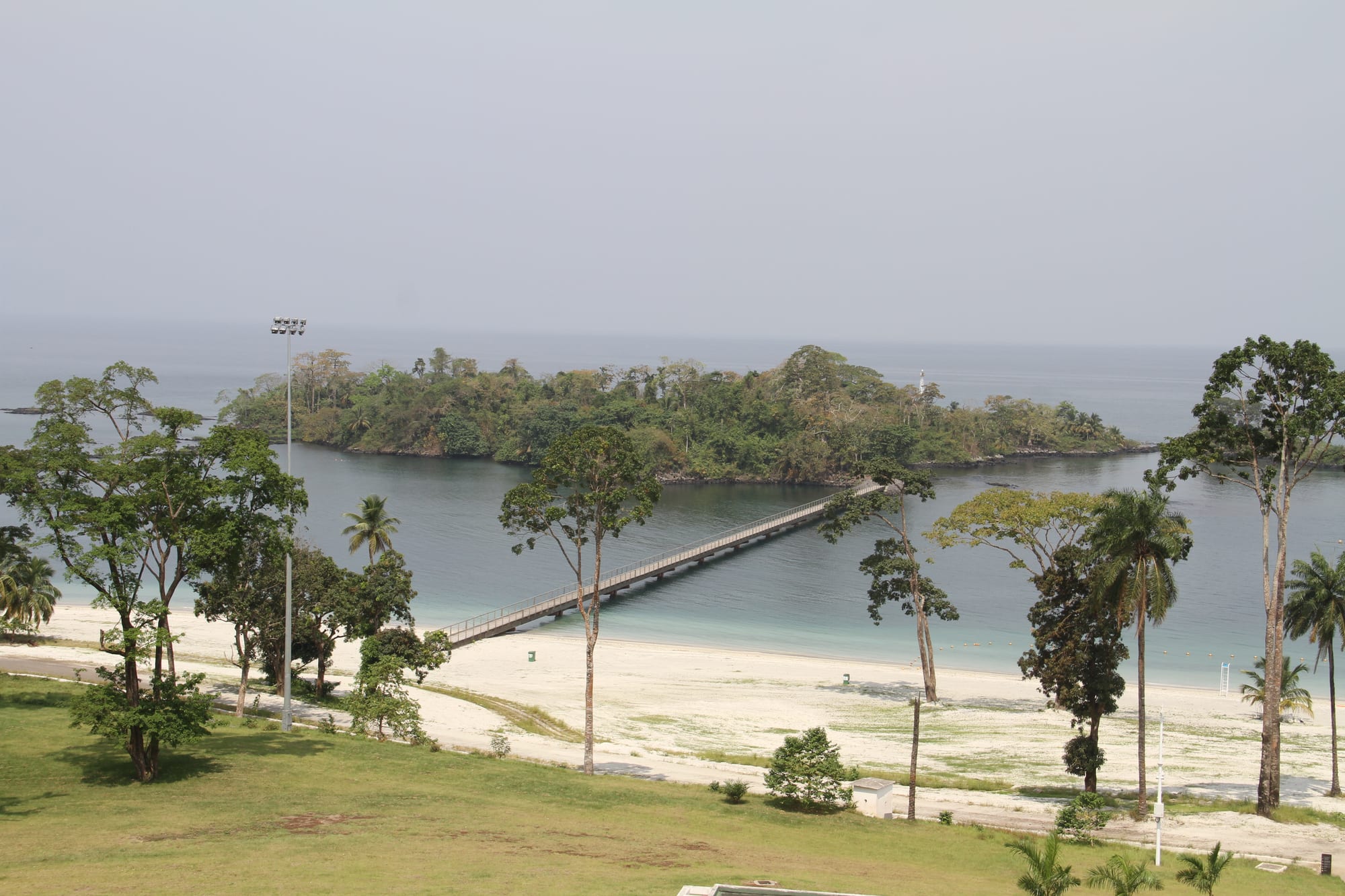
A small forested islet joined to a white-sand beach by a long wooden footbridge, with pale turquoise shallows and tall tropical trees in the foreground

Equatorial Guinea

The Islotes Horacio, forested islets linked by a footbridge to the white-sand beach at Sipopo on the island of Bioko. (Denis Barthel / Wikimedia Commons · CC BY-SA 3.0)

A small Central African country of a mainland region and volcanic islands — the only Spanish-speaking state in Africa — with large oil wealth, one of the world's longest-ruling governments, and almost no tourism.

Explore Equatorial Guinea

History

Bioko island (long called Fernando Pó) was home to the Bubi people, and the mainland to the Fang and smaller coastal groups, when Portugal claimed the islands in the fifteenth century and later ceded them to Spain. Britain used Bioko as an anti-slaving base in the nineteenth century, and Spain slowly developed cocoa plantations there, worked partly by contract labour from Nigeria and Liberia.

Spain governed the islands and the mainland enclave of Río Muni together as "Spanish Guinea." Independence came in 1968 under Francisco Macías Nguema, whose rule became one of the most murderous in post-colonial Africa: tens of thousands were killed and far more fled into exile, the economy collapsed, and the country was nearly sealed off from the world.

In 1979 Macías was overthrown and executed by his nephew, Teodoro Obiang Nguema Mbasogo, who has held power ever since and is Africa's longest-serving leader. The discovery of large offshore oil reserves in the mid-1990s made Equatorial Guinea, on paper, one of the richest countries per person in Africa, though the wealth is very narrowly held and human-rights and corruption concerns are long-standing.

Culture & Customs

The two main peoples have distinct cultures: the Bubi of Bioko, historically organised in small farming communities with their own language and spiritual traditions, and the Fang of the mainland, a large Bantu group spread across Gabon and Cameroon too, known for reliquary sculpture and the mvet epic-poetry tradition performed to a stick zither.

Spanish colonial influence left the Catholic Church, the Spanish language, and a Latin-inflected officialdom, and the country keeps cultural ties to Spain and Latin America unusual for the region. Older beliefs and practices, including forms of witchcraft accusation, persist alongside Christianity.

Public cultural life is dominated by the state and the ruling family, and civil society and independent media are heavily restricted, so much cultural expression happens privately or in the diaspora.

  • Equatorial Guinea: The House of the Word — A mostly Catholic nation of Fang, Bubi, Ndowe and Annobonese peoples, where greetings are long, elders come first, marriages bind whole families and music and dance belong to every gathering

Daily Life

Malabo, on Bioko, was the capital until January 2026, when a presidential decree moved that status to Ciudad de la Paz, a lavish planned city still under construction in the mainland forest; Bata, on the mainland, is the largest city. Most of the roughly 1.9 million people live on the mainland.

Despite the oil revenue, a large share of the population lives in poverty, with limited access to clean water, healthcare, and reliable power outside the main cities; social indicators lag far behind the country's income figures. The oil and gas sector employs relatively few people directly, and there is little other formal economy; subsistence farming and fishing sustain much of the mainland.

Daily life is quiet and closely watched, organised around the family, the church, the market, and — where it exists — government or oil-sector work.

Food

Equatoguinean cooking blends Central African staples with Spanish touches. Cassava, plantain, yam, and rice are the bases, eaten with sauces of groundnut, palm oil, and greens, and with fish and bushmeat. Soups and stews, often highly spiced, predominate, and dishes cooked in banana leaves are common.

Pepesup, a spicy fish soup, is the country's signature dish, and bambucha is a sauce of crushed cassava leaves boiled with spices and palm-kernel juice. The Spanish legacy shows in borrowed dishes such as the Spanish tortilla, and weddings and other celebrations bring large banquets. Malamba and topé (palm wine) are the traditional drinks, alongside imported beer and Spanish wine.

Cocoa and coffee, once the plantation economy of Bioko, are still grown on a small scale, and Bioko's rich volcanic soil produces good produce for local markets.

Attractions & Natural Wonders

Tourism is minimal and access is tightly controlled, but the natural setting is genuinely rich. Bioko island is built from overlapping shield volcanoes and rises to Pico Basilé at 3,011 metres, cloaked in rainforest that shelters several monkey species, some of them found nowhere else, and its remote south — the Luba Crater Scientific Reserve, around the Gran Caldera — takes in beaches that host nesting sea turtles.

Malabo itself has a walkable colonial core around the neo-Gothic cathedral, the old Spanish-era buildings around the central plaza, and a dramatic setting between the sea and the volcano's slopes. The small island of Corisco and the Elobey islets off the mainland coast have quiet beaches.

On the mainland, Monte Alén National Park protects a large block of Congo Basin rainforest with forest elephants, gorillas, and chimpanzees, though infrastructure for visitors is very limited. For most travellers, Equatorial Guinea remains a place to understand rather than to tour.

Planning basics

Budget

Equatorial Guinea is very expensive and geared to the oil industry, not tourism. Hotels in Malabo and Bata are priced for expatriates and contractors, there are few independent restaurants or guesthouses, and almost everything is imported. Cash in CFA francs is essential.

Source
Very limited data — verify against current advice.
Daily Budget Midrange
USD 200–400+ per day for hotels, a hired car with driver, and permits
Daily Budget Shoestring
Not realistically applicable

Independent travel is difficult; most visitors come for business or on a guided arrangement.

Source: Very limited data — verify against current advice.

Visa Requirements

A visa is required for almost all nationalities, and Equatorial Guinea has long been one of the hardest countries in Africa to enter. Since July 2023 there is an e-visa, open to any nationality, which must be obtained before travelling; e-visa holders have to arrive at Malabo International Airport. A yellow fever vaccination certificate is mandatory.

Typical Validity
Short single-entry stays; check the current e-visa terms

Apply for the e-visa well ahead of travel and carry all supporting documents and photos.

Safety

Serious crime against visitors is uncommon, but Equatorial Guinea is a tightly controlled state with a heavy security presence, and the main risks are political and bureaucratic: arbitrary detention, harassment at checkpoints, and severe restrictions on photography and on any perceived criticism of the government. There have been coup attempts, and a long-running dispute with Gabon over three small islands was decided by the International Court of Justice in May 2025.

Source
US Department of State and UK FCDO travel advisories — check for the latest wording.

Do not photograph government buildings, the presidential palace, airports, ports, or anyone in uniform; carry documents; and avoid all political discussion in public.

Source: US Department of State and UK FCDO travel advisories — check for the latest wording.

Climate

Equatorial and wet. Bioko island is one of the rainiest places in Africa, with heavy rain much of the year and a drier spell around November to February. The mainland (Río Muni) is somewhat drier, with its main dry season from June to August, and is hot and humid throughout.

Bioko
very wet; drier and cloudier November–February
Mainland
hot and humid; somewhat drier than Bioko, with the main dry season June–August

Transportation

Malabo (on Bioko) and Bata (on the mainland) have the main airports, linked by domestic flights. On Bioko, a ring road circles the island; on the mainland, new highways connect Bata, Mongomo, and Ciudad de la Paz (formerly Oyala), the purpose-built new capital. Travel off the main roads needs 4x4 and permits.

Carry your passport and permits at all times; military and police checkpoints are frequent and photography near them is forbidden.

Best Time to Visit

The relatively drier months from November to February are the most practical for travel and for forest access on Bioko, while the mainland is driest from June to August. Turtle nesting on Bioko's southern beaches runs roughly November to February.

Currency

The currency is the Central African CFA franc (XAF), shared by six countries and pegged to the euro at a fixed rate.

Symbol
FCFA
Cash To Bring
Euros in cash
Currency Code
XAF — Central African CFA franc

Language

Spanish is the main official language — Equatorial Guinea is the only Spanish-speaking country in Africa — alongside French and Portuguese, added to align with regional blocs. Fang is the most widely spoken Indigenous language on the mainland, and Bubi on Bioko, along with Pichi, an English-based creole, and others.

English
Limited
Official Languages
Spanish, French, Portuguese
Main Local Languages
Fang, Bubi, Pichi