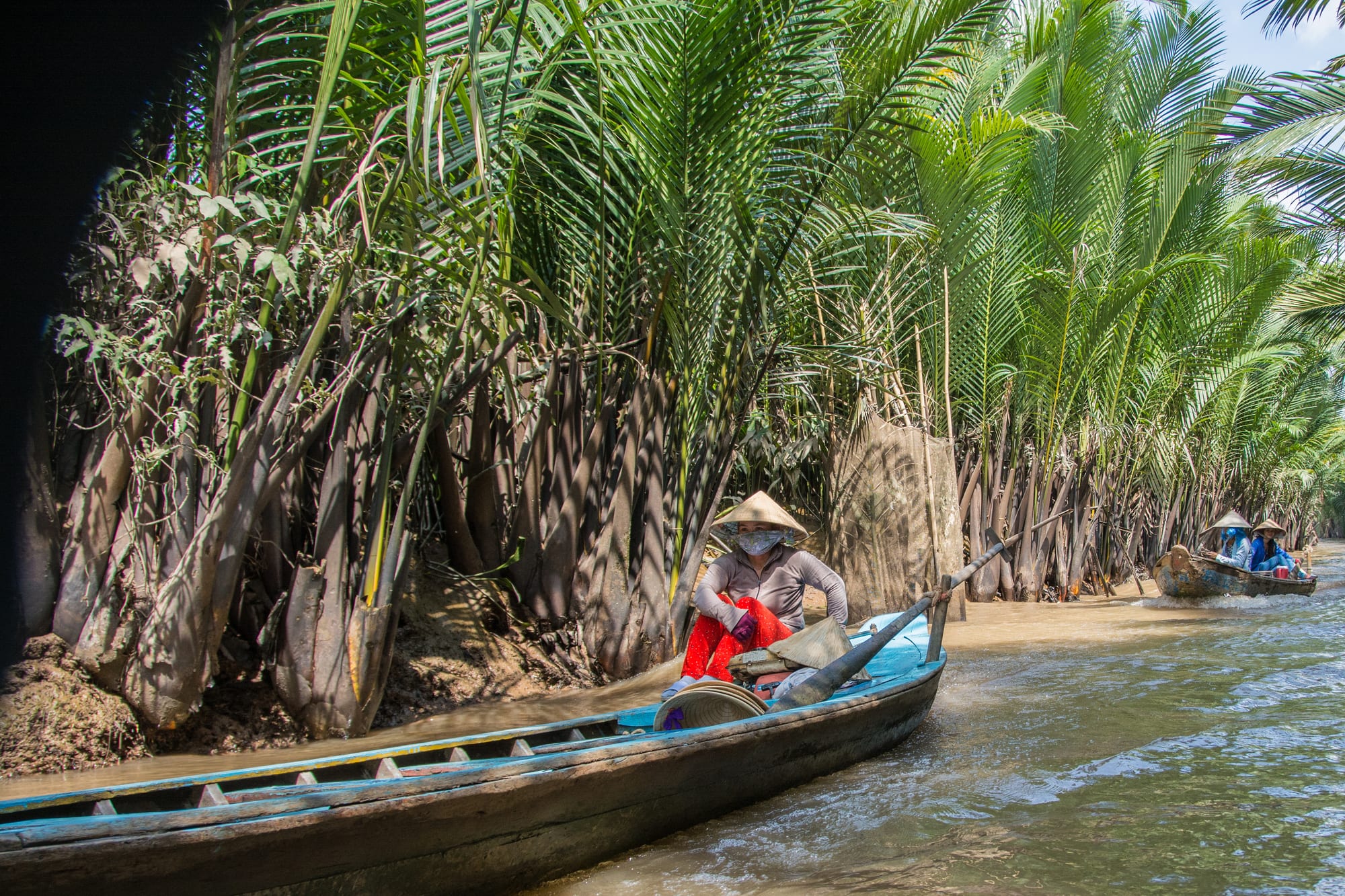
A woman in a conical hat rows a wooden boat along a muddy canal lined with dense water palms

Vietnam

The Mekong Delta

A narrow canal shaded by water palms near Mỹ Tho in the Mekong Delta. (Esin Üstün / Wikimedia Commons · CC BY 2.0)

The flat, water-laced south-western tip of Vietnam, where the Mekong splits into many mouths before reaching the sea — the country's rice and fruit basket, shaped by Funan, the Khmer and Vietnamese settlers, and stretching from Mỹ Tho and Cần Thơ to Châu Đốc, the island of Phú Quốc and the mangroves of Cà Mau.

Explore The Mekong Delta

History

The delta's earliest known civilisation was Funan, an Indianised state of the first centuries AD whose port at Óc Eo, in today's An Giang, traded with India, China and even the Roman world. The region then passed into the Khmer sphere, and for centuries it was part of the Khmer lands, thinly settled among swamps and forests. Its Khmer name for itself, Kampuchea Krom, "lower Cambodia", survives in the name of the Khmer Krom community.

Vietnamese settlers moved south through the 17th and 18th centuries, joined by Chinese refugees, who settled at Mỹ Tho, and by the Chinese exile Mạc Cửu, who ruled Hà Tiên as a semi-independent port. The Nguyễn lords gradually brought the delta under their control, and by the early 19th century it was Vietnamese territory. France took the delta from the 1860s as part of Cochinchina and dug a network of canals that turned it into one of the world's great rice-exporting regions, run by large landlords.

The 20th century was turbulent. The Hòa Hảo Buddhist sect, founded in An Giang in 1939, raised its own militia; Bến Tre's 1960 Đồng Khởi uprising was a turning point for the southern insurgency, and the battle of Ấp Bắc in 1963 was fought in Định Tường province. In 1978 Khmer Rouge forces killed thousands of villagers at Ba Chúc in An Giang. Since the 1980s the delta has become the country's great producer of rice, fish and fruit, and bridges over the Mekong's branches have linked it by road to Ho Chi Minh City.

Culture & Customs

People of the delta, the miền Tây or "west" to other southerners, are famed for easy-going warmth, open hospitality and a fondness for drinking and singing with friends. Life is organised around the water: houses face the canals, children row to school, and markets are held on boats. Đờn ca tài tử, the amateur music of the south, is strongly associated with Bạc Liêu, where the song Dạ cổ hoài lang was composed.

The delta is the most religiously mixed part of Vietnam. The Khmer Krom, most numerous in the former provinces of Trà Vinh and Sóc Trăng, follow Theravada Buddhism, with ornate pagodas and orange-robed monks, and celebrate Ok Om Bok with boat races in the autumn and their own New Year in April. The Hòa Hảo faith, a lay Buddhist movement, is strong in An Giang, and the Cao Đài has temples across the delta. Cham Muslim villages with mosques line the river near Châu Đốc, and Catholic churches rise over many villages.

The Bà Chúa Xứ temple on Sam Mountain, where a goddess statue is honoured, draws huge crowds of pilgrims from Tết through the festival in the fourth lunar month, and Chinese temples in Sóc Trăng and Bạc Liêu show the region's Chinese heritage.

Daily Life

Nearly 16 million people live in the delta, most in villages and small towns spread along the rivers and canals. Cần Thơ, with more than a million people, is the largest city and a regional centre for trade, universities and hospitals; Long Xuyên, Rạch Giá, Mỹ Tho and Cà Mau are the other main towns.

The economy runs on rice, grown in two or three crops a year, catfish and shrimp farms, fruit orchards and coconut. Phú Quốc has boomed with resorts and investment. Incomes are lower than around Ho Chi Minh City, and many young people have left to work in the factories of the southeast. The deepest concern is the delta's future: dams upstream on the Mekong trap sediment, sand mining erodes riverbanks, groundwater pumping makes the land sink, and rising seas and saline intrusion threaten the rice fields.

Days start before dawn at the floating markets and the fishing ports, slow down in the midday heat under hammocks at roadside cafés, and end with families eating and singing karaoke in the evening.

Food

The delta's cooking is based on fish, rice, fruit and fermentation. Cá lóc nướng trui is snakehead fish grilled whole in burning straw and wrapped in rice paper with herbs; lẩu mắm, a hotpot built on fermented fish, is served with a heap of river vegetables and flowers; and cá kho tộ, fish caramelised in a clay pot, is the everyday home dish. Bánh xèo in the delta is made large, with coconut milk in the batter.

Each town has a dish. Mỹ Tho gave its name to hủ tiếu Mỹ Tho, a clear pork and seafood noodle soup; Sóc Trăng has bún nước lèo, a Khmer-influenced noodle soup flavoured with fermented fish, and bánh pía, flaky pastries filled with mung bean and durian. Châu Đốc is known for mắm, fermented fish pastes of every kind, Bến Tre for kẹo dừa, chewy coconut candy, and Cà Mau for its mud crabs.

Phú Quốc makes fish sauce from anchovies, grows black pepper and produces rượu sim, a wine made from rose myrtle berries. The delta's orchards supply most of Vietnam's tropical fruit — durian, rambutan, mangosteen, longan and the Năm Roi pomelo of Vĩnh Long — and markets and orchard homestays serve them fresh.

Attractions & Natural Wonders

The central delta begins at Mỹ Tho, with the Vĩnh Tràng pagoda and boat trips to the river islands, and across the bridge at Bến Tre, whose canals are lined with water palms and coconut groves. Vĩnh Long's An Bình island has orchards and homestays. Cần Thơ is the base for the floating markets: Cái Răng at sunrise, the smaller Phong Điền upriver, the Ninh Kiều waterfront and the Bình Thủy ancient house.

To the south-east, Trà Vinh's Khmer pagodas include Âng pagoda by the Ao Bà Om pond and the Hang pagoda, home to storks; Sóc Trăng has the Bat pagoda and the Clay pagoda. Bạc Liêu has its wind farm on the shore and the house of the "Bạc Liêu prince". Further south, the Ca Mau mangroves reach the southern tip of the mainland in the Mũi Cà Mau National Park, with the U Minh forests inland.

Upriver, Châu Đốc lies near the Cambodian border, with Sam Mountain's temples, the Trà Sư melaleuca forest and the floating fish-farm houses. Đồng Tháp has the sarus cranes of Tràm Chim National Park and the flower village of Sa Đéc.

In the Gulf of Thailand, Phú Quốc island has Sao beach, the Phú Quốc prison museum, pepper farms and fish-sauce factories, and a cable car to the An Thới islands; the mainland coast at Hà Tiên has limestone hills and caves.

Cities in The Mekong Delta

Planning basics

Budget

The delta is one of the cheapest regions of Vietnam. Guesthouses, homestays on the river islands, market food and local buses cost very little, and boat trips are inexpensive when shared. Phú Quốc is the exception: its big resorts, cable car and theme parks are priced for holidaymakers, although budget rooms remain on the west coast.

Daily Budget Midrange
USD 50–130 (riverside hotel or Phú Quốc resort, restaurants, private boat or guided tour)
Daily Budget Shoestring
USD 20–35 (guesthouse or homestay, street food, buses and a shared boat trip)

Book a private boat for Cái Răng through the hotel the night before, and leave early; the market is busiest around sunrise.

Safety

The delta is safe and hospitable. The hazards are the water itself — small boats without life jackets, strong river currents and flooding in the high-water season — along with traffic on the busy national highways and sun and heat on open boats. Rip currents occur on some Phú Quốc beaches in the rainy season.

Wear a life jacket on small boats, carry water and a hat, and follow flag warnings on Phú Quốc's beaches. Check current official travel advice before travelling.

Climate

The delta is hot all year, around 25–34°C, with a wet season from roughly May to November and a dry season from December to April. From about August to November the upper delta around Châu Đốc and Đồng Tháp floods in the annual high-water season. In the late dry season salt water pushes up the rivers, and drought and saline intrusion have become serious problems. Phú Quốc is driest and calmest from November to April.

Summer
hot and humid with heavy afternoon rain, 26–33°C; rising water in the upper delta
Winter
dry and sunny, 23–33°C; calm seas around Phú Quốc

Transportation

Most visitors arrive by road from Ho Chi Minh City: Mỹ Tho is about two hours away, Cần Thơ three to four. Cần Thơ, Phú Quốc, Rạch Giá and Cà Mau have airports, with Phú Quốc also receiving international flights, and ferries run to the island from Rạch Giá and Hà Tiên. Big bridges have replaced most car ferries on the main rivers, but boats are still the way to see the canals, and a river route links Châu Đốc with Phnom Penh.

Base in Cần Thơ for the central delta, and fly or take the ferry to Phú Quốc rather than trying to add it to a road trip.

Best Time to Visit

December to April is the most comfortable time, with dry weather, full markets and the best beach season on Phú Quốc. The flood season from September to November shows the upper delta at its most striking, with flooded fields, lotus and fishing boats among the trees, though some paths are under water. Tết brings flower markets to Sa Đéc and packed roads as families go home.