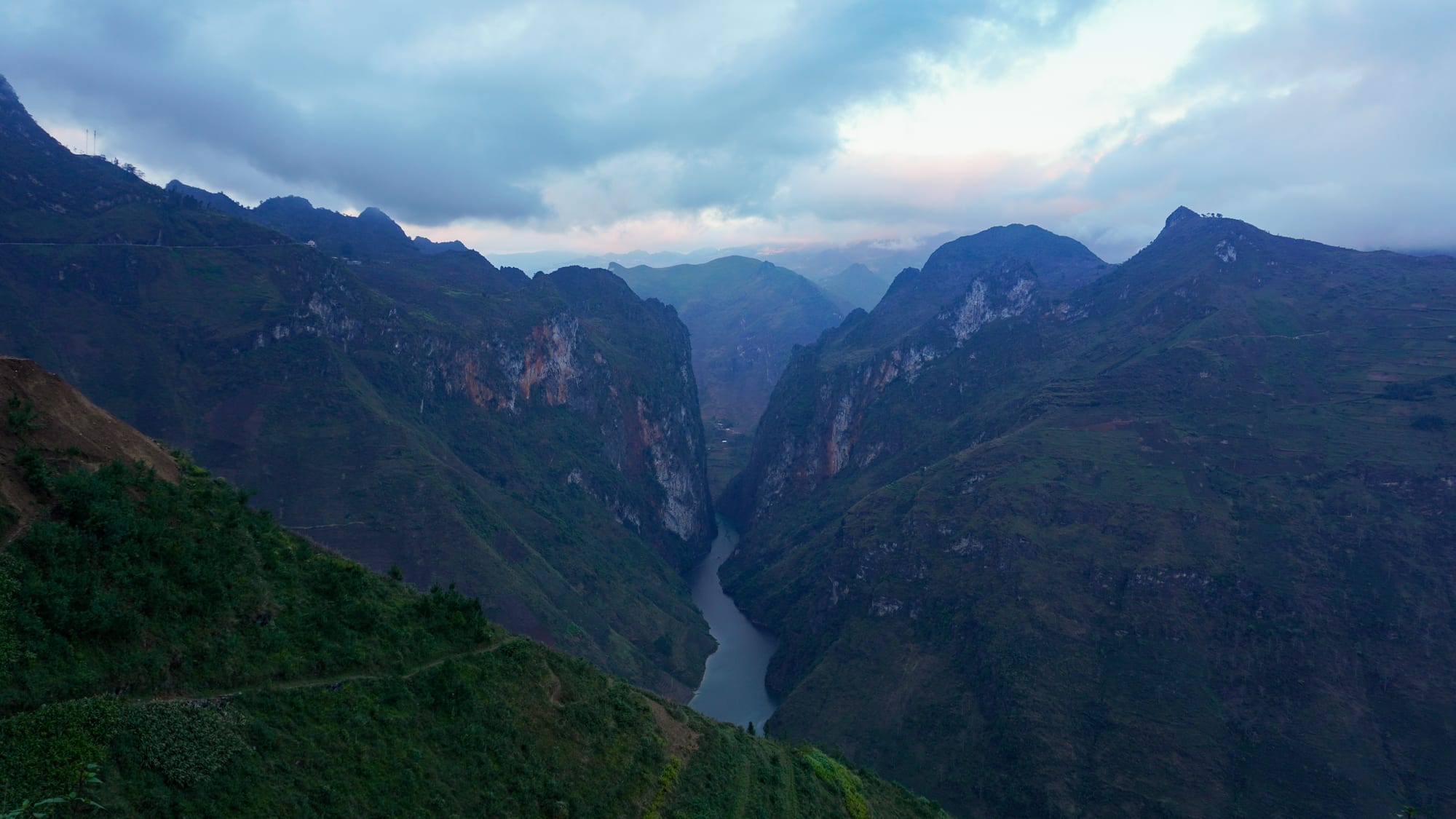
Steep green mountains and grey cliffs falling into a narrow canyon with a river at the bottom under a cloudy sky

Vietnam

Hanoi & the North

The Tu San canyon and the Nho Que River seen from the Ma Pi Leng pass in Ha Giang. (NKSTTSSHNVN / Wikimedia Commons · CC BY-SA 4.0)

Northern Vietnam, from the capital Hanoi and the flat, crowded Red River Delta out to the karst seascape of Ha Long Bay and up into the mountains along the Chinese and Laotian borders — the cradle of the Vietnamese state and the home of Hmong, Dao, Tày and Thái hill peoples.

Explore Hanoi & the North

History

The Red River Delta is where the Vietnamese story begins. The Bronze Age Đông Sơn culture cast its great decorated drums here, and legend places the Hùng kings of Văn Lang in the hills of Phú Thọ; the spiral citadel of Cổ Loa, just outside Hanoi, is linked to King An Dương Vương in the 3rd century BC. Under Chinese rule the delta was the heart of the province of Jiaozhi, and it was here that the Trưng sisters rose in AD 40 and that Ngô Quyền won independence at the Bạch Đằng River in 938, by planting iron-tipped stakes in the riverbed.

The first independent dynasties ruled from Hoa Lư in Ninh Bình until Lý Thái Tổ moved the capital to Thăng Long — today's Hanoi — in 1010. The Trần kings, whose family came from Nam Định, beat back the Mongols three times in the 13th century, again on the Bạch Đằng in 1288. Thăng Long remained the royal city until the Nguyễn moved the court to Huế in 1802.

France took the delta in the 1880s and made Hanoi the capital of French Indochina, laying out its boulevards and opera house, and built the railway up to Lào Cai and Yunnan. The Việt Minh war was won in these mountains, at Điện Biên Phủ in 1954, and Hanoi became the capital of North Vietnam. American bombing struck Hanoi and Hai Phong, notably at Christmas 1972, and in 1979 Chinese forces crossed the border and devastated towns such as Lạng Sơn and Cao Bằng. Since Đổi Mới the delta has industrialised rapidly, and the 2025 reform merged many of its provinces into larger units.

Culture & Customs

Northerners see themselves as the keepers of Vietnamese tradition. Since 1975 the national language has shifted towards the northern dialect, speech is more formal than in the south, and the Confucian habits of scholarship and ancestor worship run deep — students still pray for exam luck at the Temple of Literature. Village communal houses (đình), pagodas and guardian-spirit festivals fill the delta calendar in the weeks after Tết, including the Perfume Pagoda pilgrimage and the Hùng Kings' festival in Phú Thọ, whose worship is UNESCO intangible heritage.

The delta is rich in performing arts. Water puppetry, with lacquered figures moving across a flooded stage, grew out of village ponds here; Bắc Ninh's quan họ love duets, sung in call and response, are UNESCO intangible heritage, as is the ca trù sung poetry of old Hanoi. Craft villages specialise by the lane: Bát Tràng ceramics, Đông Hồ woodblock prints, Vạn Phúc silk. Nam Định and Ninh Bình hold some of the country's oldest Catholic communities, with church spires rising over the rice fields.

The mountains are a different world. Hmong, Red Dao, Tày, Nùng, Thái, Giáy and Lô Lô peoples keep their own languages, embroidered and indigo-dyed dress, and weekly markets that are social occasions as much as trade. Hospitality is expressed with corn wine.

Daily Life

Hanoi, with around 8.5 million people across its wide territory, is the political and cultural capital: ministries, universities and embassies, an Old Quarter where families live above their shopfronts, and new towers spreading west. Hai Phong, with around 4.7 million since absorbing Hải Dương in 2025, is the north's port and heavy-industry city; Ha Long and Cẩm Phả live from coal and tourism, and Nam Định, Thái Nguyên and Việt Trì are older industrial towns.

The delta's recent story is factories. Samsung makes phones at huge plants around Hanoi, including Thái Nguyên, and industrial parks along the expressways to Hai Phong assemble electronics for export, drawing workers from the villages and the uplands. Rice is still grown on every spare field, often by older relatives while the young work shifts. In the mountains, farming, forestry and homestay tourism are the mainstays, and incomes remain far below the delta's.

Hanoi's day starts before dawn with exercise groups around Hoàn Kiếm Lake, continues with phở on a plastic stool, and ends at bia hơi corners. The lake's surrounding streets close to traffic on weekend evenings. Congestion, winter smog and the conversion of paddy into housing are the city's everyday complaints.

Food

Northern cooking is more restrained than the south's — less sugar, fewer herbs, cleaner broths. Hanoi claims phở as its own and serves it with little garnish; bún chả, grilled pork patties and belly in a sweet-sour dipping broth with rice noodles, is the lunchtime dish, and chả cá Lã Vọng, turmeric-marinated fish fried at the table with dill and spring onion, has its own street. Bún thang, a delicate chicken, egg and pork noodle soup, and bánh cuốn, steamed rice rolls filled with pork and wood-ear mushroom, round out the breakfast repertoire, and in autumn Hanoi eats cốm, flattened young green rice.

Along the coast, Hai Phong is known for bánh đa cua, a crab broth with flat red rice noodles, and Ha Long for chả mực, pounded squid cakes. Hải Dương makes bánh đậu xanh, crumbly mung-bean sweets, and Ninh Bình mountain goat and cơm cháy, crisp fried rice crust.

The uplands cook with smoke and fire: thịt trâu gác bếp, buffalo meat dried over the kitchen hearth, cơm lam, sticky rice cooked in bamboo tubes, and the Hmong thắng cố, a stew of horse meat and offal served at markets. Thái Nguyên grows the north's best-known green tea, and the mountains distil rượu ngô, a strong corn spirit.

Attractions & Natural Wonders

Hanoi rewards several days: the Old Quarter's trade streets and Hoàn Kiếm Lake with its Ngọc Sơn temple, the Temple of Literature, the Hồ Chí Minh Mausoleum and One Pillar Pagoda, the Imperial Citadel of Thăng Long, the opera house of the French Quarter, the Hỏa Lò prison museum and the Museum of Ethnology. Day trips reach the Perfume Pagoda, Bát Tràng and Cổ Loa.

East lies the coast. Ha Long Bay's limestone islets and caves are best seen overnight on a boat, with Bái Tử Long Bay to the north as a quieter alternative; Cat Ba Island has a national park home to the critically endangered Cát Bà langur, and beside it Lan Hạ Bay for kayaking. Yên Tử, the sacred mountain of the Trúc Lâm Zen school, rises inland.

South, the Red River Delta opens into flat paddies, pagodas and Catholic churches, ending at Ninh Bình, where boats row through the caves of Tràng An and Tam Cốc, beside the old capital Hoa Lư, the Bái Đính pagoda complex and Phát Diệm's stone-and-wood cathedral.

The mountains rise to the north-west. Mai Châu is a valley of Thái stilt houses set in rice fields, the easiest mountain escape from Hanoi. Sapa's rice terraces fall through the Mường Hoa valley below Fansipan, Vietnam's highest peak, reached by cable car, and Mù Cang Chải has some of the grandest terraces in the country. Điện Biên Phủ preserves its battlefield hills. In the far north, the Ha Giang loop climbs onto the Đồng Văn Karst Plateau Geopark, past the Vương family mansion and over the Mã Pí Lèng pass; further east are Ba Bể Lake and the Bản Giốc waterfall on the Chinese border.

Cities in Hanoi & the North

Planning basics

Budget

The north is as cheap as the rest of Vietnam on the ground. Hanoi's guesthouses, street kitchens and bia hơi corners cost very little, and mountain homestays in Sapa, Ha Giang and Mai Châu are modest. The big extras are a Ha Long or Lan Hạ Bay cruise, which ranges from basic boats to expensive boutique ships, a motorbike and driver for the Ha Giang loop, and the Fansipan cable car.

Daily Budget Midrange
USD 60–130 (boutique hotel, restaurants, a bay cruise or a guided loop with a driver)
Daily Budget Shoestring
USD 25–40 (hostel or homestay, street food, sleeper buses)

Compare Ha Long cruises on what is included rather than price alone, and pay homestays in the mountains in cash.

Safety

The north is safe for visitors. The real risks are traffic in Hanoi, where crossing the road takes steady nerve, and on the mountain roads, which are steep, narrow and subject to landslides in the rainy season; motorbike crashes on the Ha Giang loop are the most common serious incident. Winter air pollution in Hanoi can be severe, and typhoons periodically halt cruises.

Wear a helmet, avoid riding mountain passes in rain or after dark, and check the air-quality index in Hanoi in winter. Check current official travel advice before travelling.

Climate

Unlike the south, the north has a real winter. Hanoi and the delta are hot and humid from May to September, often above 32°C, with heavy downpours and typhoons that can close the bays; from December to February they turn grey and cool, with a fine drizzle and temperatures in the teens. The mountains are cooler all year: Sapa and the Đồng Văn plateau can see frost and, in rare cold snaps, snow.

Summer
hot, humid and wet, 30–36°C in Hanoi; milder in the mountains, with landslide-prone rains
Winter
cool and damp, about 12–20°C in Hanoi; near freezing on cold nights in Sapa and Ha Giang

Transportation

Hanoi's Nội Bài airport is the hub, with Cat Bi at Hai Phong and Vân Đồn in Quảng Ninh as secondary airports. Expressways put Ha Long about two and a half hours from Hanoi and Ninh Bình about two; the overnight train to Lào Cai and a short road transfer, or a direct sleeper bus, reach Sapa. Ha Giang town is a long bus ride north, and most visitors ride the loop over three or four days, many on the back of a local driver's motorbike. Cat Ba is reached by bus and ferry via Hai Phong or by boat across the bay.

Take the train or a sleeper bus to the mountains rather than driving yourself, and hire a local rider for Ha Giang unless experienced on mountain roads.

Best Time to Visit

March to May and September to November are the best months: warm, drier days and clear views in the mountains. The terraces are green from about June and turn gold before the harvest in September, which is the classic time for Sapa and Mù Cang Chải, while buckwheat flowers colour the Ha Giang plateau in October and November. Summer brings typhoon cancellations on Ha Long Bay; Tết in January or February closes much of Hanoi for several days.