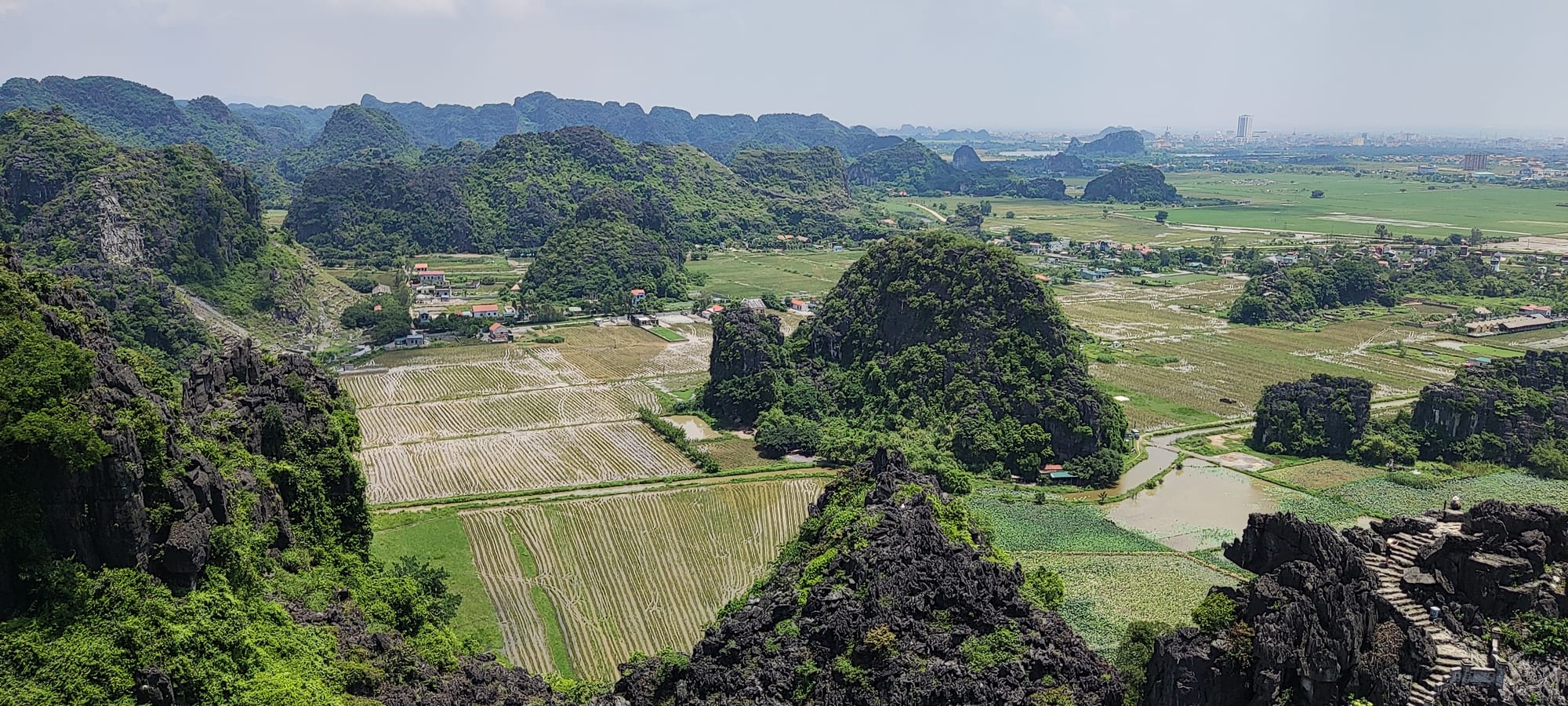
Limestone towers rising from flat rice fields and waterways, with a distant town on the horizon under a hazy sky

Hanoi & the North, Vietnam

Ninh Binh

The karst towers and rice fields near Ninh Binh, seen from the steps above Hang Múa. (Shyamal / Wikimedia Commons · CC BY-SA 4.0)

A provincial city at the southern edge of the Red River Delta, where the flat rice plain meets a belt of limestone towers cut through by slow rivers. It is the base for Tràng An and Tam Cốc, where rowing boats pass through flooded caves, and it stands beside Hoa Lư, the walled capital of Vietnam's first independent dynasties in the 10th century.

Neighbourhoods

  • The city centre
    • Close to public transport
    • Best for food
    • Budget hotels

    An ordinary working Vietnamese town on the Đáy River, built around the railway station, the market and a few wide boulevards. Few visitors come for the centre itself, but it has the cheapest rooms, the train and bus connections and the restaurants where residents eat.

    Open in Maps
  • Tam Cốc and Văn Lâm
    • First-time visitors
    • Homestays
    • Cycling

    A village strip about seven kilometres south-west of the centre, at the boat pier where the Ngô Đồng river runs into the karst. It has become the main place to stay, with homestays, bungalows, bicycle hire and restaurants along lanes between rice fields.

    Open in Maps
  • Trường Yên and Hoa Lư
    • Historic district
    • Quiet and residential

    The valley north-west of the city, enclosed by limestone walls, where the temples of the 10th-century capital stand among villages and paddies. It is rural, quiet and close to the Tràng An boat stations.

    Open in Maps
  • Ninh Xuân and the Tràng An approach
    • Views
    • Quiet and residential

    Scattered hamlets between the city and the karst, near the Hang Múa steps and the Tràng An piers, with newer guesthouses and resorts set against the rock faces and a great deal of building in progress.

    Open in Maps
  • Kim Sơn and the coast
    • Local life
    • Churches

    The reclaimed land south-east towards the sea, a centre of Vietnamese Catholicism with Phát Diệm's cathedral at its heart, along with rush weaving, shrimp ponds and the distilling of the province's best-known rice wine.

    Open in Maps

Things to do

The karst and its waterways

  • Tràng An Landscape Complexlandmark

    A UNESCO World Heritage Site listed for both its landscape and its archaeology, where rowing boats thread a circuit of flooded caves between limestone towers.

    Open in Maps
  • Tam Cốclandmark

    The three caves of the Ngô Đồng river, rowed through between rice fields and cliffs on the classic boat trip south-west of the city.

    Open in Maps
  • Hang Múaviewpoint

    A stairway of several hundred stone steps up a limestone hill to a dragon sculpture and a small pagoda, giving the wide view over the valley.

    Open in Maps
  • Bích Độnglandmark

    A temple complex of 1428, built in three levels into a cliff face above a lotus pond and reached across a stone bridge near Tam Cốc.

    Open in Maps
  • Vân Long Wetland Nature Reservepark

    A flooded wetland north of the city, punted in flat-bottomed boats, and the refuge of the critically endangered Delacour's langur, the only place the species can be seen in the wild.

    Open in Maps

Temples and history

  • Hoa Lưlandmark

    The capital of the Đinh and early Lê dynasties from 968, defended by limestone ridges, with temples to Đinh Tiên Hoàng and Lê Đại Hành standing on the palace site.

    Open in Maps
  • Bái Đính Templelandmark

    A very large modern Buddhist complex begun in the 2000s beside an older cave pagoda, with long corridors of arhat statues and a towering bell.

    Open in Maps
  • Phát Diệm Cathedrallandmark

    A stone and ironwood cathedral built in 1891 in the style of a Vietnamese communal house, about twenty kilometres south-east in Kim Sơn.

    Open in Maps
  • Thái Vi Templelandmark

    A small stone temple in the fields beyond Tam Cốc, built where Trần kings retreated during the Mongol invasions of the 13th century.

    Open in Maps

Short trips from the city

  • Cúc Phương National Parkpark

    Vietnam's first national park, declared in 1962, with limestone forest, prehistoric cave sites and rescue centres for primates and turtles.

    Open in Maps
  • Kênh Gàattraction

    A riverside village north-west of the city known for hot springs and for houses built along the water.

    Open in Maps
  • Tam Điệpattraction

    The pass and hills south of the city where Vietnamese armies gathered before the campaign that drove Qing forces out of Thăng Long in 1789.

    Open in Maps

Seasonal events

  • Tết Nguyên ĐánJanuary or February

    The lunar new year, followed by weeks of village and pagoda festivals across the province and by crowds at Bái Đính.

  • Hoa Lư festivalthird lunar month, usually April

    Processions, water-fetching rites and folk games at the temples of the old capital, commemorating the founding of the Đinh dynasty.

  • Bái Đính spring festivalfrom the sixth day of the first lunar month, usually February

    A large pilgrimage festival that draws coachloads of visitors to the hillside complex through the first months of the year.

  • The golden rice at Tam Cốclate May and June

    The rice between the karst towers ripens and is cut, the short season when the valley turns yellow and boat traffic is heaviest.

Eat and drink

Long-standing places and food districts in Ninh Binh. Hours, ratings and directions come from your maps app, always current.

Ninh Binh classics

  • Goat restaurantsrestaurant

    Dê núi, goat raised on the limestone hills, is the provincial speciality — steamed and sliced thin with lemon leaf and fermented sauce, grilled, or minced into a salad.

    Open in Maps
  • Cơm cháy kitchensrestaurant

    Rice crust cut from the bottom of the pot, dried and deep-fried into golden sheets, served with a rich goat or beef sauce and also sold in packets as a snack.

    Open in Maps
  • Miến lươn stallsrestaurant

    Glass noodles with eel, either in a clear broth or stir-fried dry with crisp shallots, a morning dish across the delta and a local favourite here.

    Open in Maps

Markets and food streets

  • Ninh Bình central marketmarket

    The city market, with river fish, delta vegetables, mountain snails in season and cooked-food stalls around the edges.

    Open in Maps
  • The restaurant streets of the city centreneighborhood

    Blocks near the station where goat houses, hotpot restaurants and beer tables serve residents and passing travellers rather than tour groups.

    Open in Maps
  • Tam Cốc's homestay kitchensneighborhood

    Family-run places along the lanes at Văn Lâm cooking set Vietnamese dinners, along with a run of cafés and bars aimed at foreign visitors.

    Open in Maps

Experience Ninh Binh

History

This corner of the delta was inhabited long before the Vietnamese state existed: caves in the limestone around Tràng An have yielded evidence of human occupation stretching back tens of thousands of years, one of the reasons the area was listed by UNESCO for its culture as well as its landscape. The defensive value of the karst is the thread running through everything that followed.

In 968 Đinh Bộ Lĩnh, having defeated the warlords who divided the country after the end of Chinese rule, declared himself emperor and built his capital at Hoa Lư, in a valley ringed by limestone walls a few kilometres north-west of the modern city. The Đinh and then the early Lê ruled from here for a little over forty years, until Lý Thái Tổ judged the site too cramped for a growing state and moved the court to Thăng Long in 1010. Hoa Lư became a country town with imperial temples, and the Trần kings later retreated into these same hills during the Mongol invasions.

The modern city grew up on the Đáy River as a provincial and market centre, and was fought over and heavily damaged during the wars of the 20th century, lying on the main road and rail line south from Hanoi. Kim Sơn district, reclaimed from the sea in the 1820s, became a stronghold of Vietnamese Catholicism. Tourism arrived late: Tam Cốc drew visitors from the 1990s, Tràng An's boat routes were developed from the 2000s, and the World Heritage listing in 2014 turned a quiet province into one of the country's busiest destinations. In January 2025 Ninh Bình city and the neighbouring Hoa Lư district were merged into a city called Hoa Lư; six months later Vietnam abolished district-level units altogether, and the province itself was enlarged by a merger with Nam Định and Hà Nam.

Culture & Customs

Ninh Bình carries its history lightly but knows it well. The Đinh and Lê emperors are treated less as distant figures than as local ancestors, honoured at the Hoa Lư temples with processions, water-fetching rites from the Hoàng Long river and folk games each spring. Hát xẩm, the begging songs traced to the Trần dynasty and performed by blind musicians at markets and river landings, is kept alive here by local troupes.

Religion is unusually visible and unusually mixed. Buddhist pilgrimage draws enormous crowds to Bái Đính, while Kim Sơn and the surrounding communes hold one of the oldest and densest Catholic populations in Vietnam, with village churches at close intervals and processions at Christmas and Easter that fill the roads. The stone and ironwood cathedral at Phát Diệm, built by a Vietnamese priest in the form of a communal house, is the emblem of that coexistence.

Village crafts survive in the ordinary way: rush and sedge weaving on the reclaimed coast, stone carving at Ninh Vân, embroidery at Văn Lâm beside the Tam Cốc pier. The shift to tourism has been fast and has changed the manners of the valley, where boat rowing is now allocated by turn among local households and much of a family's income can depend on the season's visitors.

Daily Life

Ninh Bình is a small provincial city by Vietnamese standards, with a population in the low hundreds of thousands, surrounded by densely settled farming communes. Rice remains the base of rural life on the flat land, along with goats on the limestone hills, aquaculture and shrimp ponds towards the coast, and pineapple and fruit on the southern slopes.

Industry matters more than the scenery suggests. Cement works exploit the limestone, a large vehicle assembly plant operates in the province, and garment and electronics factories along the expressway employ tens of thousands, many commuting by motorbike from villages. Tourism is the third leg, employing rowers, drivers, guides and homestay families around Tam Cốc, Tràng An and Bái Đính.

Daily life is early and rural in rhythm: fields worked before the heat, markets finished by mid-morning, children delivered to school by motorbike, and long quiet afternoons broken by the passage of tour coaches. The visible tension is between the two economies — quarrying and factory building on one side, a World Heritage landscape on the other — together with the speed of hotel and resort construction around the karst, the state of rural roads in the wet season, and flooding when the delta rivers rise.

Food

Goat is what Ninh Bình is known for. Dê núi, raised on the limestone outcrops and said to be leaner and firmer for it, appears as dê tái chanh, briefly cooked and sliced thin with lemon leaf, green banana, star fruit and a fermented soybean sauce, as well as grilled, steamed, curried or minced. It is usually ordered with cơm cháy: the crust from the bottom of a rice pot, dried, deep-fried into brittle golden sheets and either served under a thick sauce of goat or beef or sold dry in packets as the province's standard gift.

The rivers and paddies supply the rest. Miến lươn, glass noodles with eel, is a delta staple taken seriously here; ốc núi, small snails that live in the limestone and are gathered mainly in the wet months, are steamed with lemongrass and picked out with a thorn. Cá kho, fish braised slowly in a clay pot with caramel and pepper, is everyday home cooking, and nem chua from Yên Mạc — fermented minced pork wrapped in leaves — is a well-known local product.

Kim Sơn on the coast distils rượu Kim Sơn, a strong clear rice spirit with a national reputation, and the same district grows the rushes woven into mats. Everyday drinking is otherwise the northern pattern: green tea at all hours and bia hơi at pavement tables in the evening.

Planning tools

Budget

Ninh Bình is inexpensive. Homestays and small hotels cost little, food is cheap, and the main outgoings are boat tickets, site entry fees and transport, since the sights are spread over a wide rural area. A bicycle or a hired motorbike covers most of it for very little. Prices rise for Vietnamese holiday weekends and the golden rice season.

Daily Budget Midrange
USD 60–130 (bungalow or resort room, restaurant meals, boat and site tickets, a car with driver)
Daily Budget Shoestring
USD 20–35 (homestay or hostel, local restaurants, bicycle hire, one boat trip)

Carry cash for boat piers and village stalls, and take a hat and water on the boats, which have no shade and take a couple of hours.

Best Time to Visit

Late May and June bring the ripe rice at Tam Cốc, the most photographed weeks of the year. September to November is drier, cooler and less crowded, and March and April are pleasant, though the spring festival season fills Bái Đính and Hoa Lư. Midsummer is hot and humid with heavy rain, and winter is cool, grey and often drizzly.

Suggested Number of Days

One or two days cover the main boat trip and the ancient capital. Three or four allow the quieter waterways, the national park and the coast, and suit anyone cycling between sights rather than taking a car.

First Visit
1–2 days
With Surroundings
3–4 days

Transportation

The sights lie between five and thirty kilometres from the city in different directions, so something on wheels is needed. Bicycles are the usual choice around Tam Cốc, where the lanes are flat and quiet; motorbike hire, motorbike taxis and hired cars with drivers cover the longer distances. Boats are rowed, often with the feet, and are hired by the vessel at fixed piers.

Boat tickets are bought at the official piers rather than from people who approach on the road, and each route takes longer than it looks on a map.

Airport & Station Connections

Trains on the Hanoi–Ho Chi Minh City main line stop in the city centre, about two hours from the capital, and buses and minibuses run frequently down the expressway in a similar time. Many visitors come on a day trip from Hanoi, which makes for a long day. The nearest airport is Hanoi's Nội Bài, roughly two and a half hours away by road.

Walkability

The city centre is small and flat and walks easily, and the lanes around Tam Cốc are pleasant on foot between fields and rock faces. The distances between the main sights are too great to walk, however, and the connecting roads carry fast traffic with no pavement. The Hang Múa staircase is the one demanding climb, several hundred uneven steps in the open.

Safety

The area is safe, with little crime beyond opportunistic theft and occasional overcharging at piers and car parks. The practical risks are road traffic on rural roads, sun and heat on unshaded boats and staircases, and slippery stone steps after rain. Boats can be crowded and life jackets are not always offered.

Agree prices before a motorbike taxi or a boat extra, and take sun protection for the boat trips and the climb. Only ride a motorbike if experienced and licensed, and always with a helmet; hold bags away from the road; drink bottled or filtered water; and check surf conditions before swimming. Check current official travel advice before travelling.

Climate

A humid subtropical climate like the rest of the delta, with a hot wet season from May to September, including the remains of typhoons, and a cool dry season from November to March that often brings overcast skies and fine drizzle rather than real rain.

Summer
hot and humid, generally 29–35°C, with heavy downpours and high humidity
Winter
cool and damp, about 13–20°C, grey and drizzly with occasional colder spells

Local Customs

The temples at Hoa Lư and the pagodas are active places of worship: shoulders and knees covered, shoes off where indicated, and no climbing on altars or statues. Tipping is not expected, though rowers are often given something at the end of a trip. This is also one of Vietnam's most Catholic provinces, and churches follow their own rules of dress and quiet.

Ask before photographing people working in the fields or rowing, keep to the paths between planted rice, and do not buy carved stone or wildlife products offered near the sites.

Common Payment Methods

The currency is the Vietnamese đồng. Hotels, resorts and larger restaurants take cards and QR-code payments; boat piers, village homestays, markets and motorbike taxis want cash. ATMs are plentiful in the city centre and scarce out among the sights.