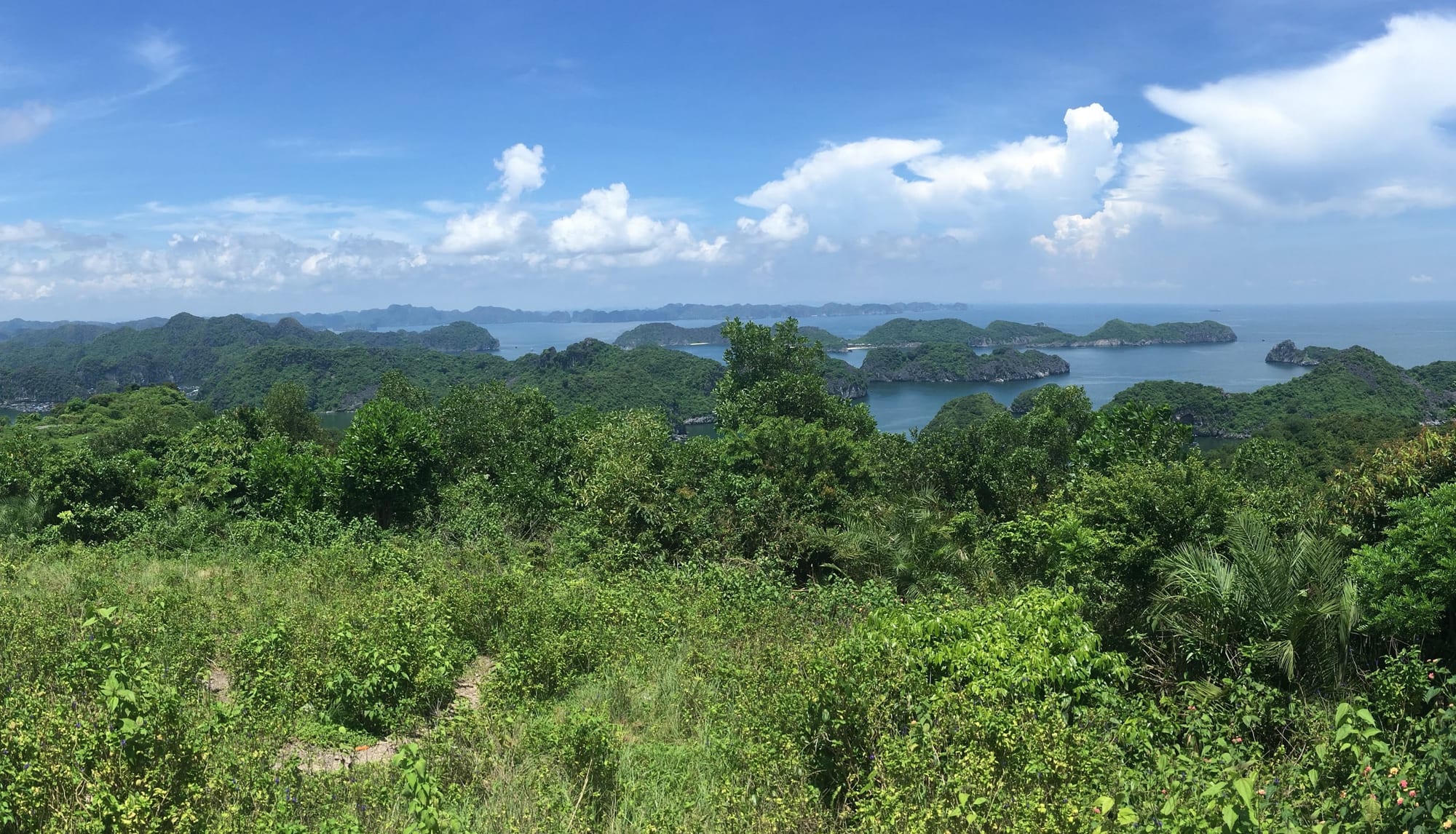
Wooded limestone islands scattered across a blue bay, seen over green hillside scrub under a sky of white clouds

Hanoi & the North, Vietnam

Cat Ba Island

Lan Ha Bay seen from the Cannon Fort viewpoint above Cat Ba town. (Christophe95 / Wikimedia Commons · CC BY-SA 4.0)

The largest island of the Cát Bà archipelago, on the southern edge of Ha Long Bay in the Gulf of Tonkin. Most of it is forested limestone protected as a national park, home to the critically endangered Cat Ba langur, and most of its people live in fishing villages and in Cat Ba town, a harbour of hotels that faces the karst islets of Lan Ha Bay.

Neighbourhoods

  • Cat Ba town
    • First-time visitors
    • Boat trips
    • Restaurants and bars

    The island's main settlement, on the south coast, where the ferries and tour boats tie up. A seafront road of hotels, dive and kayak agencies and seafood restaurants curves around the harbour, with floating fish farms moored offshore and the hills rising straight behind the buildings.

    Open in Maps
  • The town beaches
    • Beaches
    • Swimming
    • Families

    Cat Co 1, 2 and 3 lie in small coves just east of the town, linked to it and to each other by cliff paths and a short road. They are narrow strips of sand backed by hotels and resorts, busy on summer weekends with Vietnamese visitors and quiet out of season.

    Open in Maps
  • Viet Hai and the park villages
    • Quiet and residential
    • Cycling
    • Homestays

    Small farming hamlets scattered inside and around the national park, of which Viet Hai, reached by boat across the bay or by a rough road over the hills, is the best known. Homestays, bicycles and rice fields ringed by limestone make a contrast with the harbour front.

    Open in Maps
  • Cai Vieng and the north
    • Local life
    • Arrivals by ferry

    The northern end of the island, where the ferries from Hai Phong and Ha Long dock and the road runs south through farmland and mangrove to the town. It is working countryside rather than a resort, with fish ponds, quarries and roadside cafés.

    Open in Maps

Things to do

The national park and the bay

  • Cat Ba National Parkpark

    A protected area covering the island's limestone forest, caves and coastal waters, established in 1986 as the first protected area in Vietnam to take in the sea as well as the land, and the stronghold of the Cat Ba langur, which lives nowhere else.

    Open in Maps
  • Lan Ha Bayattraction

    The bay of several hundred karst islets south and east of the island, quieter than Ha Long Bay proper and the usual destination for day boats and kayaks.

    Open in Maps
  • Cat Ba Archipelagoattraction

    The wider group of 367 islands around Cat Ba, a UNESCO biosphere reserve since 2004 and part of the Ha Long Bay – Cat Ba Archipelago World Heritage Site since 2023.

    Open in Maps
  • Ha Long Bayattraction

    The famous seascape of limestone towers immediately north of the archipelago, reached from Cat Ba by boat.

    Open in Maps

Viewpoints and walks

  • Cannon Fortviewpoint

    A hilltop battery on a peak of 177 metres above Cat Ba town, with old bunkers, tunnels and helicopter landing sites and a panorama over the harbour and Lan Ha Bay.

    Open in Maps
  • Ngu Lam peakviewpoint

    A steep forest climb from the national park headquarters to a lookout tower over the wooded limestone interior.

    Open in Maps
  • Trung Trang Caveattraction

    A through-cave in the park's limestone, used as a shelter during the war and now walked with a guide and a torch.

    Open in Maps

Beaches and the water

  • Cat Co beachesbeach

    Three small sand coves east of the town, joined by a cliffside walkway, with calm water and views out to the nearest islets.

    Open in Maps
  • Hospital Caveattraction

    A concrete hospital and shelter built inside a hillside cave during the American war, bomb-proof and secret, and used as a safe house as well as a hospital.

    Open in Maps

Short trips from the island

  • Hai Phongattraction

    The port city on the mainland, reached by ferry and road, with French-era streets, a busy market and the airport most visitors use.

    Open in Maps
  • Ha Longattraction

    The mainland town on the north side of the bay, the other main departure point for cruises and the terminus of the coastal expressway from Hanoi.

    Open in Maps

Seasonal events

  • Cat Ba Island Festivallate March or early April

    The opening of the island's season, marked with boat races, processions and events along the harbour front.

  • TếtJanuary or February

    The lunar new year, when boat crews and restaurants close for several days and families return to the island's villages.

Eat and drink

Long-standing places and food districts in Cat Ba Island. Hours, ratings and directions come from your maps app, always current.

Island classics

  • Cat Ba town seafront restaurantsneighborhood

    The row of open-fronted kitchens along the harbour road, where tanks of crab, prawns, squid and the local sá sùng and ngán clams are chosen and grilled or steamed to order.

    Open in Maps
  • Floating fish farmsrestaurant

    Rafts moored in the bay keep fish and shellfish in pens beneath the platform; some serve visitors who arrive by small boat from the town.

    Open in Maps

Markets and street food

  • Cat Ba town marketmarket

    The morning market a block back from the seafront, with fish landed that day, vegetables brought over from the mainland and stalls selling bánh mì and noodle soups.

    Open in Maps
  • The evening barbecue streetneighborhood

    Charcoal grills set out on the pavement after dark sell skewered squid, scallops with peanuts and spring onion, and bia hơi by the glass.

    Open in Maps

Experience Cat Ba Island

History

People have lived on the island for a very long time: caves in the limestone, among them Cái Bèo above the harbour, have yielded traces of a coastal fishing culture several thousand years old, one of the earliest known in northern Vietnam. The archipelago sits at the mouth of the approaches to Hai Phong, and the waters around it were the route taken by invading fleets defeated on the Bạch Đằng River in 938 and 1288; through later centuries the islands were the preserve of fishing communities who lived much of their lives afloat.

Under French rule the island was a minor military and fishing outpost, and its hills were fortified, leaving the gun batteries that survive above the town. Its modern identity was shaped by the wars of the twentieth century. The island still holds a spring festival on the harbour front for the start of the season; during the American war the archipelago lay beside the bombed port of Hai Phong and the mined approaches to it, and a hospital and shelter were hollowed into a hillside cave to keep working through the raids.

After reunification Cat Ba remained a quiet district of fishing hamlets and terraced fields. The national park was established in March 1986, the first protected area in the country to include a marine zone. Tourism grew from the 1990s, first as a cheap alternative to the Ha Long Bay cruises and then in its own right, filling the harbour front with hotels; the archipelago became a UNESCO biosphere reserve in 2004 and was added to the Ha Long Bay World Heritage Site in 2023, while a sea bridge and new roads have tied the island group more closely to the mainland.

Culture & Customs

The island's culture is that of the northern coast rather than of a resort. Fishing families dominate the older settlements, and many kept floating houses moored in the bays until the authorities moved most of them ashore; the rhythm of tides, catches and boat maintenance still orders the week for a large part of the population. Village pagodas and communal houses hold their festivals in the weeks after Tết, and shrines to the sea and to local spirits stand at landing places, where offerings are made before long trips.

Cat Ba town itself is a mixed place: island families, workers from Hai Phong and the delta provinces who come for the season, and a long-standing international climbing community drawn by the limestone of the bay. Climbing arrived in the 2000s and has left a small, informal culture of guides, bars and equipment shops, and it sits alongside kayaking and diving as the island's outdoor pursuits.

Conservation is part of local identity, if sometimes uneasily. The Cat Ba langur, a golden-headed monkey found nowhere else, fell to about forty animals in 2003 before a long-running protection project began to reverse the decline, though fewer than seventy are thought to remain, and the langur appears on signs, shopfronts and school walls across the island. Residents argue among themselves about the pace of hotel building, the pressure on water and the balance between the bay's traffic and the reasons visitors come.

Daily Life

Cat Ba town holds around eight thousand people, and the wider Cát Hải special zone, which takes in the smaller island to the west as well, some forty thousand; the island's population swells many times over on summer weekends. Cat Ba town holds most of the shops, schools and offices; outside it, hamlets sit in pockets of flat ground among the karst, farming small fields, keeping goats on the slopes and working fish ponds and oyster and pearl rafts in the sheltered inlets.

Tourism, fishing and aquaculture are the economy, with a share of residents commuting to work in Hai Phong's factories and port. The season runs roughly from April to September, after which much of the harbour front closes down and families turn to repairs and to the fishing that carries them through winter. Fresh water is a limited resource on limestone, electricity and supplies come across the water, and rubbish disposal is a recurring local complaint.

The day starts early, with the market busy soon after dawn and boats leaving before the heat. Afternoons are slow, and the seafront fills again in the evening with families walking, children swimming off the piers and grills lit along the pavement. In winter the town is markedly quiet, the hotels shuttered and the loudest thing on the harbour the maintenance of engines.

Food

Seafood defines eating here, and it is usually treated simply. Crab, squid, prawns, mantis shrimp and reef fish are kept live until ordered, then steamed with ginger, grilled over charcoal or cooked into a sour soup. Two local specialities carry the island's name beyond it: sá sùng, a sandworm dug from the tidal flats, dried and either fried until crisp or used to sweeten broths, and ngán, a thick-shelled clam from the bay that is grilled, steamed or steeped in rice wine.

The wider Hai Phong tradition supplies the everyday dishes. Bánh đa cua, a crab broth with flat reddish-brown rice noodles, greens and slices of chả, is the standard breakfast; bánh mì, bún and phở stalls open early around the market, and nem cua bể, square crab spring rolls, are a regional favourite. Grilled scallops topped with peanuts and spring onion oil are eaten in quantity with beer.

Drink is straightforward: bia hơi, the fresh light draught beer of the north, poured from a keg on the pavement; rượu, rice spirit sometimes infused with seahorse or herbs at the seafront restaurants; and iced coffee thick with condensed milk in the morning. Honey, oranges and goat meat come off the island's own hills, and roadside stalls sell rolled rice rolls and steamed cakes to the first ferry passengers of the day.

Planning tools

Budget

Cat Ba is inexpensive by the standards of Vietnamese beach destinations, though prices in the town rise steeply in the Vietnamese summer holidays and fall away in winter. Accommodation ranges from hostel dormitories to resorts on the Cat Co coves. The main variable costs are boat trips into Lan Ha Bay, kayak and climbing guides, and the national park entrance.

Daily Budget Midrange
USD 60–130 (harbour-view or resort hotel, seafood dinners, a private boat or a guided climb, transfers)
Daily Budget Shoestring
USD 20–35 (hostel bed or simple guesthouse, market and street food, shared day boat, rented bicycle)

Bring cash for homestays, boatmen and the park, and settle the price of a boat or a climbing day before setting out.

Best Time to Visit

March to May and September to November are the best months, with warm days, calmer water and clearer air over the bay. July and August are hot and busy with Vietnamese holidaymakers, and typhoons between roughly July and October can stop the ferries and the boat trips for a day or two. Winter is cool, grey and damp, with few visitors and some businesses shut.

Suggested Number of Days

Two to three days suit most visitors, enough for a day on the water and a day in the park. Allow four or five to add climbing, kayaking or an overnight boat, and a day more if arriving by the slower ferry routes.

First Visit
2–3 days
With Surroundings
4–5 days

Transportation

One main road runs the length of the island, north to south between the ferry piers and Cat Ba town. Rented motorbikes and bicycles are the usual way to get around, and minibuses shuttle between the town and the ferries. Everything beyond the road — the islets, the fishing villages, the outer beaches — is reached by boat, from wooden day boats to kayaks hired in the town.

The hill road between the ferry and the town is steep and winding, so ride it slowly and avoid it after dark or in rain.

Airport & Station Connections

There is no airport on the island; Cat Bi airport at Hai Phong is the nearest. Most visitors come from Hanoi, roughly three to four hours away by combined bus and ferry, or cross from Hai Phong by road and ferry, the road running out to the neighbouring island of Cát Hải over a sea bridge of more than five kilometres. Boats also link the island towards Ha Long on the north side of the bay, and tour boats arrive from Ha Long Bay itself.

Walkability

Cat Ba town is small and easily walked end to end along the harbour, and a cliff path leads from it to the Cat Co beaches in a few minutes. The streets climb steeply as soon as they leave the water, and anything outside the town — the park headquarters, the villages, the far beaches — is too far to walk comfortably and needs a bicycle, motorbike or boat.

Safety

The island is safe, with little crime beyond occasional overcharging and opportunistic theft on the beaches. The hazards are practical: winding hill roads ridden by inexperienced visitors, strong sun, jellyfish and currents in summer, unmaintained paths on the limestone, and typhoons that can suspend all sailings at short notice.

Only ride a motorbike if experienced and licensed, and always with a helmet; hold bags away from the road; drink bottled or filtered water; and check surf conditions before swimming. Check current official travel advice before travelling.

Climate

A humid subtropical climate with a hot, wet summer and a cool, dry winter, tempered slightly by the sea. Rain falls mostly between May and September, often in heavy afternoon storms, and the island lies in the path of tropical storms in late summer and autumn.

Summer
hot and humid, typically 28–34°C, with downpours and the risk of typhoons
Winter
cool and often grey, about 15–20°C, with drizzle and sea mist

Local Customs

The island is a fishing community as much as a resort, and life outside the seafront is quiet and early. Modest dress is expected away from the beaches, particularly at village pagodas and shrines, and swimwear stays at the shore. Shoes come off at the door of a homestay. Tipping is not expected, though guides, boat crews and drivers appreciate small amounts.

Ask before photographing fishermen, their boats or the floating farms, and take rubbish off the boats and beaches, since the island's waste system is limited.

Common Payment Methods

The currency is the Vietnamese đồng. Hotels, larger restaurants and tour agencies in Cat Ba town take cards and QR-code payments, but boatmen, homestays, market stalls and the park gate expect cash. There are ATMs in the town, though far fewer elsewhere on the island, so it is worth drawing money before leaving the harbour.