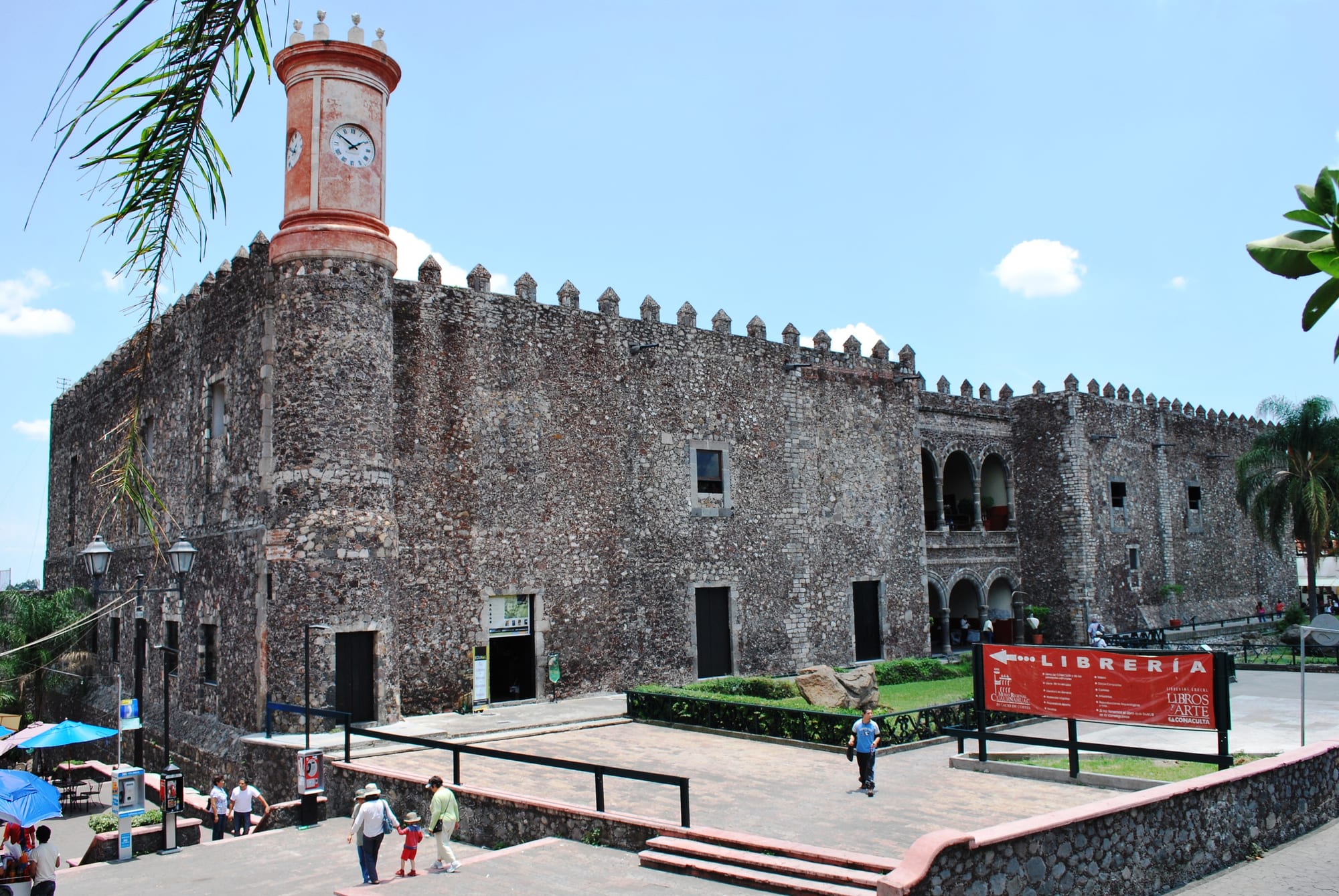
The crenellated grey stone Palace of Cortés with a red clock tower and arcaded loggia under a blue sky

Mexico City & the Centre, Mexico

Cuernavaca

The Palace of Cortés, built for the conqueror in the 1530s, east of the Morelos Garden in central Cuernavaca. (Zoran Lazic / Wikimedia Commons · CC BY-SA 3.0)

The capital of Morelos, about 90 minutes' drive south of Mexico City, built on the Tlahuica town of Cuauhnāhuac and taken by the Spanish in 1521. Cortés's fortified palace and a fortress-like cathedral survive from the conquest era; today it is a sprawling, mild-weather retreat of gardens, ravines and weekend homes, with a large community of foreign residents and Spanish-language students.

Neighbourhoods

  • Centro
    • First-time visitors
    • Historic district
    • Museums

    The historic core around the Morelos and Juárez gardens, together called the zócalo, with the Palace of Cortés on its east side and the cathedral, the Borda Garden and most of the museums a few blocks away. Street food and a handicraft market are close by, and several bus stations are downtown.

    Open in Maps
  • Acapantzingo
    • Quiet and residential
    • Local life

    A former separate village south of the centre, now part of the city, where Emperor Maximilian had a country house. It holds the Museum of Traditional and Herbal Medicine with its ethnobotanical garden, the small 16th-century chapel of San Diego and the San Miguel Acapantzingo park.

    Open in Maps
  • Vista Hermosa
    • Best for food
    • Quiet and residential

    A residential district east of the centre with restaurants, monuments along Avenida Teopanzolco and the Teopanzolco pyramids at its edge.

    Open in Maps
  • Gualupita
    • Local life
    • Close to public transport

    An old barrio beside the Amanalco ravine, with a colonial aqueduct, the Melchor Ocampo park and one of the main bus stations for Mexico City.

    Open in Maps

Things to do

Famous landmarks

  • Palace of Cortéslandmark

    The fortified residence built for Hernán Cortés between 1531 and 1535 over a Tlahuica tribute centre, the oldest surviving colonial civil building on the American mainland. Damaged in 2017, it reopened in 2023 as the Regional Museum of the Peoples of Morelos, with Diego Rivera's murals of Morelos history.

    Open in Maps
  • Cuernavaca Cathedrallandmark

    The 16th-century Franciscan church of the Assumption, built to double as a fortress, with an open chapel on its large atrium; it is one of the early monasteries around Popocatépetl on UNESCO's World Heritage list.

    Open in Maps
  • Borda Gardenpark

    An 18th-century house and terraced garden laid out by the Borda mining family, later Maximilian and Carlota's summer residence, and now a museum and the setting of the city's flower fair.

    Open in Maps
  • Teopanzolcolandmark

    A Postclassic pyramid site within the modern city, east of the centre, where evidence uncovered by the 2017 earthquake pushed the date of its first building back to the 12th century.

    Open in Maps

Museums

  • Robert Brady Museummuseum

    The Casa de la Torre, part of the old monastery beside the cathedral, which the American artist Robert Brady bought in 1960 and filled with his collection of art and objects.

    Open in Maps
  • Museum of Traditional and Herbal Medicinemuseum

    A museum and ethnobotanical garden in Acapantzingo, on land that was a farm of Emperor Maximilian, with workshops on the use of plants.

    Open in Maps
  • Juan Soriano Museum of Contemporary Artmuseum

    The state's contemporary art museum, opened in 2018 east of the centre, with a permanent collection of works by the painter and sculptor Juan Soriano.

    Open in Maps

Short trips from the city

  • Tepoztlánattraction

    A Pueblo Mágico in a valley north-east of the city, known for a 16th-century Dominican convent, its crafts market and unusual ice-cream flavours.

    Open in Maps
  • El Tepoztecolandmark

    A small Postclassic temple to the pulque god Tepoztēcatl on a peak of the Sierra de Tepoztlán above the town, inside a national park.

    Open in Maps
  • Xochicalcolandmark

    A hilltop city at its height between AD 700 and 900, south-west of Cuernavaca, with a ceremonial centre, an observatory and a site museum; it is a UNESCO World Heritage Site.

    Open in Maps

Seasonal events

  • Carnivalthe days before Lent, February or March

    The city's carnival, held since 1965, features the chinelos, the jumping masked dancers of Morelos.

  • Feria de la Florearly May

    A flower fair founded in 1965, when growers from across Mexico exhibit and compete in the Borda Garden.

Eat and drink

Long-standing places and food districts in Cuernavaca. Hours, ratings and directions come from your maps app, always current.

Cuernavaca classics

  • Pozolerías near the cathedralneighborhood

    Pozole, a broth of hominy corn and meat, is a local staple; the city's version includes green pozole made with pipián sauce.

    Open in Maps
  • Street food on the zócaloneighborhood

    Vendors in the Morelos and Juárez gardens sell corn on the cob, snow cones, sweets and fruit drinks.

    Open in Maps

Food districts and markets

  • Adolfo López Mateos Marketmarket

    The city's main market, east of the centre, for produce, cooked food and household goods.

    Open in Maps
  • Tepoztlán's ice-cream shopsneighborhood

    The nearby town is famous for ice creams in unusual flavours made by local families.

    Open in Maps

Experience Cuernavaca

History

People lived around Gualupita, in the north of today's city, by about 1000 BCE. From at least the 12th century the Tlahuica, a Nahua people, had their main settlement here, called Cuauhnāhuac, "near the trees". The town later paid tribute to the Aztecs, and its mild climate drew Aztec rulers. In April 1521, on their way to Tenochtitlan, Spanish troops under Gonzalo de Sandoval, joined by Hernán Cortés, crossed the Amanalco ravine, sacked and burned the town, and celebrated the first mass in Morelos at nearby Acapantzingo.

Cortés made the place his own. He built a fortified palace over a Tlahuica tribute house, finished in 1535, founded the church of San José at Tlaltenango and established one of the first sugar plantations in Mexico, at Atlacomulco. Franciscans raised the monastery of La Asunción, its church built to double as a fortress; it became a cathedral in 1891. In the 18th century the Taxco silver magnate José de la Borda bought a house whose grounds his son turned into a botanical garden, and in 1865 Emperor Maximilian and Carlota made it their summer home.

A railway to Mexico City arrived in 1877. During the Revolution Emiliano Zapata besieged and took the city in 1914 and lost it in 1916. The US ambassador Dwight Morrow kept a weekend house here and in 1929 paid for Diego Rivera's murals in the Palace of Cortés. Mexico City residents moved south in growing numbers from the 1980s, and the 1985 earthquake pushed more to settle. The earthquake of 19 September 2017 killed four people in the city and damaged the palace and the cathedral; the palace reopened as a museum in 2023.

Culture & Customs

The city's identity rests on its climate. Alexander von Humboldt wrote of the region's "perpetual spring", and Cuernavaca is still called the City of Eternal Spring. Since Aztec times its warmth and gardens have attracted rulers and the wealthy, and in the 20th century they attracted writers and foreigners: Malcolm Lowry set his novel Under the Volcano here, and after a Catholic study centre closed in 1969 its teachers stayed on, making Cuernavaca a leading centre for teaching Spanish to foreigners. Language students and a large foreign resident population remain part of the city's life.

Art has a strong place. Rivera's murals of the conquest and revolution in Morelos fill the Palace of Cortés; the Robert Brady Museum keeps an American artist's collection in an old monastery tower; the Juan Soriano museum, opened in 2018, shows contemporary art; and smaller museums cover popular arts, the city's history and old photographs.

The calendar is busy with festivals. The carnival before Lent features the chinelos, dancers in bearded masks and plumed hats whose leaping dance is a Morelos tradition, also famous in Tepoztlán. In early May the flower fair fills the Borda Garden with growers from across Mexico, and the old villages now inside the city keep their own patron-saint feasts, such as that of Nuestra Señora de los Milagros in Tlaltenango in September.

Daily Life

The city had 341,029 inhabitants at the 2020 census, and the metropolitan area, which takes in Jiutepec, Temixco, Emiliano Zapata, Xochitepec, Tepoztlán, Tlaltizapán and Huitzilac, had 1,028,589. The metropolitan area has grown fast since the 1960s and is increasingly tied to Greater Mexico City: many families keep weekend homes here, and some residents commute daily to the capital.

Most of the municipality's economy is retail and services, and about two-thirds of its workers are employed in sectors that depend on tourism. Plant nurseries on the outskirts grow and ship plants, flowers and seeds, and the city has a long tradition of schools teaching Spanish to foreigners. Housing takes up most of the city's land, much of it in middle-class developments such as Rancho Cortés and Rancho Tetela on the outskirts.

The city is cut by deep wooded ravines, the barrancas, which help regulate its climate, and the municipality was declared a forest protection zone in 1937 to protect its aquifers and vegetation. The influx of residents from the capital has put pressure on the city's infrastructure. Weekends are noticeably busier as visitors arrive from the capital.

Food

Pozole is the dish locals point to: a broth of hominy corn and meat, and in Cuernavaca often green, made with pipián sauce, a version served a block from the cathedral. Tacos are everywhere, and taco stands often offer arrachera, skirt steak, a thicker cut than the usual bistec, and the set comida corrida — soup, a small pasta dish, a main course and dessert, with a drink — is the usual weekday lunch.

Around the zócalo vendors sell corn on the cob, snow cones, sweets and fruit smoothies, and the Adolfo López Mateos market east of the centre is the place for produce and cooked food. The surrounding state adds its own specialities: cecina, thin salted and dried beef, from Yecapixtla, and the ice creams of Tepoztlán, made in many unusual flavours. The old villages inside the city keep their own festival food: the feast in Ocotepec is known for mole and pulque, the fermented sap of the maguey, served alongside the dance of the Moors and Christians.

Planning tools

Budget

Cuernavaca is good value by central Mexican standards, though prices rise at weekends and holidays when residents of the capital arrive. A set-price comida corrida lunch is the cheapest good meal.

Daily Budget Midrange
USD 85–200 (mid-range hotel, restaurant meals, first-class buses, site entries and taxis)
Daily Budget Shoestring
USD 35–60 (guesthouse or homestay, market meals and comida corrida, city buses)

Visit midweek for lower prices and quieter roads; the zócalo, the cathedral and the gardens cost nothing to see.

Best Time to Visit

The climate is mild all year, which is the city's main draw. October to April is dry and sunny; from about May the rainy season brings afternoon storms. Carnival before Lent and the flower fair in May are the main events, and weekends and holidays are busiest.

Suggested Number of Days

One or two days covers the centre and its museums. Three or four allow time for the towns and ruins outside the city. Many people come as a weekend trip from Mexico City; Spanish students stay for weeks.

First Visit
1–2 days
With Surroundings
3–4 days

Transportation

City buses cover most of Cuernavaca and the towns around it cheaply; they are not comfortable but are widely used, including by language students. Taxis are plentiful, and radio taxis called by phone are the safer choice. The city is spread over hills and ravines, so most journeys beyond the centre need a bus or taxi.

Call a radio taxi or use an app rather than hailing one in the street.

Airport & Station Connections

Most visitors arrive by road from Mexico City on the toll highway, about an hour and a half to two hours by car. Pullman de Morelos and other companies run frequent buses from the capital's southern bus terminal, around 75 minutes without traffic, and direct buses from Mexico City's international airport. Cuernavaca's own airport, in Temixco, has no scheduled passenger flights.

Walkability

The centre is compact and walkable, with the zócalo, the Palace of Cortés, the cathedral and the Borda Garden a few blocks apart. Beyond it, steep streets, deep ravines and busy avenues break the city up, and walking between districts is slow.

Safety

Safety varies enormously by state and even neighbourhood. Morelos is affected by organised crime, and the usual precautions apply.

Use radio taxis or apps, travel to and from Mexico City by day on the toll road, and keep valuables out of sight. Check current official travel advice before travelling.

Climate

Cuernavaca lies in the tropics but at altitude, and its temperature is fairly constant at 21–26°C, the source of its 'eternal spring' nickname. Temperatures vary across the city: the northern forest areas are cooler and the lower districts more humid.

Summer
warm, within the city's fairly constant 21–26°C range, with a rainy season of afternoon storms from about May to October
Winter
dry and sunny, still within the 21–26°C range by day, with cooler nights

Local Customs

Greetings matter: a handshake or, between friends, a kiss on the cheek. A tip is customary in restaurants. Modest dress is expected in churches, and services should not be disturbed by visitors. The large population of foreign students and residents means people are used to visitors practising their Spanish.

Ask before photographing people, especially dancers and vendors, and remove hats inside churches.

Common Payment Methods

The currency is the Mexican peso. Cards are accepted in hotels, larger restaurants and malls; markets, street stalls and buses need cash. Cash machines are common in the centre and shopping centres; use those inside banks or malls.