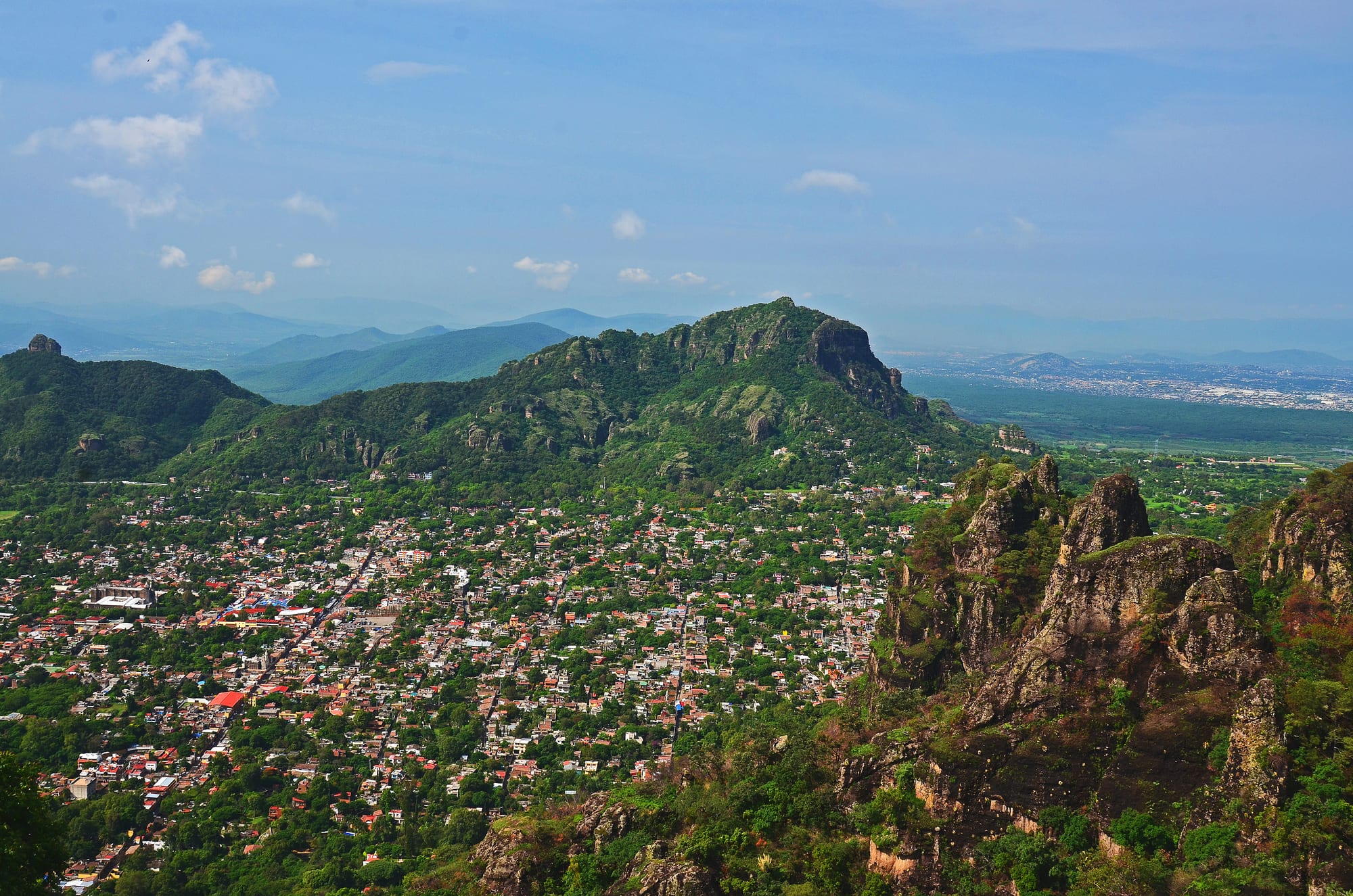
The town of Tepoztlán spread across a green valley, seen from above between forested peaks and rocky cliffs

Mexico City & the Centre, Mexico

Tepoztlán

Tepoztlán in its valley below the cliffs of the Sierra de Tepoztlán. (On^ste82 / Wikimedia Commons · CC BY 3.0)

A small town in the state of Morelos, south of Mexico City, set in a green valley below the sandstone cliffs of the Sierra de Tepoztlán. A clifftop temple to the Aztec god of pulque and a 16th-century Dominican monastery recall its long history; today it lives from weekend visitors, its market, its unusual ice creams and its carnival.

Neighbourhoods

  • Centro
    • First-time visitors
    • Markets
    • Best for food

    The heart of the town around the Dominican monastery and the market, where the weekend tianguis spreads its crafts and food stalls and the street towards the mountain leads to the trail up to the Tepozteco. Most cafés, ice-cream shops and guesthouses are within a few blocks.

    Open in Maps
  • The valley villages
    • Quiet and residential
    • Walks
    • Local life

    The municipality's smaller villages — Amatlán to the east, Santa Catalina to the west and San Juan Tlacotenco high in the forest to the north — each with its own church and fiestas, and quieter places to stay among the hills.

    Open in Maps

Things to do

The mountain and the pyramid

  • El Tepoztecolandmark

    A small temple to Tepoztēcatl, the Aztec god of pulque, built on a peak above the town; the rough trail climbs about 595 metres in 2 km, and people take from 20 minutes to three hours.

    Open in Maps
  • El Tepozteco National Parkpark

    A national park created in 1937 that protects about 230 square kilometres of mountains and forest around the town, part of the Chichinautzin Biological Corridor.

    Open in Maps

The town

  • Tepoztlán Ex Convento Museummuseum

    The Dominican monastery built by the people of Tepoztlán between 1555 and 1580, with a great atrium and corner chapels; it is part of a UNESCO World Heritage Site of early monasteries.

    Open in Maps
  • Museo Carlos Pellicermuseum

    A small archaeological museum behind the monastery, opened in 1965.

    Open in Maps
  • The weekend marketmarket

    The tianguis in the centre, where traditional pottery and handicrafts are sold alongside food stalls.

    Open in Maps

Villages and walks

  • Amatlánattraction

    A village east of Tepoztlán, held by legend to be the birthplace of Ce Acatl Topiltzin Quetzalcoatl, with a waterfall a short hike away.

    Open in Maps
  • San Juan Tlacotencoattraction

    A village in the forest at about 2,350 metres, 5 km north of the town, close to caves such as the Cueva del Diablo.

    Open in Maps

Short trips from the town

  • Cuernavacaattraction

    The capital of Morelos, long a retreat for Mexico City residents because of its warm, stable climate, with the Palace of Cortés in its centre.

    Open in Maps
  • Tlayacapanattraction

    A rural town in north-eastern Morelos whose former monastery of San Juan Bautista, begun in the 1530s, is part of the same UNESCO listing.

    Open in Maps

Seasonal events

  • Carnivalthe three days before Ash Wednesday

    The largest carnival in Morelos, when the jumping chinelos dancers, in masks and plumed hats, fill the streets.

  • Fiesta of the Tepozteco and the Virgin of the Nativity8 September

    The fiestas honouring the town's patroness and the legendary figure of the Tepozteco.

Eat and drink

Long-standing places and food districts in Tepoztlán. Hours, ratings and directions come from your maps app, always current.

Tepoztlán classics

  • Tepoznievescafe

    The best-known of the town's ice-cream makers, famous for unusual flavours.

    Open in Maps
  • Market food stallsmarket

    Stalls in the town market serving tacos, gorditas, quesadillas and the local mole verde.

    Open in Maps

Experience Tepoztlán

History

People have lived in the Tepoztlán valley for a long time: the oldest pottery found here dates to about 1500 BC. In the Postclassic period a small pyramid was built on a peak above the town to Tepoztēcatl, god of pulque, the fermented drink of the maguey; it carries inscriptions dated 1452 and 1502, and one legend says its idol drew pilgrims from Chiapas and Guatemala. The town's name comes from Nahuatl and is usually translated as "place of abundant copper" or "place of the broken rocks". Local legend makes the nearby village of Amatlán the birthplace of Ce Acatl Topiltzin Quetzalcoatl.

Tepoztlán was absorbed into the Aztec Empire under Moctezuma I and fought wars against Cuauhnahuac and Yecapixtla. During the Spanish conquest Hernán Cortés is said to have ordered the town burned when its leaders refused to meet him, as Bernal Díaz del Castillo recorded. Between 1555 and 1580 the Dominicans had the townspeople build a great monastery dedicated to the Virgin of the Nativity, now part of a UNESCO World Heritage Site.

In the 20th century the town became famous beyond Mexico: the anthropologists Robert and Margaret Redfield lived here in 1926–27 and published a classic study of village life, and the surrealist painter Wolfgang Paalen worked here in the 1950s. Tepoztlán was made a Pueblo Mágico in 2002, lost the title in 2009 and regained it in 2010. The 2017 earthquake destroyed 203 homes in the municipality, and in 2020 a forest fire burned 60 hectares of the hills.

Culture & Customs

Tepoztlán holds on to its old legends and traditions. Its legends centre on the Tepozteco, a hero said in one version to have been baptised in 1532 and to have defeated the lords of neighbouring towns in debate; the town honours him and its patroness, the Virgin of the Nativity, with a fiesta on 8 September. Each village in the municipality keeps its own feast days, such as St John's day on 24 June in San Juan Tlacotenco and St Catherine's on 24 November in Santa Catalina.

Carnival is the biggest event of the year — the largest in Morelos — running for three days before Ash Wednesday, when chinelos dancers in masks and plumed hats leap through the streets. Crafts and pottery fill the weekend market, and the town has long attracted artists and people seeking alternative ways of life, drawn by the mountains and the valley.

Land here is held communally and cannot simply be bought. In 2020, during the COVID-19 pandemic, the community blocked the entrances to the town.

Daily Life

The town itself had about 14,000 people at the 2010 census, and the whole municipality about 55,000 in 2020, according to INEGI figures. The municipality borders Mexico City's Milpa Alta borough, one of 17 municipalities that touch the capital. Its villages, among them Amatlán, Santa Catalina and San Juan Tlacotenco, keep their own churches and feast days.

Tourism is now the main source of income, built on the pyramid, the market, the town's traditional atmosphere and its ecological and alternative communities. Farming continues around it — maize, chillies and tomatoes, and livestock — and traditional pottery and handicrafts are made for the weekend market. The national Scout camp school at Meztitla, near the mountain, brings Scouts from around the world.

The rhythm of the week is set by visitors. On weekdays the town is quiet and local; on Saturdays and Sundays day-trippers from Mexico City and Cuernavaca fill the market, the cafés and the trail to the Tepozteco.

Food

Tepoztlán is best known for its ice cream. The town's nieverías, ice-cream makers, offer long lists of exotic flavours, and the local chain Tepoznieves, with several shops around town, lists up to 200, from chocolate to rose petal, fig with mezcal, or carrot with chilli.

The other local signature is mole verde, a green mole based on ground pumpkin seeds, served at fondas and market stalls; mole rojo de guajolote, turkey in red mole made with ancho and guajillo chillies, is another local dish. In the market, cooks turn out tacos, gorditas, thick corn cakes stuffed with fillings, and quesadillas, and tlacoyos and tacos acorazados, a dish from Morelos, are also part of the local kitchen.

The anthropologists who studied the town in the 1920s also published notes on its cooking, an early record of the town's kitchen. Itacates, corn cakes filled with a choice of stews such as chicken tinga, beef or squash blossom, are another local snack.

Planning tools

Budget

Tepoztlán is cheap on weekdays and busier and dearer at weekends and holidays, when visitors from the capital fill its guesthouses and restaurants. Market food is inexpensive, while the boutique guesthouses charge more.

Daily Budget Midrange
USD 85–180 (boutique guesthouse, restaurant meals, site entry and taxis)
Daily Budget Shoestring
USD 35–60 (hostel or simple guesthouse, market food, local buses)

Visit midweek for lower prices and an emptier trail; the market, the monastery atrium and the views cost little or nothing.

Best Time to Visit

October to May is dry, and the clearest weather is in the winter months. The rainy season runs from summer to early autumn, turning the cliffs green but making the trail muddy. Carnival, just before Lent, and the September fiesta are the liveliest times, and weekends are always busier than weekdays.

Suggested Number of Days

Many visitors come from Mexico City for a day or a weekend. A night or two allows a quieter look at the town once the day-trippers leave, and three or four days leave time for the valley villages and other towns of Morelos.

First Visit
1–2 days
With Surroundings
3–4 days

Transportation

The town is small and walkable. Taxis wait at stands in the centre, and local buses run to the surrounding villages and to Cuernavaca.

Take a taxi between the centre and the bus station on the edge of town if carrying luggage.

Airport & Station Connections

Tepoztlán is about an hour south of Mexico City, and buses leave frequently from the southern bus terminal at Tasqueña metro station; the ride takes about an hour and a half depending on traffic, and arrives at a small bus station on the edge of town. Frequent buses also link it with Cuernavaca. The nearest major airport is Mexico City International.

Walkability

The centre is compact and easily walked, though some streets are steep and cobbled. The climb to the Tepozteco is a genuine hike on a rough, steep trail, best done with good shoes and water and at an unhurried pace.

Safety

Safety varies enormously by state and even neighbourhood. The town is generally calm, but Morelos is affected by organised crime. The 2017 earthquake destroyed 203 homes in the municipality and closed the trail to the pyramid for a time, and a forest fire burned 60 hectares of the hills in 2020.

Travel by day on toll roads, start the Tepozteco climb early and turn back in rain, and never light fires in the national park. Check current official travel advice before travelling.

Climate

The climate is temperate with subtropical touches, and the valley is warmer than Mexico City. The rainy season starts in summer and ends at the beginning of autumn, bringing about 1,000 mm of rain a year in the valley.

Summer
wet, with afternoon rain — about 22–27°C by day in Mexico City, and Morelos is warmer
Winter
dry and sunny — about 18–23°C by day across the highlands, with cool nights

Local Customs

Tepoztlán is both a traditional town with communal land and a magnet for artists, spiritual seekers and weekend visitors, and both sides are proud of it. Greet people with 'buenos días'. Tipping is customary in restaurants.

Respect the monastery and churches as working places of worship, carry rubbish down from the mountain, and ask before photographing people in the market.

Common Payment Methods

The currency is the Mexican peso. Cash is essential for the market, street stalls, taxis and many small guesthouses; cards are taken in the larger restaurants and hotels. It is wise to arrive with cash, especially at weekends.