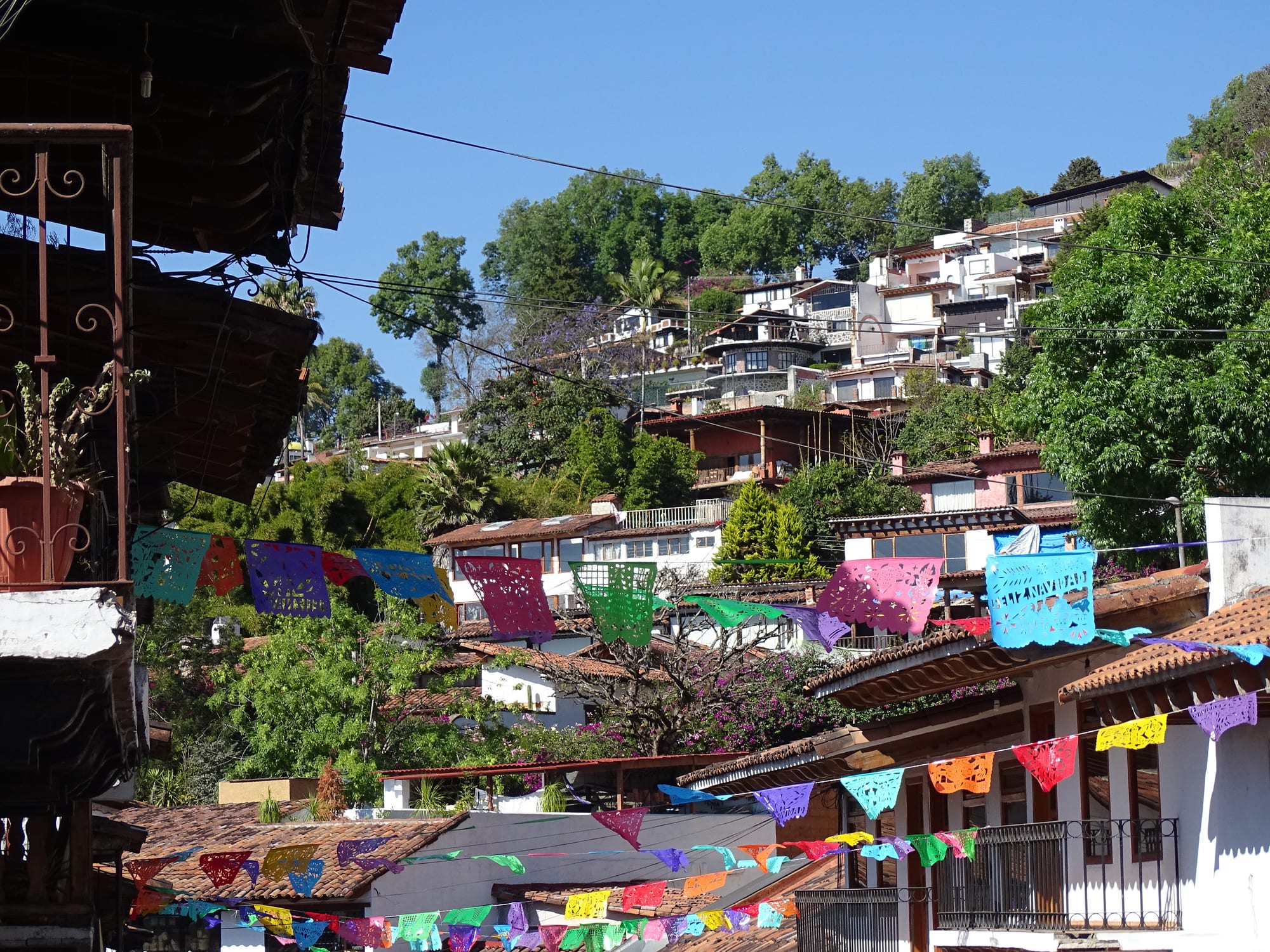
Colourful paper bunting strung across a street of tiled roofs, with white houses climbing a wooded hillside behind

Mexico City & the Centre, Mexico

Valle de Bravo

Papel picado bunting over a street in Valle de Bravo, with houses on the hillside above. (Adam Jones from Kelowna, BC, Canada / Wikimedia Commons · CC BY-SA 2.0)

A colonial town of white walls and red-tiled roofs in the State of Mexico, about 156 km south-west of Mexico City, on the shore of Lake Avándaro, a reservoir created by a dam built between 1938 and 1947. Once a quiet Franciscan mission town, it is now a weekend retreat of sailing clubs, paragliding launch sites and pine-forested hills.

Neighbourhoods

  • Centro
    • First-time visitors
    • Historic district
    • Best for food

    The old town on a small plateau above the lake, with steep cobbled streets of white houses and tiled roofs around the Jardín Central and the parish church of San Francisco. Shops and restaurants are close by.

    Open in Maps
  • The Embarcadero and the lakeshore
    • Waterfront
    • Boat trips
    • Weekend crowds

    The municipal boardwalk and dock on the lake, the town's main attraction, lined with restaurants, some of them floating, and busy with tour boats, water taxis and weekend art sellers.

    Open in Maps
  • Avándaro
    • Quiet and residential
    • Forest walks
    • Golf

    A wooded area just south of the town, with country houses, a golf club and the Velo de Novia waterfall; the hamlet of Tenantongo nearby hosted the 1971 rock festival.

    Open in Maps

Things to do

The town and its churches

  • Embarcadero Municipalattraction

    The boardwalk and dock on the edge of the lake, where boats can be hired for excursions and artists sell their work at weekends.

    Open in Maps
  • Jardín Centralpark

    The main square beside the parish church, with live music at the bandstand on Sunday afternoons and a bust of Nicolás Bravo, after whom the town is named.

    Open in Maps
  • Parroquia de San Francisco de Asíslandmark

    The parish church, first built by the Franciscans with separate naves for Spanish and Indigenous worshippers; a third, main nave begun in the 1950s was finished in 1994.

    Open in Maps
  • Santuario de Santa María Ahuacatlánlandmark

    A church begun as a chapel in 1864, whose main altar holds a revered Black Christ, with large modern canvases linking it to Mazahua legend.

    Open in Maps
  • Museo Joaquín Arcadio Pagazamuseum

    A museum of the region's cultural history named after Joaquín Arcadio Pagaza, with paintings and sculpture by local, national and international artists.

    Open in Maps

The lake, the forests and the sky

  • Velo de Noviapark

    A natural park in the forest near Avándaro where the San Juan creek drops 35 metres as the Bridal Veil waterfall.

    Open in Maps
  • Sailing and water sportsattraction

    The reservoir has more than 40 nautical clubs, and visitors sail, kayak, water-ski and fish for rainbow trout on it.

    Open in Maps
  • Paragliding and hang gliding at El Peñónattraction

    The main launch site, south of the town, which made Valle de Bravo internationally known for aerial sports and hosted the 2009 Paragliding World Championship; tandem flights are offered by local clubs.

    Open in Maps
  • Piedra Herradapark

    A federal reserve for the monarch butterflies 25 km east of town, where the butterflies cluster in the fir trees through the winter; horses and guides can be hired.

    Open in Maps

Short trips from the town

  • Nevado de Tolucaviewpoint

    Mexico's fourth-highest peak, a stratovolcano rising near the city of Toluca.

    Open in Maps
  • Monarch Butterfly Biosphere Reservepark

    The World Heritage Site that holds most of the wintering grounds of the eastern monarch butterflies, in the fir forests of the Trans-Mexican Volcanic Belt.

    Open in Maps

Seasonal events

  • El Peñón ClassicFebruary

    A hang-gliding competition held each year at the El Peñón launch site, about 30 minutes from the town.

  • Festival VallesanoMarch

    A town festival of sport, horse riding, art exhibitions, food tastings, and cultural and musical performances.

  • Festival de las Almaslate September or early October

    A cultural festival of film, dance, art, music, literature and theatre, with Day of the Dead altars, that has become the town's largest annual celebration.

Eat and drink

Long-standing places and food districts in Valle de Bravo. Hours, ratings and directions come from your maps app, always current.

Valle de Bravo classics

  • Restaurants of the Embarcaderoneighborhood

    Restaurants along the boardwalk and floating beside the dock, known for lake views and dishes of trout.

    Open in Maps
  • Street food around the Jardín Centralneighborhood

    Stalls around the main square selling corn, campechanas, tacos, pambazos and traditional ice cream, especially on Sunday afternoons.

    Open in Maps

Experience Valle de Bravo

History

The first people to settle here were the Matlatzinca. Between 1474 and 1479 the Aztec ruler Axayacatl conquered the region, one of the last additions to the Aztec Empire. After the fall of Tenochtitlan the Spanish captains Andrés de Tapia and Gonzalo de Sandoval subdued the area, and Dominicans and Augustinians followed. Around 1530 the Franciscan friar Gregorio Jiménez de la Cuenca founded the town as a congregation called El Pino, and a Franciscan convent was established between 1607 and 1615. The town's early name, Valle de Temascaltepec, comes from the Nahuatl for "hill of steam baths", and a temazcal still appears on its coat of arms.

The town suffered greatly during the War of Independence, when the Crown tried to repress the rebellion there, and later took the name of the general Nicolás Bravo. It gained town status in 1842, became a municipality in 1852 and a city in 1878, and saw Zapatista incursions during the Revolution.

The 20th century reshaped the landscape. From 1938 to 1947 the Federal Electricity Commission built the Miguel Alemán hydroelectric system, whose dams flooded the valley to create the present lake, which also supplies water to Mexico City. Hotels, golf clubs, sailing clubs and weekend houses followed. In the 1960s the Circuito Avándaro motor races made the town famous until a fatal accident ended them in 1969, and on 11–12 September 1971 the Festival Rock y Ruedas de Avándaro drew a vast crowd — "the Mexican Woodstock". Valle de Bravo was declared a ciudad típica in 1971 and a Pueblo Mágico in 2005.

Culture & Customs

The town's look is part of its identity: white walls, red-tiled roofs and cobbled lanes, and the town was named a ciudad típica in 1971. Religious life centres on the parish church of San Francisco and on the sanctuary of Santa María Ahuacatlán, whose Black Christ on the main altar is still worshipped. Most people are Catholic, with Protestant and evangelical congregations too, and the arrival of foreign residents has broadened the town's places of worship.

The calendar mixes local tradition with the cultural tastes of weekend visitors. The Festival Vallesano in March brings sport, horse riding, art and music; the Festival de las Almas, in late September or early October, is a week of film, dance, theatre and Day of the Dead altars, with events spreading to other towns of the State of Mexico. Sunday afternoons bring music to the bandstand in the Jardín Central.

Valle de Bravo is also known for adventure. It has more than 40 nautical clubs on the lake and is internationally renowned for paragliding, hang gliding and ultralight flying; it hosted the 2009 Paragliding World Championship, the Monarca Paragliding Open is held here, and a hang-glider maker has its main manufacturing facility in the area. The memory of the 1971 Avándaro festival, a landmark of Mexican rock, remains part of local lore.

Daily Life

At the 2005 count the town had about 22,000 people and the whole municipality about 53,000. The municipality covers about 422 square kilometres, half of it mountains and hills, and takes in dozens of villages and the Avándaro area to the south.

Tourism is the key industry. Millions of visitors a year — many of them weekenders from Mexico City and Toluca — support about 60 per cent of the municipality's jobs, in hotels, restaurants, sailing and flying schools, shops and services. Outside the town farming continues, mainly for family use: maize, beans, potatoes, peas, broad beans, tomatoes and onions, with potatoes and peas grown for sale. There is also some small-scale industry making ceramics, furniture and building materials.

The week has two rhythms. On weekdays the old town belongs to its residents; at weekends and holidays the roads from the capital fill, the Embarcadero and the square are crowded, and the lake is busy with boats. Nahua, Matlatzinca and Purépecha communities live in the municipality, and their languages can still be heard.

Food

The lake and the forests shape the kitchen. Trout is the local signature — rainbow trout is fished on the lake — and lake bass appears on menus too. Restaurants on the Embarcadero, including some that float beside the dock, serve fish with views over the water.

The traditional dishes of the State of Mexico are eaten here as well: mole de guajolote, turkey in mole; barbacoa and consomé de borrego, lamb and its broth; carnitas, pork cooked in its own fat; steamed pork and beef head; and tamales. Atoles, warm thickened drinks, come in many flavours, including guava and blackberry, and traditional sweets are sold as a local craft.

Around the Jardín Central, street stalls sell corn, campechanas, tacos, pambazos and traditional ice cream, especially on Sunday afternoons when the bandstand has music. At the other end of the scale, the restaurants of Valle de Bravo and Avándaro have a reputation for international cooking.

Planning tools

Budget

Valle de Bravo has long been a retreat for wealthy residents of the capital, and prices in its boutique hotels and lakeside restaurants reflect that, especially at weekends. Guesthouses in the centre and street food around the square are much cheaper, and midweek visits cost less. New Year and Easter Week bring the biggest crowds.

Daily Budget Midrange
USD 90–200 (boutique hotel, lakeside restaurants, a boat trip or tandem flight, taxis)
Daily Budget Shoestring
USD 35–60 (simple guesthouse, street food and market meals, buses and shared taxis)

Rooms for New Year's Eve and Semana Santa should be arranged well in advance; walking the old town and the Embarcadero costs nothing.

Best Time to Visit

The dry months from about October to May are the most reliable, and the monarch butterflies winter in the forests from about October to March. The rains run from June to September, the warmest months are May to August, and weekends are busy all year.

Suggested Number of Days

Most visitors come for a weekend, which is enough for the old town and the lake. Allow three or four days to add the butterfly sanctuary in winter, a flight or a day on the water, or the volcano near Toluca.

First Visit
2 days
With Surroundings
3–4 days

Transportation

Taxis are one of the main ways of getting around, within town and to the outlying villages and parks, and water taxis cross the lake. The old town itself is best seen on foot.

Agree the taxi fare before setting off, especially to outlying parks and villages.

Airport & Station Connections

Valle de Bravo is about 156 km south-west of Mexico City, around two hours by car. Buses leave roughly hourly from Mexico City's western bus terminal at Observatorio metro station and from Toluca, arriving at a small bus station in the town. The nearest airport is Toluca International Airport, a little over an hour away by taxi.

Walkability

The centre is compact but hilly, with steep cobbled streets that require good shoes. The Embarcadero is a short walk downhill from the square. Avándaro, the waterfall and the launch sites are too far to walk comfortably and need a taxi.

Safety

Safety varies enormously by state and even neighbourhood. The town centre is busy with visitors and generally calm, but the State of Mexico has some of the country's highest rates of robbery and violence against women. Paragliding, water sports and forest trails carry their own risks.

Travel to and from the town by day on main roads, fly and boat only with established operators, and use registered taxis. Check current official travel advice before travelling.

Climate

A mild, slightly humid highland climate with an average temperature of about 17.5°C. Rain falls in summer, from June to September, and the warmest months are May to August. Temperatures range from near freezing on the coldest nights to about 32°C on the hottest days.

Summer
the warmest and wettest season, with rain from June to September and highs that can reach about 32°C
Winter
dry and mild by day, with cold nights that can fall to about 1°C

Local Customs

Valle de Bravo mixes old local families, Indigenous communities — Nahua, Matlatzinca and Purépecha languages are spoken in the municipality — and weekenders from the capital. Greet people with 'buenos días' or 'buenas tardes'. Tipping is customary in restaurants and for boat and flight guides.

Respect worshippers at the Black Christ sanctuary, where many come to pray, and keep noise down in the residential streets of the old town.

Common Payment Methods

The currency is the Mexican peso. Cards are accepted in most hotels and the better restaurants, while street stalls, taxis and small shops need cash. Carry enough cash for weekends.